Most Americans know Verona for one thing: a balcony that never existed, belonging to two teenagers who never existed either. That’s not a criticism of Shakespeare, and it’s not a reason to skip Verona, it’s actually the opposite. Once you get past the fictional balcony, Verona turns out to hold something considerably more interesting than a made-up love story: two thousand years of continuous, layered urban history, dense enough and well-preserved enough that UNESCO inscribed the entire historic city center as a single World Heritage Site in the year 2000.
What UNESCO Actually Recognized
Verona’s UNESCO listing, simply titled “City of Verona,” covers 444.4 hectares of the historic center, inscribed in 2000 under two specific cultural criteria. The first, criterion (ii), recognizes Verona as an outstanding example of a city that has developed progressively and continuously for over two thousand years, incorporating high-quality artistic and architectural elements from every successive period rather than being frozen at a single historical moment. The second, criterion (iv), recognizes Verona specifically as an exceptional example of a fortified town at several key stages of European military and urban history, from Roman colony to medieval commune to Renaissance stronghold.
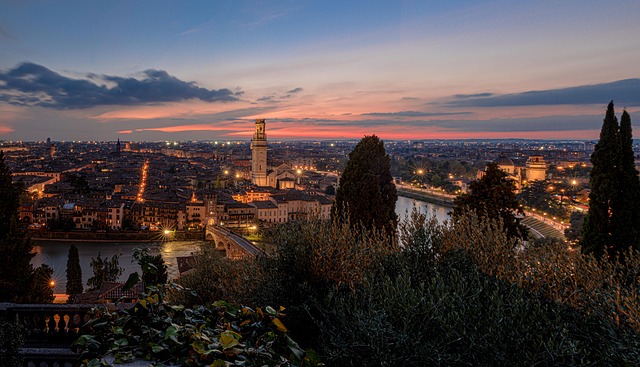
That combination of criteria matters because it explains what makes Verona genuinely different from a city like Venice, whose UNESCO status centers on a singular, unrepeatable achievement, or Vicenza, whose listing centers on one architect’s singular vision. Verona’s UNESCO status isn’t about one golden era frozen in amber. It’s about continuity: Roman foundations still visible beneath medieval streets, medieval fortifications still standing beside Renaissance palaces, all still functioning as a living, inhabited city center rather than an open-air museum. Understanding that continuity is the key to actually appreciating what you’re looking at as you walk through it.
The Arena: Rome’s Legacy, Still in Daily Use
Nothing in Verona demonstrates that continuity better than its most famous monument. The Arena di Verona, built in the 1st century AD, is a genuine Roman amphitheater, one of the best-preserved in the world and, remarkably, the third-largest surviving Roman amphitheater anywhere, smaller only than the Colosseum in Rome and the amphitheater at Capua. What makes it extraordinary isn’t simply its age or its size; it’s that the Arena has never really stopped being used. Gladiatorial contests gave way, over the centuries, to jousting tournaments, then executions, then, starting in the late 19th century, opera.
Today the Arena hosts the Verona Opera Festival each summer, typically running from June through early September, staging full-scale productions, most famously Verdi’s Aida, complete with elaborate sets, in front of audiences of up to 15,000 people seated on the same stone tiers Roman spectators once occupied. I’ve watched more than a few American guests visibly emotional after their first opera night here, and it’s not hard to understand why: there are very few places on Earth where you can watch a genuinely world-class artistic performance inside a nearly two-thousand-year-old building that’s still doing exactly the job it was built for, hosting a large crowd for a shared spectacle under an open sky.
Piazza delle Erbe: Where the Roman Forum Never Left
A short walk from the Arena sits Piazza delle Erbe, and here the continuity theme becomes almost literal: this square occupies the exact site of Verona’s original Roman forum, the city’s civic and commercial heart since antiquity, and it has never stopped serving that same basic function. Market stalls still operate here daily, as they likely have in some form for two thousand years, selling fruit, flowers, and souvenirs beneath a skyline of medieval towers and frescoed Renaissance facades.
Look closely and the square reads like a cross-section of Verona’s entire history stacked in one place: the Torre dei Lamberti, a medieval tower offering sweeping views over the city’s terracotta rooftops for anyone willing to climb or take the elevator up; the Baroque Palazzo Maffei; faded but still visible Renaissance frescoes on several surrounding building facades; and, at the square’s center, a Roman-era fountain topped with a statue known as the Madonna Verona, assembled from fragments dating back to Roman antiquity. Few squares anywhere in Europe layer this many centuries this visibly into a single, still-functioning public space.
The Scaliger Legacy: Castelvecchio and the Fortified Bridge
Verona’s medieval identity is inseparable from the Della Scala family, the Scaligeri, who ruled the city through much of the 13th and 14th centuries and left behind some of its most distinctive fortified architecture. Castelvecchio, the “Old Castle,” was built in the 1350s as both a residence and a military stronghold for the Scaliger rulers, its red-brick, swallow-tailed battlements immediately recognizable as a hallmark of the family’s building style. Today it houses Verona’s civic art museum, but the building itself, with its inner courtyards and defensive walls, remains as much the exhibit as anything hung inside it.
Attached directly to the castle is the Ponte Scaligero, a fortified bridge crossing the Adige River, built for the same defensive purpose: allowing the ruling family a secure, private escape route out of the city in case of uprising or siege. The bridge was almost entirely destroyed by retreating German forces in 1945 during the Second World War, and its careful, historically faithful post-war reconstruction, using recovered original materials wherever possible, is itself a small case study in how seriously Verona has treated the preservation of its layered history, rebuilding rather than replacing when catastrophe struck.
Elsewhere in the city, the Scaliger family’s elaborate Gothic tomb monuments, the Arche Scaligere, stand in a small fenced enclosure near the church of Santa Maria Antica, adorned with intricate stone canopies and equestrian statues of the family’s rulers, a genuinely striking, slightly eerie sight tucked into an otherwise ordinary side street.
Verona Cathedral and the City’s Deeper Religious Layers
Verona Cathedral, dedicated to Our Lady of the Assumption, is actually a complex of several connected buildings rather than a single church: the main cathedral itself, the adjoining church of San Giovanni in Fonte (a former baptistery), the church of Santa Elena, and the Chapter Library, or Biblioteca Capitolare, one of the oldest libraries in the world still operating in its original function, with a documented history stretching back over a thousand years and manuscript holdings that predate most other European library collections by centuries.
Outside the city’s more famous central sites, the Basilica of San Zeno Maggiore, a Romanesque church dedicated to Verona’s patron saint, holds one of the finest bronze door panels surviving from the medieval period, 48 individual bronze relief panels depicting biblical scenes and local legends, cast between the 11th and 12th centuries and remarkable for how much of their original detail and expressiveness has survived. It’s a site most first-time visitors skip in favor of the more central landmarks, and one I’d argue rewards the short walk for anyone with a genuine interest in medieval art.
Juliet’s Balcony: The Myth, and Why It’s Worth Addressing Directly
I’ll be direct with every guest about this, because I think honesty serves people better than playing along: Romeo and Juliet were never real people, Shakespeare set his play in Verona without ever having visited the city himself, and the famous balcony at Casa di Giulietta, along with the bronze statue in its courtyard, dates from a 20th-century tourism-driven renovation rather than any genuine connection to the fictional lovers. The building itself is a real medieval house that once belonged to the Cappello family, whose name bears a passing resemblance to Shakespeare’s “Capulet,” and that loose connection was enough for the city to lean into the legend decades ago.
None of that makes the site not worth a brief visit, especially if literature or pop culture is part of why Verona is on your itinerary at all. But I’d rather you understand what you’re actually looking at than walk away thinking you’ve seen a historically documented location, and I’d rather point your remaining time toward the genuine two-thousand-year story sitting all around it, the Arena, Piazza delle Erbe, Castelvecchio, than let a fictional balcony be the only thing you remember about the city.
Verona and the Wine Country at Its Doorstep
Verona’s UNESCO story is entirely urban, but the city sits at the doorstep of one of Italy’s most significant wine regions, and it’s genuinely worth knowing before you plan a visit. The Valpolicella hills, stretching north and west of the city, produce Amarone, a rich, powerful red made by partially drying grapes before fermentation, widely considered one of Italy’s greatest wines, alongside the lighter everyday Valpolicella and the crisp white Soave from vineyards just east of the city. Combining a morning in Verona’s historic center with an afternoon among the Valpolicella vineyards is one of the most consistently rewarding single-day itineraries I build for guests visiting from Venice, pairing two thousand years of urban history with a landscape that’s been producing wine for nearly as long.
Plan your visit: Verona & Amarone Wine: A Perfect Day Trip from Venice covers exactly this combination, a licensed guide walking you through Verona’s Roman and medieval history in the morning, followed by Valpolicella cellar visits and Amarone tastings in the afternoon, all without rushing either half of the day.
Getting to Verona and Planning Your Day
Verona sits on the main Venice-Milan rail line, with direct trains connecting Venice’s Santa Lucia station to Verona in roughly an hour to ninety minutes depending on the service. It’s an easy, comfortable day trip requiring no car for the historic center itself, since the Arena, Piazza delle Erbe, Castelvecchio, and the cathedral complex are all within a compact, walkable core. Reaching the Valpolicella vineyards, or combining Verona with nearby Lake Garda, does benefit from a car or private driver, since both extend meaningfully beyond what public transport comfortably covers in a single day.
My honest advice for a first visit: don’t try to squeeze Verona into a rushed half-day tacked onto a longer Lake Garda itinerary. The city holds enough layered history, Roman, medieval, and Renaissance, to fill a genuinely satisfying full day on its own, and treating it as a quick stop on the way to somewhere else tends to leave guests seeing the Arena and the balcony and little else, missing most of what actually earned the city its UNESCO status in the first place.
Frequently Asked Questions
Why was Verona named a UNESCO World Heritage Site?
Verona was inscribed in 2000 under two criteria: recognition as a city that developed continuously and uninterrupted for over two thousand years, layering high-quality architecture from each successive era, and recognition as an outstanding example of a fortified European town across several key historical periods, from Roman colony to medieval stronghold to Renaissance city.
Is Juliet’s balcony a real historical site connected to Romeo and Juliet?
A full day is the realistic minimum to properly see the Arena, Piazza delle Erbe, Castelvecchio, and the cathedral complex without rushing, and Verona is roughly an hour to ninety minutes from Venice by train. If you want to add Valpolicella wine tasting or a stop at nearby Lake Garda, plan for an overnight stay rather than trying to fit everything into a single rushed day.
How much time should I plan for a Verona day trip from Venice?
A full day is the realistic minimum to properly see the Arena, Piazza delle Erbe, Castelvecchio, and the cathedral complex without rushing, and Verona is roughly an hour to ninety minutes from Venice by train. If you want to add Valpolicella wine tasting or a stop at nearby Lake Garda, plan for an overnight stay rather than trying to fit everything into a single rushed day.