Most people come to Venice to look at it. Fewer people come to Venice to do it — and that’s the difference I try to talk guests into every season. This city isn’t only a backdrop for photographs. It’s a working set of habits, crafts, and rituals that Venetians have kept alive for centuries, and almost all of them are open to anyone willing to step off the main routes and take part.
None of what follows requires a specific festival date or a lucky bit of timing. These are traditions you can walk into on an ordinary Tuesday in July or a quiet Thursday in November. After nearly thirty years of guiding Americans through this city, these are the experiences I tell people they’ll regret skipping — not the ones they’ll regret paying for.
1. Cross the Grand Canal on a Traghetto
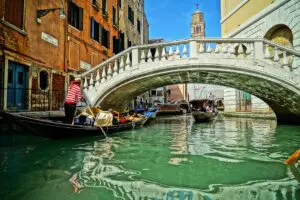
Before bridges, before vaporetti, this is how Venetians got from one side of the Grand Canal to the other — standing up, in a stripped-down gondola built to carry ten people instead of five. The traghetto (sometimes called gondola da parada) still runs today at a handful of crossing points, and it’s the single most authentic gondola experience left in the city, precisely because it isn’t staged for visitors at all.
The ride lasts about a minute or two and costs roughly €2 per person, paid in cash to the oarsman as you board or disembark. There’s no narration, no serenade, no photo stop — just two rowers, a wobbly wooden boat, and a handful of Venetians heading to work standing right next to you. Seven crossing points remain active, down from more than thirty a century ago, with reliable ones near the Rialto fish market and at San Tomà. If a proper gondola ride at €90 for thirty minutes doesn’t fit the day, this is how you ride one anyway — the way the city still actually uses them.
2. Row Venetian-Style — Voga Alla Veneta
If the traghetto is the tradition you watch happen around you, this is the one you do yourself. Voga alla veneta is the standing, forward-facing rowing style unique to Venice — the technique gondoliers use, developed specifically to let a single rower see over the bow and navigate blind corners and low bridges in water too deep for a punting pole. It’s not a stroke you’d recognize from anywhere else, and it’s been passed down, generation to generation, since before the Republic itself.
A private rowing lesson puts you standing in a traditional wooden boat with an instructor beside you, learning to balance, find the forcola (the carved wooden oarlock that makes the whole technique possible), and glide through the quieter side canals of the lagoon. It’s physical, it’s a little wobbly at first, and it is genuinely one of the only ways to understand — in your own body, not just your eyes — why this city moves the way it does. I run this as a private experience for guests who want something more active than a walking tour; you can see the details on our Venetian Rowing Experience page.
3. Stand at a Bacaro for Cicchetti and an Ombra
I won’t repeat the full cicchetti crawl here — I’ve written a dedicated guide to that experience already — but no list of Venetian traditions is honest without mentioning it. Cicchetti are small savory bites, eaten standing at the bar of a bacaro with a glass of local wine, an ombra, in hand. It’s not a meal so much as a daily ritual: quick, social, unpretentious, repeated by Venetians every single evening of the week, tourist season or not.
The tradition is centuries old and tied to Venice’s identity as a trading city where standing and talking at a counter was always more practical than sitting down to a formal dinner. If you want the full neighborhood-by-neighborhood version, with specific bacari and what to order, that’s covered in depth elsewhere on this site — here, the point is simply: do this once, standing up, the way it’s meant to be done.
4. Watch a Maestro at Work in a Murano Furnace
Glassmaking moved to the island of Murano in 1291, officially for fire safety, and the families who’ve kept the furnaces burning since then still guard techniques that have never been fully written down — they’re taught hand to hand, master to apprentice. Watching a maestro shape molten glass at nearly 1,000°C, turning a formless orange blob into a recognizable form in under a minute, is one of the few times in Venice you’ll see a centuries-old tradition performed live rather than displayed behind glass.
The demonstration itself is worth the trip out on the vaporetto. What changes the experience entirely is being introduced personally to an artisan rather than watching a show aimed at a tour bus — a conversation afterward, a question about technique, a family history going back four generations. That’s the version I try to arrange for guests whenever a furnace visit is on the day’s itinerary.
5. Have a Mask Made By Hand
Venetian mask-making predates Carnevale by centuries — masks were worn for as much as six months of the year during the Republic, not just at Carnival, letting Venetians of every social class move through the city anonymously. The tradition nearly vanished after Napoleon banned masks in 1797 and stayed dormant for almost two hundred years, until a handful of artisans revived it in the 1970s and 80s.
The workshops that kept the craft alive still work in the old way: a hand-carved plaster mold, layers of papier-mâché built up by hand, then decoration with gold leaf, fabric, or hand-painted detail. Several ateliers in Dorsoduro let visitors sit down and paint or build a mask themselves under the guidance of a working artisan — a genuinely different souvenir than anything bought off a shelf, and a direct link to a craft that came within a generation of disappearing entirely.
6. Watch a Gondola Get Built or Repaired at a Squero
Tucked along a quiet stretch of the Dorsoduro waterfront, a handful of squeri — traditional gondola boatyards, built to look like Alpine chalets because the earliest boatbuilders came down from the Cadore mountains — are still working yards today, not museums. You won’t be allowed inside; these are functioning workshops, not attractions. But the owners are long since used to being watched from across the canal, and there’s something worth pausing for in seeing a hull built entirely by eye and hand, using techniques essentially unchanged since the boat itself was standardized centuries ago.
Every gondola is still built asymmetrically — curved slightly to one side — to compensate for the weight and force of a single standing rower on the stern. It’s a detail almost no one notices from a gondola ride itself, and one of my favorite small facts to point out when a squero happens to be on the day’s route.
7. Cross a Votive Bridge, If Your Dates Allow It
I’ve written separately about Venice’s festival calendar and the living rituals tied to specific dates, so I’ll keep this one brief: if your trip happens to overlap with the Festa del Redentore (the third weekend of July) or the Festa della Salute (November 21st), a temporary pontoon bridge is built across open water so that thousands of Venetians can walk to church exactly as their ancestors have for centuries. It’s not a tourist reenactment — it’s a promise the city renews every year, and joining that walk, even as a visitor, is as close as you’ll get to experiencing Venice as Venetians experience it themselves.
Why These Traditions Matter More Than the Landmarks
Anyone can look at a photograph of the Basilica. Almost no one goes home able to say they rowed a Venetian boat standing up, crossed the Grand Canal the way locals still do for €2, or had a mask built by hand by someone whose family kept that craft alive through two centuries of near-extinction. Landmarks tell you what Venice looked like once. These traditions tell you what Venice still is.
If you’d like a day built specifically around a few of these — rowing, a furnace visit with a real introduction to the maestro, a proper cicchetti stop chosen for quality rather than foot traffic — that’s exactly the kind of itinerary I put together for guests on our private tours. Get in touch through the contact page and I’ll build the day around whichever of these traditions matter most to you.
Do I need to book the traghetto or can I just show up?
You can just show up — traghetti don’t take reservations, and you simply wait at the crossing point and board when the boat arrives, paying the oarsman directly in cash.
Is the voga alla veneta rowing lesson suitable for people with no boating experience?
Yes — lessons are designed for complete beginners, starting with the boat moored so you can practice the stroke before setting off, and most people find their balance within the first few minutes.
Is Carnevale the only time I can experience mask-making traditions?
No — the ateliers that hand-craft masks operate year-round, and a hands-on mask-painting or making session can be booked at any time of year, not just during the Carnevale season in January and February.