From Bare Earth to Herringbone Brick
The Venice we photograph today, with its uniform grey stone streets, wasn’t always paved at all. For centuries, most calli and campi were simply bare earth, or later, brick laid in a distinctive herringbone pattern — spina di pesce, “fishbone,” in Venetian. You can still find surviving patches of this older brick paving today, most famously in the campo in front of the Church of Madonna dell’Orto in Cannaregio, a rare surviving fragment of how the entire city once looked underfoot.
That changed gradually, street by street, beginning in the 16th century. Over roughly three centuries, trachyte — a hard volcanic stone — progressively replaced dirt and herringbone brick across the city’s paved surfaces. The material came from surprisingly far away: trachyte has been quarried in the Euganean Hills, about 60 kilometers from Venice, since the days of the Republic, meaning every one of these grey stone slabs was cut inland, then shipped by barge through the lagoon to be set by hand into Venice’s streets.
The Masegno: Venice’s Signature Stone
The individual stones themselves have a name: masegni. They’re the single most common paving material in the city today, making up more than 70 percent of all Venetian street pavement, and their shape is deceptively simple — flat and smooth on the top face, roughly shaped into a rounded form underneath, designed to sit snugly against the packed earth below while presenting a level, walkable surface above.
Not every street got the same treatment. The wider, more important calli — called salizade, from which the street type takes its name — were the first to be paved with masegni, while lesser streets kept their older herringbone brick for longer. That hierarchy is baked directly into Venice’s street names: any calle you walk down called a “salizada” today is, by definition, one of the streets the Republic considered important enough to pave first.
Piazza San Marco: A Pavement Designed Like a Painting
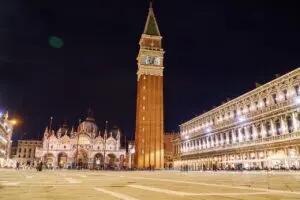
If you want to see Venetian paving at its most ambitious, stand in the middle of Piazza San Marco and look at the ground rather than the Basilica. The geometric pattern of trachyte and white marble covering the square dates to 1723, designed and executed by the Venetian architect Andrea Tirali. Before that, the piazza’s surface was startlingly humble — a Canaletto painting from that same year shows the square still covered in beaten earth, waiting for the new paving stones to be laid.
It’s worth pausing on that detail: the single most photographed square in the world was, for most of Venice’s history, simply dirt. The elegant geometric ribboning you walk across today — radiating lines of white marble set into grey trachyte — is a relatively late 18th-century addition, designed to make the Republic’s ceremonial heart look as considered from ground level as its buildings did from eye level.
The Real Purpose: A City-Wide Water-Collection Machine
Here’s the detail that changes how you see Venetian pavement entirely: for most of the city’s history, it wasn’t just a walking surface. It was plumbing.
Venice had no fresh water source of its own — no river, no natural spring, only the salt lagoon. So the Republic engineered its public squares to solve that problem structurally. Each campo with a well was built with a deliberately inclined pavement, sloping gently toward the center, so rainfall would run downward rather than sit on the surface. At the low points, a drain of Istrian marble called a pilela, or gatolo, channeled that water down into a bell-shaped brick chamber that fed a filtering cistern buried beneath the square — rainwater seeped through the loosely fitted paving stones and collected in the sand-packed cistern below, where it was naturally filtered before Venetians drew it up through the wellhead at the center.
The scale of this system is easy to underestimate. At the height of the Republic, Venice maintained roughly 6,000 of these wells across the city, and the system stayed in continuous use for over 1,300 years, until piped fresh water finally arrived from the mainland in 1884. Every time you cross a campo today and notice it dips gently toward a stone wellhead at its center — and most of the older ones still do — you’re standing on top of a rainwater-harvesting machine that kept an entire city alive for over a millennium, with the paving stones themselves acting as the intake valve.
Reading the Streets Today
Once you know what to look for, Venice’s pavement becomes genuinely readable. A few things worth watching for on your own walks:
Herringbone brick patches, most visible around Madonna dell’Orto, are survivors of the pre-trachyte era — a street type that’s mostly vanished elsewhere in the city.
A sloped campo with a well at its lowest point is a fossil of the old water-collection system, even though the wells themselves have been capped since the 1970s due to subsidence concerns.
The word “salizada” in a street name is a direct historical marker — it tells you this was one of the streets the Republic prioritized for stone paving centuries before its neighbors.
Small carved symbols set into corner stones occasionally mark old utility lines or property boundaries — a quieter, more functional cousin to the carved lions and crests found on building facades.
None of this is dramatic in the way a gilded mosaic or a marble palace is. But it’s some of the most honest history in the city — proof that everything about Venice, right down to the ground you’re standing on, was engineered by necessity, not decoration.
Walk the City With Fresh Eyes
Most visitors never get this layer of Venice explained to them, because it requires someone who knows exactly where to stop and what to point out underfoot — a well-worn gatolo drain, a patch of surviving herringbone brick, the slope of a campo that reveals its original purpose. It’s the kind of detail I build into private walks whenever a client wants to understand the city rather than just photograph it.
If that kind of layered, unhurried exploration sounds like what you’re after, get in touch directly and I’ll build a walking route around it. And if your trip includes a day outside the city, my private Prosecco Hills day trip covers an entirely different side of this region’s landscape and engineering history.
Planning logistics for your visit? My guide to Venice’s entry fee covers who needs to pay and how to book correctly before you arrive.
What is the grey stone used to pave most Venetian streets called?
It’s called masegno (plural masegni) — a trachyte, a volcanic stone quarried in the Euganean Hills near Padua and shipped to Venice for street paving since the 16th century.
Why do some Venice squares slope toward the center?
Older campi were deliberately built with a gentle slope so rainwater would drain toward a central well, where it filtered into an underground cistern — Venice’s main source of fresh drinking water for over a thousand years.
Where can I still see Venice’s older brick pavement instead of stone?
The clearest surviving example is the campo in front of the Church of Madonna dell’Orto in Cannaregio, which still preserves the herringbone brick paving used across the city before trachyte became standard.