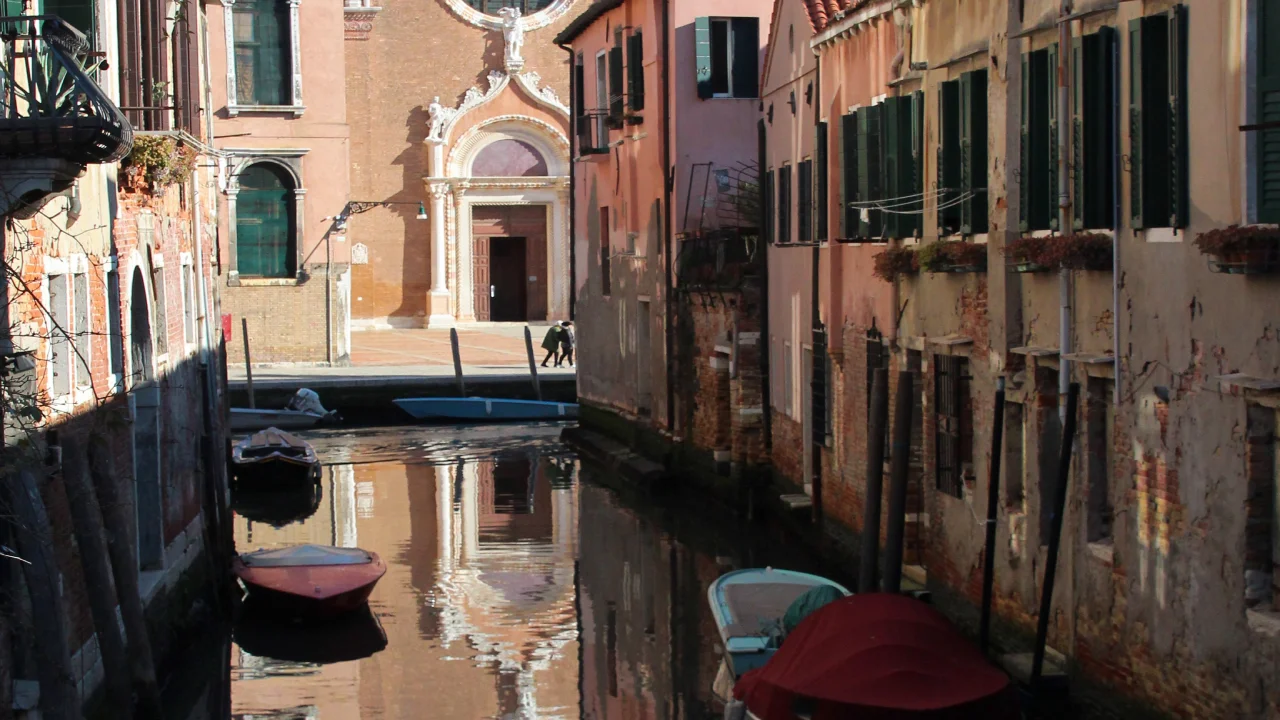
Your first few hours in Venice should be about more than finding St. Mark’s Square. They should help you understand the city, discover its hidden beauty, and feel confident exploring it on your own.
The first time you step into St. Mark’s Square, give yourself a moment before reaching for your phone.
The space feels immense after the narrow streets that lead into it. St. Mark’s Basilica rises in a sweep of arches, domes, and golden mosaics. Across the square, people come and go beneath the arcades. A short walk away, the water opens toward the island of San Giorgio Maggiore.
You can see a great deal of Venice from here and still have almost no idea how the city fits together.
That is part of the city’s extraordinary charm.
Venice is unlike anywhere else in the world. There are no cars in its historic center, streets often end at canals, and the shortest distance between two places is rarely a straight line.
Even experienced travelers can feel a little disoriented during their first hours.
But imagine discovering Venice with someone who knows the city intimately.
Someone who can explain why a particular bridge matters, introduce you to a quiet neighborhood just beyond the crowds, and help you understand how Venetians actually move through their city.
That is the idea behind Your First Three Hours in Venice, our private orientation walking tour designed especially for first-time visitors.
Led by a licensed local guide from Tour Leader Venice, this three-hour experience combines famous landmarks, lesser-known streets, practical advice, and fascinating stories about Venetian life.
And because every traveler is different, the entire walk can be customized around your interests, your hotel location, and what you’d most like to discover.
This isn’t simply a tour of Venice.
It’s your introduction to the city, guided by someone who calls this extraordinary place home.
Why Start Your Venice Vacation with a Private Orientation Walk?
Arriving in Venice is an experience in itself.
Perhaps you’ve just stepped off a train at Santa Lucia station, where the Grand Canal suddenly appears before you.
Maybe you’ve arrived by private water taxi, passing magnificent palaces before reaching your hotel.
Or perhaps you’ve crossed the lagoon from the airport and are still adjusting to the remarkable idea of a city built on water.
Wherever your journey begins, the first few hours can shape the rest of your stay.
Many visitors immediately head toward the most famous landmarks, following signs for Rialto or San Marco.
There’s nothing wrong with that.
But without understanding the city’s geography, it’s easy to spend much of your time retracing the same busy routes.
A private orientation walk changes that.
Instead of simply following a map, you’ll begin to recognize the relationship between neighborhoods, canals, bridges, and major landmarks.
You’ll discover how to move around Venice, which areas you’d like to explore further, and how to make the most of the days ahead.
More Than a Conventional Sightseeing Tour
Our orientation walk is designed to answer two important questions:
What should I see in Venice?
And perhaps even more importantly:
How can I enjoy Venice without spending my entire vacation feeling lost or rushed?
During the walk, your guide introduces you to the city’s history while sharing practical advice that can make a real difference.
You’ll learn how the Grand Canal divides the historic center, why some routes require unexpected detours, and how to recognize the different character of Venetian neighborhoods.
You’ll also discover details that many travelers overlook.
A stone wellhead in a quiet square.
A historic doorway opening directly onto a canal.
A small church with an extraordinary story.
Or a traditional workshop hidden behind an ordinary-looking entrance.
These are the details that transform a beautiful destination into a place you begin to understand.
A Three-Hour Walking Tour Designed Around You
One of the greatest advantages of a private tour is flexibility.
There is no fixed itinerary that every guest must follow.
We begin by understanding what interests you most.
Some travelers want to see Venice’s most celebrated landmarks.
Others prefer quieter neighborhoods, local traditions, architecture, or the stories of everyday Venetian life.
Families may want an entertaining introduction that keeps children engaged.
Couples might prefer a romantic walk through picturesque canals and beautiful squares.
Art enthusiasts may be interested in Venetian architecture, historic churches, and the influence of the Renaissance.
And travelers returning to Venice may prefer to avoid the busiest areas altogether.
Your licensed local guide can adapt the route to reflect these preferences.
Where Does the Tour Begin?
Whenever practical, we can arrange to meet you at your hotel or another convenient location in Venice’s historic center.
This is particularly helpful during your first visit.
Rather than trying to find an unfamiliar meeting point, you can begin discovering the city directly from the neighborhood where you’re staying.
If your hotel is near St. Mark’s Square, we may start with the city’s most famous monuments.
If you’re staying near Rialto, we might begin with the Grand Canal and the historic commercial center.
If your accommodation is in Cannaregio, Dorsoduro, or Santa Croce, the walk can introduce you to the character of those neighborhoods before continuing toward other landmarks.
The route is planned around your location, interests, and available time.
St. Mark’s Square – The Heart of the Serenissima
For many first-time visitors, St. Mark’s Square is the place they’ve dreamed of seeing.
And it deserves its reputation.
Napoleon is often credited with describing it as Europe’s finest drawing room, although the precise attribution is uncertain.
Whatever its nickname, the square remains one of the world’s most remarkable urban spaces.
Stand far enough back to appreciate the Basilica as a whole.
Its domes, arches, mosaics, and sculptural details reflect centuries of artistic exchange between Venice and the eastern Mediterranean.
Then look toward the surrounding arcades.
The buildings create a harmonious setting that has welcomed merchants, ambassadors, residents, and travelers for generations.
Your guide can explain how the square developed and why it became the ceremonial center of the Venetian Republic.
St. Mark’s Basilica
The Basilica is one of Venice’s most recognizable monuments.
Its architecture reveals the city’s close historical relationship with Byzantium and the wider Mediterranean world.
From outside, you’ll discover the meaning behind its distinctive appearance and how it reflects Venice’s political and religious identity.
Look closely at the mosaics, the sculptural decoration, and the arrangement of the façade.
Even without entering, there’s a remarkable amount to discover.
A complete interior visit requires additional time and appropriate tickets, so we normally recommend arranging that separately rather than trying to squeeze it into an orientation walk.
The Doge’s Palace
Beside the Basilica stands the magnificent Doge’s Palace.
Its pink-and-white patterned façade and delicate Gothic arcades create an extraordinary contrast with the massive political power the building once represented.
For centuries, this was one of the principal centers of government of the Venetian Republic.
The Doge, Venice’s elected head of state, occupied an important ceremonial position within a complex political system.
Your guide can introduce you to the Republic’s institutions and explain how Venice developed its distinctive form of government.
You’ll also discover why the palace occupies such a prominent position beside the lagoon.
Imagine arriving by ship centuries ago and seeing this magnificent façade rising above the waterfront.
It was architecture designed to communicate confidence, wealth, and authority.
The Waterfront and San Giorgio Maggiore
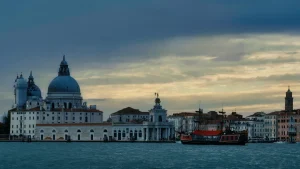
A short walk brings you to the waterfront overlooking the basin of St. Mark.
Across the water stands the island of San Giorgio Maggiore, with its celebrated church designed by Andrea Palladio.
This is an excellent place to understand Venice’s relationship with the lagoon.
The city isn’t simply a collection of canals.
It’s part of a much larger environment of islands, tidal waters, and maritime routes.
The contrast is remarkable.
One moment you’re standing in a narrow street surrounded by buildings.
A minute later, the horizon opens toward the lagoon.
That sudden change of perspective is one of the pleasures of exploring Venice on foot.
Rialto – Where Venice Became a Commercial Empire
If St. Mark’s Square represents the ceremonial heart of Venice, Rialto reveals its commercial soul.
For centuries, this district was one of the city’s most important trading centers.
Merchants negotiated contracts, exchanged goods, and developed the commercial networks that helped make Venice wealthy.
The Rialto Bridge remains one of the most recognizable symbols of the city.
But the area surrounding it is equally fascinating.
Understanding the Grand Canal
The Grand Canal is Venice’s principal waterway.
Its sweeping curve passes between magnificent palaces, historic churches, and neighborhoods that developed over many centuries.
During your walk, your guide can explain how this waterway functioned as an essential transportation route.
Look at the buildings facing the canal.
Many have impressive water entrances, reflecting a time when boats were the principal means of moving people and goods.
Watch the traffic.
Public water buses, private water taxis, delivery boats, and service vessels all share the water.
The Grand Canal isn’t simply a scenic attraction.
It’s part of a living transportation system.
The Rialto Bridge
The present stone bridge was completed in the late sixteenth century.
Its distinctive design includes a single broad arch and rows of shops.
Crossing the bridge offers memorable views of the Grand Canal, but it also provides a useful lesson in Venetian geography.
The two sides of the canal belong to different parts of the historic center.
A restaurant that appears only a short distance away on your phone may require a surprisingly long walk if you’re approaching from the wrong bank.
Understanding where the bridges are located can save considerable time during your vacation.
The Rialto Market
Depending on the day and time, your route may include the historic market area.
This district has been associated with food trading for centuries.
The market offers an opportunity to discuss Venetian ingredients, seasonal produce, seafood, and traditional food culture.
When the stalls are operating, the atmosphere can be lively and colorful.
When the market is closed, the surrounding architecture and waterfront still reveal its historic importance.
Your guide can also introduce you to the concept of the bacaro, a traditional Venetian wine bar where locals may enjoy a drink accompanied by small bites known as cicchetti.
If you enjoy discovering a city through its food, this is a wonderful subject to explore.
For travelers who want to continue independently, our walking route through Venice’s iconic neighborhoods provides inspiration for another day.
Beyond the Landmarks – The Venice Most Visitors Walk Past
Some of Venice’s most memorable places aren’t famous monuments.
They’re the smaller streets, canals, and squares encountered between the major attractions.
A narrow passage suddenly opens onto a peaceful campo.
A small bridge reveals a perfect reflection in the water.
An old doorway tells a story about how buildings were designed around boat transportation.
Or you notice a carved stone detail that has survived for centuries.
These discoveries are part of the pleasure of walking with a knowledgeable local guide.
Understanding Venetian Campi
In Venice, most public squares are called campi.
The word reflects their historical origins, when some of these spaces were open or cultivated areas.
Today, campi are essential parts of neighborhood life.
They may contain churches, cafés, shops, benches, and historic wellheads.
Unlike St. Mark’s Square, many have a distinctly residential atmosphere.
You’ll often see people meeting friends, children playing, or residents going about their daily routines.
Your guide can explain how these spaces functioned historically and why they remain important.
The Mystery of Venice’s Wells
One of the most fascinating details in a Venetian square is the traditional stone wellhead.
Venice is surrounded by water, but that water is salty.
For centuries, obtaining fresh drinking water was a major challenge.
The solution involved sophisticated rainwater collection systems.
Rainwater was filtered through layers of sand and stored in underground cisterns.
The decorative wellheads visible in many squares provided access to that stored water.
Once you understand their purpose, these objects become much more than attractive architectural details.
They reveal the practical intelligence required to sustain a city in the lagoon.
A City with Two Front Doors
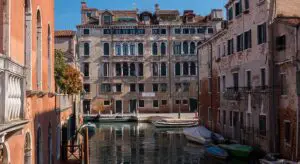
Many historic Venetian buildings were designed with entrances facing both the street and the water.
This arrangement reflects the city’s unusual transportation system.
Goods could arrive by boat.
Residents could move through the pedestrian network.
And commercial activities often depended on access to the canals.
During your walk, your guide may point out examples of these architectural features.
They’re easy to overlook until someone explains what you’re seeing.
A Local Guide’s Advice – How Not to Get Lost in Venice
Getting lost in Venice is often described as part of the experience.
And there’s some truth to that.
Wandering without a fixed destination can lead to beautiful discoveries.
But getting lost when you’re late for a restaurant reservation or trying to reach a train station is considerably less enjoyable.
One of the most useful aspects of an orientation walk is learning how to navigate the city.
Understand the Grand Canal Before Following Your Phone
Here’s a simple lesson that can save you time.
Before leaving the Rialto area, identify which side of the Grand Canal your next destination is on.
On a map, two places may appear almost adjacent.
But if they’re on opposite banks, you may need to walk to one of the bridges or use an appropriate boat crossing.
This matters particularly when you’re heading to a restaurant, meeting a guide, or finding a water taxi pickup point.
The shortest visible distance isn’t always the shortest practical route.
Learn to Recognize Landmarks
Instead of relying entirely on your phone, try remembering a few visual reference points.
A distinctive bridge.
A church façade.
A particular square.
Or a canal landing.
When you pass a landmark, look back at it.
The reverse view is what you’ll see when returning.
This small habit can make a surprising difference.
Don’t Assume Every Canal Has a Bridge Nearby
Venice has hundreds of bridges, but they’re not distributed evenly.
Some canals require a considerable detour to cross.
Others lead into quiet residential areas where the pedestrian network doesn’t continue in the direction you expect.
Your guide can explain how the different neighborhoods connect and help you recognize the principal routes.
For additional practical advice, explore our guide to finding your way through Venice without getting lost.
How to Use Venice’s Public Transportation
Although this is a walking tour, understanding Venice’s public transportation can be extremely useful.
The city’s principal public water buses are called vaporetti.
They connect different parts of the historic center with the surrounding islands and other destinations in the lagoon.
During your walk, your guide can explain the basic principles of using the system.
Understanding Vaporetto Stops
Not every stop serves every route.
Some stops have separate platforms or boarding areas depending on the direction of travel.
The name of the stop matters, but so does the route number and destination.
Before boarding, it’s important to check the direction in which the boat is traveling.
Your guide can help you understand how to identify the correct service.
Private Water Taxis
Private water taxis offer another way to travel through Venice.
They can be particularly convenient for hotel transfers, travelers with luggage, or guests who prefer direct transportation where canal access permits.
However, not every hotel has a private water entrance.
Sometimes a short walk is still necessary.
If you’re considering a private water taxi during your stay, your guide can help you understand the practical differences between the available options.
Gondolas Are a Different Experience
A gondola ride is primarily a traditional sightseeing experience rather than a regular means of public transportation.
It offers a beautiful perspective on Venice’s smaller canals.
If you’re interested in adding a gondola ride to your vacation, we can help you decide when it would best fit your itinerary.
A gondola ride is not automatically included in the standard three-hour orientation walk.
Discover Venice Through Your Personal Interests
Every traveler arrives in Venice with different expectations.
Some have spent years dreaming of seeing the Basilica.
Others are fascinated by the city’s engineering, artistic heritage, or food traditions.
A private orientation walk allows these interests to shape the experience.
For Couples – A Romantic Introduction to Venice
Venice is naturally romantic, but some of its most beautiful moments happen away from the busiest landmarks.
A quiet canal.
An elegant bridge.
A small square in the afternoon light.
Or a beautiful view across the lagoon.
Your guide can help you discover places where you can slow down and enjoy the atmosphere together.
If photography is important, mention it when booking.
We can plan time for scenic stops without turning the entire experience into a rushed photo session.
For Families with Children
Venice can be an extraordinary destination for families.
Its canals, boats, bridges, and unusual architecture create endless opportunities for discovery.
Children may be fascinated by how goods are delivered without trucks.
Or how residents collect their mail, move furniture, and travel between islands.
The city’s history also includes explorers, merchants, shipbuilders, and fascinating traditions.
Rather than presenting a long sequence of dates, a family-oriented walk can focus on stories and observations that keep younger travelers engaged.
Let us know your children’s ages and interests in advance so the route and pace can be adjusted accordingly.
For Architecture Lovers
Venice offers an extraordinary range of architectural styles.
Byzantine influences.
Venetian Gothic.
Renaissance classicism.
Baroque decoration.
And the practical architecture of everyday residential buildings.
During your walk, you may discover how these styles coexist within a remarkably compact urban landscape.
A palace façade can reveal centuries of artistic ambition.
A modest brick building may offer equally interesting clues about construction techniques and daily life.
Your guide can explain these contrasts while you explore the city.
For Art Enthusiasts
Venice has an artistic heritage that extends far beyond its most famous museums.
Churches, public buildings, and historic neighborhoods preserve evidence of the city’s creative traditions.
If you’re particularly interested in painting, sculpture, or decorative arts, we can emphasize those subjects during your orientation walk.
For travelers planning to explore the city’s museum district, our self-guided walking itinerary through Dorsoduro can provide inspiration for another day.
For Travelers Interested in Local Life
Perhaps your favorite travel experiences involve discovering how people actually live.
Where they shop.
What they eat.
How they move around.
And which traditions remain part of daily life.
Your orientation walk can include conversations about Venetian neighborhoods, food culture, local customs, and the challenges of living in a city without cars.
This perspective helps reveal Venice as a real community rather than simply a collection of beautiful monuments.
When Is the Best Time to Take Your Orientation Walk?
For most first-time visitors, we recommend scheduling the tour early in your stay.
The first full day is often ideal.
You’ll have time to settle into your hotel, recover from your journey, and begin exploring with fresh energy.
More importantly, you’ll still have the rest of your vacation to use what you’ve learned.
On Your Arrival Day
An arrival-day tour can work well if you reach Venice early and have enough time to check into your accommodation.
However, travelers arriving from the United States should consider jet lag and possible travel delays.
After a long overnight flight, a three-hour walk may feel more demanding than expected.
If you’re uncertain, the following morning may be a more comfortable choice.
In the Morning
Morning tours are often an excellent option.
You can begin exploring before the busiest part of the day and enjoy the city as it comes to life.
If visiting the Rialto Market is a priority, a suitable morning schedule may be particularly useful.
Market activity depends on the day and operating hours.
In the Afternoon
Afternoon walks can also be beautiful.
The changing light gives canals and buildings a different appearance.
Depending on the season, the atmosphere may become quieter as the day progresses.
An afternoon tour can also be arranged to finish near a neighborhood where you’d like to have dinner.
Comfortable Walking in Venice
Venice is best discovered on foot, but there are a few practical considerations.
The historic center includes numerous bridges, most with steps.
Stone paving can become slippery during rain or high-water conditions.
And narrow streets can be crowded during busy periods.
Comfortable walking shoes are essential.
How Far Will We Walk?
The distance depends on the selected itinerary, the number of stops, and your preferred pace.
Some guests enjoy covering several neighborhoods.
Others prefer a slower experience with more time to observe the surroundings.
Because this is a private tour, we can adjust the pace to suit your group.
If someone in your party has limited mobility or finds stairs difficult, please let us know in advance.
We can discuss the most suitable route, although Venice’s historic layout means that some barriers cannot always be avoided.
What Happens If It Rains?
Light rain doesn’t necessarily prevent a walking tour.
Venice can be particularly atmospheric when the paving stones reflect the colors of its buildings.
However, weather conditions may require adjustments.
During periods of high water, certain routes may become less comfortable or temporarily impractical.
Your guide will adapt the walk when necessary, taking local conditions into account.
What Is Included in Your Private Venice Orientation Walk?
Your three-hour experience includes a licensed local Venice tour guide dedicated exclusively to your party.
The tour is private, so you won’t be joining a group of strangers.
The itinerary can be customized according to your interests, accommodation location, and preferred pace.
During the walk, your guide will introduce you to Venice’s history, architecture, neighborhoods, and practical aspects of daily life.
You’ll also receive useful advice for exploring independently during the rest of your stay.
Included
- Three hours with a private licensed local guide.
- A personalized walking itinerary through Venice’s historic center.
- Exterior introductions to selected landmarks and historic areas.
- Stories about Venetian history, architecture, and local traditions.
- Practical orientation and navigation advice.
- Recommendations tailored to your interests.
- A convenient meeting point agreed in advance.
Not Included
The standard tour does not include admission tickets to museums, churches, or monuments requiring paid entry.
Gondola rides, private water taxis, public transportation tickets, meals, drinks, and additional paid experiences are also excluded unless specifically arranged.
If you’d like to include one of these services, please let us know before booking.
We can discuss the available options and any additional costs.
Can We Customize the Tour During the Walk?
Absolutely.
One of the pleasures of a private experience is the freedom to follow your curiosity.
Perhaps you discover a neighborhood you’d like to explore more deeply.
Maybe a particular building catches your attention.
Or you decide you’d rather spend more time along the Grand Canal than visit another landmark.
Whenever practical, your guide can adjust the route during the tour.
Of course, Venice’s geography and the time available impose some limits.
We can’t guarantee that every requested destination will fit into three hours.
But we can prioritize the places and experiences that matter most to you.
This flexibility is especially valuable for families, couples, and travelers who prefer a relaxed pace.
Why Three Hours Is an Ideal Introduction
Three hours provides a useful balance between discovery and comfort.
It’s long enough to explore several important areas, understand the city’s basic geography, and enjoy meaningful conversations with your guide.
But it’s short enough to leave plenty of time for other activities.
You might spend the afternoon visiting a museum.
Enjoy a leisurely lunch.
Take a gondola ride.
Or return to a neighborhood that particularly interested you.
The purpose of the orientation walk isn’t to see everything in Venice.
That would be impossible in three hours.
The purpose is to give you the knowledge and confidence to enjoy the rest of your visit.
Why Choose Tour Leader Venice?
Tour Leader Venice specializes in private, personalized experiences designed to reveal the city’s history, culture, and living traditions.
Founded by Igor Scomparin, a licensed guide with professional experience dating back to 1997, our company brings together local knowledge and years of experience working with international travelers.
We understand that visitors arriving in Venice for the first time often have practical questions.
How do we get around?
Which neighborhoods should we explore?
How can we avoid spending too much time in crowded areas?
What should we book in advance?
And how can we make our limited time in Venice more meaningful?
Our orientation walk is designed to help answer those questions while introducing you to the beauty of the city itself.
We believe that a memorable private tour should feel like a conversation rather than a lecture.
There should be room for questions, unexpected discoveries, and the freedom to enjoy Venice at your own pace.
What You’ll Take Away from Your First Three Hours
By the end of the walk, Venice should feel a little more familiar.
You’ll have seen some of its celebrated landmarks.
Discovered quieter streets and canals.
Learned about the history that shaped the city.
And gained practical knowledge that will help you navigate its unusual geography.
Perhaps you’ll remember a particular bridge.
A small square you want to revisit.
A restaurant neighborhood you’d like to explore.
Or the story behind a historic building that you might otherwise have walked past.
The most satisfying part of an orientation tour often comes later.
You’re returning from dinner when you suddenly recognize a square you visited earlier.
You know which bridge to cross.
You remember where the canal leads.
And for the first time, Venice begins to feel less like a maze and more like a place you understand.
That’s when you realize how valuable those first three hours have been.
Plan Your Private Venice Orientation Walk
Your first visit to Venice deserves a thoughtful introduction.
Whether you’re traveling as a couple, with family, or with friends, our private three-hour orientation walk can be tailored to your interests and travel plans.
When contacting us, simply tell us your preferred date, the number of guests, where you’re staying, and what you’d most like to discover.
If you have any mobility considerations or reservations immediately before or after the tour, please mention them as well.
We’ll help arrange a suitable meeting point and discuss the best approach for your visit.
Your First Three Hours in Venice is more than an introduction to famous landmarks.
It’s the beginning of a deeper connection with one of the world’s most extraordinary cities.
Discover our Private Venice Orientation Walking Tour
Let us introduce you to Venice, one bridge, one canal, and one unforgettable story at a time.
Is the three-hour Venice Orientation Walk suitable for a first visit?
Yes. It’s designed for first-time visitors who want to see some of Venice’s best-known sights, explore smaller streets and canals, and learn how to get around on their own. A licensed local guide adjusts the route to your party’s interests and pace.
Does the walk include admission to St. Mark’s Basilica or the Doge’s Palace?
The orientation walk introduces the landmarks from the outside. If you’d like to tour the interiors of St. Mark’s Basilica or the Doge’s Palace, arrange a separate visit and allow time between the two experiences.
Where do we meet for the private Venice Orientation Walk?
The meeting point is arranged when you book. Share where you’re staying or arriving, along with any plans immediately after the walk, so the team can propose a practical starting point and route.