The Test I Actually Use
After thirty years of guiding, I’ve stopped judging a Venetian street by how it looks and started judging it by what it’s selling. Walk down any street in central San Marco and count the storefronts: glass trinkets, leather bags, carnival masks made in a factory outside the city, restaurants with laminated multilingual menus and photographs of the food out front. Every single business on that street exists because of tourism. Remove the tourists, and the street has no reason to exist in its current form.
Now walk down a street in central Cannaregio, away from the one stretch that’s become genuinely popular with visitors, and count the storefronts differently: a hardware store, a pharmacy, a shop selling school supplies, a butcher, a laundromat, a bar where the coffee costs €1.20 and nobody’s translating the menu. These businesses exist because people live upstairs and need them. That’s the difference I’m pointing at, and it’s a difference of economic function, not appearance.
Scale Changes Everything
Cannaregio is the largest of Venice’s six sestieri by both land area and population, and that size does something the smaller districts can’t replicate: it creates enough physical distance between the tourist-facing edge and the residential core that the two can coexist without one swallowing the other entirely. San Marco is compact enough that its entire footprint has been absorbed into the tourist economy — there’s no “back half” of San Marco that tourism hasn’t reached, because the whole sestiere is small enough to walk in twenty minutes.
Cannaregio doesn’t have that problem, or rather, its size is exactly what protects it from that problem. The stretch nearest the train station and the Strada Nova functions almost entirely for visitors passing through. But the district keeps going — north past the Ghetto, into streets around Sant’Alvise and the northern lagoon edge — long after the tourist logic of the southern edge has run out of momentum. A visitor has to actively choose to keep walking to find that part of the district, which is precisely why so few do, and precisely why it’s stayed the way it has.
Continuity of Trade, Not Just Continuity of People
I’ve written elsewhere about how few residents remain in Venice’s historic center, and I won’t repeat those numbers here — you can find them in detail in our piece on Venice’s population decline. What I want to point to instead is something less discussed: which trades have survived in Cannaregio, not just which people.
This was historically a working district — shipbuilders, glass importers before the furnaces moved to Murano, printers, and later a significant Jewish merchant community confined to the Ghetto but deeply woven into the city’s commercial life. Walk Cannaregio today and you’ll still find functioning workshops doing the same categories of work their predecessors did: a handful of genuine mask ateliers where the work is actually made on-site rather than imported, printers and bookbinders, boat repair yards along the northern canals. Compare that to San Marco, where the artisan shopfronts you see are almost entirely retail — selling objects made elsewhere, staffed by employees rather than the makers themselves. Cannaregio’s continuity isn’t just that people still live there. It’s that some of the same categories of work still happen there, for reasons that have nothing to do with tourism.
The Campo Test
Every sestiere has its campi — the open squares that function as a neighborhood’s living room. But not every campo functions the same way anymore. In San Marco, the campi have largely been converted into extensions of the tourist circuit: outdoor seating for restaurants, gathering points for tour groups, photo backdrops.
Cannaregio still has campi that operate the way they were designed to — as neighborhood space. Campo Santa Maria Formosa gets tourist traffic, certainly, but push further into Cannaregio and you’ll find smaller campi where children are genuinely playing football against a church wall, where elderly residents sit on the same bench they’ve occupied for decades, where the loudest sound at 9pm is Italian being spoken by neighbors rather than a dozen languages being spoken by strangers. I don’t think this is a coincidence or a matter of luck. It’s downstream of the economic point above: where the local economy still functions, local life still happens in public space. Where it doesn’t, the public space gets reassigned to serve visitors instead.
What This Isn’t
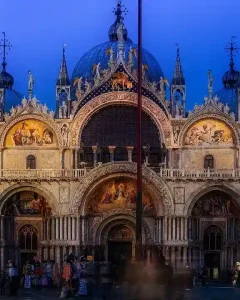
I want to be careful here, because I think “authenticity” arguments about Venice can tip into a kind of tourist snobbery that I find genuinely unpersuasive — the idea that visiting San Marco or the Rialto is somehow the “wrong” way to see Venice, and that only the neighborhoods tourists avoid count as real. That’s not my argument. San Marco is spectacular precisely because it was built to be spectacular; the Basilica and the Doge’s Palace are not lesser experiences because they’re crowded. Cannaregio isn’t “more Venice” than San Marco in some moral sense.
What I’m arguing is narrower and, I think, more defensible: if what you’re specifically looking for is a neighborhood that still functions as a neighborhood — where the businesses, the public space, and the rhythms of the day are still organized primarily around the people who live there — Cannaregio is where you’ll find that most consistently, at the largest scale, for the most straightforward structural reasons. Not because it’s prettier or older or more “hidden.” Because its size and its economic history have let it hold onto a functioning local economy that most of the historic center has lost.
How to Actually Experience This, Rather Than Just Read About It
The authenticity I’m describing isn’t something you can photograph from a gondola. It shows up in small, unglamorous moments: buying bread from a bakery where you’re the only customer not speaking Venetian dialect, timing a walk for early evening when the fondamente fill with residents rather than visitors, noticing which shops have handwritten signs in Italian only. I always tell guests that the real test of whether they’ve found the “authentic” Cannaregio isn’t whether a street looks quiet — it’s whether they can tell, from what’s for sale, that the street doesn’t need them there to survive.
Is Cannaregio less interesting to visit because it has fewer major monuments than San Marco?
Not in my experience — it has a different kind of interest. San Marco offers concentrated, spectacular monuments; Cannaregio offers the texture of daily life alongside genuinely significant sights of its own, including the world’s first Jewish Ghetto and major Tintoretto works at Madonna dell’Orto. Most guests I take through both come away valuing them for different reasons rather than ranking one above the other.
Are there parts of Cannaregio that feel just as touristy as San Marco?
Yes — the stretch from the train station along Strada Nova, and increasingly Fondamenta della Misericordia in the evenings, function much more like the tourist economy than the rest of the district. The “authentic” character I’m describing is concentrated in the quieter northern and eastern sections, not the entire sestiere uniformly.
Is this kind of authenticity something a large group tour can actually experience?
Honestly, not easily. The quiet, functional character of these streets tends to disappear the moment a large group moves through them — which is part of why I keep my own tours small and adjust the route in real time based on what’s actually happening in a given campo that day, rather than following a fixed script built for crowds.