If you’ve ever admired a building in the United States with a columned portico and a symmetrical, temple-like facade, from a state capitol to a courthouse to the White House itself, you’ve admired the legacy of a single 16th-century architect who did nearly all of his defining work in one mid-sized city an hour west of Venice. That city is Vicenza, and it’s one of the most underrated stops on this entire site, precisely because it doesn’t have Venice’s canals or Verona’s Shakespearean fame to sell itself with. What it has instead is Andrea Palladio, and an entire UNESCO World Heritage Site built almost single-handedly around his work.
What UNESCO Actually Protects Here
Vicenza’s UNESCO listing, officially “City of Vicenza and the Palladian Villas of the Veneto,” is unusual in its structure. It was inscribed in 1994, initially covering just the historic center of Vicenza and its 23 buildings attributed to Andrea Palladio, plus three villas just outside the city walls. In 1996, the listing was extended to include 24 additional Palladian villas scattered across the wider Veneto countryside, in the provinces of Vicenza, Verona, Padua, Treviso, Venice, and Rovigo, bringing the total to 47 individual Palladian structures protected under a single serial UNESCO site.
That structure matters because it means “seeing Vicenza’s UNESCO heritage” isn’t really about visiting one city; it’s about understanding an architectural language that started in Vicenza’s town center and then spread out across the entire Venetian mainland, one country villa at a time. You can experience a meaningful, complete version of it in a single focused day in the city itself, but the full listing genuinely extends across the region, a testament to how thoroughly one architect reshaped an entire territory’s visual identity in the span of a few decades.
Who Was Andrea Palladio, and Why Does an Entire City Belong to Him?
Andrea Palladio wasn’t born into privilege or architectural training. He started as a stonemason’s apprentice in Padua before moving to Vicenza in his teens, and his transformation from tradesman to the most influential architect in Western history happened largely because of one relationship: with Gian Giorgio Trissino, a wealthy Vicentine humanist and scholar who recognized the young stonemason’s talent, gave him the name “Palladio” (a reference to the Greek goddess of wisdom, Pallas Athena), and funded his education in classical Roman architecture, including direct study trips to Rome itself.
What Palladio developed from that education was a genuinely systematic architectural language: strict mathematical proportion, symmetry, and a vocabulary of columns, pediments, and porticoes borrowed directly from ancient Roman temples, but adapted for entirely secular purposes, private homes, civic buildings, country estates. He didn’t just design individual buildings; he wrote about his methods, publishing I Quattro Libri dell’Architettura (The Four Books of Architecture) in 1570, an illustrated treatise that would go on to influence architects across Europe for the next two centuries and, eventually, across the Atlantic. Thomas Jefferson owned and heavily annotated a copy of Palladio’s treatise while designing Monticello, and Palladian principles, symmetrical facades, classical porticoes, mathematically proportioned rooms, became the default visual language for American civic architecture well into the 19th century. Standing in Vicenza today means standing at the literal source of a design vocabulary that, without most Americans ever realizing it, quietly shaped the look of their own country’s courthouses, banks, and government buildings.
The Basilica Palladiana: The Building That Launched a Career
If one building explains why Vicenza belongs to Palladio, it’s the Basilica Palladiana, dominating Piazza dei Signori at the heart of the city. It wasn’t originally his building at all; it was a 15th-century Gothic town hall that had structurally failed, its upper hall too heavy for its original supports. In 1549, at just 41 years old, Palladio won the commission to redesign its exterior, wrapping the failing medieval structure in a new double-tiered loggia of white stone, using a rhythmic system of arches and columns known today as the “Palladian window” or “Serliana,” a motif he’d go on to reuse across dozens of later projects and one that would itself become one of the most widely copied architectural elements in Western building.
The commission made Palladio’s public reputation almost overnight, and the building itself remains genuinely striking: a masterclass in disguising structural necessity as elegant, rhythmic design, wrapped around a building that, underneath the loggia, is still largely the same Gothic hall it always was. It’s a fitting symbol for Vicenza as a whole, an ordinary medieval city transformed, quite literally on its surface, into a showcase for one man’s architectural ambition.
Teatro Olimpico: Palladio’s Final, Impossible Project
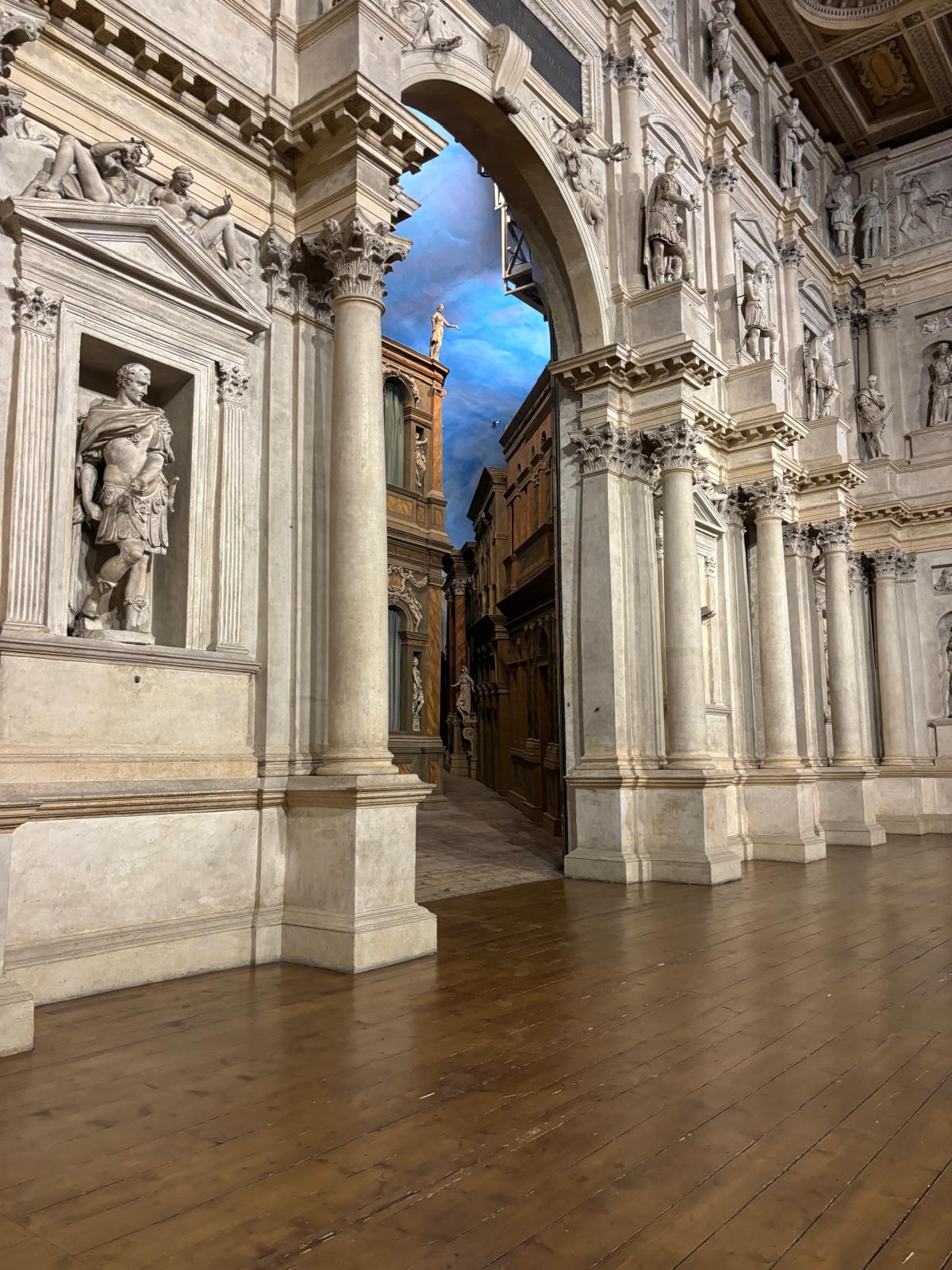
A short walk away sits Palladio’s last work, and arguably his most technically ambitious: the Teatro Olimpico, designed in 1580, the same year Palladio died, and completed after his death by his student Vincenzo Scamozzi. It holds a genuine, unambiguous superlative: it’s the oldest surviving indoor theater in the world still in its original form.
What makes it extraordinary isn’t simply its age but its stage. Scamozzi completed Palladio’s design with an elaborate permanent set representing the streets of the ancient Greek city of Thebes, built using forced perspective, streets that appear to recede dramatically into the distance but that are, in reality, only a few meters deep. It’s an illusion so effective that photographs consistently fail to capture just how convincing it is in person; standing at the correct angle in the audience seating, the streets genuinely appear to stretch away toward a distant horizon. The theater was inaugurated in 1585 with a performance of Sophocles’s Oedipus Rex, and remarkably, it still hosts occasional performances today, one of the only theaters of its age anywhere in the world still used, at least occasionally, for its original purpose.
Palazzo Chiericati and the Palazzi of Corso Palladio
Beyond these two headline buildings, Vicenza’s historic center holds a genuinely dense concentration of Palladian palazzi, private residences built for the city’s wealthy families, lining Corso Palladio and the surrounding streets. Palazzo Chiericati, begun in 1550 and today home to the Vicenza Civic Museum’s art collection, stands out for its ground-floor loggia opening directly onto the street, an unusually public, almost civic gesture for a private residence, designed to give the building a monumental, temple-like presence facing what was then an open square.
Walking Corso Palladio itself, ideally with enough time to actually look up rather than simply pass through, reveals building after building carrying Palladio’s distinctive vocabulary: giant-order columns spanning multiple floors, precisely proportioned window bays, and facades that manage to feel both monumental and genuinely livable, a balance that later, lesser architects working in the “Palladian style” often struggled to replicate. It’s this density, dozens of buildings by a single architect within a walkable historic center, that makes Vicenza function almost like an open-air museum of one man’s evolving ideas, from his earliest, more tentative commissions to the confident, mature style of his final projects.
La Rotonda: The Villa That Became a Global Template
Just outside the city walls sits the building most responsible for Palladio’s international legacy: Villa Almerico Capra, universally known as La Rotonda. Begun around 1567 for a retired Vatican official who wanted a villa suited for entertaining rather than agricultural production, La Rotonda breaks from the working-farmhouse model of most Palladian villas entirely. It’s built on a perfectly symmetrical square plan, with an identical temple-front portico on all four sides and a central circular hall topped by a dome, a design so purely formal and so removed from practical agricultural function that it reads almost as architectural philosophy rendered in stone.
That formal purity is exactly why La Rotonda became the single most copied building in the history of Western residential architecture. Its direct descendants include Chiswick House in London, Mereworth Castle in Kent, and, filtered through Thomas Jefferson’s own study of Palladio’s treatise, elements of Monticello itself. Standing in front of La Rotonda today, most American guests tell me it feels oddly, unplaceably familiar, and it should: they’ve likely encountered its architectural descendants their entire lives without ever knowing the source sat on a quiet hillside outside a mid-sized Italian city.
The Other Villas: A Landscape Shaped by One Architect
While La Rotonda gets the most attention, the wider UNESCO listing’s 24 villas reveal a more varied, and in some ways more historically interesting, side of Palladio’s work: real working agricultural estates, built for Venetian noble families who needed their rural properties to generate income as much as to project status. Villa Barbaro in Maser, roughly 40 minutes northeast of Vicenza, pairs Palladio’s architecture with interior frescoes by Paolo Veronese, considered among the finest fresco cycles of the entire Venetian Renaissance, and remains, remarkably, a still-functioning wine estate today. Villa Emo in Fanzolo shows Palladio’s classic formula for a working villa at its clearest: a central residential block flanked by long, low agricultural wings (barchesse), designed to unify the aristocratic house and its farm buildings into a single, coherent architectural composition rather than treating them as separate concerns. Villa Valmarana ai Nani, closer to Vicenza itself and easily combined with a Rotonda visit, holds another remarkable fresco cycle, this one by Giambattista Tiepolo and his son Giandomenico, added over a century after Palladio’s death but sharing the same underlying architectural logic.
Seeing more than one or two of these villas in a single day requires either a car or a private guide, since they’re scattered across multiple provinces rather than concentrated in one area, but even a single villa visit beyond La Rotonda meaningfully deepens an understanding of Palladio’s range, from severe formal geometry to working agricultural pragmatism, all built from the same essential design vocabulary.
Vicenza Beyond Palladio: The City of Gold
It’s worth knowing that Vicenza’s identity isn’t purely architectural history frozen in the 16th century. The city has been a major center of Italian goldsmithing for generations, earning it the nickname “the City of Gold,” and it remains one of the world’s most significant hubs for jewelry production and trade today, home to Vicenzaoro, one of the largest jewelry trade fairs in the world. That ongoing prosperity shows in small, tangible ways throughout the city center: immaculately maintained streets, a lively aperitivo culture along Corso Palladio in the early evening, and an overall sense of quiet, working affluence that feels genuinely different from more purely tourist-oriented Italian cities. If you want to see what a prosperous, functioning mid-sized Italian city actually looks like day to day, rather than a place preserved primarily for visitors, Vicenza offers one of the clearest windows into that anywhere in the Veneto.
Getting to Vicenza and Planning Your Visit
Vicenza sits on the main Venice-Milan rail line, with frequent regional and high-speed trains connecting Venice’s Santa Lucia station to Vicenza in roughly 50 minutes to an hour. It’s an easy, flexible day trip requiring no car for the city center itself, since the historic core, Piazza dei Signori, the Basilica Palladiana, the Teatro Olimpico, and Corso Palladio’s palazzi, is entirely walkable. La Rotonda sits a short taxi ride or a roughly 30-minute walk outside the city walls, easily added to a half-day or full-day visit.
Reaching the wider countryside villas, Villa Barbaro, Villa Emo, and the others scattered across the Veneto, is a different matter, since they’re spread across multiple provinces with limited public transport connections between them. This is exactly the kind of day, or the kind of extended Veneto loop, worth planning with a private guide or driver rather than attempting piecemeal on your own, particularly since several of the villas keep limited seasonal opening hours that are easy to miss without advance planning.
Plan your visit: We offer reliable private transfers to Vicenza and other key destinations across the Veneto, and for a fuller Palladian day combining Vicenza’s historic center with La Rotonda or the wider countryside villas, reach out through our customized private tours page to build an itinerary matched to how much of Palladio’s work you actually want to see.
Frequently Asked Questions
How many UNESCO-protected Palladian buildings are there in total?
47: 23 buildings within Vicenza’s historic center (inscribed in 1994) plus 24 villas scattered across the wider Veneto region (added in the 1996 extension), spanning the provinces of Vicenza, Verona, Padua, Treviso, Venice, and Rovigo.
Can I visit La Rotonda’s interior, or only the exterior?
The exterior and gardens are typically open to visitors most days of the week, but interior access to La Rotonda is generally limited to specific days, historically Wednesdays and weekends during the spring-to-autumn season, so check current opening days before planning your visit around seeing the inside.
How long does a Vicenza day trip from Venice take, and is it worth doing alongside another city?
Vicenza is roughly an hour from Venice by train, making it a comfortable half-day or full-day trip on its own. It’s also easily combined with Padua, roughly 20 minutes further down the same rail line, for travelers who want to cover two of the Veneto’s UNESCO