Ask most American visitors what comes to mind when they picture the Veneto, and you’ll hear canals, gondolas, maybe vineyards. Almost nobody pictures flamingos. And yet less than two hours south of Venice, where the Po River finally empties into the Adriatic after crossing the entire width of northern Italy, sits one of the largest wetland systems in Europe, a UNESCO-recognized landscape of lagoons, pinewoods, and sand dunes that supports over 360 bird species and a genuine, sizable colony of pink flamingos. It’s the part of the Veneto that looks the least like the Veneto most people imagine, and it’s exactly why I keep sending curious guests there.
What UNESCO Actually Recognizes Here
It’s worth being precise about the Po Delta’s UNESCO status, since it’s a different kind of recognition than the World Heritage Sites most travelers are used to hearing about elsewhere in the Veneto. In June 2015, the Po Delta was designated a UNESCO Biosphere Reserve under the Man and the Biosphere (MAB) Programme, an intergovernmental initiative that has recognized sites like this since 1971. Unlike the World Heritage List, which exists to protect and conserve specific places of outstanding cultural or natural value, the MAB Programme exists to recognize and support a different, more dynamic relationship: how a human population and a natural ecosystem can develop together sustainably, rather than the landscape being preserved purely by keeping people out of it.
The Po Delta Biosphere Reserve spans nearly 140,000 hectares across two regions, Veneto and Emilia-Romagna, organized into three zones: a small core area of about 10 percent representing the most ecologically important habitat, a surrounding buffer zone, and a wider transition area where sustainable farming, fishing, and tourism continue as part of daily life. It’s the only true river delta in Italy, and the largest protected wetland system in the country, formed where the Po’s various branches meet the sea without the kind of hard engineered barriers found at many other European river mouths, letting the landscape shift and reshape itself in a way that’s become genuinely rare in modern Europe.
There’s also a second, distinct UNESCO connection worth knowing, since it sometimes causes confusion: the city of Ferrara and its section of the Po Delta, on the Emilia-Romagna side, were separately inscribed on the UNESCO World Heritage List in 1995, expanded in 1999, under the name “Ferrara, City of the Renaissance, and its Po Delta.” That’s a different, older, and more traditional World Heritage listing, focused on Ferrara’s Renaissance urban planning, layered onto the same general delta landscape that the 2015 Biosphere Reserve later recognized more broadly across both regions. For a Veneto-based traveler, the practical takeaway is simple: what you’re visiting from the Venetian side of the delta, around Rosolina and Porto Caleri, sits inside the Biosphere Reserve, a living, working landscape rather than a fixed historical monument.
A Landscape That Changes as You Walk Through It
What makes the Po Delta so visually distinct from the rest of the Veneto is the sheer variety packed into a relatively compact stretch of coastline. Moving from inland toward the sea, you pass through what ecologists describe as three characteristic landscape bands: the ancient, long-settled delta closer to the mainland, shaped by centuries of agriculture and land reclamation; a middle zone of coastal dune systems, pinewoods, and brackish lagoons; and, finally, the active delta itself, where new land is still being built in real time as the river deposits sediment into the sea, one of the very few places left in Europe where you can watch a coastline still forming rather than simply eroding.
That variety supports an extraordinary range of wildlife. The reserve hosts more than 360 recorded bird species, including purple herons, spoonbills, and glossy ibises, and it’s genuinely one of the best birdwatching destinations in Italy. The area’s colony of pink flamingos, numbering in the thousands, is perhaps its most unexpected resident, a species most Americans associate with Florida or the Caribbean, thriving instead in the shallow, mineral-rich lagoons of northeastern Italy. The delta is also home to the Cervo della Mesola, a population of red deer on the Emilia-Romagna side recognized as genetically distinct from every other red deer population in Europe, the reserve’s only resident large mammal and a genuine conservation point of pride for the area.
Porto Caleri: A Wild, Protected Edge of the Delta
On the Veneto side of the delta, at the far southern tip of the Rosolina Mare coastline, sits Porto Caleri, home to the Giardino Botanico Litoraneo di Porto Caleri, the Coastal Botanical Garden of Porto Caleri, sometimes simply called the Giardino Botanico Litoraneo del Veneto. Established by the Veneto Region in 1990 and formally opened the following year, the reserve protects roughly 24 hectares (some more recent counts put the fully protected area closer to 44 hectares) of genuinely spontaneous, naturally occurring coastal habitat, not a cultivated garden in the traditional sense, but a carefully protected slice of what this entire coastline looked like before large-scale tourism development reshaped most of the nearby Adriatic shore. It sits at the northern edge of the Veneto Regional Po Delta Park and inside the broader UNESCO MAB Biosphere Reserve, and it’s managed by the Regional Forestry Service of Padua and Rovigo in collaboration with the University of Padua, which uses the site for ongoing ecological research alongside its role as a public nature reserve.
Walking Through Every Habitat the Delta Has to Offer
What makes Porto Caleri worth the trip isn’t a single standout feature; it’s the sheer compression of distinct habitats packed into a single walkable reserve. A visit typically moves through umbrella pine and maritime pine woodland, then into low, wind-sculpted Mediterranean maquis, then across small freshwater ponds and wetlands, over active sand dunes still shifting with the wind and tide, and finally to the beach itself and the brackish lagoon behind it, the Laguna di Caleri. Few places in Italy let you walk through this many genuinely distinct coastal ecosystems in the space of an hour or two, moving on foot from pine forest to open dune to lagoon shoreline without ever leaving a single protected reserve.
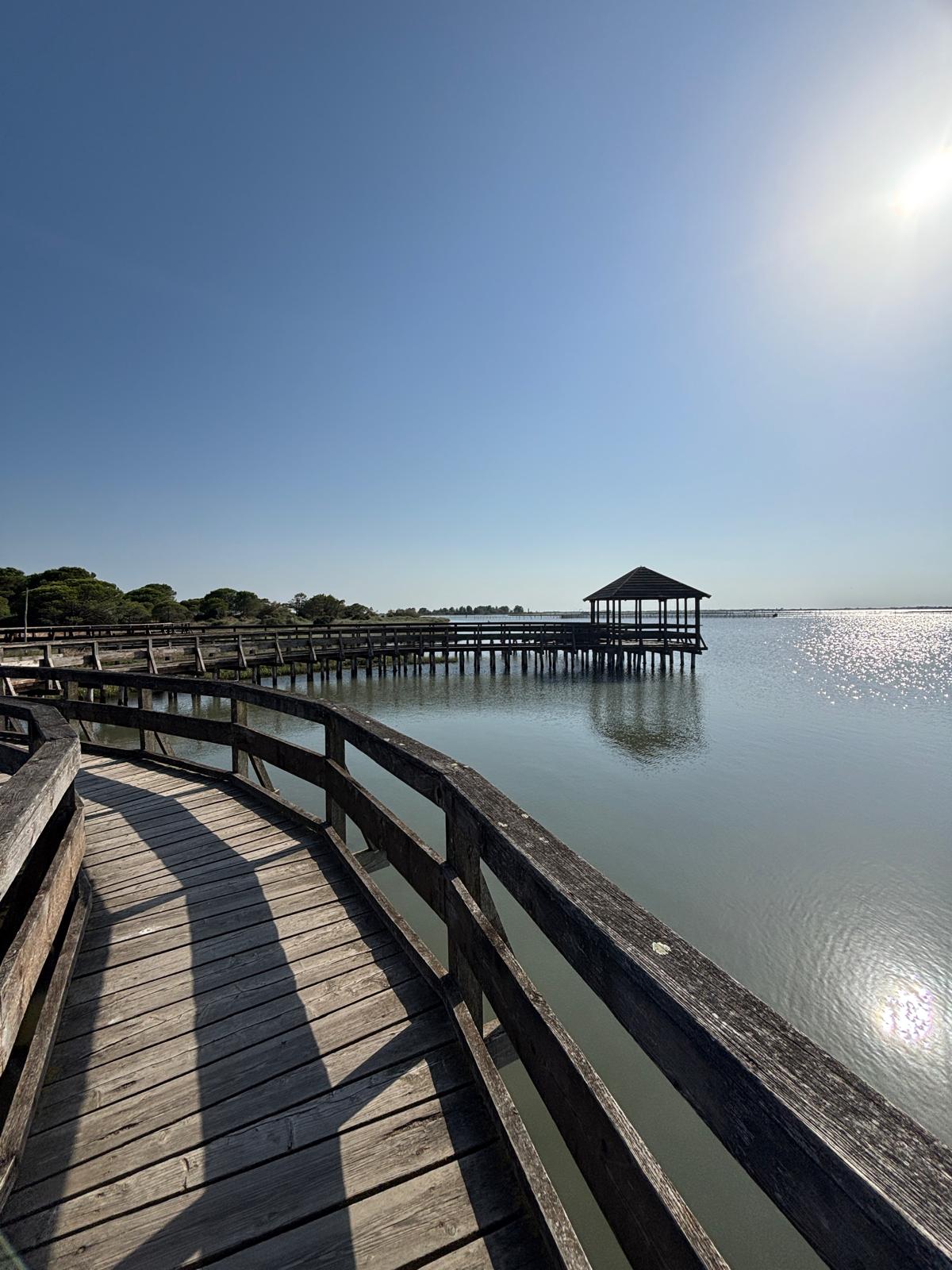
The reserve is organized around three marked trails of increasing length: a short yellow route of roughly 600 meters, a mid-length red route of about 1,650 meters, and a longer blue route stretching close to 2,850 meters, the last of which includes a raised wooden boardwalk crossing directly over wetland areas, giving walkers a close, dry-footed view into habitat that would otherwise be inaccessible. Along the way, look for green lizards basking on sun-warmed sand, sea buckthorn shrubs (olivello spinoso) with their distinctive orange berries clinging to the dunes, and, depending on the season, a genuinely wide variety of migratory and resident birds moving between the pine cover and the open lagoon.
Why It Was Protected in the First Place
The reserve exists specifically because this stretch of coastline had already become rare by the time it was formally protected in 1990. Much of the Adriatic coast nearby had been developed for beach tourism decades earlier, and Porto Caleri represented one of the last surviving examples of the region’s genuinely spontaneous coastal vegetation, dune structure, and lagoon habitat, largely untouched by the hotel and resort development that reshaped most of the surrounding shoreline. Its subsequent designation as a Site of Community Importance under European Union conservation law reinforced that original protective intent, recognizing the reserve’s ecological value at a continental, not just regional, scale.
Getting There, and Why It’s Worth the Distance from Venice
Porto Caleri sits roughly 90 minutes to two hours south of Venice by car, in the province of Rovigo, past Chioggia and along the coastal road toward Rosolina Mare. It’s genuinely a different kind of day trip than anything else covered elsewhere on this site: no churches, no palaces, no UNESCO monument in the traditional sense, just open sky, water, and a landscape that moves and shifts under its own natural rhythm. For guests who’ve already spent several days absorbing Venice’s dense, layered urban history, or who simply want a genuine nature-focused day that most first-time visitors to the Veneto never think to ask about, the Po Delta and Porto Caleri offer something no other stop on a typical Venice itinerary can.
The most rewarding way to experience the wider delta beyond Porto Caleri’s walking trails is by boat, gliding along the Po’s quieter side channels where the flamingo colonies and the bulk of the bird life actually concentrate, areas that simply aren’t visible or reachable on foot. Combining a boat excursion on the water with a walk through Porto Caleri’s dune and pinewood trails gives the most complete picture of the delta’s full range of habitats in a single day.
Plan your visit: the Po Delta and Porto Caleri sit outside our standard day-trip offerings, but it’s exactly the kind of nature-focused excursion I build as a custom itinerary for guests who want to go beyond Venice’s historic core. Reach out through our customized private tours page to put together a Po Delta day built around your schedule and interests, whether that’s birdwatching, walking, or a slower boat-based exploration of the delta’s inner channels.
Frequently Asked Questions
the Po Delta a UNESCO World Heritage Site?
Not in the traditional sense most travelers expect. The Po Delta was designated a UNESCO Biosphere Reserve in 2015 under the Man and the Biosphere (MAB) Programme, a different category focused on sustainable coexistence between people and nature rather than strict preservation of a fixed monument. A separate, older UNESCO World Heritage listing, “Ferrara, City of the Renaissance, and its Po Delta” (1995, expanded 1999), covers the Emilia-Romagna side of the delta around Ferrara specifically.
How far is Porto Caleri from Venice, and can I visit in a day?
Spring and autumn migration periods generally offer the richest birdwatching, as resident species overlap with migratory birds passing through the delta’s wetlands. The flamingo colony, along with herons, spoonbills, and glossy ibises, can be seen across a wide part of the year, though summer’s longer days and warmer weather also make for the most comfortable walking conditions on Porto Caleri’s dune and pinewood trails.
What’s the best time of year to see the flamingos and other birdlife in the Po Delta?
Spring and autumn migration periods generally offer the richest birdwatching, as resident species overlap with migratory birds passing through the delta’s wetlands. The flamingo colony, along with herons, spoonbills, and glossy ibises, can be seen across a wide part of the year, though summer’s longer days