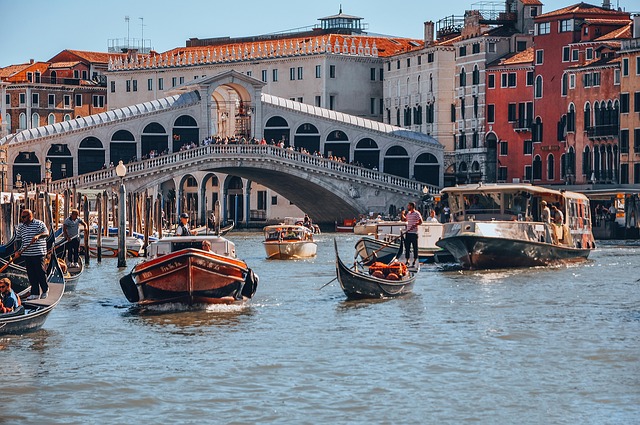
Most visitors cross a dozen bridges in a single afternoon without ever thinking about them as anything other than obstacles between themselves and the next photo stop. I understand the instinct — when you’re navigating Venice for the first time, a bridge is just a set of stairs you didn’t expect. But once you know what to look for, those 435 bridges become a kind of open-air archive. They record fires, plagues, street brawls, prison sentences, and a thousand years of a city that had to invent itself, one crossing at a time.
Venice’s historic center is made up of 121 islands, and every one of those bridges exists to stitch them into a single, walkable city. That number — 435 — is the one most commonly cited for the historic center, and it’s worth sitting with for a second: a city smaller than most American downtowns, criss-crossed by more bridges than most countries build in a decade.
A City That Started With No Bridges at All
Here’s the detail that surprises almost every client I take through the city: for the first several centuries of its existence, Venice had essentially no bridges. The lagoon’s original islands were farther apart than they are now, and boats were the only way to move between them. People who couldn’t afford a boat used makeshift wooden planks laid out by local entrepreneurs charging a toll to cross — a detail that tells you everything about Venetian pragmatism from the very beginning.
As the city grew and land reclamation pulled the islands closer together, informal wooden crossings started to appear — flat, without steps, and built to accommodate something you wouldn’t expect in a city now famous for having no cars: horses. Until the 1400s, horses were a normal part of Venetian street life, and early bridges were built flat specifically so animals could cross them.
The shift away from wood came slowly. The first documented stone bridges in Venice — the Ponte della Canonica and the Ponte de San Provolo — were built around 1172, constructed to accommodate the annual procession of the Doge. But stone construction on any real scale didn’t take hold until the 16th century, when Venice fully embraced its identity as a maritime power and began building the arched, boat-friendly bridges we recognize today.
One detail that always gets a reaction from my clients: none of Venice’s original bridges had railings. Parapets weren’t added until the 19th century, and in the meantime, people fell into the canals with enough regularity that the city’s daily newspaper once ran a running list of who had gone in the water the day before. A single bridge in Cannaregio — the Ponte Chiodo, near Ca’ d’Oro — still has no railing today, preserved exactly as its predecessors once were.
The Bridge That Took 90 Years to Build
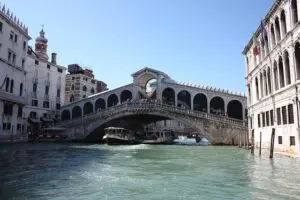
If one bridge tells the story of Venetian ambition better than any other, it’s the Rialto. The site has carried some kind of crossing since the 12th century, starting with a pontoon bridge called the Ponte della Moneta — named for the toll people paid to use it. Wooden versions came and went for centuries, repeatedly damaged by fire, overcrowding, and at least one dramatic collapse in 1444, when a crowd gathered to watch a boat parade proved too heavy for the structure beneath them.
By the 16th century, Venice’s leadership knew wood wasn’t going to cut it anymore. In 1551, the Senate opened a competition for a permanent stone bridge, and the list of architects who submitted designs reads like a who’s-who of the Renaissance — Michelangelo, Andrea Palladio, and Jacopo Sansovino among them. The commission ultimately went to a relatively unknown local architect named Antonio da Ponte, whose surname, fittingly, means “of the bridge.”
Da Ponte’s design was audacious for its time: a single stone arch with no central support, spanning nearly 29 meters and rising high enough for boats to pass beneath. Rival architect Vincenzo Scamozzi publicly predicted it would collapse. Construction began in 1588 and finished in just three years, in 1591 — and the bridge that critics swore wouldn’t stand has now carried foot traffic for over 430 years. It remains the oldest of the four bridges crossing the Grand Canal, and until the 19th century, it was the only way to cross the canal on foot at all.
The Bridge Named for a Sigh
Not every bridge in Venice tells a story of engineering triumph. Some tell stories of loss. The Bridge of Sighs — Ponte dei Sospiri — was built in the early 17th century by Antonio Contino, whose uncle had worked on the Rialto, to connect the Doge’s Palace to the New Prisons. Its name comes from the legend that condemned prisoners, walking across it toward their cells, would catch their final glimpse of Venice through its small stone-barred windows and let out a sigh before disappearing from the free world entirely.
Today it’s one of the most photographed structures in the city, but I always tell clients: the bridge you can walk across isn’t a viewing platform, it’s a former one-way passage to captivity. That context changes how it feels to stand on the Ponte della Paglia and look at it.
Fists, Feet, and a Bridge With a Very Blunt Name
Venice’s bridges also preserve some of the city’s rowdier history. The Ponte dei Pugni — the “Bridge of Fists” — in Dorsoduro still bears carved footprints marking the starting positions for organized brawls between rival neighborhood factions, who fought to force one another off the bridge and into the canal below. It originally had no railings either, which tells you the city wasn’t especially worried about the outcome.
Then there’s the Ponte delle Tette, in San Polo — a name I’ll translate loosely as the “Bridge of a Certain Anatomical Feature.” In the 15th century, Venice had such a significant population of sex workers that the Republic designated a specific district for them, and the windows overlooking this particular bridge became a place where women advertised their services to passersby. It’s a strange footnote, but it’s also a genuine piece of Renaissance social history hiding in plain sight, unmarked, on a bridge most tourists cross without a second glance.
Why This Matters for How You Experience Venice
I bring this history up not as trivia, but because it changes how a trip through Venice actually feels. Once you understand that every bridge was a solution to a specific problem — a fire risk, a brawl, a market that outgrew its wooden crossing — the city stops being a backdrop and starts being a document you can read as you walk through it. That’s the difference between a guided walk that hits the landmarks and a private route built around the stories that connect them, which is exactly what I build into every private Venice walking tour I lead.
How many bridges does Venice actually have?
The historic center’s 121 islands are connected by 435 bridges, a figure widely cited for the main city. That number climbs higher if you include the surrounding lagoon islands like Murano and Burano, each of which has its own small network of bridges.
Why do some Venice bridges have no railings?
Originally, none of them did — railings weren’t added until the 19th century, after centuries of people falling into the canals. One bridge, the Ponte Chiodo in Cannaregio, still has no railing today, preserved as a rare surviving example of the city’s original bridge design.
Which bridges cross the Grand Canal, and can I walk all of them?
Four bridges cross the Grand Canal: the Rialto, the Ponte degli Scalzi near the train station, the Ponte dell’Accademia, and the modern Ponte della Costituzione near Piazzale Roma. All four are open to pedestrians and free to cross, with no tickets or restrictions required.