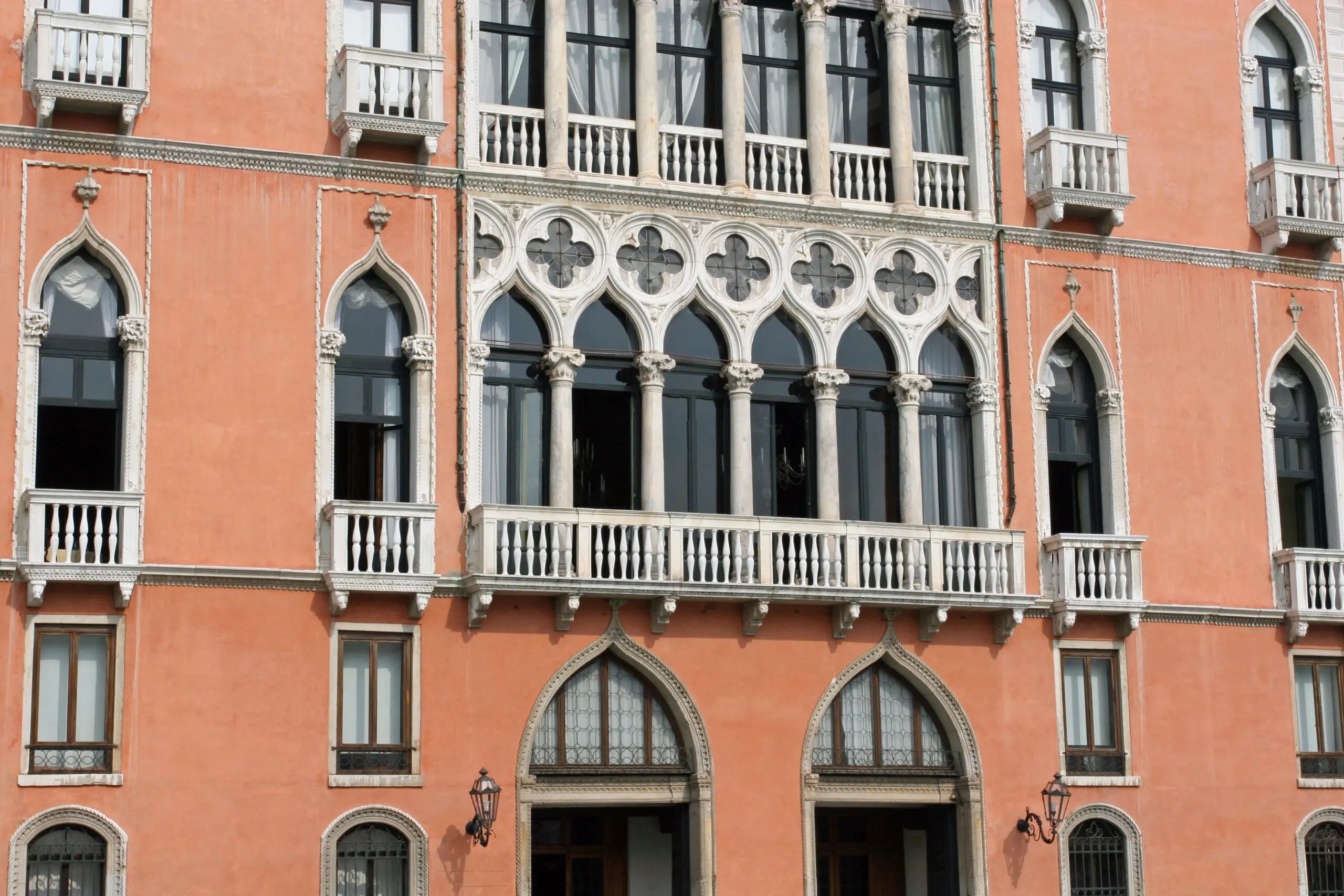
Palazzo Pisani Moretta is a fifteenth-century Gothic palace on Venice’s Grand Canal that became an eighteenth-century Rococo masterpiece and, in 2025, entered a new chapter under Belgian fashion designer Dries Van Noten. Its story stretches from the Bembo and Pisani families to the extraordinary patronage of Chiara Pisani, Tiepolo’s frescoes, historic masquerades, and the Fondazione Dries Van Noten’s cultural program.
A palace on the Grand Canal
Palazzo Pisani Moretta stands in San Polo, between Rialto and the bend near Ca’ Foscari. Its position tells the story of a Venice where a waterfront façade was a family’s public identity. Guests approached from the canal, and the principal rooms faced the city’s most prestigious thoroughfare.
The date, person, and physical setting matter because Venice’s palaces were built to be used, not simply admired. A visitor who looks closely at the relationship between the water entrance, the ceremonial rooms, and the changing ownership can understand how a building adapts to different centuries. Where access is restricted, the exterior and published historical sources still offer a meaningful encounter.
The fifteenth-century beginning
The palace dates to the late fifteenth century and is associated with the Bembo family in its earliest history. Its Venetian Gothic Fiorito façade, with elaborate six-light windows, belongs to a world of merchant fortunes, stone craftsmanship, and carefully displayed status.
The distinction between documented history and a romantic story is especially important here. The palace’s architecture and collections have been repeatedly transformed, and not every detail visible today belongs to its original fifteenth-century phase. Visitors should resist treating the whole building as a frozen Renaissance interior and instead notice the layers of choices made by successive owners.
The façade as a statement
Two great Gothic window groups organize the exterior. The lower loggia recalls the Doge’s Palace; the upper windows use quadrilobe motifs. The visual rhythm was intended to impress from the water, long before photography or a modern museum visitor existed.
For travelers from the United States, this is a useful way to read Venice beyond the standard landmark checklist. The city is full of privately owned buildings whose artistic significance is greater than their public visibility. Understanding ownership, conservation, and changing cultural uses often explains more than a list of famous names or glamorous parties.
Why the Pisani Moretta name matters
The palace passed into the Pisani Moretta family’s orbit in 1629. Their branch took its name from an earlier family figure, Almorò Pisani. The building initially served as income-producing property before becoming the family’s principal residence in the eighteenth century.
The date, person, and physical setting matter because Venice’s palaces were built to be used, not simply admired. A visitor who looks closely at the relationship between the water entrance, the ceremonial rooms, and the changing ownership can understand how a building adapts to different centuries. Where access is restricted, the exterior and published historical sources still offer a meaningful encounter.
Venetian patricians and public power
A noble palace was never just a private home. Families invested in architecture, patronage, marriages, and political relationships to establish standing within the Republic. The Pisani name carried memories of naval command and the War of Chioggia, which later influenced the decorative program.
The distinction between documented history and a romantic story is especially important here. The palace’s architecture and collections have been repeatedly transformed, and not every detail visible today belongs to its original fifteenth-century phase. Visitors should resist treating the whole building as a frozen Renaissance interior and instead notice the layers of choices made by successive owners.
The extraordinary role of Chiara Pisani
In the 1740s, Chiara Pisani directed a major renovation. As a wealthy widow and patron, she transformed the palace into a coherent Rococo interior. Her agency is an important corrective to histories that attribute every Venetian building decision to male architects or family heads.
For travelers from the United States, this is a useful way to read Venice beyond the standard landmark checklist. The city is full of privately owned buildings whose artistic significance is greater than their public visibility. Understanding ownership, conservation, and changing cultural uses often explains more than a list of famous names or glamorous parties.
The vanished external staircase
One of Chiara’s most significant decisions was replacing an older external Gothic stair with a monumental interior staircase. The change altered how guests moved through the house. It shifted the experience from a medieval arrangement to a more theatrical eighteenth-century procession.
The date, person, and physical setting matter because Venice’s palaces were built to be used, not simply admired. A visitor who looks closely at the relationship between the water entrance, the ceremonial rooms, and the changing ownership can understand how a building adapts to different centuries. Where access is restricted, the exterior and published historical sources still offer a meaningful encounter.
The monumental stair and its materials
The grand staircase is supported by twelve columns of white marble and Istrian stone. The materials connect the palace’s eighteenth-century ambitions to Venice’s long tradition of imported stone and sophisticated craftsmanship. Architecture here is both structure and choreography.
The distinction between documented history and a romantic story is especially important here. The palace’s architecture and collections have been repeatedly transformed, and not every detail visible today belongs to its original fifteenth-century phase. Visitors should resist treating the whole building as a frozen Renaissance interior and instead notice the layers of choices made by successive owners.
Tiepolo and a family’s heroic mythology
Giambattista Tiepolo frescoed a ceiling with Venus presenting Aeneas to the gods of Olympus. The classical subject offered an elevated analogy to the family’s celebrated ancestor Vettor Pisani. Mythology was not neutral decoration; it helped communicate lineage and legitimacy.
For travelers from the United States, this is a useful way to read Venice beyond the standard landmark checklist. The city is full of privately owned buildings whose artistic significance is greater than their public visibility. Understanding ownership, conservation, and changing cultural uses often explains more than a list of famous names or glamorous parties.
Other artists inside the palace
Gaspare Diziani, Jacopo Guarana, Giuseppe Angeli, and other painters contributed to the interior’s layered artistic character. The rooms show how a great Venetian residence could function as a curated environment, combining ceilings, stucco, furniture, and views across the canal.
The date, person, and physical setting matter because Venice’s palaces were built to be used, not simply admired. A visitor who looks closely at the relationship between the water entrance, the ceremonial rooms, and the changing ownership can understand how a building adapts to different centuries. Where access is restricted, the exterior and published historical sources still offer a meaningful encounter.
The Camerino d’Oro
The intimate Golden Room, with its white-and-gold decoration, reveals a different scale from the large ceremonial salons. Such spaces remind visitors that aristocratic houses balanced public performance with private living. The quality of decoration could remain high even when the room was small.
The distinction between documented history and a romantic story is especially important here. The palace’s architecture and collections have been repeatedly transformed, and not every detail visible today belongs to its original fifteenth-century phase. Visitors should resist treating the whole building as a frozen Renaissance interior and instead notice the layers of choices made by successive owners.
Veronese and the painting that left Venice
Paolo Veronese’s monumental The Family of Darius before Alexander once belonged to the palace’s celebrated collection. Goethe saw it there in 1786. The painting was acquired for London’s National Gallery in 1857, illustrating how Venetian treasures entered international collections.
For travelers from the United States, this is a useful way to read Venice beyond the standard landmark checklist. The city is full of privately owned buildings whose artistic significance is greater than their public visibility. Understanding ownership, conservation, and changing cultural uses often explains more than a list of famous names or glamorous parties.
The great guests of another era
Historical accounts associate the palace with figures including Joseph II, the future Tsar Paul I, and Joséphine Bonaparte. Their presence reflects the palace’s role as a place of elite hospitality and diplomacy. The precise circumstances of individual visits deserve careful treatment rather than romantic embellishment.
The date, person, and physical setting matter because Venice’s palaces were built to be used, not simply admired. A visitor who looks closely at the relationship between the water entrance, the ceremonial rooms, and the changing ownership can understand how a building adapts to different centuries. Where access is restricted, the exterior and published historical sources still offer a meaningful encounter.
The end of the old dynasty
The Pisani Moretta family line eventually ended, and the palace entered a different period of private ownership. Like many Venetian buildings, it survived by adapting its uses while preserving much of its architectural identity. Continuity did not require remaining a single family’s home forever.
The distinction between documented history and a romantic story is especially important here. The palace’s architecture and collections have been repeatedly transformed, and not every detail visible today belongs to its original fifteenth-century phase. Visitors should resist treating the whole building as a frozen Renaissance interior and instead notice the layers of choices made by successive owners.
Carnival and the palace of masquerades
In modern times Palazzo Pisani Moretta became widely known for exclusive events and masquerade balls, including Il Ballo del Doge. Its decorated rooms provided a dramatic setting, though such events were not the same as ordinary museum access. Private use helped shape the palace’s contemporary reputation.
For travelers from the United States, this is a useful way to read Venice beyond the standard landmark checklist. The city is full of privately owned buildings whose artistic significance is greater than their public visibility. Understanding ownership, conservation, and changing cultural uses often explains more than a list of famous names or glamorous parties.
Cinema and the Venetian image
The palace has also appeared in the modern visual culture of Venice, including the film The Tourist. Its façade and rooms became part of the city imagined through fashion, cinema, and glamorous events. That visibility increased international interest in a building with a much older story.
The date, person, and physical setting matter because Venice’s palaces were built to be used, not simply admired. A visitor who looks closely at the relationship between the water entrance, the ceremonial rooms, and the changing ownership can understand how a building adapts to different centuries. Where access is restricted, the exterior and published historical sources still offer a meaningful encounter.
May 2025: Dries Van Noten arrives
Belgian fashion designer Dries Van Noten purchased the palace in May 2025. The acquisition followed his retirement from the fashion label’s creative direction and his search for a new cultural project. The palace was not simply acquired as a conventional private residence.
The distinction between documented history and a romantic story is especially important here. The palace’s architecture and collections have been repeatedly transformed, and not every detail visible today belongs to its original fifteenth-century phase. Visitors should resist treating the whole building as a frozen Renaissance interior and instead notice the layers of choices made by successive owners.
A designer known for color and textiles
Van Noten built an international reputation for unexpected combinations of prints, textiles, colors, and historical references. These interests resonate with Venice’s centuries-old traditions of weaving, decorative arts, and theatrical presentation. The relationship is a cultural dialogue, not a claim that the palace was designed for fashion.
For travelers from the United States, this is a useful way to read Venice beyond the standard landmark checklist. The city is full of privately owned buildings whose artistic significance is greater than their public visibility. Understanding ownership, conservation, and changing cultural uses often explains more than a list of famous names or glamorous parties.
Patrick Vangheluwe and the project
Van Noten’s partner Patrick Vangheluwe has been associated with the new Venetian chapter. Reports describe the decision as carefully considered rather than impulsive. The scale and complexity of the building made stewardship a serious commitment beyond the initial purchase.
The date, person, and physical setting matter because Venice’s palaces were built to be used, not simply admired. A visitor who looks closely at the relationship between the water entrance, the ceremonial rooms, and the changing ownership can understand how a building adapts to different centuries. Where access is restricted, the exterior and published historical sources still offer a meaningful encounter.
A foundation rather than another luxury hotel
The new Fondazione Dries Van Noten presents Palazzo Pisani Moretta as a space for dialogue across art, design, fashion, music, and performance. This direction matters in a city where the conversion of historic buildings into visitor accommodation is often debated.
The distinction between documented history and a romantic story is especially important here. The palace’s architecture and collections have been repeatedly transformed, and not every detail visible today belongs to its original fifteenth-century phase. Visitors should resist treating the whole building as a frozen Renaissance interior and instead notice the layers of choices made by successive owners.
The inaugural presentation in 2026
The foundation opened its inaugural presentation, The Only True Protest Is Beauty, on April 25, 2026. It brought fashion and art into conversation with the palace’s historic interiors. The official foundation website now states that this presentation has concluded; travelers should not assume it remains on view.
For travelers from the United States, this is a useful way to read Venice beyond the standard landmark checklist. The city is full of privately owned buildings whose artistic significance is greater than their public visibility. Understanding ownership, conservation, and changing cultural uses often explains more than a list of famous names or glamorous parties.
Why the collection is not the building
An exhibition is temporary, while the palace’s architecture is centuries old. Understanding that distinction prevents visitors from confusing a current program with the permanent historical fabric. Future displays and access arrangements should be checked directly with the foundation.
The date, person, and physical setting matter because Venice’s palaces were built to be used, not simply admired. A visitor who looks closely at the relationship between the water entrance, the ceremonial rooms, and the changing ownership can understand how a building adapts to different centuries. Where access is restricted, the exterior and published historical sources still offer a meaningful encounter.
What visitors can see from outside
Even without an interior ticket, the façade is visible from the Grand Canal. A vaporetto or private boat provides a perspective closer to the way important guests once approached. The pointed arches and windows are easier to appreciate from the water than from a narrow street.
The distinction between documented history and a romantic story is especially important here. The palace’s architecture and collections have been repeatedly transformed, and not every detail visible today belongs to its original fifteenth-century phase. Visitors should resist treating the whole building as a frozen Renaissance interior and instead notice the layers of choices made by successive owners.
Do not assume daily opening
The palace’s changing program means opening hours, tickets, and exhibitions should never be invented. Consult the foundation’s official website before planning a visit. A historic palazzo that hosts an exhibition is not necessarily open every day as a conventional civic museum.
For travelers from the United States, this is a useful way to read Venice beyond the standard landmark checklist. The city is full of privately owned buildings whose artistic significance is greater than their public visibility. Understanding ownership, conservation, and changing cultural uses often explains more than a list of famous names or glamorous parties.
A practical local observation
The best way to understand the building is to see it twice: first from the water, where the Gothic façade dominates, and then through its documented interior history, where the eighteenth-century renovation becomes central. This contrast explains why the exterior and interior seem to belong to different centuries.
The date, person, and physical setting matter because Venice’s palaces were built to be used, not simply admired. A visitor who looks closely at the relationship between the water entrance, the ceremonial rooms, and the changing ownership can understand how a building adapts to different centuries. Where access is restricted, the exterior and published historical sources still offer a meaningful encounter.
Why its future matters
The palace now links Venetian patrician history, eighteenth-century female patronage, and contemporary international fashion. Its next chapter will be judged by how respectfully new cultural activity coexists with fragile historic rooms and whether the public can meaningfully encounter the building.
The distinction between documented history and a romantic story is especially important here. The palace’s architecture and collections have been repeatedly transformed, and not every detail visible today belongs to its original fifteenth-century phase. Visitors should resist treating the whole building as a frozen Renaissance interior and instead notice the layers of choices made by successive owners.
The palace in Venice’s wider story
Palazzo Pisani Moretta is an example of Venice’s ability to reinterpret existing architecture without erasing its past. The Bembo origins, Pisani ownership, Chiara’s Rococo transformation, and Van Noten’s foundation belong to one evolving history rather than disconnected stories.
For travelers from the United States, this is a useful way to read Venice beyond the standard landmark checklist. The city is full of privately owned buildings whose artistic significance is greater than their public visibility. Understanding ownership, conservation, and changing cultural uses often explains more than a list of famous names or glamorous parties.
Explore the context
For other hidden architectural stories, read the details that tell Venice’s real story. For the craft traditions that make interiors like these possible, see Venice’s forgotten female artisans. For the living city behind its famous palaces, read how Venice works before sunrise.
Sources and visiting information
The Fondazione Dries Van Noten official palace history provides the architectural and historical chronology, including the 2025 acquisition and current cultural mission. Consult its website for future exhibition announcements and access. The featured image is an authentic photograph of Palazzo Pisani Moretta from Wikimedia Commons; it is not a reconstruction.
Explore the wider story
For related perspectives, discover Venetian merchant palaces; private bridges of Venice; why Venetian palaces lean. These articles add historical and practical context to this subject.
Frequently Asked Questions
Who owns Palazzo Pisani Moretta today?
Belgian fashion designer Dries Van Noten acquired the Grand Canal palace in May 2025. The Fondazione Dries Van Noten now develops a cultural program connecting art, fashion, design, and other disciplines.
When was Palazzo Pisani Moretta built and who decorated it?
The palace originated in the late fifteenth century. Its major eighteenth-century interior transformation was directed by Chiara Pisani, with works by Giambattista Tiepolo, Jacopo Guarana, Gaspare Diziani, and other artists.
Can tourists visit Palazzo Pisani Moretta in 2026?
Access depends on the Fondazione Dries Van Noten’s announced exhibitions and events. Its inaugural 2026 presentation has concluded; check the official foundation website for current opening arrangements rather than assuming daily museum access.