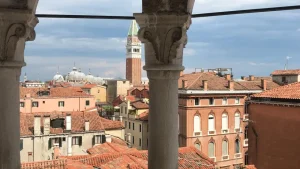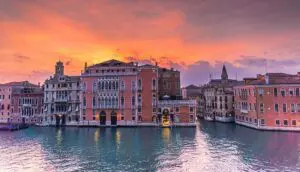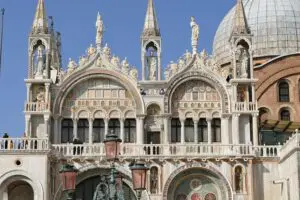
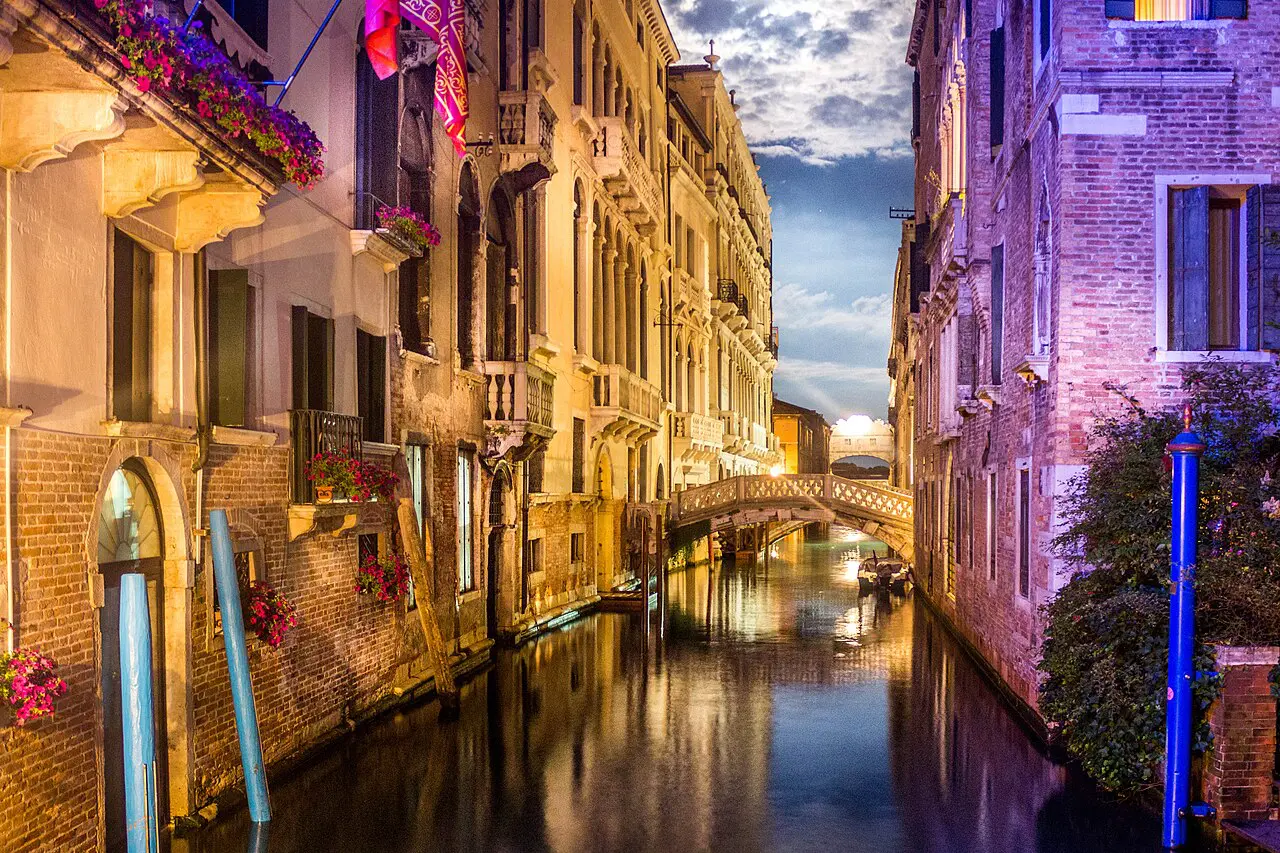
When the sightseeing day ends
There is no single hour when the last tourist leaves Venice. Many travelers stay overnight, and restaurants, theaters, hotels, and transport services continue operating. Yet the character of certain streets changes noticeably as day visitors depart and major attractions close. For residents, that transition is not a magical moment when the city becomes private again. It is simply the beginning of another part of the day: collecting children, buying groceries, getting home from work, walking a dog, or preparing for tomorrow. This article explores those evening routines rather than promising an empty Venice.
A useful distinction is between what a visitor can observe during a brief stay and what the daily operation of the city requires. The most visible scenes are not always the most important ones. Behind them are choices about time, space, money, and professional responsibilities that shape everyday life.
The city does not become silent
Venice is often described as completely silent after dark. Some residential calli are remarkably quiet, but sounds continue: footsteps, conversations, boat engines, restaurant service, deliveries, and occasional maintenance. The experience differs between Rialto, San Marco, Cannaregio, Castello, and the Giudecca. A late-night visitor may encounter lively squares or almost deserted lanes within a short walk. Describing all of Venice as one peaceful neighborhood would ignore the people and businesses who remain active. The changing soundscape is best understood as a pattern rather than a guarantee.
Local conditions also change. Water levels, weather, transport arrangements, and the availability of skilled people can make a routine task straightforward one day and complicated the next. It would be misleading to describe any single route or schedule as universal. Practical knowledge means knowing when to verify conditions.
Residents have different evenings
A household with school-age children experiences the city differently from an older resident, a hospitality worker, or someone returning from the mainland. Some people work evenings, others finish early, and many depend on public transport. A single anecdote cannot stand in for every Venetian’s routine. The historic center contains a diverse population whose schedules are shaped by employment, family obligations, mobility, and housing. The common thread is not that everyone lives slowly. It is that ordinary life must fit within a city designed around walking and boats.
The wider significance is cultural as well as practical. Venice survives as a living place because people continue to work, maintain equipment, care for homes, and use shared spaces. Appreciating that ordinary effort adds depth to the monuments and canals that first draw travelers here.
Coming home without a car
Most residents of the historic center cannot drive to their front door. A journey home may involve a train, bus, tram, or car to the edge of Venice, followed by walking or public water transport. Carrying bags over bridges changes how people plan errands. This is a familiar daily calculation, not a picturesque inconvenience staged for visitors. Our separate guide explains why Venice has no cars and how its transport logistics work. Here the focus is what those constraints feel like at the end of a normal day.
A useful distinction is between what a visitor can observe during a brief stay and what the daily operation of the city requires. The most visible scenes are not always the most important ones. Behind them are choices about time, space, money, and professional responsibilities that shape everyday life.
The last practical errand
An evening shopping trip in Venice depends on opening hours, location, and what can be carried home. A small bag of food is manageable; bulky purchases require more planning. Residents may choose shops along a regular walking route rather than crossing several bridges for a marginally better price. It is easy for visitors to romanticize the absence of cars without recognizing the effort involved. For a fuller look at local food shopping, see how residents actually buy groceries in Venice. This article stays with the evening rhythm.
Local conditions also change. Water levels, weather, transport arrangements, and the availability of skilled people can make a routine task straightforward one day and complicated the next. It would be misleading to describe any single route or schedule as universal. Practical knowledge means knowing when to verify conditions.
The difference between a campo and a square
A campo is not simply a scenic backdrop. Depending on its location and design, it can serve as a place for conversation, a route home, a meeting point, or a setting for neighborhood life. Some campi remain busy into the evening, while others are mostly quiet. Residents use these spaces alongside visitors, which means neither group owns the atmosphere. Travelers can enjoy them without turning every encounter into a photograph. Observing how people share public space is often more revealing than seeking a supposedly secret square.
The wider significance is cultural as well as practical. Venice survives as a living place because people continue to work, maintain equipment, care for homes, and use shared spaces. Appreciating that ordinary effort adds depth to the monuments and canals that first draw travelers here.
Children and the geography of play
Families in Venice navigate a city of bridges, narrow lanes, canals, and public spaces. Children may use designated play areas and neighborhood meeting points, but not every campo is a playground. Water safety and pedestrian awareness are practical concerns. Parents also have to coordinate schools, extracurricular activities, and travel to other parts of the lagoon or mainland. These routines continue long after sightseeing groups leave. The city’s beauty does not erase the need for safe routes, appropriate facilities, and predictable transport.
A useful distinction is between what a visitor can observe during a brief stay and what the daily operation of the city requires. The most visible scenes are not always the most important ones. Behind them are choices about time, space, money, and professional responsibilities that shape everyday life.
The evening vaporetto
Public water buses remain an important connection for residents and overnight visitors. Service frequency and routes vary by line and time, and the last convenient connection may shape dinner or work plans. A traveler who misses a boat can often adjust the evening; a resident making a daily journey faces that constraint repeatedly. Always check the current ACTV timetable rather than relying on a blog’s fixed departure time. The experience illustrates a key difference between tourism and residency: the same beautiful waterway can be a commuting route.
Local conditions also change. Water levels, weather, transport arrangements, and the availability of skilled people can make a routine task straightforward one day and complicated the next. It would be misleading to describe any single route or schedule as universal. Practical knowledge means knowing when to verify conditions.
Workers are still at work
A city dependent on tourism has people whose shifts begin or end when visitors are relaxing. Restaurant teams clean kitchens, hotel staff work late, transport crews finish services, and maintenance workers prepare for the next day. Their labor is easy to overlook because it happens around the edges of the visitor experience. Our feature on the workers who keep Venice operating before sunrise covers the early shift. The evening has its own equally important labor patterns.
The wider significance is cultural as well as practical. Venice survives as a living place because people continue to work, maintain equipment, care for homes, and use shared spaces. Appreciating that ordinary effort adds depth to the monuments and canals that first draw travelers here.
Waste and cleaning after hours
Busy pedestrian routes generate waste that must be collected and managed. Cleaning and collection schedules vary by district and service, so it would be inaccurate to claim that every street is cleaned at one fixed hour. The logistical problem is distinctive: much of the historic center lacks ordinary truck access. Waste services rely on a mix of pedestrian collection arrangements and waterborne transport. A resident sees these systems as part of the normal city, while a visitor may only notice them when a collection interrupts a photograph.
A useful distinction is between what a visitor can observe during a brief stay and what the daily operation of the city requires. The most visible scenes are not always the most important ones. Behind them are choices about time, space, money, and professional responsibilities that shape everyday life.
Restaurants belong to residents too
Venetian dining is not divided neatly into tourist restaurants and secret local establishments. Many businesses serve a mix of customers, and residents have different tastes and budgets. Some neighborhoods have establishments closely tied to daily life, while heavily visited areas may focus more on short-stay demand. A respectful traveler need not search for a mythical restaurant where tourists are unwelcome. Better questions concern quality, seasonality, clear prices, and consideration for people living nearby. Evening dining can be enjoyable without treating residents as an attraction.
Local conditions also change. Water levels, weather, transport arrangements, and the availability of skilled people can make a routine task straightforward one day and complicated the next. It would be misleading to describe any single route or schedule as universal. Practical knowledge means knowing when to verify conditions.
The bacaro is not a private club
Bacari are part of Venice’s social and food culture, but they are commercial businesses, not guaranteed windows into an untouched past. Their atmosphere varies by location, ownership, and clientele. Standing outside with a drink can be convivial, but narrow passages and residential doorways still need to remain clear. The best approach is to enjoy the experience while respecting neighbors. An authentic evening is defined less by finding a hidden address than by behaving as a considerate guest in a lived-in neighborhood.
The wider significance is cultural as well as practical. Venice survives as a living place because people continue to work, maintain equipment, care for homes, and use shared spaces. Appreciating that ordinary effort adds depth to the monuments and canals that first draw travelers here.
Noise reaches homes quickly
Venetian streets can be narrow, and residential windows may overlook public routes. Voices and rolling luggage can carry through enclosed spaces, particularly late at night. A conversation that seems quiet in a broad city avenue may feel intrusive in a small calle. This is one of the most practical differences between visiting and living in Venice. The same intimate urban form that visitors admire can make privacy difficult. Lowering voices near homes and avoiding unnecessary nighttime disturbance are simple ways to improve coexistence.
A useful distinction is between what a visitor can observe during a brief stay and what the daily operation of the city requires. The most visible scenes are not always the most important ones. Behind them are choices about time, space, money, and professional responsibilities that shape everyday life.
Short-term stays and neighbors
Visitors staying in apartments share entrances, stairs, courtyards, and waste arrangements with residents. The building is not a hotel simply because one unit is rented to travelers. Arriving late, dragging suitcases, and leaving rubbish incorrectly can affect neighbors. Guests should follow their host’s instructions and municipal rules, especially for waste and access. The larger debate over tourism and housing is complex, but everyday courtesy is straightforward. A good evening in Venice begins with remembering that someone else may be trying to sleep behind the next door.
Local conditions also change. Water levels, weather, transport arrangements, and the availability of skilled people can make a routine task straightforward one day and complicated the next. It would be misleading to describe any single route or schedule as universal. Practical knowledge means knowing when to verify conditions.
The housing question after dark
When shop shutters close, residential windows become more noticeable. Some are lit, some are dark, and appearances alone do not reveal whether a home is occupied permanently, seasonally, or used for visitors. It is tempting to read an entire housing crisis from one deserted alley, but responsible reporting needs broader evidence. Venice has experienced longstanding concerns about population decline, housing affordability, and the changing use of property. For the economic side, see the hidden cost of everyday life in Venice.
The wider significance is cultural as well as practical. Venice survives as a living place because people continue to work, maintain equipment, care for homes, and use shared spaces. Appreciating that ordinary effort adds depth to the monuments and canals that first draw travelers here.
A quiet street is not an abandoned city
A street with few pedestrians at ten in the evening may be residential, closed for the day, or simply away from a main route. It does not prove that nobody lives there. Equally, a lively restaurant district does not prove that a neighborhood has a strong permanent population. Visitor impressions can be powerful but misleading. The better approach is to distinguish what can be observed from what requires population data. Venice is a living city facing real demographic challenges, and both parts of that statement deserve attention.
A useful distinction is between what a visitor can observe during a brief stay and what the daily operation of the city requires. The most visible scenes are not always the most important ones. Behind them are choices about time, space, money, and professional responsibilities that shape everyday life.
Why neighborhoods feel different
San Marco has concentrations of major attractions and hospitality businesses. Cannaregio, Castello, Dorsoduro, Santa Croce, San Polo, and the Giudecca each contain their own mix of residential life, commerce, and visitor activity. None is uniformly local or uniformly tourist-oriented. Evening atmosphere can change within a few streets. Rather than claiming one district is the last authentic Venice, notice the kinds of businesses open, the transport links, and how people use public spaces. Those clues reveal the city’s complexity without ranking its residents as more or less genuine.
Local conditions also change. Water levels, weather, transport arrangements, and the availability of skilled people can make a routine task straightforward one day and complicated the next. It would be misleading to describe any single route or schedule as universal. Practical knowledge means knowing when to verify conditions.
The Giudecca after the rush
The Giudecca has residential communities, workplaces, cultural spaces, and hospitality businesses. Its separation from the main historic-center islands by water makes transport planning important. An evening there can feel different from San Marco, but the island is not a theme park of quiet authenticity. Visitors should check return services and avoid assuming every waterfront path or courtyard is publicly accessible. For residents, the water crossing is part of ordinary life. The island’s atmosphere is best appreciated through that everyday reality rather than through promises of solitude.
The wider significance is cultural as well as practical. Venice survives as a living place because people continue to work, maintain equipment, care for homes, and use shared spaces. Appreciating that ordinary effort adds depth to the monuments and canals that first draw travelers here.
November changes the evening
In mid-November, darkness arrives earlier than in summer and weather may be cool or damp. Fewer daylight hours change how a visitor experiences the city, but they do not erase evening activity. Seasonal events, restaurant schedules, and weather can influence where people gather. Acqua alta forecasts also matter when planning routes near low-lying areas. Do not assume that a dramatic high-water photograph represents ordinary conditions every night. A flexible plan, suitable clothing, and current transport information make November evenings more comfortable.
A useful distinction is between what a visitor can observe during a brief stay and what the daily operation of the city requires. The most visible scenes are not always the most important ones. Behind them are choices about time, space, money, and professional responsibilities that shape everyday life.
Walking safely after sunset
Venice’s central pedestrian areas are often navigable after dark, but bridges, steps, uneven paving, and narrow waterfront edges require attention. Not every canal has a protective railing. Travelers should use well-lit routes where practical, avoid rushing, and be cautious around water. It is better to consult a reliable map than to follow an unfamiliar shortcut into a dead end. Accessibility can be especially challenging because bridge crossings remain part of the network. A romantic evening walk is most enjoyable when it is planned with ordinary care.
Local conditions also change. Water levels, weather, transport arrangements, and the availability of skilled people can make a routine task straightforward one day and complicated the next. It would be misleading to describe any single route or schedule as universal. Practical knowledge means knowing when to verify conditions.
The problem with chasing empty photographs
Photographers sometimes seek a Venice without any people in the frame. That can produce beautiful images, but it risks treating residents as visual clutter. A delivery worker, commuter, or family walking home belongs to the city as much as its architecture does. Respectful photography avoids intrusive images of private windows and people who have not agreed to be subjects. An empty canal scene can be atmospheric, yet the more interesting story may be the coexistence of ordinary life and extraordinary surroundings.
The wider significance is cultural as well as practical. Venice survives as a living place because people continue to work, maintain equipment, care for homes, and use shared spaces. Appreciating that ordinary effort adds depth to the monuments and canals that first draw travelers here.
What residents do not need from visitors
Residents do not need travelers to perform exaggerated gestures of admiration for their everyday routines. They need clear passageways, manageable noise, proper waste disposal, and respect for private entrances. The most useful visitor etiquette is practical rather than sentimental. Do not sit on residential steps without permission, block a bridge for photographs, or enter a courtyard because a gate is open. These small decisions matter particularly at night, when the balance between public enjoyment and domestic privacy becomes more delicate.
A useful distinction is between what a visitor can observe during a brief stay and what the daily operation of the city requires. The most visible scenes are not always the most important ones. Behind them are choices about time, space, money, and professional responsibilities that shape everyday life.
An evening itinerary without intrusion
A thoughtful evening can begin with an early dinner, continue with a walk along established public routes, and end near a convenient transport stop or accommodation. Choose a district based on where you are staying rather than racing across the city to find an allegedly secret location. Pause in a public campo, admire illuminated facades, and listen to the changing soundscape. Check vaporetto schedules if you need a boat. The aim is not to collect empty streets but to appreciate a city that remains active after its main attractions close.
Local conditions also change. Water levels, weather, transport arrangements, and the availability of skilled people can make a routine task straightforward one day and complicated the next. It would be misleading to describe any single route or schedule as universal. Practical knowledge means knowing when to verify conditions.
A local guide’s useful distinction
One practical insight is that the quietest-looking route is not always the easiest route home. A canal can interrupt a direct line on the map, and a missed bridge may add a significant detour. After dark, choosing a familiar crossing or a reliable transport connection can be wiser than following the shortest visual distance. Local navigation is shaped by bridges, waterways, and service patterns. This is particularly important for visitors with luggage, reduced mobility, or limited time. Beauty and logistics are inseparable in Venice.
The wider significance is cultural as well as practical. Venice survives as a living place because people continue to work, maintain equipment, care for homes, and use shared spaces. Appreciating that ordinary effort adds depth to the monuments and canals that first draw travelers here.
The reality behind the romance
The most compelling Venice after dark is not a deserted stage set. It is a city where people finish shifts, prepare meals, travel home, care for families, and negotiate the costs and inconveniences of island life. Its beauty is real, but so are the pressures of housing, services, and tourism. Igor Scomparin has worked as a licensed guide since 1997, and Tour Leader Venice encourages visitors to understand both sides. The best way to experience the evening is to enjoy its atmosphere without forgetting whose home it is.
A useful distinction is between what a visitor can observe during a brief stay and what the daily operation of the city requires. The most visible scenes are not always the most important ones. Behind them are choices about time, space, money, and professional responsibilities that shape everyday life.
Frequently Asked Questions
Does Venice become empty when day tourists leave?
Some streets become much quieter, but Venice does not empty out. Residents, overnight visitors, hospitality workers, and transport crews continue using the city after attractions close.
Is Venice safe to walk around at night?
Many central routes are regularly used after dark, but travelers should remain attentive to steps, bridges, canal edges, weather, and their return route. Check current local advice.
What is the best way to experience Venice after dark respectfully?
Enjoy public streets and squares, keep voices down near homes, respect private entrances, dispose of waste properly, and check water-bus schedules before heading out.
Further Reading and Practical Verification
For current water-bus services consult ACTV; for tide forecasts consult the Venice tide forecasting center. Neighborhood conditions, businesses, and public transport schedules can change.