Venice’s Arsenale is far more than an atmospheric setting for contemporary art. For centuries, this vast complex in Castello was the shipbuilding heart of the Venetian Republic, where specialized workers, timber, rope, and naval technology were brought together on an extraordinary scale. Today, parts of its industrial architecture host La Biennale exhibitions. Understanding the Arsenale’s original purpose reveals a side of Venice that most first-time visitors never see.
The city behind the postcard
The Venice Arsenale is one of the most consequential industrial sites in European history. Long before contemporary art installations filled its cavernous buildings, the complex supplied the ships, equipment, and specialized labor that helped Venice become a maritime power. Its story is not simply one of military success. It is a story about architecture organized around production, the management of scarce resources, and a city that depended on water as both highway and defense.
Today, visitors encounter parts of this vast historic environment through La Biennale’s exhibitions. The dramatic brick halls and waterside structures make compelling galleries, but they were not built for contemplation. Their original purpose was practical, urgent, and often dangerous. Understanding that contrast changes the way you experience both the architecture and the art.
What exactly is the Arsenale?
The Arsenale is an extensive former shipbuilding and naval complex in Venice’s Castello district. It developed over centuries rather than emerging as a single planned monument. Workshops, storage areas, basins, walls, and access points were adapted as Venice’s maritime needs changed. The surviving site preserves evidence of that long evolution.
Its scale is easy to underestimate from outside. Unlike a palace designed to present a grand façade to the public, the Arsenale was largely a working compound, protected by walls and organized around internal movement. Visitors who see only the monumental gateway miss the larger idea: this was an interconnected production landscape in which timber, rope, weapons, sails, and ships moved through a coordinated system.
A foundation in the medieval Republic
The origins of the Arsenale are conventionally traced to the early twelfth century, with 1104 often cited in historical accounts. The exact story of its beginnings is more complicated than a single date suggests, because the site was repeatedly enlarged and reorganized. What matters is the long-term commitment Venice made to maintaining a permanent naval production capacity.
Medieval maritime powers needed ships that could carry cargo, protect trade routes, and respond to conflict. Venice’s geography made this especially pressing. The lagoon provided shelter and access to the Adriatic, but it also required sophisticated knowledge of channels, tides, and vessel design. A centralized shipbuilding complex became a powerful answer to these challenges.
Why Venice needed a state shipyard
Ships were expensive and technically demanding. A large fleet required reliable supplies of timber, rope, metal fittings, canvas, weapons, and trained workers. Leaving every requirement to separate private workshops would have made coordination difficult, especially during emergencies. The Arsenale allowed the Venetian state to concentrate many of these activities within one controlled environment.
That concentration helped Venice maintain commercial and military influence across the Mediterranean. It did not eliminate the role of private shipyards or independent craftspeople. Rather, the state complex formed part of a broader maritime economy. Its significance lies in how it brought people, materials, and administrative power together on a remarkable scale.
The architecture of organized labor
At first glance, the Arsenale’s repetitive brick structures can seem austere beside Venice’s ornate churches and palaces. Their rhythm, however, reveals a different architectural intelligence. Long bays, substantial walls, generous internal volumes, and water-facing openings supported specific tasks. Space was designed to accommodate work rather than ceremony.
The repeated forms also tell a story about standardization. Similar spaces could house related activities, store large objects, and permit movement between production stages. In a historic city famous for ornament, these buildings offer a valuable lesson: architecture can be extraordinary because it works exceptionally well, not only because it displays wealth.
Reading the great brick halls
When you enter a former Arsenale hall during a Biennale exhibition, look beyond the artwork for a moment. Notice the span of the roof, the thickness of the walls, the spacing of openings, and the way daylight reaches the interior. These details reveal the original building’s practical character.
The halls were designed to shelter materials and labor. Their proportions reflect the demands of handling large components and organizing work teams. Contemporary art may temporarily change their atmosphere through lighting and partitions, but the underlying structure remains legible. One of the pleasures of visiting is discovering two architectures at once: the historical building and the temporary exhibition built inside it.
The Corderie and the importance of rope
The Corderie dell’Arsenale, the former rope-making building, is among the most striking spaces associated with the Biennale. Rope was essential to sailing ships, and producing it required long, controlled working areas. The building’s extraordinary length was not an architectural whim. It followed directly from the material being manufactured.
Rope making illustrates why naval production depended on far more than hull construction. Rigging systems had to withstand enormous forces, and the reliability of cordage could affect an entire voyage. The Corderie’s conversion into an exhibition space makes that history unusually tangible. Contemporary installations may stretch through the hall, echoing the linear organization of a building once dedicated to an indispensable maritime craft.
Why timber mattered so much
Wood was the essential material of historic shipbuilding, but not every tree could supply every component. Builders needed timber with suitable strength, shape, flexibility, and durability. Procuring and managing this resource connected Venice’s shipyards to forests and trade networks far beyond the lagoon.
This is a useful corrective to the romantic image of Venice as a city detached from the mainland. The Republic’s maritime power depended on inland resources and complicated systems of transport. When you admire a brick hall at the Arsenale, remember that its historic activity was supported by forests, rivers, roads, and workers spread across a much larger territory.
A ship is a collection of specialized skills
A vessel could not be built by carpenters alone. Shipwrights, caulkers, rope makers, sailmakers, metalworkers, and other specialists contributed essential knowledge. Their tasks were interconnected: an error in one component could create problems elsewhere. The Arsenale’s organization made these relationships easier to coordinate.
The work also depended on experience that could not be reduced to written instructions. Workers understood how materials behaved, how tools should be handled, and how construction stages affected one another. This human expertise is easy to overlook when discussing Venice’s powerful institutions. The buildings are impressive, but the people who worked within them made the system function.
Production, preparation, and the myth of the assembly line
The Arsenale is often described as an early precursor to modern industrial production. That comparison captures something important about its coordination of tasks, but it should not be taken too literally. Historic shipbuilding involved skilled handwork, variable materials, and processes quite different from twentieth-century factory assembly lines.
Still, the ability to prepare equipment, organize specialists, and move vessels through successive stages was remarkable. The famous stories of astonishingly rapid ship preparation reflect the Republic’s reputation for logistical sophistication, even when individual anecdotes require caution. The more durable lesson is that Venice developed a system for bringing together complex work under sustained public administration.
How water shaped the site
The Arsenale’s basins and waterways were central to its operation. Venice could move large objects by water more naturally than by land, and ships needed direct access to navigable channels. The relationship between buildings and water was therefore structural rather than scenic.
Modern visitors may focus on picturesque reflections, but a working shipyard saw water as infrastructure. Basins provided places to float, position, and move vessels. Access routes linked the production compound to the wider lagoon. The same geography that makes Venice beautiful to travelers also determined how its industrial economy functioned.
The walls and the question of security
The Arsenale was not simply an open district of workshops. Its walls and controlled entrances reflected the strategic importance of the materials and vessels inside. Naval resources represented a major investment, and protecting them was a matter of state security.
This enclosure still shapes the visitor’s experience. From surrounding streets, much of the complex remains hidden. You may walk beside long walls without realizing how extensive the spaces beyond them are. That separation is historically meaningful. The Arsenale was designed as a specialized world within the city, connected to Venice yet distinct from its everyday public streets.
The monumental entrance
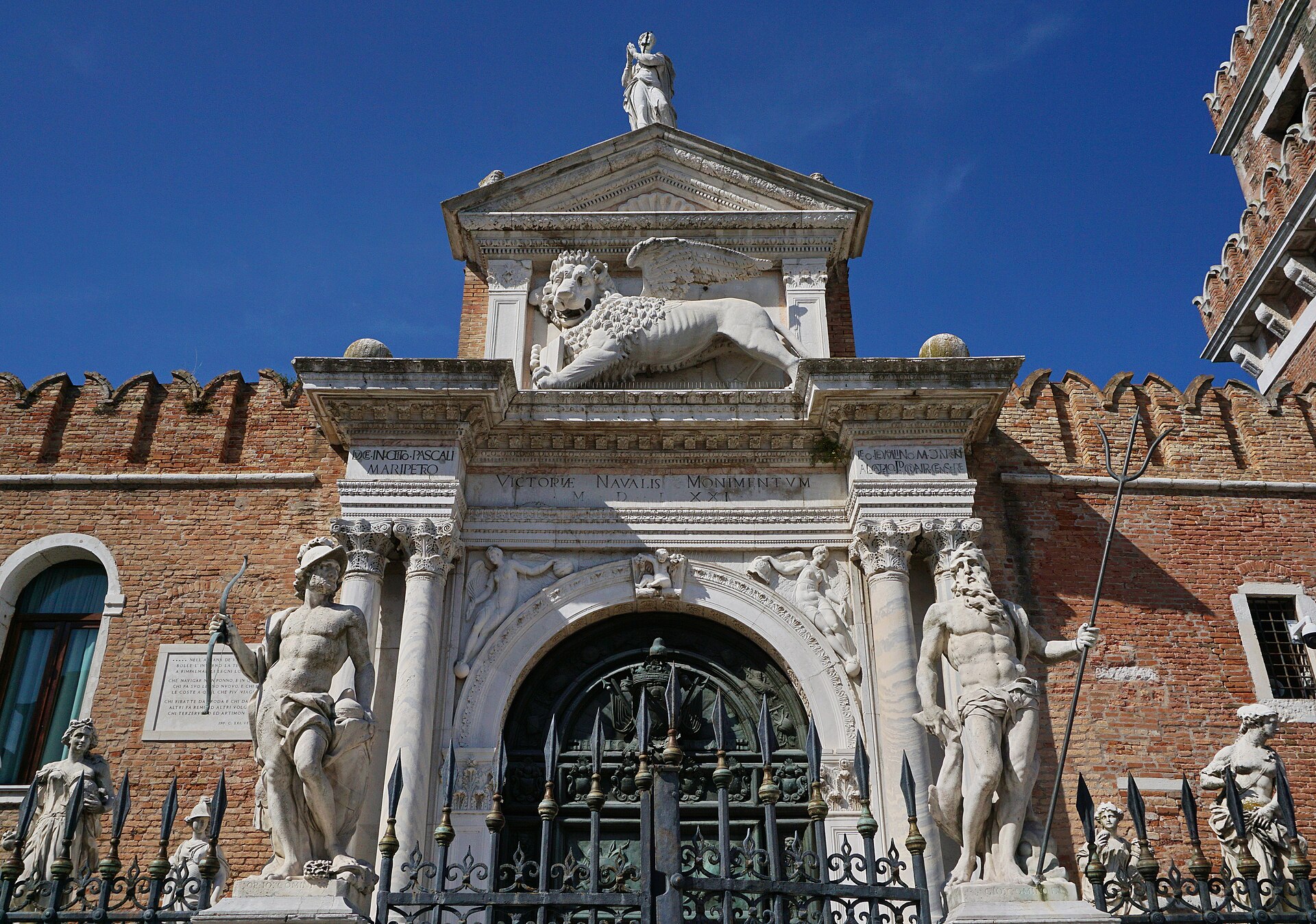
The land entrance to the Arsenale is among Venice’s memorable architectural statements. Its classical language and sculptural decoration announce the power of the Republic. The gateway belongs to a different register from the practical workshops behind it: where the industrial halls prioritize function, the entrance communicates prestige and authority.
Take time to study this contrast. A visitor approaching the gate sees an image of state ambition, while the actual productive system lay deeper inside. The distinction helps explain how Venice represented itself. The Republic celebrated its maritime identity through monumental architecture while relying on less glamorous networks of labor and supply to sustain that identity.
The lions and the politics of display
Stone lions near the Arsenale entrance are frequently noticed by visitors. Their presence invites questions about Venice’s political symbolism, overseas connections, and the movement of objects across the Mediterranean. Some of the lions have histories extending beyond their current setting.
Rather than repeating a simplified story about every sculpture, consider how such objects were used to create an atmosphere of power and continuity. Their placement makes the entrance a stage for public memory. It also reminds us that historic monuments can carry complicated histories of collection, conquest, reuse, and interpretation.
Expansion over the centuries
The Arsenale did not remain unchanged after its medieval beginnings. The Republic expanded and adapted it in response to shifting military requirements, technologies, and economic circumstances. Different sections preserve traces of those phases, making the complex a layered record rather than a single architectural moment.
This is why labels such as old Arsenale and new Arsenale can be useful but incomplete. The site was repeatedly reworked. A visitor looking for one pure medieval appearance will miss its historical richness. The more revealing question is how each generation modified the inherited infrastructure to meet new needs.
Galleys, sailing ships, and changing technology
Venice’s naval history spans different vessel types and changing forms of warfare. Oared galleys were central to many Mediterranean operations, while sailing technologies and naval artillery altered maritime strategy over time. These changes affected construction, equipment, storage, and the spaces required for maintenance.
The Arsenale’s evolution therefore reflects technological change as well as political ambition. It was not a static monument to one golden age. Its workshops had to respond to new demands, and its buildings were altered accordingly. Thinking about those adaptations makes the complex feel more like a living industrial system than a frozen relic.
The Republic and the workers of the Arsenale
The workers associated with the Arsenale, often known as arsenalotti, formed an important part of Venice’s social and economic life. Their specialized labor was closely tied to the state. The relationship brought responsibilities, privileges, and forms of institutional identity that distinguished them from many other workers.
It is tempting to imagine the entire workforce as a single harmonious community, but large production systems involve hierarchy, discipline, and competing interests. The history is more compelling when the workers are understood as real people rather than decorative characters in a patriotic story. Their knowledge sustained the fleet, and their labor shaped the rhythms of the surrounding city.
Castello beyond the shipyard
The Arsenale belongs to Castello, one of Venice’s six historic sestieri. The surrounding streets, churches, waterfronts, and residential areas provide an important counterpoint to the monumental complex. Here the visitor can sense the relationship between a powerful institution and the ordinary life of the city around it.
A short walk through the neighborhood after visiting the exhibition helps restore that context. Notice the scale of the houses, the small campos, and the practical routes used by residents. Venice is not simply a collection of attractions connected by bridges. It is a place where institutions, work, and daily routines have always occupied the same limited geography.
The Riva degli Schiavoni and the maritime city
The waterfront along the Riva degli Schiavoni offers a useful introduction to Venice’s maritime geography. From this edge of the city, the relationship between the lagoon, historic trading networks, and the eastern districts becomes easier to understand. The views are beautiful, but they also reveal the practical importance of access by water.
As you continue toward the Arsenale, consider how ships, supplies, workers, and visitors once moved through a city without modern road transport. The waterfront is not merely a promenade. It is a reminder that Venice’s urban identity grew from its connection to waterways and distant ports.
The Arsenale after the fall of the Republic
The end of the Venetian Republic in 1797 transformed the political world that had sustained the Arsenale. Subsequent administrations and changing naval requirements altered the site’s role. Parts of the complex continued to have military and institutional functions, while other spaces eventually became available for cultural uses.
The transition from state shipyard to mixed historic and contemporary complex was gradual. It is inaccurate to imagine that the entire Arsenale suddenly became an art museum. Different areas have different custodians, uses, and access rules. That distinction remains important for travelers today.
Why contemporary art belongs here
The Arsenale’s transformation into a major Biennale venue is one of Venice’s most successful examples of historic industrial architecture gaining new cultural life. Large installations can occupy spaces whose scale would overwhelm a conventional gallery. The buildings themselves contribute texture, memory, and atmosphere.
Yet the relationship between art and architecture is not automatically harmonious. A contemporary work may echo the building’s history, challenge it, or deliberately ignore it. That tension is productive. Visitors should resist assuming that every artwork is about shipbuilding simply because it is displayed in the former shipyard.
La Biennale and the Arsenale
La Biennale di Venezia uses the Arsenale for major international exhibitions, including the International Art Exhibition and other programs. Its long halls and varied spaces allow curators to create sequences of artworks that unfold as visitors walk through the complex.
The Arsenale is one of the two principal venues associated with Biennale Arte, alongside the Giardini. They have different histories and spatial characters. The Giardini’s national pavilions form a landscape of individual architectural identities; the Arsenale offers an extensive industrial environment whose connected spaces can support large-scale curatorial narratives.
The Corderie as an exhibition journey
Walking through the Corderie during a Biennale can feel like moving along a carefully edited visual essay. The length of the hall creates a natural sequence, with one installation leading toward another. Temporary walls, lighting, and display structures modify the original space without erasing its powerful proportions.
Pay attention to what the building does to your sense of time. You may see a work from far away before reaching it, or encounter a sudden change of scale after passing a partition. The architecture shapes anticipation and memory. Even when the exhibition changes, the hall’s linear character remains one of its defining qualities.
The Tese and the language of working space
The term tese refers to structures associated with the Arsenale’s historic production and storage functions. Their repeated bays and generous interiors have become recognizable settings for contemporary installations. They are often visually dramatic precisely because they were not originally conceived as refined galleries.
A useful way to read these spaces is to compare what is permanent with what is temporary. Brick walls, structural supports, and rooflines belong to the historic fabric. Exhibition partitions, lighting equipment, labels, and artworks belong to a changing curatorial layer. Distinguishing the two helps visitors appreciate the site without confusing historical architecture with contemporary staging.
The 2026 art exhibition context
Biennale Arte 2026 is titled In Minor Keys and runs from May 9 to November 22, 2026. The Arsenale is a central venue for the exhibition, but individual presentations, visitor routes, and access arrangements should always be checked against the current official program.
This article focuses on the architecture and shipbuilding history of the Arsenale rather than reviewing every artwork in the 2026 exhibition. That distinction is intentional. The art changes from edition to edition, while the industrial fabric offers a deeper framework for understanding why the site is so distinctive.
How to approach the architecture while visiting art
Begin by looking up. Roof trusses, repeated supports, and long interior perspectives can reveal the building’s underlying logic. Next, look at the edges: doorways, windows, changes in wall texture, and the points where modern exhibition infrastructure meets historic surfaces.
Finally, consider movement. Why does a corridor feel unusually long? Why does one room open directly toward another? How might the original production process have influenced those relationships? These questions encourage architectural observation without requiring access to restricted working areas or specialized technical knowledge.
A practical route through the neighborhood
A rewarding approach is to begin near the waterfront east of St. Mark’s Square, walk toward the historic Arsenale entrance, and then continue to the Biennale entrance indicated on your ticket. This route combines a public view of the monument with the experience of the exhibition complex.
Do not assume that the monumental gateway is the same entrance used for every Biennale event. The site is extensive and different areas may have separate access arrangements. Use the organizer’s official map on the day. In Venice, a short distance on a map can involve bridges, dead ends, and unexpected detours.
When to visit in October
October can be an appealing time to explore the Arsenale because the intense heat of midsummer has usually passed. However, Venice’s weather can be changeable, with rain, wind, and occasional high-water conditions. Pack a light waterproof layer and comfortable shoes with good grip.
For the Biennale, check the current opening schedule and ticket conditions rather than assuming that every part of the complex follows the same hours. Allow a substantial block of time if you plan to see art as well as architecture. A rushed visit tends to reduce the historic buildings to a dramatic backdrop, missing much of what makes them important.
Tickets and access
The Arsenale is not a single attraction with one universal admission policy. Public views of the historic entrance are different from ticketed Biennale exhibitions, and some portions of the wider complex retain restricted or institutional uses. Confirm exactly which area you intend to visit.
For Biennale Arte, use the official organizer’s ticketing and visitor information to understand admission types, opening days, and any special conditions. Do not rely on an outdated travel blog for prices. Ticket categories can change, and a special exhibition or event may have arrangements that differ from the main show.
Getting there without a car
Venice’s historic center has no ordinary road traffic, so access is by foot and boat. The best route depends on your starting point, the entrance in use, and your mobility needs. From central Venice, walking may be practical, while visitors coming from the train station may prefer a waterbus for part of the journey.
Public boats can be crowded and do not remove every walking requirement. There may still be a distance between the nearest stop and the exhibition entrance. Check ACTV services and the Biennale’s directions shortly before your visit. Allow a margin for missed connections, queues, and the time needed to find the correct entrance.
Accessibility and the historic fabric
Historic industrial buildings can present accessibility challenges even when exhibition organizers provide adapted routes and assistance. Uneven surfaces, distances between halls, and the surrounding bridges may matter as much as the interior displays.
Travelers with limited mobility should consult official accessibility information in advance and contact the venue about their particular needs. A plan that works for a visitor comfortable with several kilometers of walking may not work for someone using a wheelchair or who needs frequent rest. Avoid treating the Arsenale as one uniform, easily navigated site.
A visit with children
The Arsenale’s immense spaces and shipbuilding history can engage children who might not normally be enthusiastic about architecture. Ask them to imagine how workers moved timber or rope, or why a building needed to be so long. These questions turn scale into something tangible.
For contemporary art exhibitions, follow any age guidance and be mindful that some installations may contain intense imagery or sound. A shorter visit centered on a few discoveries is often better than attempting to cover every gallery. Give children a chance to notice details themselves rather than delivering a long lecture.
Photography and respectful visiting
The historic architecture can be spectacular in photographs, especially where natural light emphasizes brick textures and long perspectives. But a successful photograph should not come at the expense of other visitors or the preservation of the site.
Follow the exhibition’s current photography rules. Do not use restricted areas as shortcuts, touch historic surfaces or artworks, or block circulation to capture an empty-looking image. Consider taking one broad architectural photograph and several carefully observed details. The best images often communicate the building’s function and scale rather than simply its atmosphere.
A local guide’s perspective
The most common mistake in visiting the Arsenale is to treat it only as a convenient venue for contemporary art. The deeper experience comes from recognizing how the former shipyard shaped the city and how its architecture still influences the way exhibitions are encountered.
Tour Leader Venice’s local guiding perspective, informed by Igor Scomparin’s work as a licensed guide since 1997, encourages travelers to connect buildings with the lives and skills of the people who used them. A thoughtful itinerary can combine the historic entrance, Castello’s streets, and the Biennale without turning the day into a race between attractions.
Three details that reveal the real story
First, notice the relationship between water and buildings. The shipyard’s organization made sense because vessels and heavy materials could move through waterways. Second, study the repeated structural bays. Their rhythm reflects a working system, not merely a stylistic preference.
Third, compare the public grandeur of the gateway with the functional character of the industrial halls. Together they express two sides of the Venetian Republic: the political image it wanted to project and the labor-intensive infrastructure on which its maritime power depended. These details provide a framework for understanding the site even if you do not know the names of individual architects.
Why this place matters beyond Venice
The Arsenale raises questions that remain relevant to cities everywhere. What happens when an industrial site loses its original purpose? How can historic architecture be reused without erasing its identity? Can cultural programs preserve public interest in spaces that might otherwise become inaccessible or neglected?
Venice’s answer is neither simple nor complete. The Arsenale still contains different functions and levels of access. Yet its exhibition spaces show how an old industrial environment can support contemporary creativity while keeping the memory of production visible. That balance is part of the site’s continuing importance.
A final way to see the Arsenale
Visit the Arsenale as both a monument and a working idea. Its architecture grew from the demands of shipbuilding, state organization, and life on the lagoon. The Biennale gives parts of that architecture new uses, but the buildings continue to tell their own story.
If you leave remembering only one thing, let it be this: the grandeur of Venice was not created solely in palaces and churches. It also emerged from the hands of skilled workers, the management of materials, and the remarkable industrial spaces of the Arsenale. Contemporary art becomes richer when that history remains in view.
Continue exploring Venice
Discover ten hidden details that explain Venice’s history, learn why Venice developed without cars, and explore the often-overlooked women artisans of Venice. For current exhibitions and tickets, consult La Biennale’s official website.
Frequently Asked Questions
What was the Venice Arsenale originally used for?
The Arsenale was the Venetian Republic’s major state shipbuilding and naval production complex. It brought together ship construction, supplies, storage, and specialized crafts.
Can visitors enter the Venice Arsenale?
Some areas are accessible through ticketed Biennale exhibitions or specific events, while other areas have restricted uses. Check official entry information before visiting.
Is the Arsenale the same as the Giardini at the Venice Biennale?
No. The Arsenale and the Giardini are separate principal exhibition venues with different locations and architectural histories. Plan travel time between them.