I’ll say this plainly, the same way I say it to every guest standing in the courtyard on Via Cappello: Romeo and Juliet were never real people, the famous balcony wasn’t there until the 1930s, and Shakespeare almost certainly never set foot in Verona. None of that makes the city’s Romeo and Juliet sites not worth visiting. It just means what you’re actually looking at is a genuinely fascinating story about how a five-hundred-year-old piece of fiction slowly, deliberately became a physical place, brick and stone and a courtyard full of tourists, real enough that thousands of people every year still leave handwritten letters addressed simply to “Juliet, Verona.”
Where the Story Actually Came From
Shakespeare didn’t invent Romeo and Juliet. He adapted it, and the trail leads back, through several Italian and English intermediaries, to a writer named Luigi Da Porto, born in Vicenza in 1485. Sometime before June 1524, Da Porto wrote a novella titled Historia novellamente ritrovata di due giovani amanti (“A newly discovered story of two young lovers”), composed at his own villa in Montorso Vicentino near Vicenza and dedicated to his cousin Lucina Savorgnan. Local tradition holds that Da Porto drew inspiration from the twin castles of Montecchio Maggiore, whose names echo Romeo’s family, the Montecchi. Da Porto’s version already set the tragedy specifically in Verona, already featured two feuding families with names closely resembling the Capulets and Montagues, and already ended in the lovers’ shared death, the essential structure Shakespeare would later inherit almost entirely intact.
The story passed through further hands before reaching England: the Italian writer Matteo Bandello published his own expanded version in 1554, which was then adapted into English verse by Arthur Brooke as The Tragical History of Romeus and Juliet. It was Brooke’s poem, not any Italian original directly, that served as Shakespeare’s primary source when he wrote his own Romeo and Juliet around 1594 to 1596. Shakespeare set his play in a real city he almost certainly never visited, working entirely from secondhand literary sources, which is worth remembering every time you hear someone describe Verona as “Shakespeare’s city”: it’s more accurate to call it Da Porto’s city, borrowed by an English playwright who never crossed the Adriatic.
The Coincidence That Isn’t Quite a Connection
Verona’s association with the story gets one more layer of apparent legitimacy from an unexpected source: Dante Alighieri. In Purgatorio, Canto VI of the Divine Comedy, written more than two centuries before Da Porto’s novella, Dante references the “Montecchi” and “Cappelletti” as an example of the destructive factional politics tearing Italian cities apart in his own era, a real historical detail entirely disconnected from any love story. For centuries, that Dante reference was popularly assumed to place the Cappelletti specifically in Verona, lending the later Romeo and Juliet legend a veneer of genuine medieval documentation. It’s a connection worth being honest about, though: even Dante’s own son, Pietro Alighieri, writing a commentary on his father’s poem, clarified that the Cappelletti family Dante meant were actually from Cremona, not Verona. The apparent historical anchor turns out to be, on closer inspection, a case of mistaken geography compounding a work of pure fiction.
Juliet’s House: A Real Medieval Building, a Twentieth-Century Balcony
The building known today as Casa di Giulietta stands at Via Cappello 23, a genuine medieval tower house documented since 1351, considerably older than the story now associated with it. For most of its early history, it functioned as an inn known as the Stallo del Cappello, and between the 14th and 17th centuries it belonged to the Dal Cappello family, whose coat of arms, featuring a pilgrim’s hat, is still carved into the keystone of the arch overlooking the interior courtyard. That single carved hat is, in a very real sense, the entire physical foundation the Juliet legend was eventually built on: in the early 19th century, as Romeo and Juliet’s popularity grew across Europe, locals and early literary tourists connected the Dal Cappello name and its hat emblem to Shakespeare’s “Capulet” family, and the building was informally identified as Juliet’s ancestral home. The Comune di Verona purchased the property outright in 1905, formalizing the city’s stake in what was, at that point, still primarily a matter of popular legend rather than any documented fact.
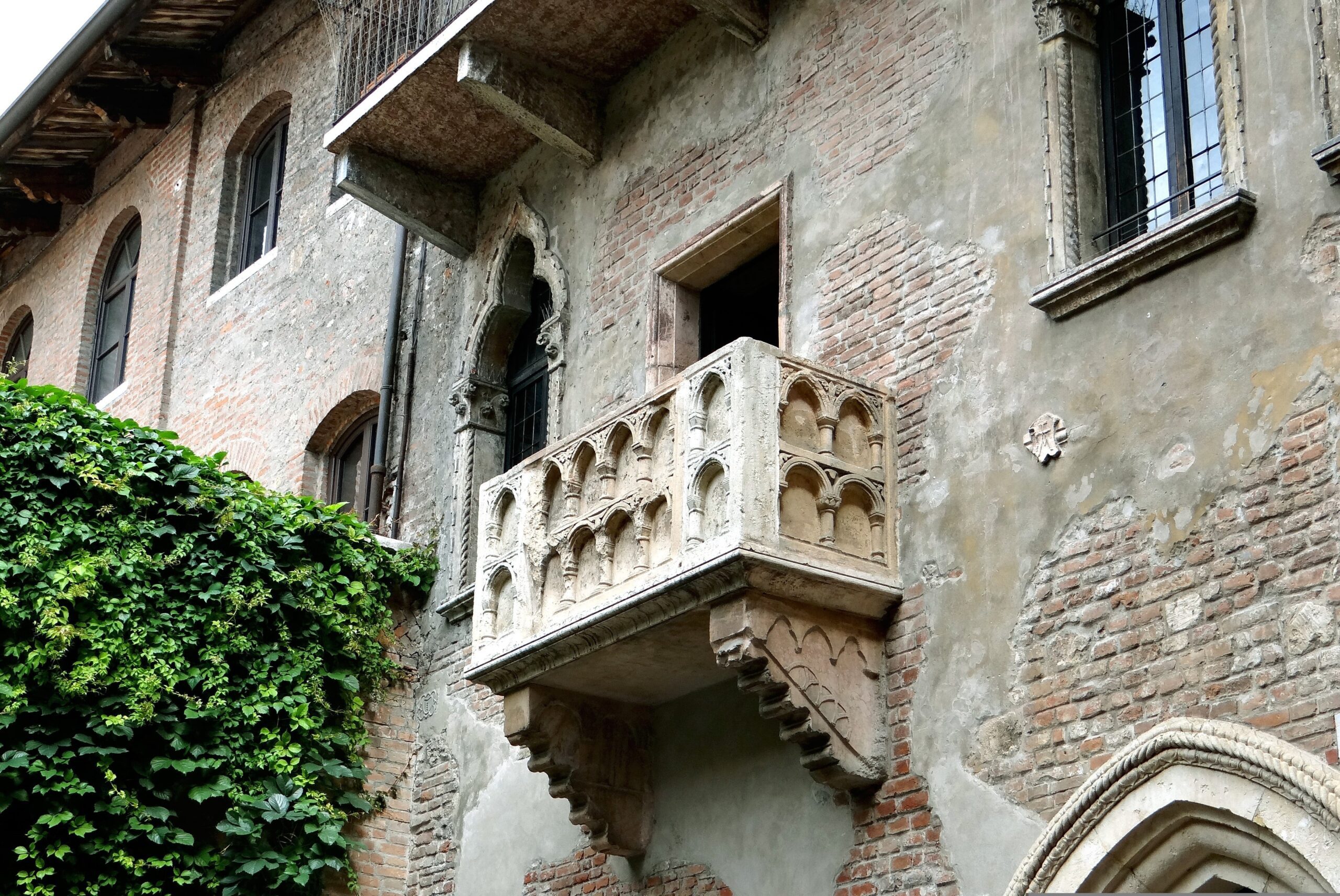
The building’s transformation into the fully realized romantic landmark visitors encounter today came considerably later, and the trigger was, of all things, Hollywood. George Cukor’s lavish 1936 film adaptation of Romeo and Juliet generated enormous international attention, and Antonio Avena, then director of Verona’s civic museums, who had also served as a consultant on the film’s set design, seized the moment. Between 1939 and 1940, Avena oversaw a deliberate, neo-medieval reimagining of the building’s courtyard facade, and it was here, for the very first time, that Juliet’s balcony appeared, assembled specifically for the renovation from a spare 14th-century Gothic stone slab, decorated with a double row of blind arches, salvaged from Castelvecchio. Before 1939, no balcony had ever stood on that facade at all. The interior rooms received a similarly deliberate makeover during the same renovation, painted ceilings and walls in a historicizing style consistent with the romantic atmosphere Avena was constructing throughout.
A further, now-iconic addition arrived decades later: in 1972, the sculptor Nereo Costantini’s bronze statue of Juliet was placed in the courtyard, quickly becoming the site’s second most photographed feature after the balcony itself, and the subject of its own persistent tourist tradition, touching the statue’s right side for good luck in love, a practice that has, over the decades, visibly worn and polished the bronze. The narrow entrance corridor leading into the courtyard from Via Cappello developed its own parallel tradition: for years, visitors covered every available surface with handwritten love notes and graffiti, a practice conservation concerns have since redirected onto designated panels, preserving the sentiment while protecting the actual historic stonework underneath.
Today, the courtyard and Costantini’s statue are freely accessible to anyone walking in off the street, while the balcony itself and the museum housed inside the building require a paid ticket, including, among its exhibits, original and reproduction period furniture, Renaissance-style frescoes, and, in a nice bit of self-aware layering, costumes from Franco Zeffirelli’s celebrated 1968 film adaptation of the play.
Romeo’s House: The One Building the City Didn’t Reinvent
A short walk away, on Via Arche Scaligere, sits the building popularly known as Casa di Romeo, and it’s worth knowing that this one received none of the deliberate romantic staging applied to Juliet’s House. It’s a genuine, striking medieval palazzo, but historical research links it not to any Montecchi family but to a branch of the wealthy Nogarola family, close associates of the ruling Della Scala dynasty, with no documented Montecchi connection whatsoever beyond the popular tradition that adopted the building’s name. Its Romanesque portal, decorated in stone and brick, opens onto a courtyard with a loggia, round arches, and red marble columns carved with fruit and flower motifs, genuinely fine medieval architecture in its own right, independent of any borrowed literary association.
Unlike Juliet’s House, Romeo’s House remains a private residence today, visible only from the outside, with a small plaque near the entrance bearing a quoted fragment from the play’s first act: “O where is Romeo? Tut, I have lost myself; I am not here; this is not Romeo, he’s some other where.” It’s easy to walk right past it without noticing, precisely because the city never built the same tourist infrastructure around it that it built around Juliet’s House, a genuinely telling contrast in how selectively Verona chose which parts of its own legend to actively develop.
Juliet’s Tomb: An Empty Sarcophagus With Its Own Long History
The third major site on Verona’s Romeo and Juliet trail sits a short distance from the historic center, inside the former Franciscan convent of San Francesco al Corso, founded in the 13th century. Here, in an underground crypt, rests a genuine red marble sarcophagus, empty and lidless, dating from the 13th or 14th century, traditionally identified since at least the 16th century as Juliet’s Tomb, making it, remarkably, an older tourist tradition than either the house or the balcony. The site drew genuine sentimental pilgrimages beginning in the 18th century, well before Avena’s 20th-century interventions elsewhere in the city; visitors reportedly chipped away small pieces of the sarcophagus as souvenirs over the centuries, enough that by the early 1900s the site had fallen into genuine disrepair.
Antonio Avena, the same museum director responsible for Juliet’s balcony, also shaped this site’s modern presentation, relocating the sarcophagus into a specially constructed crypt within the former convent’s cloister in 1938. In 1973, the surrounding complex reopened more fully as the Museo degli Affreschi, the Fresco Museum, dedicated to the art historian Giovanni Battista Cavalcaselle, housing a genuinely significant collection of frescoes detached from Veronese palaces and churches across the 19th and 20th centuries, alongside the tomb itself. In a detail that captures Verona’s willingness to lean fully into its own legend, the museum’s frescoed hall now regularly hosts real civil wedding ceremonies, for Veronese couples and international visitors alike, a modern, functioning tradition built quite deliberately on top of a five-hundred-year-old fiction.
The Juliet Club: Answering Letters to a Character Who Never Existed
Perhaps the most genuinely moving part of Verona’s Romeo and Juliet tradition has nothing to do with any historic building at all. Starting in the 1930s, Ettore Solimani, the caretaker responsible for looking after Juliet’s Tomb, began noticing letters left behind by visitors, addressed simply to Juliet herself, seeking advice, comfort, or simply somewhere to direct heartbreak they had nowhere else to put. Moved by what he found, Solimani began writing back personally, becoming, in effect, Juliet’s first unofficial secretary.
That informal practice eventually became something more structured: in 1972, Giulio Tamassia formally founded the Juliet Club, a dedicated organization of volunteers who continue, to this day, reading, translating, and personally responding to letters addressed to Juliet from every corner of the world, some mailed directly, others left inside Juliet’s House itself or at the tomb. The club’s volunteers report answering letters covering an extraordinary emotional range, grief, coming out to unsupportive parents, congratulations on new marriages, simple loneliness, treating each one with genuine care rather than a form response. The tradition inspired the 2010 film “Letters to Juliet,” and the club still operates today from its own address in the historic center, accessible to visitors and volunteers by appointment rather than as a standard tourist stop.
Seeing It All Honestly
I’ll be direct about how I think this trail is best experienced: not as a pilgrimage to genuine historical sites, because it isn’t one, but as a walk through one of the more interesting case studies anywhere in Europe of how a city can deliberately, carefully construct a living tradition around a piece of fiction, and how that constructed tradition can, decades later, become genuinely meaningful in its own right regardless of its invented origins. The letters answered by real volunteers at the Juliet Club are real correspondence with real emotional weight, even though the Juliet receiving them never existed. That tension, invented history producing authentic present-day meaning, is, to me, the most interesting thing about the entire Romeo and Juliet trail, considerably more interesting than simply photographing a balcony that’s younger than most of your grandparents.
Plan your visit: Verona & Amarone Wine: A Perfect Day Trip from Venice covers how to combine Verona’s Romeo and Juliet sites with the Arena, Piazza delle Erbe, and the rest of the city’s genuine two-thousand-year history in a single, well-paced day.
Frequently Asked Questions
Is Juliet’s balcony in Verona original, or was it added later? The balcony is a 20th-century addition, assembled in 1939-1940 by museum director Antonio Avena from a spare 14th-century Gothic stone slab salvaged from Castelvecchio. Before that renovation, no balcony existed on the building at all; the addition was inspired by the international attention generated by George Cukor’s 1936 Hollywood film adaptation of the play.
Were Romeo and Juliet real historical people? No. The story originates from a 1524 novella by the Vicentine writer Luigi Da Porto, later expanded by Matteo Bandello and adapted into English before Shakespeare wrote his own version around 1594-1596. Verona’s connections to the story, the house, the balcony, the tomb, are all later constructions built around a work of fiction rather than documented historical fact.
Can I still write a letter to Juliet, and will I actually get a response? Yes. The Juliet Club, founded in 1972 and continuing a tradition begun in the 1930s by the caretaker of Juliet’s Tomb, still reads and personally responds to letters addressed to Juliet from visitors around the world, whether mailed directly, left at Juliet’s House, or dropped near the tomb at San Francesco al Corso.