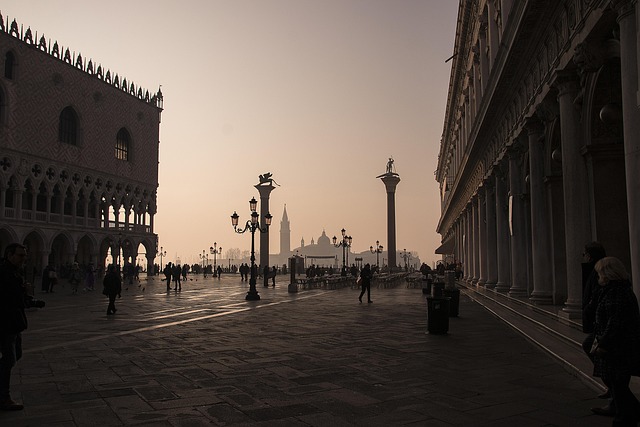
Guests planning their first Venice trip almost always ask me the same question: what’s the one walk I should do if I only get one? After nearly thirty years leading people through this city, I’ve settled on a single continuous route that moves through four of Venice’s six sestieri, threading together the landmarks everyone’s heard of with the quieter corners that make the city feel real. It takes roughly four to five hours at an unhurried pace, longer if you stop to eat, and it requires nothing but comfortable shoes.
Starting Point: Piazza San Marco
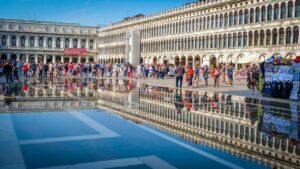
Begin where nearly every Venice trip begins, but arrive early — ideally before 9 a.m., while the square is still closer to empty than to the crowds that arrive by mid-morning. Take in St. Mark’s Basilica, the Doge’s Palace, and the Campanile, but resist the urge to linger for hours here. San Marco is Venice’s most famous face, not its most representative one, and the real value of this walk is in what comes next.
Exit the square via the Mercerie, the narrow shopping streets that have connected San Marco to Rialto for centuries. This stretch gives you an early sense of how Venice’s calli work — narrow, shop-lined, and often crowded, but a necessary contrast to where you’re headed.
Into San Polo: The Rialto Markets
Cross the Rialto Bridge — Venice’s oldest crossing of the Grand Canal, completed in 1591 — and you’ll land in San Polo, home to the city’s historic market district. The erbaria and pescheria, Venice’s produce and fish markets, are worth timing your walk around if possible; they’re liveliest in the morning and offer one of the few remaining glimpses of Venice’s working, rather than purely touristic, identity. From here, wander into Campo San Polo itself, the second-largest square in the city, before continuing toward Campo San Giacomo dell’Orio if you want a genuinely quiet detour into Santa Croce.
Crossing into Dorsoduro: Art and Water
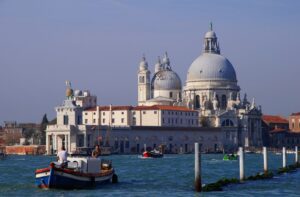
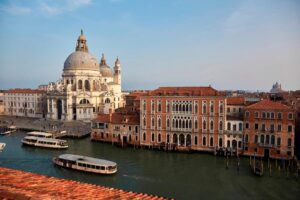
From San Polo, make your way toward the Ponte dell’Accademia, one of only four bridges spanning the Grand Canal. Crossing it delivers you into Dorsoduro, and the view south from the bridge’s center — toward the Basilica di Santa Maria della Salute — is one I still stop for every time.
Dorsoduro rewards slower walking than anywhere else on this route. Stop at the Gallerie dell’Accademia if art interests you, or continue toward Campo Santa Margherita, the liveliest neighborhood square in the city, filled with students, local market stalls, and unpretentious bacari serving cicchetti. From here, the Fondamenta delle Zattere offers a long, sunny waterfront walk facing Giudecca — an ideal spot for a gelato break with a view.
Back Toward San Marco via Campo Santo Stefano
Loop back toward San Marco through Campo Santo Stefano, one of Venice’s longest and most historic squares, where the local phrase andare al liston — “to go for a walk” — originated from the stone promenade that once ran through it. This stretch of the walk gives a good sense of how Venetians actually move through their city: purposefully, but never in a straight line, because Venice’s layout simply doesn’t allow it.
The Optional Extension: Cannaregio and the Jewish Ghetto
If you have energy left, a worthwhile extension crosses toward Cannaregio, home to the historic Jewish Ghetto — the origin of the very word “ghetto,” established here in 1516 — and a neighborhood with a far more residential, lived-in feel than San Marco or the Rialto. The Fondamenta della Misericordia offers some of the best casual bacaro dining in the city, and this stretch is where I most often see guests relax into the trip, having shed the tourist-checklist mindset somewhere back around Rialto.
A Few Practical Notes
This route deliberately avoids Castello and the far eastern edge of the city, simply because a first-timer’s walk needs a natural endpoint rather than an exhaustive tour of all six sestieri. If you have a second day, Castello — with the Arsenale and the quieter waterfront along the Riva degli Schiavoni — makes an excellent follow-up.
Expect crowds around San Marco and Rialto regardless of timing, but they thin dramatically the moment you cross into Dorsoduro or Santa Croce. And build in more time than you think you’ll need — Venice’s narrow calli and constant bridges make distances deceptive; a route that looks like twenty minutes on a map often takes forty in practice, especially with stops.
Why Walking This Route With a Guide Changes It
I’ve walked this exact path with hundreds of guests over the decades, and the experience is never quite the same twice, because the history embedded in each campo, church, and bridge along the way is enormous, and a self-guided walk necessarily misses most of it. A private guide can also read the crowds in real time — rerouting around a suddenly packed Rialto Bridge, timing the Accademia crossing for the best light, knowing exactly which bacaro to duck into when everyone needs a break.
If you’d like this walk built into a private tour, with the full history and context woven in as we go, I’d be glad to lead it. You can learn more about my private tours or get in touch to start planning your visit.
How long does this walking route through Venice take?
Roughly four to five hours at an unhurried pace, longer with stops for food, markets, or museum visits along the way.
What’s the best time of day to start a walking tour of Venice?
Early morning, ideally before 9 a.m., allows you to experience Piazza San Marco before the daily crowds arrive, and sets a good pace for the rest of the route.
Does this route cover all of Venice’s neighborhoods?
No — it focuses on San Marco, San Polo, Dorsoduro, and an optional extension into Cannaregio, leaving Castello and the outer islands for a second day or a separate excursion.