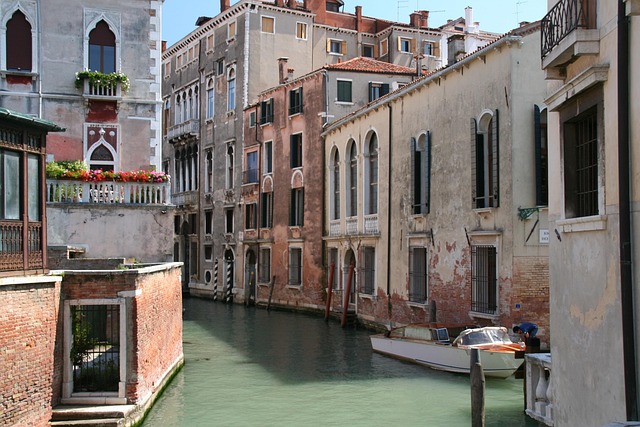
There’s a particular kind of exhaustion I see on the faces of new arrivals at the train station every morning. They step off, phones already out, scanning for the fastest route to the next attraction. Give them forty-eight hours, and something shifts. The shoulders drop. The phone goes back in the pocket. I’ve been guiding travelers through this city for nearly thirty years, and I can tell you: Venice doesn’t just tolerate slowness, it demands it. And for American travelers arriving from a culture built on speed, that demand is often exactly what they didn’t know they needed.
A City That Physically Cannot Be Rushed
Venice has no wheeled vehicles — no cars, no buses, not even bicycles (Fund for Education Abroad) . Every direction the city has, it delivers on foot or by water. Once you accept that, an entire mental architecture starts to dismantle itself. You cannot check a map app and speed-walk in a straight line, because there is no straight line. You cannot Uber past a delay. You cannot outrun a slow afternoon.
This isn’t inconvenience for its own sake. Built across 118 islands connected by roughly 400 bridges and 177 canals (Wikipedia) , Venice was never designed with the modern traveler’s need for velocity in mind. It was designed by merchants and doges centuries before anyone imagined a smartphone, and that design still governs how you move through it today. I often tell my guests: the city is not slow because it’s behind the times. It’s slow because it was built to be lived in, not rushed through.
When I lead a passeggiata — an unhurried wander through the back calli — I’m not filling time until the next monument. The wandering is the experience. Some of the most memorable moments I’ve shared with guests happened in a quiet campo with no name they’d recognize, where an elderly Venetian was feeding pigeons and the only sound was water lapping against stone.
The Sestieri: Six Neighborhoods, Six Different Paces
Venice divides into six historic districts, or sestieri — San Marco, Cannaregio, Castello, Dorsoduro, San Polo, and Santa Croce. Most first-time visitors never leave San Marco, which is precisely where the crowds concentrate and the noise builds. But walk fifteen minutes into Cannaregio’s residential fondamente, and the transformation is almost startling. Laundry lines cross between buildings. Children play in the campi. Life continues at its own unhurried rhythm, tourism a background hum rather than the main event.
This is where I steer guests who tell me they want to “really see” Venice, not just photograph it. Dorsoduro, home to the Accademia and quieter canal-side bacari, offers the same gift: proximity to the city’s soul without the crush of foot traffic that defines the primary tourist arteries.
Digital Disconnection Isn’t a Trend Here — It’s the Default
Back home, “digital detox” has become its own industry: retreats, apps, wellness packages promising to unplug you for a fee. In Venice, disconnection happens without any of that machinery. Cell signal genuinely weakens in certain stretches of the lagoon and along the narrower calli, tucked between centuries-old stone walls. GPS gets confused by the layout, sometimes hilariously so. You will get lost. I promise you that. And I promise you it will be one of the best parts of your trip.
There’s a reason I rarely hand guests a printed itinerary with rigid timings. The city rewards improvisation. A closed bacaro leads to discovering a better one two streets over. A wrong turn leads to a hidden sottoportego with a fresco no guidebook mentions. American travelers, especially those managing demanding careers, often tell me this is the first time in years they’ve gone hours without checking a phone — not because they were told to, but because the city simply absorbed their attention entirely.
The Rhythm of Venetian Daily Life
Slowing down in Venice also means adjusting to a different clock. Mornings begin at the erbaria and pescheria near the Rialto, where fishmongers and vegetable sellers set up before most tourists are awake — worth rising early for, even on vacation. Midday brings the cicchetti hour, when Venetians duck into a bacaro for small plates and a glass of wine standing at the bar, unhurried conversation more important than the food itself. Late afternoon, the light over the lagoon turns a color I’ve never quite been able to describe to guests beforehand; they always understand it the moment they see it.
Evenings slow further still. Restaurants don’t rush table turnover the way many American establishments do. A dinner reservation is not a fifty-minute obligation — it’s an invitation to linger. I’ve watched guests initially fidget with this unfamiliar pace, then visibly relax into it by the second course.
Why This Matters More for Americans Specifically
I’ve guided travelers from dozens of countries, but I notice something particular in American guests: a kind of vacation guilt, an instinct to optimize even leisure time. Itineraries arrive pre-loaded with must-see lists, back-to-back bookings, a sense that if a museum isn’t visited or a landmark isn’t photographed, the trip has somehow failed.
Venice quietly resists that instinct. There are only so many ways to move through this city, and none of them are fast. My role, increasingly, isn’t just interpreting art and history — it’s giving guests permission to slow down, to sit at a campo café for an hour with no agenda, to take a vaporetto ride purely to watch the palazzi drift by rather than to reach a destination.
This is also where a private guide earns their keep in a way a self-guided app tour cannot replicate. I know which campi are empty at 4 p.m., which fondamenta stretch offers the best light for a quiet walk, when the Frari is nearly silent versus when it’s swarmed. Under Italian law, only licensed guides (Fund for Education Abroad) can lead groups inside major monuments — but beyond legal necessity, a local guide with decades here can build an entire day around unhurried discovery rather than checklist tourism, something no algorithm-generated app itinerary can replicate.
Where Stillness Lives: The Lagoon Islands
For guests who want to go even further into Venice’s slower register, I often suggest a half-day into the lagoon itself. The outer islands — quieter, sparsely visited compared to the historic center — offer a Venice almost entirely free of crowds. Boat travel there enforces its own pace; there’s no shortcut across open water. Conversations meander. Phones stay in pockets, partly because there’s often nothing to check anyway.
These excursions pair beautifully with a longer stay, and I frequently build them into multi-day private itineraries for guests who’ve told me, often on day one, that all they really want by day three is quiet.
A Different Kind of Souvenir
Most travelers leave a destination with photographs and purchased mementos. Guests who spend real time slowing down in Venice tend to leave with something else: a recalibrated sense of pace they try, often unsuccessfully, to hold onto once they’re home. I’ve had guests email me months later just to say they still think about a particular quiet morning at the fish market, or an hour spent doing nothing in a campo in Castello.
That’s the real argument for building unhurried time into a Venice trip, whether it’s your first visit or your fifth. The monuments will still be extraordinary if you rush them. But the city itself — its particular gift — only reveals itself to those willing to slow down long enough to receive it.
If you’re planning a trip built around this kind of unhurried, personally guided experience rather than a checklist tour, I’d be glad to help design it. You can see how I structure private tours of Venice, or get in touch directly to start planning.
Is it easy to disconnect from technology while visiting Venice?
Yes — cell signal is often weaker in the narrower calli and along certain lagoon stretches, and GPS frequently struggles with Venice’s layout, which naturally encourages travelers to put their phones away and navigate by instinct instead.
What’s the best way to experience Venice at a slower pace?
Move away from the main San Marco routes into quieter sestieri like Dorsoduro or Cannaregio, allow unstructured time with no fixed itinerary, and consider a private guide who can build the day around quiet moments rather than a rigid sightseeing checklist.
Are the Venice lagoon islands worth visiting for a quieter experience?
Yes — the outer lagoon islands see far fewer visitors than the historic center and offer some of the most peaceful, unhurried experiences in the entire Venice area, especially when reached by private boat rather than crowded public routes.