Everyone who visits Venice knows the three headline islands: Murano for glass, Burano for lace, Torcello for its ancient cathedral. But the lagoon holds well over 60 islands scattered across its 552 square kilometers, and most of them have simply been left behind — by history, by tourism, by the slow retreat of anyone willing to live somewhere reachable only by boat. I’ve spent years piloting guests past these places, and the ones that leave the deepest impression are almost never the famous three. They’re the ones nobody’s heard of.
Here’s an introduction to the lagoon’s quieter, stranger corners.
Torcello: The City That Died Before Venice Was Born
It’s easy to forget, standing on Torcello’s near-empty paths, that this was once the beating heart of the lagoon — a settlement so significant that Venice itself started as its overflow. At its medieval peak, Torcello is believed to have supported a population approaching ten thousand, with a cathedral, sixteen cloisters, and a functioning bishopric. Today it has a permanent population in the single digits to low dozens, depending on the year. Malaria, silted waterways, and the diversion of the rivers that once fed it turned the island unlivable by the 1400s, and residents dismantled their own abandoned buildings to reuse the stone in Venice and Murano.
What remains is startling precisely because so little does: the Byzantine mosaics inside the Basilica of Santa Maria Assunta, founded in 639 AD, are among the finest anywhere outside Ravenna, and the eerily quiet piazza gives almost no hint that a real city once stood there.
San Francesco del Deserto: The Island St. Francis Left Behind
Between Sant’Erasmo and Burano sits a tiny island, barely visible from a passing vaporetto, marked by a distinctive line of cypress trees. Tradition holds that Francis of Assisi landed here in 1220 on his return from the Holy Land and founded a small hermitage — a story that can’t be fully verified but has shaped the island’s identity for eight centuries regardless. The land was later donated to the Franciscans by a Venetian noble family, and a monastery has operated here ever since, with one interruption: the island’s poor drainage and unhealthy conditions forced the friars to abandon it for roughly two centuries before they returned in 1453.
There’s no public vaporetto stop. You reach San Francesco del Deserto by private boat or organized tour only, and the handful of resident friars still welcome visitors for a brief, quiet look at the cloisters — one of the only places in the entire lagoon where the silence feels intentional rather than abandoned.
Sant’Erasmo: Venice’s Working Garden
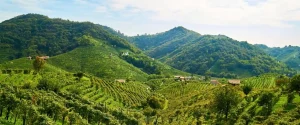
If Murano and Burano are the lagoon’s showpieces, Sant’Erasmo is its farm. It’s the largest island in the lagoon by area, and almost entirely agricultural — a patchwork of vineyards and vegetable fields that has supplied Venice’s kitchens for centuries. It’s especially famous among Venetians for the violetto di Sant’Erasmo, a purple baby artichoke that shows up on menus across the city every spring.
What surprises visitors most is how normal it feels: real farmhouses, real tractors, unhurried streets with no souvenir stalls. It’s one of the few lagoon islands where you’re more likely to run into a Venetian buying produce than a tour group buying glass trinkets, which is exactly why I like bringing guests here who’ve already done Murano and Burano and want to see what the lagoon actually looks like when nobody’s performing for tourists.
Lazzaretto Nuovo: The Plague Island Turned Museum
Long before Poveglia became the lagoon’s most famous quarantine site, Lazzaretto Nuovo was doing the same grim work. From the mid-1400s until the late 1700s, ships suspected of carrying plague were quarantined here before being allowed to dock in Venice proper — a system that, macabre as it sounds, was one of the earliest organized public health measures in Europe. Unlike most forgotten islands, this one has been extensively excavated by archaeologists and now houses a small volunteer-run museum documenting exactly how the quarantine system functioned, including graffiti left by sailors waiting out their isolation centuries ago.
(For the lagoon’s other, far more infamous quarantine island — and its recent transformation into a locals-only park — I’ve written about Poveglia’s full story separately, since it deserves its own space.)
San Michele: The Island of the Dead
Between Venice and Murano sits an island entirely dedicated to burial. San Michele has served as Venice’s cemetery since Napoleonic-era regulations banned burials within the crowded historic center for public health reasons — a rule that’s still in effect today. It was originally two separate islands, each home to its own monastery, later joined into one when the modern cemetery was built. Ezra Pound, Igor Stravinsky, and Sergei Diaghilev are all buried here, drawing a steady trickle of literary and musical pilgrims to what is otherwise one of the most peaceful, cypress-lined spots in the entire lagoon.
Can I visit all of these islands on public transport?
Some, like Sant’Erasmo, have regular vaporetto service. Others, like San Francesco del Deserto and Lazzaretto Nuovo, require a private boat or a scheduled guided visit, since there’s no standard public stop.
Is Torcello worth visiting if I’ve already seen Murano and Burano?
Yes — Torcello is a completely different experience. Where Murano and Burano are about craft and color, Torcello is about scale and loss: a nearly empty island that used to be a major city, which hits differently once you understand what’s missing.
Are any of these islands dangerous or off-limits to visit?
A few, like Poveglia, are officially closed to the public, but the islands covered here — Torcello, San Francesco del Deserto, Sant’Erasmo, Lazzaretto Nuovo, and San Michele — are all legally and safely accessible by boat.