You’ve decided to see Venice properly — not shuffling behind a numbered paddle, but really understanding the city. So you open GetYourGuide, or Viator, or Airbnb Experiences, or ToursByLocals, and you start scrolling. A thousand listings blur past, each one promising the same three things: “hidden gems,” “skip the line,” “see Venice like a local.” They all sound identical because, in a sense, they are. And somewhere in that endless scroll, the most important question quietly disappears: who actually receives the money you’re about to spend, and what are you truly getting in return?
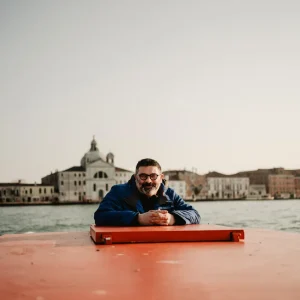
After 28 years as a licensed Venice guide — a career that’s been featured by Rick Steves, NBC, and USA Today — I want to walk you through how this industry really works behind the screen, because almost no one explains it honestly. The big platforms have spent hundreds of millions of dollars making themselves feel like the obvious, safe, easy choice. They’re convenient, I’ll grant them that. But convenient and best are not the same word, and once you understand what’s happening beneath those glossy listings, the choice between a global platform and an independent local guide stops being a close call.
This is the conversation I’d have with you over a coffee before your trip. Let’s start with the part the platforms never put on the listing.
The Hidden Machinery: Where Your Money Actually Goes
Here’s the uncomfortable truth about the big booking sites: they are, at their core, advertising and technology companies — not travel companies. They don’t run tours. They’ve never walked you down a back canal at dawn. They don’t know which bacaro pours the best ombra or which church hides the Tintoretto worth crossing the city for. What they sell is visibility, and they charge the people who do the actual work handsomely for it.
On platforms like Viator and GetYourGuide, the commission taken from the guide on every single booking typically runs between 20% and 30%. GetYourGuide’s standard starting rate sits near the top of that range, and in 2025 the company pushed many operators toward 30% — some with only a month’s notice, in the middle of peak season. ToursByLocals and Airbnb Experiences run on the same fundamental model: a large slice of what you pay is skimmed off the top and sent to a corporate headquarters in Berlin, Boston, Vancouver, or San Francisco, long before your guide sees a euro.
Let’s make that concrete. Imagine you pay €300 for a private day in Venice booked through a platform. Depending on the commission, somewhere between €60 and €90 of that money never reaches the person standing beside you in St. Mark’s Square. It doesn’t buy you a longer day. It doesn’t buy you a better lunch or deeper access. It funds the platform’s Google ads, its app development, and its shareholders’ returns. You paid for an experience; a third of it bought you marketing.
Now, the platforms will argue — fairly — that this commission pays for reach, payment processing, customer service, and the trust they’ve spent years building. That’s all true. But you should at least know that the trade exists, because there’s another way to spend that same €300 where nearly all of it goes toward making your day extraordinary, and toward keeping Venice alive. Let me explain why that second part matters as much as the first.
1. You Support a Living City — Not a Corporation
This is the heart of the whole argument, so I won’t soften it: when you book directly with an independent local guide, your money stays in Venice. When you book through a giant platform, a substantial portion of it leaves Italy entirely.
Venice is not a theme park, even though the crush of summer crowds can make it feel like one. It is a real, fragile, living city — and it is emptying out. The resident population of the historic center has collapsed over the decades, driven down by rising costs, the conversion of homes into short-term rentals, and an economy increasingly built to extract value from tourists rather than sustain the people who actually live here. Every year there are fewer Venetians left in Venice.
Here’s where your choice genuinely matters. Money spent directly with a local guide doesn’t evaporate into a foreign corporation’s balance sheet. It supports a Venetian household. It gets spent again at the neighborhood market, at the family-run trattoria, with the Murano glass master, with the boat mechanic and the baker and the wine producer up in the hills. It circulates within the community you came to admire, helping real people afford to keep living in the city that makes your trip possible in the first place.
Choosing a local guide isn’t an act of charity, and I’d never frame it that way — because the local option also happens to be the better experience by almost every measure. But it carries a quiet bonus the platforms can’t offer: the version of tourism that leaves a place stronger than it found it. When you plan a private tour of Venice directly with a local, you’re voting, with your wallet, for the kind of Venice you’d actually want to come back to.
2. Licensed Expert vs. “Local Host”: A Difference That’s Actually the Law
Here’s something most travelers have no idea about, and it’s one of the strongest reasons to choose carefully.
In Italy, being a tour guide is a regulated profession. To become a licensed tour guide, you must pass a demanding examination covering the city’s history, art, architecture, and culture — and only licensed guides are legally permitted to conduct professional tours inside the major monuments, churches, and museums. This isn’t a formality or a marketing badge; it’s the law, and unlicensed guiding can result in fines for the person doing it.
Why should you, the traveler, care? Because it directly shapes what your guide can and cannot do for you. A licensed guide can take you inside the Doge’s Palace, St. Mark’s Basilica, the Accademia, and explain what you’re looking at with the depth of someone who studied for years to earn the right. Many of the “local hosts” you’ll find on the big experience platforms are not licensed guides. At best, they can show you the outside of things and walk you through the streets; they often can’t legally guide you through the very sites you crossed an ocean to see. Some operate in a grey zone and risk being stopped mid-tour.
So when you book with a verified, licensed local guide, you’re not just getting warmth and good company. You’re getting a vetted professional whose expertise has been formally tested, who can unlock the full city for you, and who carries decades of accumulated knowledge that no platform algorithm can replicate. If certainty about credentials matters to you — and it should — the simplest move is to talk to your guide directly and confirm exactly who you’re getting before you commit.
3. A Real Person — Not a Host Lottery
Now let’s talk about the human being who actually shows up.
Here’s what the platforms tend to obscure behind their friendly branding: when you book “a local guide” through most of them, you frequently don’t get to choose who that person is. You book a time slot and a generic experience, and you’re assigned whoever happens to be available that day — a guide you’ve never spoken to, whose name you might not learn until they appear at the meeting point holding a sign. The marketplace model is, structurally, a lottery. You’re trusting the system, not a person.
Booking direct flips this entirely. You know exactly who you’re getting, because you’re communicating with them — with me — before you ever set foot in Italy. You can see my face, read my background, watch how I respond to your questions, and arrive at the meeting point certain that the person you researched is the person walking you through the labyrinth. That continuity sounds small until you’re standing on a foreign bridge wondering whether the stranger approaching is your guide or a stranger. It’s the entire difference between a transaction and a relationship — and a relationship is what turns a good day into a memorable one.
There’s a second benefit to that continuity: if you’re in Venice for several days, you have the same guide throughout. I remember that yesterday you loved the quiet of Cannaregio and lit up at the Tintorettos, so today I build on it. Platforms reshuffle hosts; a real relationship compounds.
4. Real Customization vs. the Standardized Catalog
The big platforms run on standardization. They have no choice. To sell the same product thousands of times across thousands of cities, every experience must be packaged into a fixed listing: this exact route, this duration, these stops, this script, every single time. When you book, you’re choosing from a menu — Package A, B, or C — and slotting yourself into a pre-built tour designed for an imaginary “average tourist” who doesn’t actually exist. You bend yourself to fit the product.
An independent local guide works the other way around. The product bends to fit you. The day starts not with a checkout button but with a conversation about who you are and what you’re hoping for.
Traveling with kids who run out of energy after lunch? We pace the day around their rhythm, with gelato breaks built in and the heavy art saved for when they’re fresh. Are you an architecture obsessive who’d happily spend ninety minutes on the Gothic façades of the Grand Canal? Wonderful — we’ll go deep. Photographers who need the soft morning light on a specific bridge? We chase it. A couple celebrating a milestone anniversary who’d rather wander aimlessly and linger over wine than tick off a checklist? That’s a completely different day, and I’ll design exactly that. First-timers who genuinely do want the greatest hits — St. Mark’s, the Rialto, a gondola? Also wonderful, done with stories you’ll never get from a recorded audio guide.
None of those days fits in a catalog box, because they’re not the same day. This is why my private Venice experiences begin with your interests rather than my itinerary. And it’s why a Prosecco country day trip with me looks nothing like the standardized coach excursion the platforms sell: instead of the tasting room that processes group after group all afternoon, I bring you into the small family cellars I’ve known for years, where the welcome is real because the relationship is real.
5. Flexibility and Accountability the Platforms Can’t Match
Book through a platform, and the moment something goes sideways — the weather turns, a museum announces a strike, your cruise ship docks late, a child gets sick — you’re funneled into a faceless customer-service queue, often staffed in another country, bound by rigid cancellation policies written first and foremost to protect the corporation. You become a case number.
Book directly with a local guide, and you simply have my phone number. Rain in the morning forecast? We rework the plan over a quick message and pivot to interiors and covered routes. Running late off the ship? I know the city’s rhythms intimately and reshuffle the day on the fly so you don’t lose your highlights. Something catches your eye halfway through and you want to chase it? We just do — there’s no policy to consult, because there’s no corporation sitting between us. It’s just a guide who cares deeply whether your one day in Venice is wonderful, because my entire reputation, built person by person over nearly three decades, rests on it.
That accountability runs deeper than logistics. A platform guide answers to an algorithm and a star rating. An independent local answers to you, directly, face to face. That changes how the whole day feels.
6. Better Value — Honestly Examined
Many travelers assume a global platform must be cheaper, by sheer scale. Often the reverse is true. Remember that 20–30% commission: it doesn’t appear from nowhere. It’s baked into the price you pay on the platform. When you book direct, that margin isn’t lining a tech company’s pockets — it either stays in yours or, better still, gets reinvested into the experience itself. A longer day. A more generous tasting. An extra stop. Access to artisans and winemakers who open their doors precisely because they know and trust the guide bringing you.
So booking local generally isn’t “paying less for less.” It’s paying for more of what you actually came for — and none of the overhead you didn’t. Value, properly understood, isn’t the lowest number on a listing; it’s how much of your money turns into genuine experience. By that measure, direct booking wins handily.
How to Book a Great Local Guide Directly (A Quick Practical Guide)
Since the whole point is to help you travel better, here’s how to do this well rather than just take my word for it:
- Look for a real website and a real name. An independent guide with their own site, their own story, and their own contact details is far more accountable than an anonymous platform listing.
- Verify the license. In Italy it’s your right to ask a guide to confirm they’re licensed. A genuine professional will happily show proof.
- Have a real conversation first. The best sign of a great local guide is that they want to understand your trip before they sell you anything. If you can email or message a human and get a thoughtful reply, you’ve found the right kind of operator.
- Check independent reviews. Look for reviews that mention the guide by name — those carry far more weight than an aggregate platform score.
- Book direct once you trust them. When you’ve found your person, booking straight through their site keeps your money local and your experience personal.
If that sounds like exactly the kind of trip you want, the easiest first step is simply to get in touch and tell me what you’re dreaming of.
To Be Fair: When the Big Platforms Make Sense
I won’t pretend the platforms are worthless — that would be dishonest, and you’d see through it anyway. For instant, low-stakes bookings, they’re genuinely useful: a single museum entry ticket, a simple group walk, a last-minute slot when you’ve planned nothing and just want something to do this afternoon. They offer a familiar checkout, buyer protection, and the reassurance of a recognizable brand. For certain travelers, on certain days, that’s exactly enough, and there’s no shame in using them for it.
But a real day in Venice — the kind you’ll still be describing to friends years later, the reason you crossed an ocean and navigated this maze of water and stone — is not a low-stakes transaction. It’s the centerpiece of your trip. And the centerpiece deserves a licensed human being who has devoted their life to this city, not an algorithm optimizing for commission.
The Bottom Line
The big platforms sell you a product. An independent local guide gives you a relationship — with the city, with its people, and with someone who’ll still answer your message next year when you need a dinner reservation or a recommendation for your friends’ upcoming trip. Your money stays in Venice instead of flowing to a headquarters that’s never set foot here. Your day is built around you instead of around a fictional average tourist. You get a licensed expert who can unlock the whole city, not a host who can only show you its exterior. And the person sharing this irreplaceable place with you is doing it because it’s their life’s work, not a gig-economy side hustle squeezed between commissions.
So before you tap “book now” on a platform, consider booking the human instead. Reach out and let’s design a Venice experience that’s genuinely yours — and that helps keep this extraordinary, fragile city alive in the process.
Frequently Asked Questions
Are tours booked through GetYourGuide, Viator, or Airbnb actually cheaper than booking a local guide directly?
Not usually. The big platforms charge guides a commission of roughly 20–30% per booking, and that cost is built into the price you pay. When you book directly with an independent local guide, that margin isn’t going to a tech company — it either stays in your pocket or gets reinvested into a richer experience. You’re often paying a similar price for genuinely more value, with all of it staying in the local economy.
Why does it matter where my tour money goes?
Venice is a living city with a shrinking resident population, struggling against the pressures of mass tourism. When you book directly with a local guide, your money supports a Venetian household and circulates through the local economy — the markets, the artisans, the family restaurants. When you book through a global platform, a substantial cut leaves Italy entirely. Booking local is simply the version of tourism that helps keep the city alive.
Do local guides really customize more than platform tours?
Yes, and it’s structural, not just a slogan. Platforms sell standardized, pre-packaged itineraries thousands of times over, so the experience is fixed: same route, same script, same stops. An independent local guide designs the day around your specific interests, pace, and group — art, food, photography, kids, anniversaries, first-timers — because they’re building one bespoke day, not selling one mass-produced one.