“What is Scuola Grande di San Rocco? Why should I visit if I’m already going to the Academia? Is seeing Tintoretto’s work here worth the time?”
These questions appear from travelers who’ve heard the name, recognize Tintoretto as significant Renaissance artist, want to understand whether this location justifies a separate visit versus focusing on major museums, curious about why it remains relatively unknown despite artistic importance, seeking to optimize museum time deciding between competing Venice attractions.
The honest answer: Scuola Grande di San Rocco represents one of Venice’s most extraordinary artistic achievements — a confraternity building housing the largest concentrated collection of works by single Renaissance master (Tintoretto), featuring 56 paintings covering 40,000+ square feet of wall and ceiling space, creating total immersive artistic environment impossible in conventional museums, where the artist designed works specifically for architectural spaces they inhabit, creating coherent artistic vision spanning decades, addressing religious and humanitarian themes through revolutionary compositional and technical innovation, remaining relatively undiscovered by international tourism despite being arguably more important artistically than major museums most travelers prioritize.
After 28 years guiding Venice — understanding which artistic sites genuinely deserve visitor attention, recognizing how Tintoretto’s revolutionary practice differs fundamentally from more famous Renaissance contemporaries, knowing why Scuola Grande remains undervisited despite its significance, working with art enthusiasts who discover this site and report profound experience surpassing expected museum visits — I know that Scuola Grande di San Rocco represents exactly the kind of discovery that transforms understanding of Renaissance art and creates unforgettable cultural encounters.
The fundamental realities most travelers miss:
Scuola Grande di San Rocco isn’t a museum but original institutional building housing artworks created specifically for those spaces — the paintings remain in intended architectural contexts (not decontextualized gallery walls), creating viewing experience fundamentally different from museum display where artworks are isolated, removed from original spatial relationships, viewed under artificial museum conditions
Tintoretto’s collection here (56 paintings executed over approximately 30 years) represents artist’s complete artistic vision more comprehensively than any museum collection — rather than selected masterworks or survey of career, you encounter artist’s sustained engagement with single commission, watching artistic development and technical innovation across decades while addressing coherent thematic program
The sheer scale and density of Tintoretto paintings creates overwhelming sensory experience — 40,000+ square feet covered with paintings creates immersive environment where you surrender to artistic vision rather than viewing paintings as discrete objects, the cumulative effect transcending individual works
Understanding that Scuola Grande remains relatively undiscovered by international tourism despite superior artistic importance to several more-famous Venice attractions — American travelers typically visit Academia, Doge’s Palace, maybe Peggy Guggenheim; relatively few make it to Scuola Grande despite it housing arguably the most coherent and important single artist concentration in Venice
The confraternity context (charitable organization dedicated to Saint Rocco) explains the artistic program’s humanitarian and spiritual dimensions, distinguishing it from museum collections organized by curatorial logic or from church art created for religious services — Scuola Grande represents sustained artistic vision supporting institution’s social purpose
This is the completely honest Scuola Grande di San Rocco guide — explaining what the confraternity building is and its historical significance, describing Tintoretto’s extraordinary collection and artistic importance, providing specific information about the paintings and artistic themes, addressing why the site remains undervisited despite importance, offering practical visitor information and optimal viewing strategies, and helping you understand whether this represents essential Venice artistic experience or specialized interest worthy of dedicated time.
What Is Scuola Grande di San Rocco: History, Purpose, and Significance
Understanding the building’s context and why it matters institutionally and artistically.
The Confraternity Concept:
What confraternities were:
Medieval and Renaissance “scuole” (confraternities) represented lay charitable organizations — associations of citizens organized around religious devotion, mutual aid, and social service, distinct from churches (religious institutions), monasteries (monastic communities), or government agencies
Scuole Grande specifically:
The “Grande” designation indicated major confraternities with substantial resources and membership (hundreds to thousands of members), creating influential civic institutions wielding social and economic power alongside religious purpose
Saint Rocco devotion:
Saint Rocco (1295-1376, French pilgrim and healer) became venerated for miraculous plague interventions — during medieval and Renaissance plague epidemics, Rocco invoked for protection, confraternities dedicated to him organized plague relief, charity, care for afflicted
Scuola Grande di San Rocco founding:
Founded 1478 (late 15th century), the confraternity grew wealthy and influential through membership donations and charitable work, accumulating resources enabling monumental artistic commissions
The Architectural Context:
Building structure:
Constructed over multiple decades (15th-16th century), the palazzo represents Renaissance civic architecture — substantial multi-story building in San Polo neighborhood (Dorsoduro/San Polo border area), designed as institutional headquarters combining assembly hall, charity administration, religious devotion space
The spaces:
Ground floor (Sala Terrena): Lower hall, darker space, housing seasonal sculptural and architectural displays, recently enhanced with modern exhibition context
Upper floors: Primary artistic spaces including:
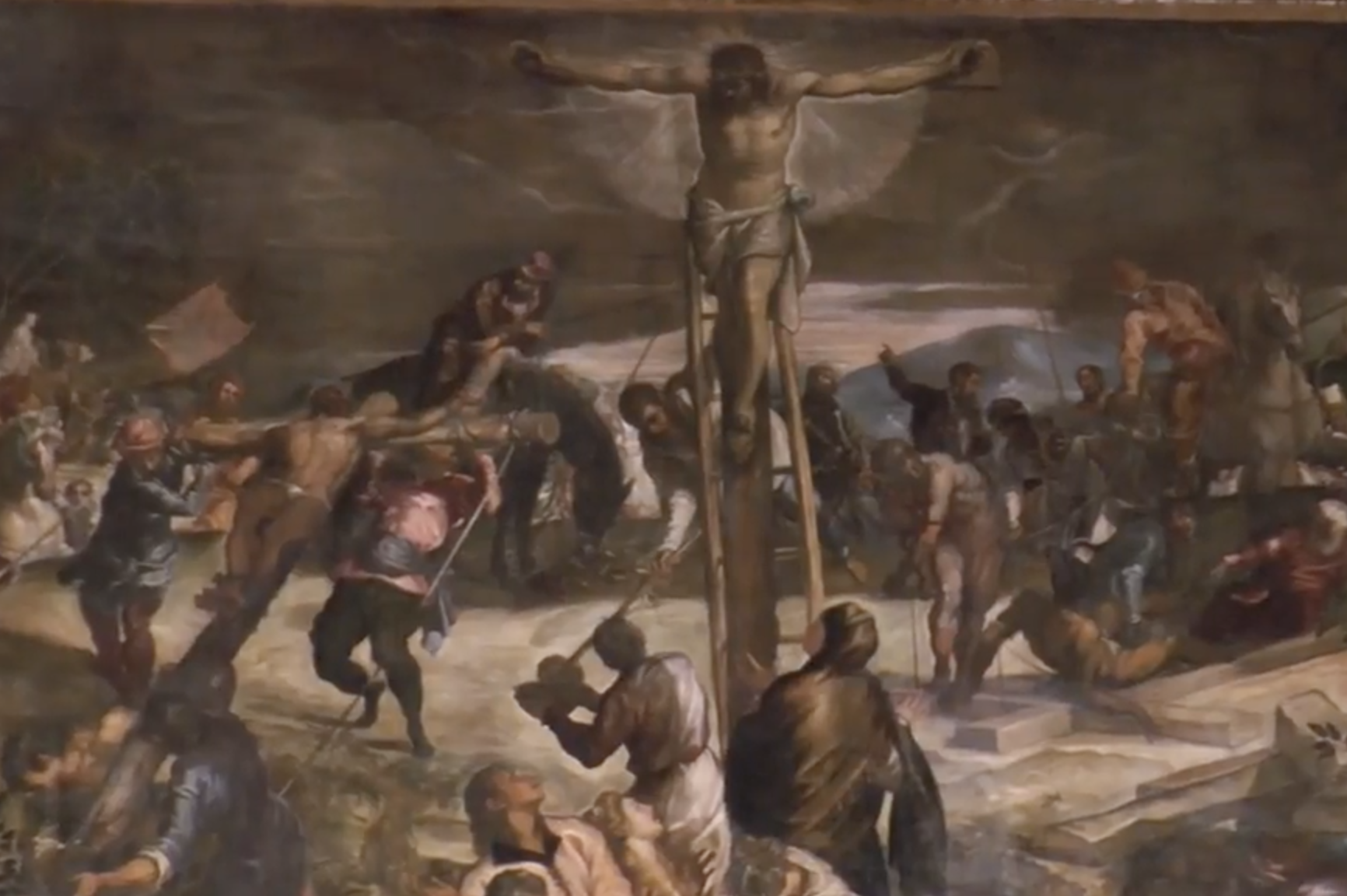
Sala dell’Albergo (small upper room): Decorated first (1564-1567), contains Tintoretto’s monumental Crucifixion and other major works
Sala Maggiore (Great Hall): Vast ceiling and wall paintings covering entire room (approximately 2,500+ square meters), organized thematically, representing artistic achievement of monumental scale
Sala dell’Albergo and connecting corridors: Additional Tintoretto paintings creating coherent artistic environment throughout building
Tintoretto’s Commission and Involvement:
The artistic opportunity:
In 1564, Scuola Grande commissioned Tintoretto to decorate the Sala dell’Albergo (smaller chamber), beginning relationship lasting approximately 30 years, producing 56 paintings addressing Old Testament, New Testament, and saint-related themes
The commission’s development:
Rather than completing project quickly, Tintoretto maintained ongoing relationship with Scuola Grande, continuously producing new works as commissions expanded to additional rooms, creating sustained artistic engagement unusual for Renaissance artists typically moving between commissions and patrons
The artistic compensation:
Tintoretto negotiated to serve as confraternity member without payment, providing works in lieu of membership dues, creating unusual arrangement where artist’s contribution to institution’s spiritual mission displaced financial transaction, reflecting his commitment to project’s meaning alongside compensation
The result:
By Tintoretto’s death (1594), he had created 56 paintings specifically for Scuola Grande, covering approximately 40,000 square feet of wall and ceiling surface, creating total artistic environment representing artist’s complete mature vision
The Artistic Significance:
Tintoretto’s revolutionary approach:
Tintoretto (1518-1594) represents major Renaissance figure differing fundamentally from more famous contemporaries (Michelangelo, Raphael, Titian) through revolutionary compositional and technical innovations:
Compositional revolution: Rather than stable balanced compositions organizing figures symmetrically, Tintoretto employed diagonal thrust, spiraling arrangements, complex spatial recession creating dynamic movement and psychological intensity; figures often positioned asymmetrically, creating tension and dramatic energy
Technical innovation: Employing sketchy loose brushwork (versus precise detailed technique), dramatic chiaroscuro (extreme light/dark contrast), distorted perspective, unusual color choices, creating visual intensity and emotional power surpassing representational accuracy
Spiritual intensity: Rather than serene Renaissance idealization, Tintoretto’s religious works convey spiritual struggle, mystical intensity, divine intervention through dramatic visual means — the paintings feel visionary, ecstatic, almost hallucinatory in spiritual power
Narrative complexity: Individual paintings often contain multiple narrative moments (past, present, future), simultaneous events, complex theological meaning compressed into single composition, requiring extended viewing and contemplation
The collective achievement:
Scuola Grande’s paintings represent sustained engagement with these revolutionary approaches across decades — rather than isolated masterpieces, you encounter systematic development of compositional and technical ideas, watching Tintoretto refine and evolve methods across 56 works addressing coherent thematic program
Why Scuola Grande Remains Relatively Unknown:
The visibility problem:
Unlike academies and museums with signage, marketing, guidebook prominence, Scuola Grande exists as working confraternity building, religious/charitable institution rather than tourist attraction, receiving minimal commercial promotion
The tourist hierarchy:
Standard Venice guidebooks list Academia, Doge’s Palace, Peggy Guggenheim, church masterpieces; Scuola Grande mentioned but not prominently, creating impression of secondary importance despite arguably housing more significant Tintoretto concentration than Academia
The museum expectation:
International travelers expect “museums” — formal institutions with admission, curated displays, organized collections; Scuola Grande’s identity as religious/charitable confraternity building, not museum, creates misalignment with tourism expectations
The specialized knowledge requirement:
Appreciating Scuola Grande’s significance requires understanding Tintoretto’s importance and revolutionary artistic practice — casual visitors unfamiliar with Renaissance art history may not recognize its importance without expert guidance
The Venetian focus:
Tintoretto remains primarily known to Venice specialists and Renaissance art historians; international art world privileges Florence (Leonardo, Michelangelo) and Rome (Raphael), creating Tintoretto as “Venetian master” rather than Renaissance equal to more famous figures
Tintoretto’s Vision: The Paintings and Artistic Program
Understanding the specific artworks and Tintoretto’s thematic approach.
The Sala dell’Albergo (The First Commission):
The monumental Crucifixion (1564-1567):
Tintoretto’s largest canvas in Venice (approximately 17 x 40 feet), the Crucifixion dominates the small chamber overwhelming viewer with scale and intensity
What makes it revolutionary:
Rather than isolated Christ figure centered in composition (conventional approach), Tintoretto positions Crucifixion as chaotic event occupying entire painted space — Christ appears almost incidental within tumultuous scene of soldiers, executioners, onlookers, activity filling entire composition, creating sense of divine tragedy disrupting cosmic order
The visual drama:
Diagonal cross thrusts skyward, soldiers positioning themselves asymmetrically, light raking across scene creating chiaroscuro intensity, the complete scene conveying spiritual upheaval, mystical violence, redemptive suffering simultaneously
Associated paintings in Sala dell’Albergo:
Christ Before the Council — frontal Christ confronting authority, psychological intensity through compositional tension
The Pool of Bethesda — miraculous healing scene with complex spatial recession, multiple narrative moments simultaneously visible
St. Rocco Curing the Plague Victims — thematic connection to confraternity’s mission, showing saint’s miraculous intervention
The Sala Maggiore (The Great Hall):
The ceiling paintings:
Covering entire ceiling (approximately 2,500+ square meters), the painted panels depict Old Testament scenes (Moses receiving law, manna from heaven, brazen serpent, others) arranged thematically
The artistic approach:
Rather than geometric perspectival ceiling decorations (conventional Renaissance approach), Tintoretto employs illusionistic perspective creating sense of supernatural space opening above viewer, figures floating in mystical space transcending architectural boundaries
The narrative complexity:
Each scene contains multiple moments, psychological tension, dramatic lighting, compositional innovation — watching ceiling requires prolonged attention and multiple viewings to comprehend individual paintings’ complexity
The wall paintings:
Surrounding the Sala Maggiore’s central space, wall paintings (approximately 30+ works) continue thematic program:
New Testament scenes — Annunciation, Adoration of the Magi, Resurrection, Ascension, others addressing salvation history
Saint Rocco narratives — depicting saint’s life, miracles, spiritual power, addressing confraternity’s devotional focus
Theological complexity:
The complete program addresses redemption history (creation through salvation), saint’s miraculous intervention, social charity (plague relief, medical care), creating coherent spiritual and institutional narrative spanning entire building
Specific Masterworks to Seek:
The Healing of the Paralytic at the Pool of Bethesda:
Complex spatial composition with multiple narrative moments (Christ touching paralytic, onlookers, architectural setting), miraculous healing occurring within everyday urban space, demonstrating Tintoretto’s ability to compress theological meaning into complex visual narration
The Ascension:
Christ rising into celestial space with swirling apostles below, the composition itself creates upward thrust carrying viewer’s attention toward divine ascent, the entire painting structure participating in spiritual meaning
The Temptation of Saint Anthony:
Theatrical demonic assault on saint, nightmarish creatures and supernatural events filling composition, showing Tintoretto’s ability to convey spiritual struggle through visual drama and psychological intensity
Saint Rocco in Prison Visited by an Angel:
Saint in darkness receiving divine visitation, miraculous light illuminating figure, demonstrating Tintoretto’s mastery of chiaroscuro creating spiritual presence through dramatic lighting
The Viewing Experience: How to Engage with This Collection
Understanding the practical and aesthetic encounter of visiting.
The Scale and Density:
The overwhelming sensory experience:
Upon entering Sala Maggiore, most visitors experience moment of overwhelming scale — the vast ceiling, walls entirely covered with paintings, the visual density surpassing typical museum experiences, creating initial disorientation
The strategic approach:
Rather than attempting comprehensive viewing, successful engagement requires selective focus:
Option 1: Slow selective attention — spend 2-3 hours focusing on 10-15 paintings in depth (reading wall descriptions, sitting with individual works, noticing compositional details), understanding Tintoretto’s artistic language through sustained attention
Option 2: Comprehensive but rapid survey — walk through all spaces noting major compositions, getting impression of scale and thematic program, returning for deeper engagement if inspired
Option 3: Guided experience — expert guide provides curatorial framework, identifies key works, explains Tintoretto’s revolutionary techniques, contextualizing collection within artist’s career and Renaissance art history
Spatial Navigation:
Ground floor entry (Sala Terrena): Smaller chamber with seasonal installations, modern exhibition context, orients visitor and provides introduction
Ascending to upper floors: Climbing stairs to Sala dell’Albergo and Sala Maggiore reveals artistic program progressively, the stairwell itself often contains paintings
The Sala dell’Albergo: Smaller intimate chamber (compared to Sala Maggiore) containing monumental Crucifixion and thematically related works, allows focused engagement
The Sala Maggiore: The primary vast space, containing ceiling and wall paintings creating total immersive environment, requires decision-making about viewing strategy
Recommended Engagement Sequence:
First encounter: Enter Sala Maggiore allowing initial overwhelming response; sit (benches provided) allowing adjustment to scale and artistic density
Focused viewing: Choose specific area (ceiling paintings, wall paintings, single wall) and spend extended time with limited number of works
Compositional study: Examine how Tintoretto structures individual paintings — diagonal thrust, asymmetrical balancing, spatial recession, figure positioning creating meaning through arrangement
Technical observation: Notice brushwork, color choices, light effects, understanding Tintoretto’s revolutionary techniques distinguishing him from contemporaries
Thematic engagement: Recognize religious and institutional meanings — Old Testament prefiguring New Testament, saint’s role as healer and protector, charity as confraternity’s mission
Return visits: Most meaningful engagement develops through multiple visits (if Venice stay allows), allowing progressive comprehension of collection’s complexity and coherence
Time Requirements:
Minimal visit: 45-60 minutes (overview, major works, superficial engagement) Substantial visit: 2-3 hours (focused attention, multiple works in depth, some understanding of artistic program) Comprehensive engagement: 3-4 hours (slow contemplative viewing, extensive study of compositional techniques, spiritual engagement)
Practical Visitor Information
Understanding how to access and experience Scuola Grande.
Location and Navigation:
Address: Campo San Rocco, San Polo district (near Frari church, Rialto area)
Getting there:
From Rialto Bridge area, navigate northwest through San Polo neighborhood; multiple routes possible, approximately 10-15 minute walk; campo marked on maps; ask locals if navigation uncertain
From Frari church (nearby major landmark), walk toward Campo San Rocco; the two major institutions in proximity
Vaporetto option: Lines serving San Polo/Rialto area (Line 1, 2, N) with stops approximately 5-minute walk from Scuola Grande
Hours of Operation:
Generally: 9:00 AM-5:00 PM daily (subject to seasonal variation and special closures; verify current hours before visiting)
Possible closures: Confraternity may close for special events or religious observances; checking ahead prevents wasted journey
Admission and Fees:
Entrance fee: Approximately €10-11 (modest by museum standards)
Reduced rates: Students, seniors, Venice residents typically receive discounts
Free admission: Occasionally on specific days or times (check current policy)
Advance booking: Generally not required but can be helpful during peak season for avoiding minor delays
Accessibility Considerations:
Climbing: Multiple sets of stairs required (not wheelchair accessible, challenging for mobility limitations)
Physical demands: Extensive standing and viewing (benches available but limited)
Art engagement: Deeply visual medium requiring seeing (audio guides available for some information, but visual observation paramount)
Guidance and Information:
No formal audio guides: Unlike museums with standard audio devices, Scuola Grande may offer limited technology-based guidance (policies vary)
Wall placards: Italian and English descriptions of major works provided, offering basic context
Expert guides available: Specialized art historians available for private or small-group guiding (book in advance for optimal experience)
Our services: Specialized Tintoretto and Renaissance art guidance available combining Scuola Grande visit with broader artistic education
Photography Policy:
Generally permitted: Photography without flash typically allowed (verify current policy); the lighting environment often challenging for photography (dramatic dark/light making exposure difficult)
Respect for artwork: Flash damages paintings, so flash prohibition essential
Timing Recommendations:
Early morning (9:00-10:30 AM): Quietest, best light conditions (natural light from windows), minimal crowds
Mid-morning (10:30 AM-12:00 PM): Increasingly crowded, reasonable light conditions
Afternoon (2:00-4:00 PM): Variable lighting (depends on sun angle), potentially crowded
Late afternoon (4:00-5:00 PM): Final light opportunities, fewer crowds, approaching closing
Avoid: Peak midday (11:00 AM-2:00 PM) for quietest experience
Weather Considerations:
Rain days: Dramatic dark atmospheric lighting (chiaroscuro paintings particularly effective), few tourists, contemplative mood
Sunny days: Natural light from windows enhances viewing (though creates glare on glass-protected paintings), crowded conditions
Winter: Shorter daylight hours (limiting viewing time), dramatic low-angle light, fewer tourists
Contextualizing Scuola Grande: How It Compares to Major Venues
Understanding how this site positions within broader Venice art landscape.
Comparison to Gallerie dell’Accademia:
Academia strengths:
- Comprehensive Venetian painting survey (13th-18th century)
- Multiple artists representing broader artistic traditions
- Chronological organization helping understand artistic development
- Iconic masterpieces (Vivarini, Bellini, Titian, Veronese, others)
Scuola Grande advantages:
- Single artist comprehensive vision (56 Tintoretto works spanning decades)
- Original architectural contexts (paintings where intended, not museum gallery display)
- Thematic coherence (complete program addressing unified subject matter)
- Immersive experience (overwhelming artistic density) versus selective presentation
- Revolutionary artistic techniques exemplified systematically
The choice: Academia for survey learning and iconic masterpiece viewing; Scuola Grande for deep artist engagement and thematic understanding
Comparison to Doge’s Palace:
Doge’s Palace strengths:
- Historical significance (seat of Republic government)
- Architectural grandeur (Gothic palazzo aesthetics)
- Multiple artistic periods represented
- Iconic paintings (Tintoretto’s Paradise)
- Tourist infrastructure and guided access
Scuola Grande advantages:
- Focused single artist engagement
- Spiritual/charitable mission (different institutional context)
- Complete artistic program (not selected works)
- Less touristed experience
Comparison to Churches:
Major churches (Frari, Santi Giovanni e Paolo):
Church strengths:
- Multiple artists, architectural beauty, religious context
- Free or low-cost entry
- Active religious function
- Iconic location/fame
Scuola Grande advantages:
- Concentrated single artist work
- Thematic coherence
- Total immersive artistic environment
- Dedicated viewing focus (not navigation/worship disruption)
The Unique Position:
Scuola Grande stands alone — no other Venice venue combines single artist concentration, architectural intentionality, thematic coherence, and artistic revolution at comparable scale
The artistic importance: Many art historians argue Tintoretto’s work at Scuola Grande surpasses any single room in Academia (which surveys centuries of artists) or Doge’s Palace (which emphasizes historical over artistic significance)
The experience quality: Visitors consistently report Scuola Grande as more profound artistic encounter than larger more-famous museums, creating memorable experiences surpassing expectations
Our Expert Guidance Services
If you want deep understanding of Tintoretto’s revolutionary practice and Scuola Grande’s artistic significance — contextualizing paintings within Renaissance artistic development, explaining compositional innovations and technical mastery, connecting confraternity mission to artistic program — we provide specialized Renaissance art and Tintoretto-focused guidance.
What We Provide:
Tintoretto expertise:
- Explaining artist’s revolutionary compositional and technical approaches
- Contextualizing within Renaissance artistic traditions
- Understanding how Tintoretto differs from Michelangelo, Raphael, Titian
- Identifying signature techniques (chiaroscuro, diagonal thrust, illusionistic space)
- Following artistic evolution across 56 Scuola Grande paintings
Scuola Grande navigation:
- Curatorial guidance identifying essential works
- Interpretive framework for viewing program’s thematic coherence
- Explaining confraternity context and institutional mission
- Spatial guidance through complex building layout
- Optimal timing and focusing strategies
Painting-specific analysis:
- Detailed examination of major compositions
- Iconographic and theological meaning explanation
- Technical analysis (brushwork, color, light effects)
- Compositional strategies and geometric underlying structures
- Relationship to Renaissance artistic tradition
Comparative artistic context:
- Understanding Tintoretto’s place among Renaissance masters
- Contrasting with Academia’s broader survey approach
- Explaining significance relative to other Venice artistic sites
- Renaissance Florence vs. Venice artistic traditions
Photography and documentation:
- Optimal viewing positions for understanding compositions
- Technical guidance for artwork documentation
- Compositional guidance for visitor photography
Extended artistic education:
- Frari church Titian works comparison
- Other Tintoretto locations throughout Venice
- Renaissance Venice artistic traditions
- Confraternity institutions and their artistic patronage
Understanding Complete Context
For artistic exploration: Academy guide, church masterpieces, contemporary art.
For neighborhood exploration: San Polo district, Frari church proximity.
For discovery approaches: Hidden architectural gems, authentic neighborhood experiences, spontaneous exploration.
For all experiences: Complete tour options.
Scuola Grande di San Rocco Represents Tintoretto’s Most Complete Artistic Vision — 56 Paintings Spanning 40+ Years, 40,000+ Square Feet Wall and Ceiling Coverage, Original Architectural Contexts, Revolutionary Compositional and Technical Innovation, Coherent Thematic Program, Relatively Undiscovered Despite Artistic Importance
After 28 years guiding Venice and being featured by Rick Steves, NBC, and US Today, I recognize Scuola Grande di San Rocco as genuinely significant artistic destination — Renaissance confraternity building (charitable organization dedicated to Saint Rocco plague relief) commissioning Tintoretto to decorate interior over approximately 30 years, resulting in 56 paintings addressing Old Testament, New Testament, and saint-related themes covering approximately 40,000 square feet of wall and ceiling space. Tintoretto (1518-1594) represents revolutionary Renaissance artist whose diagonal thrust compositions, extreme chiaroscuro, spiritual intensity, and technical innovation fundamentally differ from more famous contemporaries, Scuola Grande containing artist’s most complete single vision — 56 works spanning career showing sustained artistic development, thematic coherence, and revolutionary techniques exemplified systematically rather than isolated masterpieces. The building remains relatively undiscovered by international tourism despite arguably containing more significant artistic achievement than more-famous venues (Academia emphasizes survey over single-artist mastery, Doge’s Palace prioritizes historical over artistic significance), tourists typically visiting Academia, Doge’s Palace, churches while overlooking Scuola Grande’s superior concentrated artistic achievement. Practical visiting: located Campo San Rocco, San Polo district (near Frari church, Rialto area), approximately €10-11 admission, 9:00 AM-5:00 PM hours, requires stair climbing, no wheelchair access; optimal engagement requires 2-3 hours focused viewing (versus 45-minute superficial survey), early morning (9:00-10:30 AM) best conditions (quietest, optimal light), multiple visits ideal for progressively comprehending 56-painting program’s complexity. We provide expert Tintoretto and Renaissance art guidance, Scuola Grande navigation, painting-specific analysis, compositional explanation, architectural contextualization, comparative artistic education. Contact us for Scuola Grande experiences revealing Renaissance masterpiece most travelers miss. Let’s explore Tintoretto’s complete artistic vision.
Contact us for expert Scuola Grande di San Rocco guidance — Tintoretto mastery and Renaissance art expertise.
Frequently Asked Questions
Should I visit Scuola Grande di San Rocco if I’m already planning to see the Academia, or would that be artistic overkill?
Visiting both is worthwhile despite redundancy concerns — they serve different purposes and provide complementary rather than overlapping experiences; skipping one in favor of the other represents false choice. Academia strengths for your visit: (1) Survey approach — Academia covers 13th-18th century Venetian painting, showing artistic traditions, style evolution, multiple artistic voices, essential for understanding Venetian art history broadly. (2) Iconic masterpieces — Vivarini, Bellini, Carpaccio, Titian, Veronese, other major figures represented, providing essential encounter with major Renaissance achievements. (3) Accessibility — formal museum structure, clear curation, audio guides, signage creating intuitive visitor experience. (4) Necessary context — understanding Venetian artistic traditions’ breadth helps comprehend Tintoretto’s revolutionary positioning. Scuola Grande strengths for your visit: (1) Single artist depth — 56 Tintoretto paintings spanning 30+ years showing sustained artistic vision, thematic coherence, artistic evolution impossible in survey museums. (2) Revolutionary technique — Tintoretto’s revolutionary compositional and technical approaches exemplified systematically, understanding his artistic revolution through repeated exposure. (3) Immersive experience — 40,000+ square feet of continuous artistic engagement creates total sensory overwhelm superior to selective museum viewing. (4) Institutional context — confraternity mission, charitable focus, architectural intentionality provide meaningful context museums cannot replicate. (5) Unique positioning — nowhere else provides comparable concentrated single-artist, single-institution, original-context experience. The honest assessment: Academy and Scuola Grande are complementary not redundant. Academia teaches you Renaissance art survey, Scuola Grande teaches you Tintoretto mastery. Both enhance overall understanding. The time-efficiency question: (1) If visiting 3+ days: Both definitely worthwhile (allocate 3-4 hours Academia, 2-3 hours Scuola Grande, total 5-7 hours art engagement across multiple-day visit). (2) If visiting 2 days: Choose based on priorities — Academia if wanting broad Renaissance understanding, Scuola Grande if wanting single-artist deep engagement. (3) If visiting 1 day absolute maximum: Academia takes priority (more canonical, comprehensive, essential foundational knowledge). Strategic recommendation: Include Scuola Grande if: (a) Venice visit allows 3+ days total, (b) Renaissance art interests you beyond casual appreciation, (c) Artist mastery and revolutionary technique interest you, (d) You appreciate immersive artistic experiences over survey surveys. Skip for Scuola Grande if: (a) Time severely limited (Academia priority), (b) Medieval/Renaissance art survey your primary interest (Academia covers this), (c) You’re uninterested in technical artistic analysis, (d) Climbing stairs problematic. Many serious art enthusiasts do both — Academia provides breadth, Scuola Grande provides depth, combined creating comprehensive Venetian art understanding. They’re genuinely different experiences serving different learning goals; one doesn’t substitute for other.
Is Scuola Grande better than the Academia, or are they roughly equivalent artistic experiences?
They’re fundamentally different rather than comparable — “better” depends entirely on what you value artistically; different visitors would rationally choose differently. Arguments Scuola Grande is “better” (more significant artistic experience): (1) Artist mastery concentration — 56 Tintoretto paintings spanning career shows sustained vision and development impossible in Academia’s survey approach; the cumulative exposure to revolutionary technique creates deeper understanding. (2) Original architectural contexts — paintings remain where Tintoretto intended them, not removed to museum galleries; the relationship between artwork and space creates meaning museums cannot replicate. (3) Thematic coherence — the confraternity program addresses unified subject matter (redemption history, saint’s miraculous power, charitable mission), creating meaningful progression versus Academia’s historical survey organization. (4) Total immersion — 40,000 square feet of continuous artistic engagement creates overwhelming sensory experience transcending individual masterpiece appreciation. (5) Revolutionary artistic achievement — Tintoretto’s techniques (diagonal thrust, chiaroscuro, illusionistic space) represent more radical artistic revolution than individual Bellini or Titian paintings, showing 16th-century artistic innovation. (6) Institutional authenticity — functioning confraternity building (not sterile museum) maintains living context and spiritual mission. Arguments Academia is “better” (more essential/comprehensive): (1) Broader artistic knowledge — covers 600+ years of Venetian painting, showing traditions and evolution, essential foundational understanding versus single-artist focus. (2) Iconic masterpiece collection — concentrated selection of greatest works from multiple artists, representing Renaissance artistic achievement comprehensively. (3) Curatorial excellence — professional art historians organized collection for optimal learning, clear presentation versus Scuola Grande’s thematic but less explicitly didactic arrangement. (4) Accessibility — formal museum structure, clear organization, familiar visiting experience, minimal barriers to engagement. (5) Art historical canon — Academia contains works considered essential Renaissance art (Bellini’s Accademia Altarpiece, Vivarini masterpieces, Carpaccio cycles), representing established artistic importance. (6) Comparative positioning — Academia collections comparable globally to great art museums (Uffizi, Louvre), conferring prestige and canonical status. The honest assessment: Academia = breadth, excellence, canonical importance, curatorial professionalism (what you “should” see for art historical education). Scuola Grande = depth, revolutionary mastery, sensory immersion, institutional authenticity (what creates transcendent personal experience). Choose Academia if: You want foundational Renaissance art knowledge, prefer curator-guided learning, value iconic masterpiece concentration, have limited time. Choose Scuola Grande if: You want single-artist mastery and artistic revolution depth, prefer immersive experience over curated selection, appreciate original institutional contexts, seeking profound personal encounter. The non-choice: Serious art visitors do both — they’re genuinely complementary, not competitive. Academia teaches you art history broadly; Scuola Grande teaches you artistic genius intensively. Together they create understanding neither alone provides. The “better” question misframes comparison — they’re different experiences serving different learning goals.
Will I understand and appreciate Tintoretto’s work at Scuola Grande without background art knowledge, or do I need significant Renaissance art education first?
You can appreciate Scuola Grande’s artworks without art history background, though your appreciation depth depends on approach and effort invested — background knowledge enhances understanding but isn’t prerequisite for meaningful engagement. What non-specialists can appreciate without background: (1) Visual drama and intensity — Tintoretto’s paintings are genuinely visually compelling even without theoretical knowledge; the diagonal thrust, dramatic lighting, swirling compositions create sensory impact immediately recognizable. (2) Emotional power — the religious and spiritual themes communicate emotionally (suffering, redemption, miraculous healing, divine intervention) through visual means directly, requiring no theological education. (3) Technical mastery and skill — the accomplished painting technique, complex composition, convincing figure rendering recognize skill even without understanding Renaissance art conventions. (4) Scale and immersion — the overwhelming sensory experience of 40,000 square feet of continuous art creates powerful encounter requiring no knowledge. (5) Thematic coherence — observing how similar themes repeat across multiple paintings, understanding Saint Rocco’s miraculous interventions, recognizing Old Testament prefiguring New Testament — these patterns emerge through looking without explicit instruction. What background knowledge enhances: (1) Artistic positioning — understanding how Tintoretto’s revolutionary approach differs from Michelangelo, Raphael, Titian; appreciating his innovation requires knowing contemporary conventions he violated. (2) Compositional analysis — recognizing diagonal thrust, illusionistic space, chiaroscuro techniques and understanding why they’re revolutionary requires knowing Renaissance norms. (3) Iconographic meaning — identifying biblical figures, understanding theological symbolism, recognizing confraternity mission’s charitable dimension deepens with religious and historical knowledge. (4) Artistic intentionality — understanding artist’s choices (figure positioning, color selection, light effects) as meaningful decisions rather than arbitrary requires artistic literacy. (5) Historical context — knowing Tintoretto’s biographical details, his Venice context, Scuola Grande’s institutional mission enriches understanding. Practical approaches for non-specialists: (1) Guided experience — hiring expert guide provides educational context, explaining revolutionary techniques, theological meanings, artistic significance, transforming raw visual experience into comprehensible artistic achievement; this is ideal solution for non-specialists (€100-150 for 2-hour guidance) multiplying appreciation depth exponentially. (2) Self-education before visiting — spending 30 minutes reading about Renaissance art, Tintoretto’s life, confraternity mission, basic Catholicism provides framework for understanding; Wikipedia + brief intro sufficient. (3) Slow contemplative viewing — without guidance, spending extended time with individual paintings, reading wall descriptions, asking questions of docent staff (often available for inquiries) gradually builds understanding. (4) Multiple visits — if Venice stay allows, returning multiple times allows progressive comprehension developing naturally. (5) Comparison and discussion — if visiting with others, discussing what you observe, asking questions, exchanging interpretations builds collective understanding. The honest perspective: Non-specialists often have more profound experiences than those burdened with art historical preconceptions — approaching with openness and genuine observation frequently generates authentic emotional and aesthetic response that educated analysis might inhibit. Many visitors report Scuola Grande as “most moving art experience” without formal background. My recommendation: Definitely visit Scuola Grande without background knowledge, approaching with openness to emotional/sensory experience; consider hiring guide for first 60-90 minutes (providing educational framework), then spending remaining time in unguided contemplation having context. This combination provides intellectual understanding plus personal engagement generating most meaningful experience.