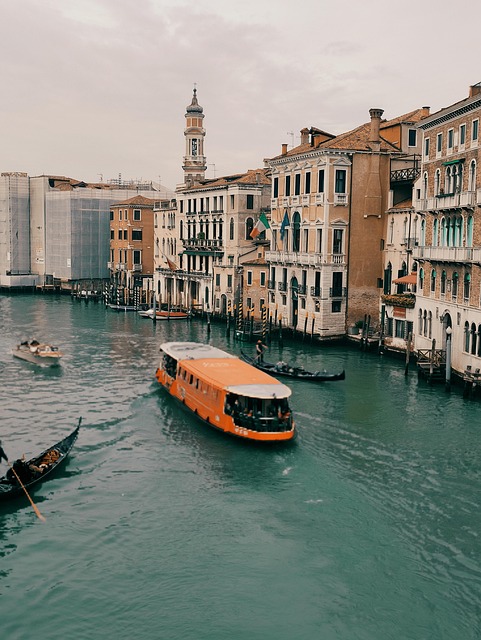
If Dorsoduro is Venice’s art-and-elegance side, Castello is its working memory — the sestiere that quietly ran the Venetian Republic for centuries and somehow still gets treated as an afterthought by most visitors. It’s the largest of Venice’s six districts by far, stretching from just behind the Doge’s Palace all the way east to the lagoon’s edge, and it remains the one most locals will tell you to see if you actually want to understand this city rather than just photograph it.
The Republic’s Industrial Heart
Castello’s identity was built around the Arsenale, the vast former shipyard and armory that once made Venice the dominant naval power in the Mediterranean — at its height, one of the largest pre-industrial production complexes in the world, sprawling across roughly 46 hectares. I’ve written a full piece on its history elsewhere, so I won’t retread that ground here, but it’s worth knowing that the Arsenale’s scale is really the key to understanding Castello as a whole: this was never the sestiere of doges and grand ceremony. It was the sestiere of shipwrights, rope-makers, and sailors — a working-class engine room, and that identity has never entirely worn off.
Via Garibaldi: Venice’s Only Real Street
Most of Venice moves through narrow calli that wind and dead-end without warning. Castello has something almost no other sestiere does: Via Garibaldi, a genuinely wide, straight thoroughfare — created by filling in a canal — lined with everyday shops, bakeries, and bacari rather than souvenir stalls. A produce boat still moors at one end each weekday morning, selling fruit and vegetables the way it has for generations. This is Castello’s actual daily rhythm, and walking it at ten in the morning, surrounded by residents doing their shopping rather than visitors doing their sightseeing, is one of the more grounding things you can do in this city.
San Pietro di Castello: The Cathedral Venice Forgot
Here’s the detail that surprises almost everyone I guide through Castello: San Pietro di Castello, tucked away on its own small island at the sestiere’s eastern edge, served as Venice’s actual cathedral and the seat of the Patriarch from 1451 until 1807 — centuries during which St. Mark’s Basilica was technically just the doge’s private chapel. The church holds what’s known as the Throne of St. Peter, its base carved with Arabic inscriptions, a quiet reminder of how thoroughly Venice’s trade networks stretched into the Islamic world. The island today is almost eerily peaceful — a small garden, a leaning Renaissance bell tower, one modest bar — and it’s rare to share it with more than a handful of other visitors.
The Giardini and the Biennale
Castello is also home to the Giardini della Biennale, Venice’s largest public park and, every odd year from spring through autumn, home to the international pavilions of the Venice Biennale — architecture by figures like Alvar Aalto sitting among mature trees and genuine grass, a rarity in a city built almost entirely of stone and water. Outside Biennale season, the Giardini simply functions as green, unhurried public space, which in Venice is its own kind of luxury.
Why “Underrated” Is the Right Word
Castello doesn’t lack landmarks — it has the Arsenale, a former cathedral, the Biennale gardens, and the sweeping lagoon-facing promenade of the Riva degli Schiavoni connecting it all back to San Marco. What it lacks is the performance. Nothing here is dressed up for visitors, which is exactly why it rewards the traveler willing to walk further east than the Bridge of Sighs. This is Venice still doing what Venice actually does, rather than Venice recreating itself for an audience.
Exploring Castello With Someone Who Knows Its Layers
Castello’s size is its own challenge — it’s easy to see the Riva degli Schiavoni and assume you’ve “done” the neighborhood, when the real character sits further in, past Via Garibaldi and out toward San Pietro. On a private Venice tour, I build Castello afternoons around that depth rather than the postcard edge — the Arsenale’s gate, yes, but also the quiet campo life the guidebooks skip entirely.
Is Castello walkable from San Marco?
Yes — Riva degli Schiavoni connects them directly, and it’s roughly a 15-minute walk to the Arsenale, longer out to San Pietro di Castello.
Is Castello a good base for staying in Venice?
Very much so — its western edge near San Marco offers convenience, while the eastern reaches are quieter and often better value than San Marco or Dorsoduro.
What’s the best time to visit if I want to see the Biennale?
Biennale Arte and Architettura alternate years, typically running from spring through late autumn — worth checking current dates before planning around it.