“What does Venice look like at sunrise? Is it worth waking up early? Why don’t tourists see Venice in the morning?”
These questions appear from travelers who’ve heard vague references to Venice’s magical early hours, seen stunning dawn photographs suggesting a completely different city than crowded daytime experience, or simply wonder whether the effort of pre-dawn waking justifies the reward of seeing Venice before tourist masses arrive.
The honest answer: Venice at sunrise (approximately 5:30-7:00 AM depending on season) reveals the city in its most authentic state — residential neighborhoods awakening with locals heading to work, morning light creating extraordinary colors impossible to replicate at midday, the complete absence of tourist crowds allowing solitary exploration of normally-packed landmarks, and the visceral experience of Venice functioning as lived-in city versus performing as tourist destination.
After 28 years experiencing Venice at all hours — walking empty dawn streets countless times, photographing morning light transformations, understanding which specific locations provide optimal sunrise views, knowing how early-morning Venice differs fundamentally from daytime tourist experience, and guiding travelers who want to see the real city beyond surface tourism — I know that sunrise hours create genuinely transformative perspectives revealing Venice most tourists completely miss despite visiting the same geographic location.
The fundamental realities most travelers miss:
Most tourists never see sunrise Venice because hotels serve breakfast 7:30-10:00 AM (after optimal early hours have passed), tour groups don’t operate before 9:00 AM, the physical effort of waking at 5:00-6:00 AM feels unreasonable when on vacation, and conventional travel advice doesn’t emphasize that Venice’s character changes completely based on time of day.
The Biennale art crowd — notorious for late-night gallery events, opening parties extending past midnight, curator dinners lasting until 2:00 AM — particularly tends toward late mornings and afternoon starts, meaning Biennale visitors miss prime early hours when contemporary art venues remain closed but the city itself becomes the exhibition.
Sunrise Venice isn’t just “less crowded” — it’s a qualitatively different experience where the city transitions from night to day, locals dominate the streets versus tourists, morning routines reveal authentic Venetian life, and the light quality creates visual conditions photographers wait entire careers to capture.
Understanding that sunrise access requires intentional effort (alarm clocks, sacrificing sleep, potentially skipping hotel breakfast) but delivers rewards impossible to achieve during conventional tourist hours transforms how you approach Venice visiting from passive consumption to active discovery.
This is the completely honest sunrise Venice guide — explaining what you actually see and experience during dawn hours, revealing specific locations providing optimal morning light and authentic local encounters, describing practical logistics making early rising sustainable during multi-day visits, addressing how to integrate sunrise exploration with Biennale schedules, and helping you decide whether the 5:30 AM alarm justifies the unique perspectives gained.
What Sunrise Actually Looks Like: The Visual Transformation
Understanding the light, color, and atmospheric changes occurring during Venice’s dawn hours.
The Pre-Dawn Blue Hour (30-45 Minutes Before Sunrise):
Timing: Approximately 5:00-5:45 AM in summer, 6:30-7:15 AM in winter
What you see:
Deep blue atmospheric light — the sky transitions from black night to rich blue, creating ethereal quality where artificial lights (streetlamps, building illumination) still glow against the lightening sky.
Empty streets and canals — the profound quiet of a sleeping city, hearing your own footsteps echo off palazzo walls, the only sounds being distant seabirds or the occasional early-morning delivery boat.
Building lights still visible — residential windows showing warm interior light, creating the intimate sense of witnessing private Venetian life as people prepare for their day.
The mirror-still water — canals completely calm before boat traffic begins, creating perfect reflections of buildings doubling the visual impact, the famous Venetian “floating” quality becomes literal as architecture reflects flawlessly in glassy water.
The Actual Sunrise (Golden Hour Beginning):
Timing: Variable by season — 5:45-6:30 AM summer, 7:15-8:00 AM winter
The color progression:
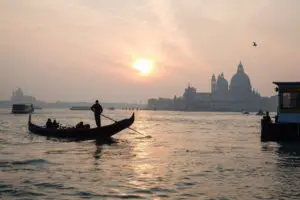
The eastern sky ignites — if you’re positioned to see toward the lagoon’s Adriatic side (eastern Venice, Giardini area where Biennale pavilions sit, San Pietro di Castello, Sant’Elena), the sky transforms from blue to pink to orange to gold as the sun approaches the horizon.
The “Venetian pink” appears — the distinctive rose-gold light that painters have attempted to capture for centuries, the warm dawn rays hitting Venice’s Istrian stone and brick creating color palette unique to this specific geographic location and atmospheric conditions.
Building facades illuminate — the first direct sunlight strikes the upper floors and rooftops of eastern-facing buildings while street level remains in shadow, creating dramatic vertical light gradients.
The lagoon catches fire — if viewing toward open water, the entire eastern lagoon surface reflects the sunrise colors creating vast expanse of gold and pink stretching to the horizon.
Shadows stretch dramatically — the low sun angle creates long shadows from every vertical element (campanili, chimneys, bridges), adding three-dimensional depth to normally-flat views.
The Post-Sunrise Golden Hour (45-90 Minutes After Sunrise):
Timing: Approximately 6:30-8:00 AM summer, 8:00-9:30 AM winter
What happens:
The warm directional light — photographers’ beloved “golden hour” where the sun sits low enough to create warm color temperature and dramatic side-lighting but high enough to fully illuminate scenes.
The city awakens gradually — watching Venice transition from sleeping to active: metal shutters rolling up on shops, locals heading to work, bakeries opening (the first fresh bread emerging from ovens, creating intoxicating aromas), the vaporetti beginning regular service.
The tourist-to-local ratio inverts — instead of 95% tourists and 5% locals (the daytime reality in San Marco and Rialto areas), early morning shows 90% locals and 10% tourists (mostly photographers and the occasional early-rising traveler who discovered this secret).
The architecture reveals detail — the angled morning light emphasizes architectural relief, ornamental details, the texture of stone and brick invisible in flat midday light or evening shadows.
Where to Experience Sunrise: The Essential Locations
Understanding which specific sites provide optimal dawn experiences and why.
Riva degli Schiavoni (Waterfront Promenade):
Why it’s exceptional for sunrise:
Eastern orientation — facing directly toward where the sun rises over the lagoon, creating unobstructed view of the dawn color progression.
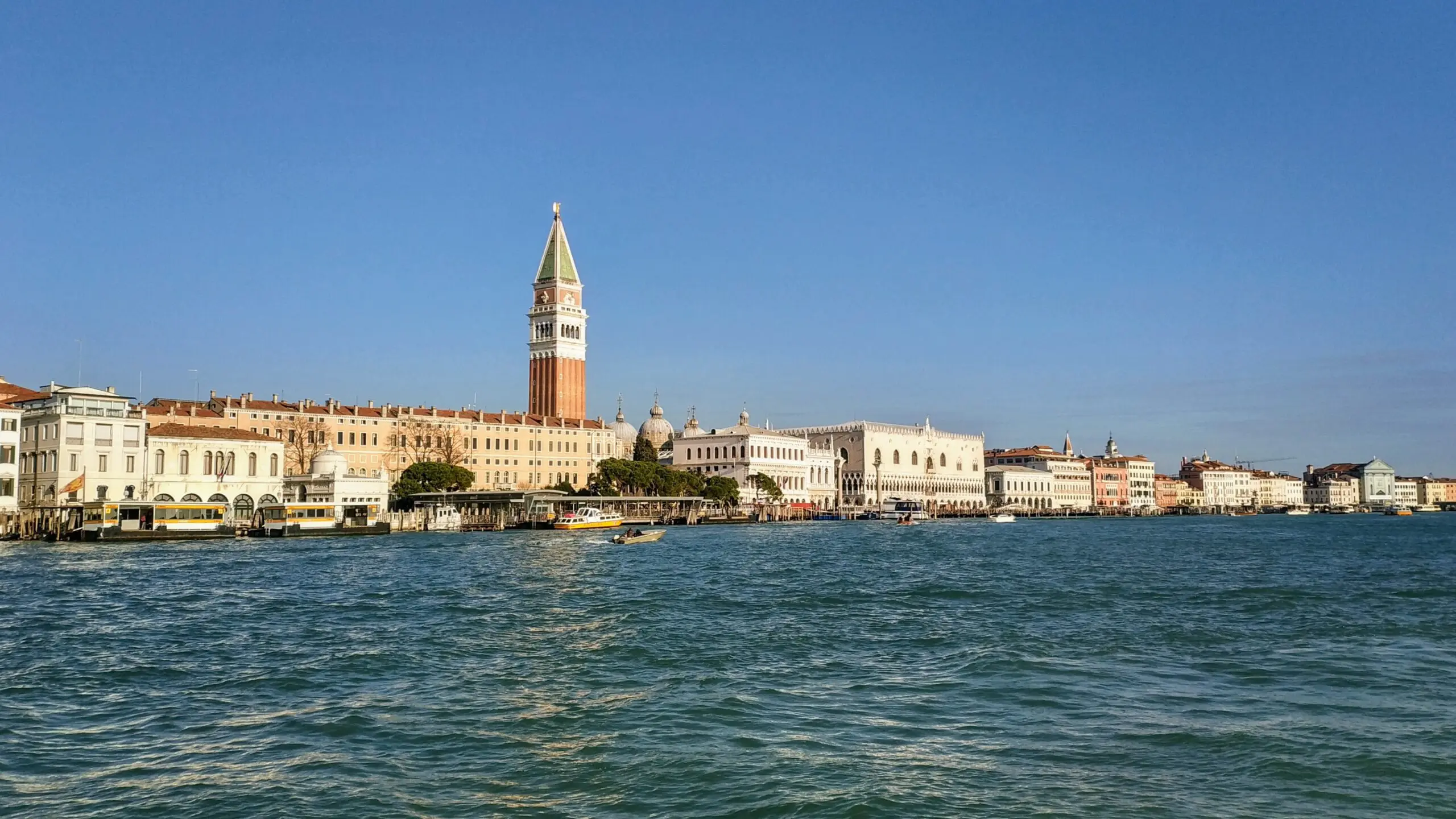
The visual elements — San Giorgio Maggiore island and Palladio’s church creating foreground silhouette, the lagoon stretching to distant barrier islands, gondolas and boats moored along the riva creating leading lines and compositional elements.
The length — the promenade extends from San Marco to the Arsenale, providing multiple vantage points and the ability to walk while shooting as light conditions change.
Accessibility — easy to reach from most Venice hotels, requires no complex navigation to find.
What you’ll see:
- The sun rising behind San Giorgio Maggiore creating dramatic backlit silhouette
- The entire lagoon surface reflecting sunrise colors
- The morning vaporetti beginning their routes, their wakes creating patterns across mirror-calm water
- Early-morning fishermen and boat operators preparing for the day
- The transformation from the romantic “Venice of night” to the working “Venice of morning”
Rialto Bridge at Dawn:
Why it’s transformative:
Complete tourist absence — the bridge that’s shoulder-to-shoulder crowded by 10:00 AM sits completely empty at 6:00 AM, allowing you to stand at the center experiencing the Grand Canal view without human obstruction.
The Grand Canal perspective — seeing Venice’s main waterway extending in both directions, the palazzo facades catching first light, the water beginning to stir as delivery boats make their morning runs.
The Rialto Market proximity — the fish and produce markets begin setting up around 6:30-7:00 AM, providing authentic Venetian commercial life observation.
What you’ll see:
- The iconic Rialto Bridge view completely devoid of tourists
- The market vendors arriving by boat, unloading produce and fish
- The first cafés opening (perfect for post-sunrise espresso)
- The palazzo facades along the Grand Canal catching warm morning light
- The transition from deserted to bustling as the city awakens
Fondamenta della Misericordia (Northern Cannaregio):
Why it reveals authentic Venice:
Residential neighborhood character — this northern Cannaregio area houses actual Venetians, not tourist accommodations, meaning morning activity reflects genuine local life.
The canal reflections — the long straight fondamenta (canal-side walkway) provides perfect reflection conditions in still morning water.
Minimal tourist presence — even during daytime this area sees far fewer tourists than San Marco/Rialto, at sunrise it’s exclusively local.
What you’ll see:
- Venetians walking to work, buying morning newspapers at tabacchi
- Children being escorted to school by parents or grandparents
- The neighborhood bakery opening (locals queuing for fresh bread and pastries)
- Sunrise light hitting the colorful building facades creating warm glows
- Cats prowling the empty fondamente (Venice’s feral cat population is most visible in quiet early hours)
Campo Santa Maria Formosa:
Why it’s photographically valuable:
The open campo (square) allows unobstructed sky views while maintaining Venetian architectural context, creating compositions combining open space and built environment.
The campanile (bell tower) provides vertical element catching first light while the campo remains shadowed.
Multiple directional options — the campo’s irregular shape provides various compositional angles.
What you’ll see:
- The campo completely empty (versus daytime when it fills with tourists and locals)
- The church facade catching warm morning light
- Venetian residents crossing the campo on morning errands
- Pigeons gathering (Venice’s pigeon population is controversial but photographically interesting in morning light)
The Giardini della Biennale Area:
Why it matters for Biennale visitors:
Seeing where you’ll spend days in completely different context — experiencing the Biennale grounds at dawn when the pavilions are closed reveals the park’s beauty beyond its art exhibition function.
The waterfront views — the Giardini sits on Venice’s southeastern edge providing expansive lagoon views toward Lido and Sant’Elena.
The green space — rare in Venice, the Giardini’s trees and gardens create different photographic opportunities than omnipresent stone architecture.
What you’ll see:
- The national pavilions as architectural objects in morning light without exhibition crowds
- The lagoon sunrise from the park’s edge
- Venetians jogging, walking dogs, or exercising in the green space
- The peaceful atmosphere before the Biennale’s daily operations begin
Punta della Dogana and Salute:
Why it’s iconic:
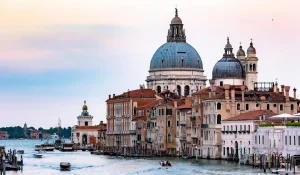
The geographic convergence — this point where the Grand Canal meets the Giudecca Canal provides 360-degree water views and iconic Venetian architecture (Santa Maria della Salute’s baroque domes).
The Palladio views — seeing San Giorgio Maggiore directly across the water catching first light.
The customs house architecture — Punta della Dogana’s distinctive triangular form creates strong compositional element.
What you’ll see:
- The sunrise illuminating Salute’s white Istrian stone domes
- The convergence of two major Venice waterways in morning calm
- Water traffic beginning (vaporetti, delivery boats, occasional early gondola)
- The transformation of this high-traffic area from deserted to active
What You Actually Experience: Beyond the Visual
Understanding the non-photographic elements making sunrise Venice transformative.
The Sound Landscape:
What you hear at dawn that daytime chaos obscures:
Your own footsteps — the echo off palazzo walls, the rhythm of walking on stone streets, the intimate acoustic experience of moving through empty urban space.
Seabirds — gulls calling, the distinctive lagoon bird sounds that Venice’s tourist noise normally drowns completely.
Water sounds — the lap of small waves against fondamenta walls, the gentle movement in canals, sounds invisible during the day when boat motors dominate.
Venetian voices — when you do encounter locals, hearing actual Venetian dialect (veneto/veneziano) in natural conversation versus English and tourist languages dominating later hours.
Church bells — the morning bells ringing across neighborhoods, the layered sound as different churches mark the hour, the tradition extending back centuries.
Boat motors — the distinctive sound of Venice’s working vessels (delivery boats, garbage collection, early vaporetti) creating the soundtrack of the city’s essential functions.
The Olfactory Experience:
What you smell in morning Venice:
Fresh bread — bakeries firing ovens around 5:30-6:30 AM, the aroma of baking bread wafting through streets as you walk.
Coffee — the first bars opening, espresso machines warming up, the bitter-sweet coffee scent signaling Venetian morning rituals beginning.
The lagoon air — the salt-water smell, the marine character of Venice’s aquatic environment, the humidity carrying scents differently than dry air.
Absence of food smells — tourist restaurants haven’t begun cooking yet, eliminating the sometimes-unpleasant mixture of competing cuisines that later hours bring.
The Social Encounters:
Who you meet and what they reveal:
Working Venetians — people commuting to jobs, the demographic showing Venice as functioning city versus tourist destination. Brief conversations (if you speak Italian) reveal genuine local perspectives.
Market vendors — arriving at Rialto to set up stalls, the commercial choreography of Venice’s food supply system.
Delivery people — unloading boats, transporting goods to shops and restaurants, the logistical network making Venice function visible.
Fellow early risers — the rare tourists who’ve discovered sunrise Venice, usually photographers or serious travelers, creating brief camaraderie among those “in the know.”
Elderly Venetians — older residents maintaining morning routines they’ve followed for decades, embodying continuity with Venice’s past.
The Psychological Impact:
What sunrise exploration does to your Venice understanding:
Breaking the tourist bubble — witnessing Venice as place where people actually live and work versus place existing to entertain visitors.
Creating ownership — having seen Venice at hours most tourists never experience generates feeling of deeper connection and insider knowledge.
Establishing perspective — understanding that the crowded Venice you’ll encounter later in the day represents tourist-dominated hours versus the “real” Venice you witnessed at dawn.
Reducing crowd stress — knowing that peaceful uncrowded Venice exists makes tolerating midday tourist masses psychologically easier.
Enhancing appreciation — seeing Venice in multiple temporal contexts (dawn quiet, midday bustle, evening transition) creates richer understanding than single-timeframe experience.
The Practical Logistics: How to Actually Do This
Understanding realistic strategies for integrating sunrise exploration into Biennale visits.
The Alarm Clock Reality:
Summer sunrise timing (June-August): Sun rises 5:30-5:45 AM, meaning wake-up at 5:00 AM for optimal pre-dawn blue hour experience
Spring/Autumn timing (April-May, September-October): Sun rises 6:00-7:00 AM, allowing slightly more humane 5:30-6:30 AM wake-up
Winter timing (November-February, outside Biennale season): Sun rises 7:15-8:00 AM, creating “easier” 6:45-7:30 AM wake-up but cold temperatures
The honest assessment: Waking at 5:00-6:00 AM feels brutal when on vacation, requires genuine commitment, and tests your dedication to experiencing authentic Venice versus sleeping comfortably.
Strategies That Actually Work:
The “one sunrise day” approach:
- Choose single day during multi-day Venice stay for sunrise exploration
- Go to bed early the night before (9:00-10:00 PM)
- Set alarm for 5:00-5:30 AM
- Explore 90 minutes (5:30-7:00 AM)
- Return to hotel for breakfast and brief rest before Biennale visiting
- Allows experiencing sunrise without daily early-rising exhaustion
The “first morning” strategy:
- If arriving Venice from long-haul flights (trans-Atlantic, Asia-Pacific), jet lag often creates 4:00-5:00 AM natural waking
- Rather than fighting jet lag lying in bed, use it productively for sunrise exploration
- Bonus: helps reset circadian rhythm to European time
The “night owl extension” approach:
- For travelers who naturally stay up late (common during Biennale opening week parties and events)
- Stay awake through the night, experience sunrise as end of evening versus beginning of morning
- Go to sleep 8:00-9:00 AM, wake early afternoon
- This is unsustainable for multiple days but works for single exceptional sunrise experience
The “guided dawn tour” option:
- We offer private sunrise walking tours providing structured early-morning experience
- Having committed appointment and expert guide creates external accountability making early rising easier
- Combines optimal location visits with cultural/historical context
- Includes breakfast at traditional Venetian bar after exploration
What to Bring:
Essential items for sunrise Venice:
Camera (if photography is priority) — smartphone cameras now handle low-light well, but dedicated cameras with manual controls provide superior results in changing dawn conditions
Layers — even summer mornings can be cool (15-18°C), and you’ll be standing still for photography versus generating warmth through walking
Comfortable walking shoes — you’ll cover 3-5 kilometers during 90-minute exploration
Water — shops and cafés mostly closed until 6:30-7:00 AM, carry water for hydration
Small notebook (optional) — for recording observations, impressions, locations you want to return to
Minimal gear — avoid large backpacks or excessive equipment, keep mobile and unencumbered
The Breakfast Question:
Hotel breakfast typically starts 7:30-8:00 AM — if you’re exploring 5:30-7:00 AM, you’ll return before breakfast service begins.
Options:
Skip hotel breakfast, eat at local bar — traditional Venetian bars open 6:30-7:00 AM serving espresso and cornetti (croissants), providing authentic local experience and calories after early rising
Return for hotel breakfast — allows hotel meal and brief rest before Biennale visiting begins
Pack snacks — bringing granola bars or fruit from previous day’s shopping allows early-morning energy without depending on open establishments
Integrating Sunrise with Biennale Schedules
Understanding how early-morning exploration complements contemporary art engagement.
The Complementary Rhythm:
Sunrise Venice (5:30-7:00 AM) → Hotel breakfast and brief rest (7:00-9:00 AM) → Biennale Giardini pavilions (9:00 AM-1:00 PM) → Lunch break → Biennale Arsenale or collateral exhibitions (2:30-6:30 PM) → Evening gallery events and dinners
This creates balanced day combining early-morning authentic Venice, mid-morning/afternoon art immersion, evening cultural/social engagement without feeling overscheduled.
The Photographic Progression:
For photographers attending Biennale:
Dawn architectural photography provides completely different subject matter and lighting than Biennale pavilion interiors, creating portfolio diversity
The juxtaposition — sunrise Venice representing centuries of tradition and beauty versus Biennale contemporary art representing cutting-edge innovation creates conceptual dialogue in photographic projects
The Venice-as-art perspective — experiencing the city itself as aesthetic object during optimal light conditions complements experiencing curated contemporary art in pavilions
The “Real Venice” Balance:
Biennale visitors risk Venice tunnel vision — experiencing only pavilions, galleries, art-world events, missing the living city hosting the exhibition
Sunrise exploration provides essential counterbalance — witnessing how Venetians actually live, seeing the city function independent of tourism/art exhibition, understanding the complete context within which contemporary art operates
This creates richer Biennale experience — understanding that Venice chose/was chosen to host the world’s premier contemporary art event because of specific historical, cultural, and aesthetic qualities visible during dawn hours when the city reveals its authentic character
Why Almost No Tourists Do This
Understanding the barriers preventing sunrise Venice experience.
The Psychological Barriers:
“I’m on vacation, I shouldn’t have to wake up early” — reasonable perspective that prioritizes rest and relaxation over optimization and experience collection
“I can see Venice anytime during the day” — true but missing that Venice’s character fundamentally changes based on time, different hours reveal different realities
“It’s too much effort for marginal improvement” — underestimating how transformative the experience actually is versus imagining it’s just “less crowded” version of daytime Venice
“I’ll do it tomorrow” — the perpetual postponement where tomorrow never comes and the Venice visit ends without ever experiencing sunrise
The Logistical Barriers:
Hotel breakfast timing — most hotels serve 7:30-10:00 AM, after optimal sunrise hours, and tourists feel they should maximize value by eating the included meal
Tour schedules — group tours don’t operate before 9:00 AM, creating perception that Venice isn’t “open” earlier
Social pressure — traveling companions may resist early rising, creating group dynamics where the early-morning motivated person feels guilty imposing on others
Lack of information — guidebooks mention sunrise Venice casually but don’t emphasize how transformative it is, creating awareness without motivation
The Energy Management Issue:
Biennale visiting is exhausting — hours walking through pavilions, standing viewing installations, attending evening events, late-night dinners and parties
Adding 5:30 AM wake-up feels unsustainable — the calculation that sleep deprivation will impair afternoon Biennale engagement, making early rising seem counterproductive
The honest reality: One sunrise day during multi-day visit won’t destroy your energy, and the experience value justifies the temporary fatigue
Our Sunrise Venice Experiences
If you want guaranteed sunrise Venice experience — structured exploration with expert guidance eliminating decision fatigue about where to go and what you’re seeing — we offer private dawn walking tours designed for Biennale visitors and serious travelers.
What We Provide:
Optimal routing — visiting the essential sunrise locations (Riva degli Schiavoni, Rialto, residential neighborhoods) in sequence maximizing changing light conditions
Cultural context — explaining what you’re seeing beyond visual beauty: the architectural history, the Venetian life patterns, the neighborhood characters, the relationship to Venice’s broader story
Photography guidance — for those prioritizing images, providing compositional suggestions, optimal vantage points, technical advice for low-light shooting
Local encounters — introducing you to early-morning Venetians when opportunities arise (market vendors, café owners, neighborhood residents), facilitating authentic interactions
Traditional breakfast — concluding at historic Venetian bar for espresso and cornetti (pastries), the authentic local morning ritual
Flexible timing — coordinating with your Biennale schedule, accommodating jet lag if you’re arriving from long-haul flights, adjusting to seasonal sunrise variations
Why Guided Experience Works:
External accountability — having committed appointment makes actually getting out of bed dramatically easier than solo motivation
Navigation elimination — you don’t waste precious dawn minutes being lost or uncertain about routing, we lead you directly to optimal locations
Educational depth — understanding the historical, cultural, and contemporary significance of what you’re witnessing versus just observing pretty scenes
Access — we know which bars open earliest, which routes avoid construction or flooding, which specific spots provide optimal views
Understanding Complete Venice Context
For Biennale experiences: Aerial perspectives, expert pavilion tours, complete Venice geography.
For Venice depth: How locals live, neighborhood exploration, Rialto Market, bacari culture.
For regional exploration: Prosecco, Dolomites, multi-region helicopter.
For practical planning: How many days, seasonal timing.
For all experiences: Complete tour options.
Venice at Sunrise Reveals the Real City — Empty Landmarks, Authentic Local Life, Extraordinary Light, Complete Tourist Absence Creating Experiences 95% of Visitors Never Witness
After 28 years experiencing Venice at all hours and being featured by Rick Steves, NBC, and US Today, I know sunrise exploration (5:30-7:00 AM depending on season) transforms understanding from tourist destination to lived-in city — Rialto Bridge standing completely empty versus shoulder-to-shoulder crowded, Riva degli Schiavoni showing unobstructed lagoon sunrise, residential neighborhoods revealing Venetians commuting to work and buying morning bread, the distinctive “Venetian pink” dawn light photographers wait careers to capture, the profound quiet allowing hearing footsteps echo and water lap against stone. The experience requires genuine commitment (5:00-6:00 AM wake-up feels brutal on vacation, hotel breakfast typically starts after optimal hours pass, traveling companions may resist), but delivers irreplaceable perspectives showing Venice functioning authentically versus performing for tourists. Optimal locations include Riva degli Schiavoni (eastern lagoon sunrise), Rialto Bridge and Market (commercial Venice awakening), Cannaregio residential areas (genuine local life), Biennale Giardini (experiencing exhibition grounds in completely different context). Integration with Biennale works perfectly — sunrise exploration 5:30-7:00 AM, hotel breakfast and rest, pavilion visiting 9:00 AM onward, creating balanced days combining authentic Venice with contemporary art without overwhelming schedules. We offer private guided dawn tours providing optimal routing, cultural context, photography guidance, local encounters, traditional breakfast, external accountability making early rising easier. Contact us for sunrise Venice experiences revealing the city 95% of tourists miss. Let’s show you the real Venice before tourist hours begin.
Contact us for private sunrise Venice experiences — expert-guided dawn exploration.
Frequently Asked Questions
Is waking up for Venice sunrise actually worth the effort, or is it just marginally better than daytime visiting?
Sunrise Venice is qualitatively different experience, not merely “less crowded” version of daytime — the transformation goes far beyond tourist density reduction. What you gain: complete landmark solitude (Rialto Bridge with zero people vs. hundreds by 10 AM, allowing unobstructed views and contemplative experience), authentic local life observation (Venetians heading to work, market vendors setting up, neighborhood bakeries opening, genuine daily rhythms vs. tourist-serving performances), extraordinary light quality (the “Venetian pink” dawn glow, dramatic shadows, mirror-still canal reflections photographers specifically travel to capture), profound atmospheric quiet (hearing your footsteps echo, seabirds calling, church bells, water sounds normally drowned by tourist chaos), and psychological ownership (experiencing Venice most visitors never see creates deeper connection and insider perspective). The honest effort assessment: Yes, 5:00-6:00 AM wake-up feels brutal when on vacation, requires sacrificing sleep or hotel breakfast, and tests commitment. But the transformation is dramatic enough that virtually everyone who actually does it reports the experience as trip highlight, often returning for multiple dawn explorations during their stay once they witness how different sunrise Venice actually is. The marginal vs. transformative question: If you think sunrise might be 10-20% better than midday, skip it and sleep. If you understand it reveals completely different Venice — working city vs. tourist destination, authentic vs. performed, quiet vs. chaos, optimal light vs. harsh midday — then the 90-minute effort (5:30-7:00 AM exploration) justifies waking early at least once during multi-day visits.
What’s the best season to experience Venice at sunrise, and does Biennale timing (May-November) work well for dawn photography?
Biennale season (May-November, odd-numbered years) provides excellent sunrise conditions across the six-month duration, though each period offers distinct characteristics. May-June optimal: sunrise 5:30-6:00 AM creates early wake-up but coincides with spring’s fresh atmosphere, clearer air after winter, pleasant temperatures (15-20°C mornings), Biennale opening week energy, longer days allowing extended morning exploration before heat builds. July-August challenges: earliest sunrise (5:30-5:45 AM) requires brutal wake-up, heat builds quickly after 7:00 AM making post-sunrise hours less comfortable, though summer’s reliable weather provides consistent conditions and dramatic light. September-October ideal: sunrise timing becomes more humane (6:15-6:45 AM), autumn light quality superb with crisp air, spectacular later-season colors, fewer tourists than summer peak, comfortable morning temperatures, coincides with Biennale mid-season when you’ve established visiting rhythm. November closing: sunrise shifts later (7:00-7:30 AM) creating easiest wake-up, dramatic autumn/early winter light, Biennale final weeks, but increasing weather unpredictability and cold temperatures (8-12°C mornings) require warmer clothing. Photography specifically: September-October provides best light quality (clear air, warm tones, dramatic shadows), though May-June’s longer golden hour extends shooting time. The bottom line: Any Biennale-season month works for sunrise, with September-October offering optimal balance of humane timing, excellent light, comfortable temperatures, and reduced crowds.
Can you experience sunrise Venice on your own, or do you need a guide to navigate and find the best locations?
You absolutely can experience sunrise Venice independently — the essential locations (Riva degli Schiavoni, Rialto Bridge, San Marco) are easily-identifiable landmarks requiring no expert navigation, Venice’s compact scale means you can cover multiple prime spots in 90-minute walk, and the joy of solitary dawn exploration has inherent value beyond structured tours. Independent approach advantages: complete freedom to linger where you wish, spontaneous route changes based on light or discoveries, lower cost (zero vs. guide fees), personal contemplative experience without group dynamics. Guided experience advantages: we provide optimal routing maximizing changing light conditions (visiting locations in sequence matching sunrise progression), cultural/historical context explaining what you’re seeing beyond visual beauty, photography guidance (compositional suggestions, technical advice for low-light shooting), access to locations you might not find independently (residential Cannaregio streets, hidden campos, optimal vantage points), local encounters facilitated through our relationships (market vendors, café owners, neighborhood residents), traditional breakfast at historic Venetian bar concluding experience, and external accountability (committed appointment making actual early rising dramatically easier than solo motivation). The honest assessment: If you’re confident navigating, comfortable with basic orientation, primarily want solitary experience, and don’t need cultural context, independent sunrise exploration works perfectly — bring camera, comfortable shoes, simple map/phone, and start walking toward lagoon views or Rialto at 5:30 AM. If you want guaranteed optimal experience, educational depth, photography improvement, or struggle with early-rising motivation, guided sunrise tour delivers superior value through expertise, access, and structure.