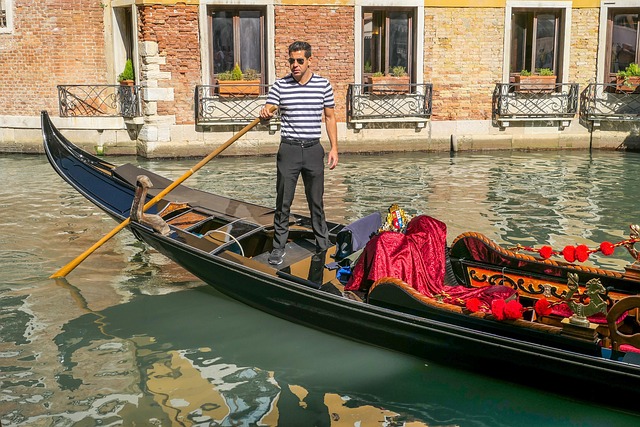
Most visitors watching a gondolier glide past assume they’re seeing a performance for tourists. What they’re actually watching is the tail end of a technique that predates the Republic itself, still practiced today by thousands of ordinary Venetians who have nothing to do with the gondola trade at all.
A Rowing Style Built for a City Without Roads
Voga alla veneta — Venetian rowing — is done standing up, facing forward, using a single oar rather than a pair. It’s a deceptively strange way to move a boat until you understand why: standing and facing forward gives the rower a clear line of sight down narrow canals with blind corners, essential in a city with no room for error and constant cross-traffic. The technique depends on the forcola, an intricately carved wooden oarlock — traditionally walnut or cherry — shaped into an open cradle that lets a single rower execute an entire vocabulary of strokes: forward, braking, turning, all from one position, without ever lifting the oar from the water. Each forcola is carved individually by a small number of remaining craftsmen, shaped specifically to the boat and the rower’s height and style.
Not Just for Gondoliers
Here’s what surprises most visitors: gondoliers are a tiny, licensed minority of the people who row this way. The real heart of voga alla veneta lives in Venice’s remiere — rowing clubs scattered across the city’s sestieri, where residents of every age, background, and income row for sport, tradition, and simply to be on the water. These clubs function as some of the last genuine social gathering spaces left in Venice, where a teenager and a retiree might train side by side, and where the technique is passed down the way a language is — not from a manual, but from someone standing next to you correcting your stroke.
For decades after the Second World War, women’s participation in Venetian rowing faded. That’s reversed sharply in the past ten to fifteen years, with women’s crews now among the most active and competitive in the remiere system — a genuine shift in a tradition that’s otherwise remained almost unchanged for centuries.
The Boats Themselves Are Disappearing Craft
Beyond the gondola, Venice’s lagoon once carried a whole family of distinct rowing boats, each built for a specific job: the wide, stable caorlina, once used for fishing and transport and still raced today by six-person crews; the versatile sandolo, a family boat suited to one to four rowers; the asymmetrical pupparino; and the increasingly rare batela, in its elegant coda di gambero — “shrimp tail” — form, once one of the most common boats on the lagoon and now largely preserved through rowing schools rather than daily use. These boats appear constantly in the work of Venetian painters like Canaletto, Guardi, and Carpaccio — a visual record of a working waterborne city that’s mostly vanished from the canals today.
The Vogalonga Revival
Much of voga alla veneta’s survival as a living practice, rather than a museum piece, traces back to the Vogalonga — a non-competitive, 30-kilometer rowing race through the lagoon, launched in the 1970s partly in protest against motorboat wake damaging the city’s foundations. Its popularity triggered what one Venetian lagoon scholar has called a genuine revolution: a new generation taking up the voga specifically as a sport, reviving clubs and boat types that had been quietly fading.
Why This Matters More Than It Might Seem
There’s a particular kind of local wisdom embedded in this technique — one Venetian rower has put it more bluntly than I could: “we row with our heads; the rest of the world rows with its ass.” Learning the voga isn’t primarily about strength. It’s about balance, timing, and reading water most visitors never learn to see at all. That’s arguably the whole point of the tradition surviving: it forces a kind of attention to the city’s actual physical logic that walking its streets never quite demands.
Experiencing It Yourself
If watching this from a bridge isn’t enough, we offer a hands-on Venetian rowing experience — a genuine attempt at the technique in a stable batellina, in the quiet lagoon away from Grand Canal traffic, guided by someone who’s actually mastered it. It routinely surprises guests as one of the most memorable things they do in Venice, well beyond anything a standard gondola ride offers.
Do you need to be strong or athletic to try voga alla veneta?
No — balance and technique matter far more than raw strength, and lessons in stable training boats are accessible to most fitness levels and ages.
Is this the same skill gondoliers use professionally?
Yes, the underlying technique is identical, though gondoliers undergo years of licensed training and apprenticeship to row Venice’s busiest waterways commercially.
Can visitors watch the remiere clubs train?
Informally, yes — rowing clubs are visible along many of Venice’s quieter canals in the early morning and evening, particularly around the Cannaregio and Giudecca waterfronts, though formal visits typically require an invitation or connection.