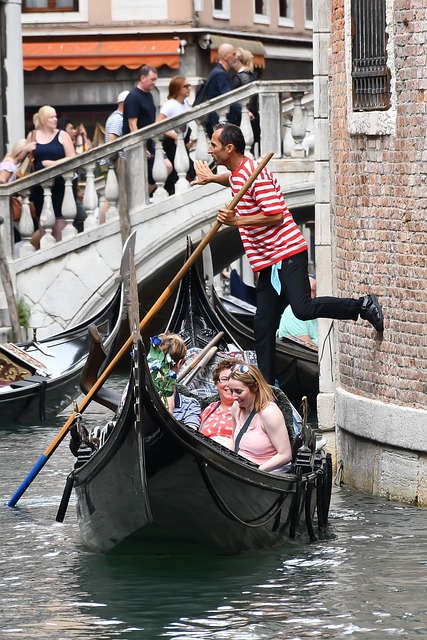
Everyone notices the Basilica. Almost nobody notices the hand-painted sign fifty feet from it, or the strange numbering on the building next door, or the wooden poles leaning out of the water along every canal. After nearly thirty years walking these streets with visitors, I’ve come to believe the small, purely functional details of Venice — the ones nobody designed to be beautiful, they just had to work — are what actually stay with people. Here are the ones I point out most often.
Nizioleti: Street Signs Painted Like Bedsheets
Venice has no standard street signage. Instead, street and campo names are hand-painted directly onto building facades inside a rough white rectangle bordered in black — a nizioleto, Venetian for “little sheet,” because that’s exactly what the white panel resembles. There are roughly 4,000 of them across the city, and they date back to the Napoleonic administration between 1808 and 1816, when Austrian authorities first tried to formally catalogue a city that had spent 1,100 years getting by on oral tradition and local memory alone.
What makes them worth noticing isn’t just the charm — it’s the linguistic fossil they preserve. Because officials recorded the names Venetians actually used rather than translating them into standard Italian, nizioleti are written in genuine Venetian dialect. Every one you pass is a small, accidental act of language preservation, still legible on a wall two centuries later.
A Numbering System With No Streets In It
Look closely at a nizioleto and you’ll sometimes see a number alongside it — and if you try to use those numbers to navigate the way you would in any other city, you’ll get nowhere. Venice doesn’t number buildings by street. It numbers them by sestiere, the six historic districts, in one long continuous sequence that can run past 6,000 before starting over in the next district. A building numbered 4,000 in Cannaregio might sit nowhere near building 3,999 — that number could be blocks away, across a canal, on an entirely different route.
It sounds chaotic, and to a first-time visitor, it absolutely is. But it’s also a genuine relic of how the city organized itself before formal street names existed at all — by neighborhood and parish rather than by thoroughfare. I’ve stopped trying to explain it as a system to be decoded and started explaining it as what it actually is: proof that Venice was never built to make sense to outsiders. It was built to make sense to Venetians.
Altane: The Rooftop Terraces You Have to Look Up to Find
From ground level in the narrow calli, you’d never guess Venice has its own quiet rooftop world. Altane are wooden terraces, built out over rooftops on stilts, unique to Venetian domestic architecture and centuries old. Their original purpose was startlingly specific: Renaissance Venetian women used them to bleach their hair in the sun, spreading a dye called acqua di gioventù through their hair and drawing it up through a wide-brimmed straw hat with the crown cut out, called a solana, to protect their scalp while the sun did the rest.
Today altane are simply prized private space — somewhere to catch light and air in a city built almost entirely of shadowed passageways — and you’ll rarely spot one on a grand Grand Canal palace. They belong to ordinary houses, tucked above the roofline, visible only if you actually look up as you walk. Once you know to check, you’ll start seeing them everywhere.
Briccole: The Poles That Keep the Lagoon Honest
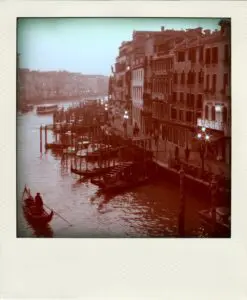
Out in the lagoon and along the city’s wider canals, you’ll notice groups of weathered wooden poles rising out of the water, often lashed together in twos or threes. These are briccole, and they’re not decorative and not for mooring — they mark the boundary of navigable channels, warning boat pilots where deep water ends and the lagoon’s shallow mudflats begin. Regulations governing their placement date back to 1439, and the system has barely changed since.
The wood itself, usually oak, lasts only five to ten years before shipworms and tide wear it down enough to need replacing — which means every briccola you see today is a fairly recent replacement for one just like it, in a chain stretching back nearly six centuries. Retired briccole don’t go to waste; local woodworkers slice the worm-eaten trunks into furniture and decorative panels, turning the lagoon’s own maintenance cycle into small, genuinely one-of-a-kind objects.
Why the Small Things Add Up
None of these details will get top billing on a map or a museum ticket. That’s exactly why I bring guests to them deliberately — they’re the parts of Venice that reveal how the city actually functions day to day, underneath the postcard version everyone already expects. A sign painted like a bedsheet, a numbering system with no logic a visitor could guess, a hairstyling platform on a rooftop, a fence of poles in open water — each one is a small, practical answer to the strange problem of building a working city on a lagoon, and each one is still doing its job centuries later.
This is the layer of Venice I try to build into every private walking tour — not instead of the major sights, but alongside them, so a guest leaves understanding the city rather than just having photographed it. If that kind of close attention to detail is what you’re after, take a look at our private tours, or get in touch through the contact page and I’ll build a walk around exactly this.
Are nizioleti official street signs, or just historic curiosities?
They’re genuinely official — the Comune di Venezia maintains and repaints them, and they remain the city’s actual standard for street signage, with no separate modern system replacing them.
Can you visit an altana, or are they all private?
Almost all altane belong to private residences and aren’t open to visitors, though a handful of hotels and rental apartments include rooftop terrace access that recreates the same experience.
Do briccole ever get replaced with something other than wood?
There’s been growing debate over replacing traditional wooden briccole with a more durable recycled-plastic alternative designed to mimic their appearance, largely due to rising shipworm damage from warmer lagoon water, though wood remains the standard for now.