“What is San Michele? Why would I visit a cemetery? Is there really something worth seeing on Venice’s island of the dead?”
These questions appear from travelers encountering San Michele’s name in guidebooks, recognizing some famous people buried there, curious whether visiting a cemetery offers meaningful experience versus standard tourism, wondering what distinguishes a Venetian cemetery island from ordinary graveyards, seeking to understand whether the visit justifies journey to outlying island location.
The honest answer: San Michele represents genuinely unique Venice experience — a functioning cemetery island established 1407, serving as final resting place for centuries of Venetians alongside notable international figures (Ezra Pound, Igor Stravinsky, Diaghilev, others), featuring distinctive white-stone chapel, walled gardens, carefully maintained graves and monuments creating peaceful contemplative space radically different from bustling Venice proper, offering encounter with death, mortality, historical memory, and Venetian cultural traditions often absent from tourist Venice, creating philosophical and atmospheric experience transcending typical sightseeing and providing genuine reflection on human impermanence and cultural legacy.
After 28 years guiding Venice — understanding how visitors respond to encounters with death and mortality in travel context, recognizing San Michele’s distinctive atmospheric quality, knowing how cemetery visits can generate profound reflection and human connection despite appearing unpromising initially, working with travelers who visit San Michele and report unexpectedly moving experiences that reshape their Venice understanding — I know that San Michele deserves consideration as legitimate destination offering something qualitatively different from conventional attractions.
The fundamental realities most travelers miss:
San Michele isn’t merely “a cemetery to visit” but represents genuine cultural institution reflecting Venetian relationship with death, burial traditions, commemoration practices, creating encounter with Venetian identity beyond typical tourist contexts
The cemetery’s island location (separate from Venice proper, accessible by dedicated vaporetto) creates necessary journey requiring intentional commitment, transforming it from casual stop into pilgrimage-like experience, the separation itself creating psychological and emotional shift
The graves of famous figures (Pound, Stravinsky, Diaghilev) create specific pilgrimage destinations for literary, musical, artistic devotees, people traveling to pay respects to cultural figures they admired, transforming the cemetery into sacred site for particular communities
Understanding that San Michele offers escape from Venice’s overwhelming crowds and tourist density — the island provides genuine quiet, contemplative space unavailable elsewhere in Venice, the peaceful atmosphere becoming valuable precisely because so different from surrounding chaos
The cemetery’s architectural beauty (Renaissance chapel, walled gardens, organized layout) deserves appreciation independent of its death-related function, the designed landscape demonstrating aesthetic attention to mortuary space
The visit creates natural confrontation with mortality and human impermanence — the thousands of graves, the centuries of accumulated death, the famous and unknown resting equally, generating philosophical reflection absent from typical tourism
This is the completely honest San Michele guide — explaining what the cemetery is and its historical significance, identifying notable burials and their cultural importance, describing the visitor experience and atmospheric qualities, providing practical information for visiting, addressing why this unconventional destination offers meaningful experience, and helping you understand whether contemplating death and cultural legacy through cemetery visiting aligns with your Venice approach.
San Michele: History, Purpose, and Venetian Tradition
Understanding the island’s significance in Venice’s cultural and spiritual life.
Historical Foundation and Evolution:
The 1407 establishment:
San Michele was officially established as Venice’s primary cemetery in 1407 (early 15th century), resolving longstanding problem of burial space within densely crowded Venice proper — prior to San Michele, burials occurred in various church locations creating spatial conflict and sanitary concerns
The island’s previous history:
The island housed Benedictine monastery and convent before conversion to cemetery use, the religious history creating spiritual foundation for subsequent mortuary function
The urban planning context:
Venice’s extreme density (literally built on water with limited land) meant cemetery space impossible within the city itself, the island location provided necessary separation while maintaining accessibility — a water journey making cemetery visit distinct ritual rather than incidental neighborhood experience
The functional purpose:
San Michele functioned as Venice’s primary cemetery for centuries (approximately 1407-1869), providing burial space for merchant class, nobility, and common Venetians, representing centuries of accumulated Venetian dead
The municipal transformation:
By 19th century, cemetery space again became inadequate for expanding city, new cemeteries established elsewhere, San Michele’s role modified to maintain historical burials while accepting selective new interments, continuing as major Venetian cemetery though not exclusive burial location
The Cemetery’s Design and Layout:
The Renaissance organization:
The island was designed with structured layout — central chapel, organized grave sections, walled perimeter creating enclosed sacred space distinct from surrounding water and chaos
The chapel and architectural centerpiece:
A Renaissance church (rebuilt 16th century) stands at the cemetery’s center, the white stone structure providing focal point and spiritual anchor for the burial grounds
The walled gardens:
Mature trees, organized pathways, maintained gardens create pastoral atmosphere unusual for cemeteries — the Mediterranean vegetation, monumental cypress trees, flowering plants create beauty within mortality context
The grave organization:
Graves organized into sections by century, wealth level, and nationality, creating visible social stratification (wealthy monuments versus modest stones), the layout revealing Venetian social structures through burial arrangements
The water relationship:
The island’s water boundary creates psychological separation from Venice proper, the water journey itself becoming ritual, the island feeling genuinely removed despite close proximity to city center
Venetian Attitudes Toward Death and Burial:
The Mediterranean tradition:
Venetian burial traditions reflect Mediterranean and Italian Catholic customs — family tombs maintained across generations, regular cemetery visitation for commemoration, death acknowledged openly rather than hidden
The commemoration practice:
Venetian families regularly visit graves maintaining monuments, leaving flowers, preserving memory of deceased — the cemetery functions as active memorial space not merely repository of remains
The famous dead veneration:
Distinguished Venetians and visiting cultural figures received burial honors, the cemetery becoming repository of Venetian and international cultural heritage, graves becoming pilgrimage sites for devotees of buried figures
The social equality principle:
Despite wealth distinctions visible in monument scale, death creates ultimate equality — the grandest monuments eventually decay, the unknown graves endure equally, creating memento mori reflection unavoidable while walking among graves
Notable Burials: Cultural Figures and Their Significance
Understanding who rests at San Michele and why their graves matter.
Ezra Pound (1885-1972):
The literary significance:
Ezra Pound represents major modernist poet and literary innovator — “The Waste Land” and other major 20th-century works influenced by his editorial guidance, his poetry revolutionized English-language verse through imagism and other innovations, his literary legacy permanent
The Venice connection:
Pound lived in Venice final years (1958-1972), settling in the city after complex life spanning multiple continents, artistic movements, political controversies; Venice became his final home and resting place, the city significant in his late work and thinking
The grave pilgrimage:
Pound’s grave attracts literary devotees, scholars, poets visiting to pay respects to the modernist master, the modest burial location contrasting with his monumental literary influence, the pilgrimage reflecting how literature creates transcendent remembrance
The contemplative meditation:
Standing at Pound’s grave, visitors encounter tension between literary immortality (his works enduring, widely read) and physical mortality (the actual remains beneath stone), creating reflection on how cultural achievement transcends physical death
Igor Stravinsky (1882-1971):
The musical revolutionary:
Stravinsky represents one of 20th century’s greatest composers — works like “The Rite of Spring” revolutionized classical music, his compositional innovations spanning multiple styles and periods established him as towering figure in musical history
The Venice connection:
Stravinsky maintained lifelong relationship with Venice, visiting regularly, finding inspiration in the city’s unique character, his final resting place in Venice creating fitting conclusion to artistic relationship spanning decades
The musical pilgrimage:
Musicians and classical music enthusiasts visit Stravinsky’s grave as pilgrimage site, the cemetery becoming destination for those devoted to his musical legacy, the physical grave providing focal point for remembrance and gratitude
The artistic legacy consideration:
Like Pound’s grave, Stravinsky’s burial creates reflection on how artistic genius transcends mortality — his music continues being performed and appreciated centuries after his death, the physical remains less significant than the enduring cultural contribution
Sergei Diaghilev (1872-1929):
The artistic impresario:
Diaghilev founded the Ballets Russes, commissioning masterworks from leading composers and artists (Stravinsky included), revolutionizing dance and theatrical art through his visionary impresario work
The Venice death:
Diaghilev died in Venice (somewhat mysteriously, from complications of illness), the city becoming unexpected final resting place for the Russian theatrical genius
The cultural monument:
Diaghilev’s grave represents artistic patronage legacy — the works he commissioned endure, the artists he discovered became masters, his grave becoming memorial to taste and vision transcending individual artistic practice
Other Notable Burials:
Venetian nobility and merchants: Multiple prominent Venetian families represented, their monuments revealing social importance and wealth
International cultural figures: Artists, musicians, writers from various nations choosing Venice as final resting place, the cemetery becoming international cultural monument
Twentieth-century personalities: Various notable figures representing arts, sciences, and public life, the accumulated graves creating cultural historical record
The Pilgrimage Phenomenon:
The grave-visiting tradition:
Visitors specifically seek certain graves (Pound, Stravinsky, Diaghilev primarily), creating modern pilgrimage tradition where cultural devotion manifests as cemetery visitation, flowers left at graves expressing ongoing relationship with deceased cultural figures
The meaning-making function:
The graves serve memorial purpose beyond physical remains — visiting creates personal connection with cultural legacy, the physical location enabling contemplation and gratitude toward artistic contributions
The Visitor Experience: Atmosphere, Reflection, and Encounter
Understanding what visiting San Michele actually feels like and creates.
The Arrival Ritual:
The vaporetto journey:
Travel to San Michele requires dedicated vaporetto (Line 4.1 or similar), the water journey itself creating ritualistic transition from Venice proper to island of the dead, the crossing creating psychological shift
The island approach:
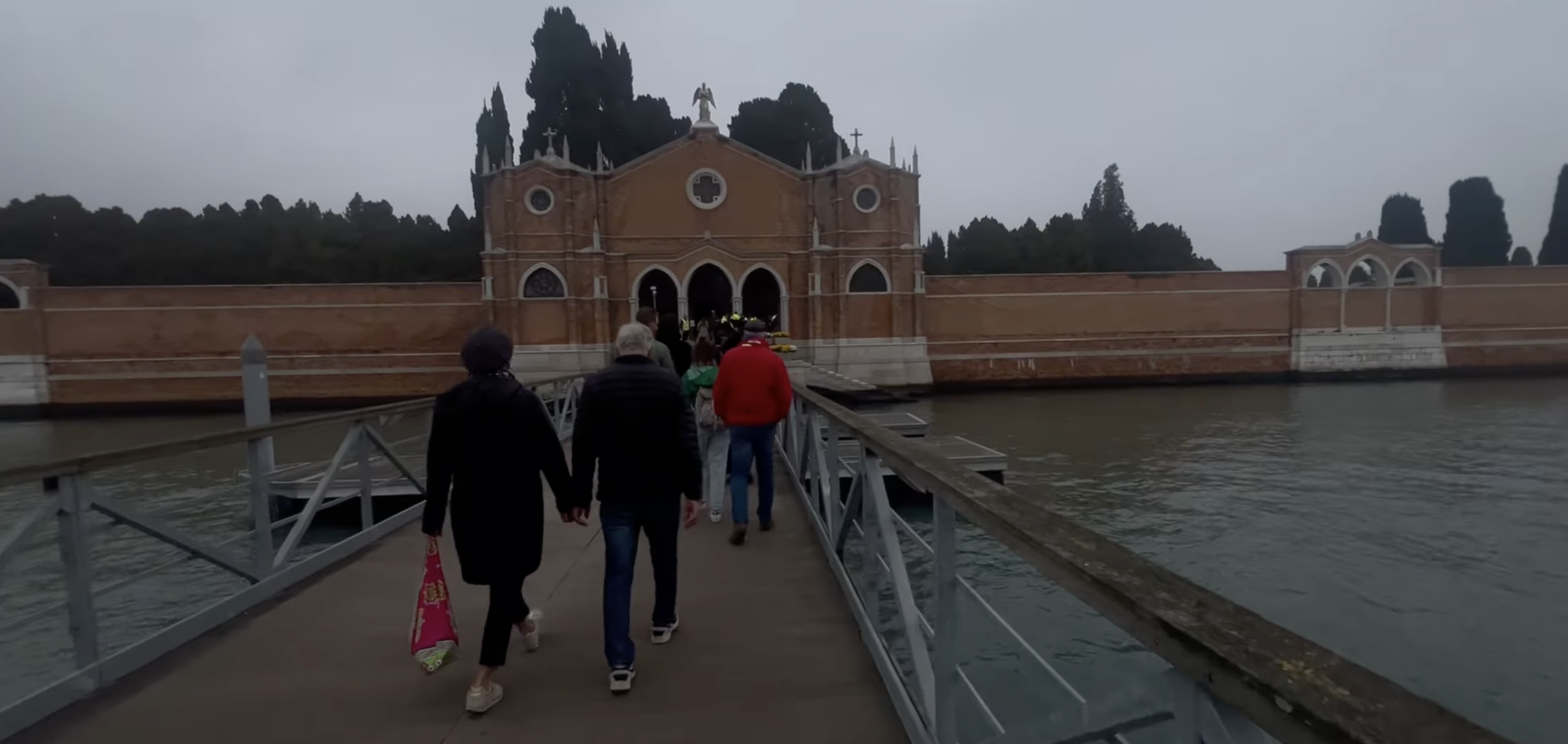
As the boat approaches San Michele, the walled cemetery perimeter becomes visible, the white stone walls and cypress trees creating distinctive visual impression, the island feeling genuinely separate from Venice
The entry gateway:
The cemetery entrance (through the walled perimeter) creates threshold moment — stepping through the gate marks transition from external world into contemplative memorial space, the architectural boundary reinforcing psychological separation
The Atmospheric Quality:
The profound quiet:
Unlike Venice’s constant activity, water traffic, crowds, San Michele offers genuine silence and quiet — the absence of tourism chaos, commercial activity, and human noise creates rare stillness
The light quality:
The open cemetery space, mature trees, and water surroundings create particular light conditions — soft filtered light through cypress, reflections from water, creating contemplative atmosphere
The botanical beauty:
The carefully maintained gardens, Mediterranean vegetation (cypress, flowering plants), seasonal color create aesthetic beauty unexpected in cemetery context — the landscape designed for both memorial purpose and aesthetic appreciation
The time-suspended feeling:
Walking among graves spanning centuries, reading names and dates, encountering repeated patterns (families, generations, centuries of human lives) creates sense of time’s passage and human continuity — the accumulated dead creating palpable sense of historical depth
The Emotional Dimensions:
The mortality confrontation:
The cemetery’s fundamental purpose creates unavoidable confrontation with death and human impermanence — thousands of graves, the inscriptions recording human lives and their endings, creating reflection on mortality absent from typical tourism
The grief observation:
Visiting during family commemoration times (All Saints’ Day, specific feast days), you observe Venetian families tending graves, leaving flowers, remembering deceased, witnessing authentic grief and memory-keeping traditions
The equality reflection:
The grave arrangement (wealthy monuments alongside modest stones) creates visual memento mori — the wealthiest monuments eventually weather and deteriorate equally with simple graves, reflecting mortality’s democratic quality
The legacy contemplation:
Visiting famous graves (Pound, Stravinsky) creates reflection on cultural immortality versus physical mortality — how artistic achievement transcends death, creating legacy outlasting biological existence
The Solitude Possibility:
The rare Venice emptiness:
San Michele offers genuine solitude unavailable elsewhere in Venice — the ability to sit quietly, observe graves, reflect without crowds or commercial pressure, creating meditative possibility
The personal meaning-making:
The quiet and contemplative atmosphere invite personal reflection — visitors often report experiencing profound thoughts about their own mortality, life meaning, relationships with deceased people from their own lives
The philosophical opportunity:
The cemetery creates natural philosophical space — questions about death, legacy, meaning, remembrance, human continuity emerging naturally through the physical environment
Finding Notable Graves: A Practical Guide
Understanding how to locate specific burials.
General Cemetery Organization:
The layout principle:
The cemetery organizes graves into sections, with pathways creating navigable structure, directional signs providing general guidance (though specific grave locations require asking cemetery staff or using guidebooks)
The centuries organization:
Graves roughly organized chronologically, with earlier burials in certain sections, more recent burials in others, allowing chronological exploration alongside specific grave-seeking
The monument diversity:
Visible architectural variation (grand family monuments, modest individual stones, sculptural memorials) creates visual diversity while navigating, the monument scale reflecting historical period and family wealth
Finding Pound, Stravinsky, and Diaghilev:
The specific locations:
All three notable figures rest in the cemetery, their graves marked and generally known, cemetery staff (or guidebooks) providing directions to their specific locations
Pound’s grave: Located in the cemetery’s organized sections (specific location varies by recent guide information, cemetery staff can direct)
Stravinsky’s burial: Similarly accessible through staff direction or cemetery maps
Diaghilev’s cenotaph: Also within cemetery grounds, identifiable through inquiries
The actual experience:
Standing at these graves, visitors often experience complex emotions — the physical remains beneath the stone contrasting with the cultural immortality the figures achieved, the humble burial locations contrasting with international significance, creating humanizing encounter with cultural heroes reduced to mortality
Respectful engagement:
Many visitors leave flowers, sit quietly, or stand in contemplation at significant graves, the pilgrimage aspect involving genuine emotional engagement rather than mere sightseeing
Exploring Unknown Graves:
The random wandering:
Much of San Michele’s power emerges from undirected exploration — reading grave inscriptions, discovering family names repeated across centuries, encountering unknown lives recorded in stone, creating sense of historical continuity
The inscription reading:
Venetian names, dates spanning centuries, occasional photographs and mementos create intimate connection with individual lives, the accumulated graves telling stories of Venice’s population across generations
The family monument discovery:
Observing how families maintained tombs across centuries, multiple generations buried together, the physical monuments revealing family history and social evolution
The Architectural and Spatial Design
Understanding San Michele’s physical beauty and intentional design.
The Renaissance Chapel:
The architectural centerpiece:
The white stone chapel dominates the cemetery’s center, the Renaissance structure providing focal point and spiritual anchor, the architecture demonstrating aesthetic attention to mortuary space
The spiritual function:
The chapel serves ceremonial purpose — funeral services and commemorations occurring within the space, the religious function maintaining spiritual dimension of the cemetery
The architectural beauty:
The chapel represents skilled Renaissance design — proportions, stone work, and architectural details demonstrating craftsmanship and aesthetic intention beyond purely functional requirements
The Walled Enclosure:
The perimeter boundary:
The high stone walls enclosing the cemetery create distinct separation from surrounding water and city, the architectural boundary creating psychological transition into memorial space
The gateway passage:
The entrance gateway marks formal threshold, the passage creating ritualistic entry into sacred space distinct from external world
The enclosed garden quality:
The walls and organization create “garden” atmosphere rather than typical cemetery feeling, the enclosed pastoral space inviting contemplation and aesthetic appreciation
The Tree and Vegetation Design:
The cypress prominence:
Monumental cypress trees (Mediterranean symbol of mortality and eternity) provide vertical emphasis and structural presence throughout cemetery, the mature trees creating environmental frame for graves
The seasonal variation:
Gardens plantings create seasonal color and variation — spring flowers, summer greenery, autumn changes, winter structure, the botanical rhythm underlying the human commemoration purpose
The water integration:
The island’s water boundary creates natural frame — views across lagoon to Venice proper, water reflections creating contemplative visual experience, the water relationship emphasizing separation and removal
Practical Visitor Information
Understanding how to access and experience San Michele.
Location and Transportation:
Island location: San Michele lies in the Venice lagoon, approximately 10-15 minutes vaporetto from San Marco or Rialto areas, distinct island accessible only by water
Vaporetto access:
Line 4.1: Direct service from Fondamente Nove (north Venice) to San Michele, approximately 5-10 minute journey
Line 4.2: Alternative routing, slightly longer journey but serving other lagoon islands
Frequency: Vaporettos run approximately every 10-20 minutes throughout day
Duration and schedule: Early morning departures (approximately 6:00 AM) through evening, check current vaporetto schedule for exact times
Return journey: Return vaporettos available regularly, plan approximately 2-4 hours total time (transportation + visit duration)
Hours of Operation:
Summer hours (approximately April-September): 7:30 AM-6:00 PM
Winter hours (approximately October-March): 7:30 AM-4:00 PM
Closed Mondays: The cemetery typically closes one day weekly (often Monday), verify before traveling
Special closures: Occasionally closes for maintenance or special commemorations, checking ahead prevents wasted journey
Admission:
Free entry: No admission fee for cemetery access (included in general Venetian water access or vaporetto ticket)
Respectful behavior expected: Though free, the space requires respectful engagement — quiet demeanor, respectful treatment of graves and monuments, no disruptive behavior
Practical Preparation:
Footwear: Comfortable walking shoes essential (cemetery involves considerable walking on stone pathways)
Weather consideration: Open cemetery exposed to weather — sun protection, rain preparation, appropriate clothing necessary
Time requirements:
Minimal visit: 45-60 minutes (general exploration, perhaps seeking one significant grave)
Substantial visit: 2-3 hours (extended exploration, multiple graves, contemplative time)
Leisurely visit: 3-4 hours (slow wandering, extensive grave-reading, sitting and reflection time)
Guidance assistance:
Cemetery staff: Available for grave-location inquiries, knowledgeable about significant burials and cemetery history
Guidebooks: Specific San Michele guides and Venice guidebooks provide grave locations and biographical information
Our services: Expert guidance available for San Michele visits providing historical context, notable grave locations, contemplative framework
Photography:
Generally permitted: Photography of monuments and landscapes typically allowed
Respectful limits: Flash and intrusive photography discouraged, respect for families visiting deceased
Compositional beauty: The cemetery offers genuine photographic subjects (architectural details, landscape views, seasonal variations) beyond grave documentation
Special Commemoration Times:
All Saints’ Day (November 1): Major Venetian commemoration with extensive family cemetery visitation, the cemetery crowded with Venetians maintaining graves, authentic cultural observation
Christmas period: Another significant commemoration time with family visits and grave decorations
Individual saint feast days: Specific commemoration occasions varying by family tradition
Visiting during these times: Provides cultural observation opportunity but less solitude, the cemetery active with Venetian traditions
Integration with Venice Exploration
Understanding how San Michele fits within broader visiting strategy.
The Lagoon Experience:
Beyond Venice proper: San Michele visits require leaving Venice’s pedestrian core, experiencing Venice from water perspective, understanding lagoon geography and island relationships
Other lagoon options: The vaporetto journey enables visits to other lagoon islands (Murano, Burano, Torcello) if timing and interest allow, creating broader lagoon understanding
The water-based Venice: The journey itself provides different Venice perspective — viewing the city from water, understanding it as archipelago rather than singular landmass
The Contemplative Pause:
The recovery function: After Venice’s overwhelming crowds and sensory density, San Michele provides recovery space — quiet, contemplation, psychological reset enabling fresh engagement with city
The meditation opportunity: The cemetery’s atmosphere invites slowing pace, extending thinking time beyond typical tourism, creating meditative possibility within Venice visit
The perspective shift: Confronting mortality and historical depth creates different lens for subsequent Venice exploration — human impermanence and historical continuity becoming visible themes throughout city visiting
The Time Strategy:
Optimal placement in visit:
Early visit option: Morning San Michele visit (quiet, good light, contemplative start to day) enables afternoon Venice engagement refreshed
Afternoon option: Afternoon San Michele visit (late light quality, fewer crowds, wind-down before evening) creates contemplative conclusion to daily activities
Multi-day spacing: If visiting 3+ days, dedicating separate morning to San Michele allows full engagement without crowding schedule
Combining with lagoon islands: San Michele vaporetto journey enables visits to Murano, Burano, Torcello on same excursion (though timing becomes tight)
The Philosophical Placement:
The beginning or end: Some visitors choose San Michele early in visit (setting contemplative tone, establishing mortality awareness), others choose final day (creating reflective conclusion, emphasizing legacy and meaning-making)
The standalone pilgrimage: Others treat San Michele as independent pilgrimage visit rather than fitting into tourist itinerary, acknowledging its non-entertainment purpose through dedicated attention
Our Expert Guidance Services
If you want meaningful context for San Michele visit — understanding Venetian death traditions and burial practices, learning about notable figures and their cultural significance, facilitating philosophical and contemplative engagement, providing historical and literary context — we provide specialized San Michele and reflection-focused guidance.
What We Provide:
Venetian cultural context:
- Understanding burial traditions and death rituals
- Explaining cemetery’s historical role in Venetian society
- Contextualizing mortality and commemoration practices
- Understanding family burial patterns and social history revealed through graves
- Exploring Venetian attitudes toward death and remembrance
Notable figure expertise:
- Ezra Pound biographical context and literary significance
- Igor Stravinsky compositional achievement and Venice connection
- Sergei Diaghilev and the Ballets Russes legacy
- Other notable burials and their cultural contributions
- Understanding pilgrimage traditions around cultural figures
Philosophical and contemplative facilitation:
- Framing questions about mortality, legacy, and human meaning
- Creating space for personal reflection on death and impermanence
- Understanding cemetery as sacred/contemplative space
- Facilitating meditation or thoughtful observation
- Connecting San Michele experience to broader Venice themes
Historical and architectural guidance:
- Cemetery design and spatial organization
- Renaissance chapel architecture and artistic context
- Understanding grave monuments and memorial traditions
- Recognizing artistic and sculptural elements
- Contextualizing cemetery within Venice’s urban history
Navigation and practical support:
- Locating specific graves
- Understanding cemetery layout and organization
- Providing biographical and epitaph information
- Optimizing timing for quiet and light conditions
- Logistics for vaporetto transportation
Photograph and documentation support:
- Optimal positioning for photographing monuments
- Light condition timing for landscape photography
- Compositional guidance for architectural details
- Respectful documentation approaches
Broader lagoon context:
- San Michele within lagoon island geography
- Coordinating with Murano, Burano, Torcello visits
- Understanding Venice from water perspective
- Lagoon ecological and historical context
Understanding Complete Context
For Venice’s historical layers: Neighborhood history, architectural heritage, artistic traditions.
For artistic and cultural pilgrimage: Frari Church Titian, Scuola Grande Tintoretto, literary and musical Venice.
For lagoon exploration: Murano, Burano, Torcello island visits, water-based Venice understanding.
For contemplative approaches: Spontaneous wandering, getting lost productively, authentic experiences.
For all experiences: Complete tour options.
San Michele Cemetery Island Represents Unique Venice Experience — Functioning Cemetery Established 1407, Island Location Creating Ritual Separation, Ezra Pound and Igor Stravinsky Notable Burials, Renaissance Chapel and Walled Gardens, Centuries of Accumulated Venetian Dead, Contemplative Atmosphere, Mortality Confrontation, Cultural Legacy Pilgrimage, Escape from Crowded Venice, Philosophical Reflection Opportunity
After 28 years guiding Venice and being featured by Rick Steves, NBC, and US Today, I recognize San Michele as genuinely significant destination offering qualitatively different experience from conventional tourism — the cemetery island established 1407 (solving Venice’s burial-space problem through island location) houses centuries of Venetian dead alongside international cultural figures (Ezra Pound 1885-1972, modernist literary master; Igor Stravinsky 1882-1971, revolutionary 20th-century composer; Sergei Diaghilev 1872-1929, Ballets Russes impresario; others), creates pilgrimage destination for literary, musical, and artistic devotees visiting graves of cultural heroes. The island’s design (Renaissance chapel centerpiece, walled perimeter, mature cypress trees and Mediterranean gardens, organized pathways) creates contemplative space radically different from Venice’s overwhelming crowds and commercial density, the water journey itself constituting ritualistic transition into memorial space. The cemetery functions as active Venetian institution — families regularly maintaining graves and leaving flowers, creating authentic commemoration traditions continuing contemporary practice, the accumulated graves spanning centuries revealing Venetian social history, family patterns, and cultural evolution visible through monument styles and burial organization. Visiting San Michele creates unavoidable confrontation with mortality and human impermanence — thousands of graves, centuries of accumulated death, famous and unknown resting equally, generating philosophical reflection on legacy, cultural immortality versus physical death, human continuity across generations. Practical visiting: accessible by vaporetto Line 4.1 from Fondamente Nove (approximately 5-10 minute journey), free entry, 7:30 AM-6:00 PM hours (closed Mondays typically, varies seasonally), 1-3 hours recommended for meaningful engagement, early morning optimal for quiet and light conditions. We provide expert guidance facilitating philosophical engagement, Venetian cultural context, notable figure biographical expertise, cemetery navigation, historical and architectural understanding, contemplative framework supporting meaningful encounter. Contact us for San Michele experiences creating reflection and connection with Venice’s historical depth and mortality’s universal meaning. Let’s visit Venice’s island of the dead.
Contact us for expert San Michele guidance — contemplative facilitation, cultural context, philosophical reflection support.
Frequently Asked Questions
Is visiting a cemetery a depressing or morbid experience, or can it be genuinely meaningful and contemplative?
Cemetery visiting can be profoundly meaningful and contemplative rather than depressing — the experience depends on approach and openness, creating reflection impossible in typical tourism contexts. Why cemetery visiting isn’t inherently depressing: (1) Celebration of life through remembrance — graves and monuments represent lives lived, families continuing traditions, human persistence across generations, creating affirmation rather than depression. (2) Historical connection and continuity — reading names and dates spanning centuries creates sense of human continuity, understanding yourself as part of long human succession rather than isolated existence. (3) Beauty and care — San Michele’s maintained gardens, monument artistry, careful organization demonstrate respect and beauty dedicated to death, transforming mortuary space into aesthetic environment. (4) Pilgrimage and honor — visiting graves of cultural figures you admire (Pound, Stravinsky) creates meaningful connection, honoring achievements and legacy, the physical grave providing focal point for gratitude and respect. (5) Psychological permission for reflection — unlike daily life’s constant activity and distraction, the cemetery creates natural psychological permission to slow thinking, consider mortality and meaning, contemplate what matters. (6) Existential relief — confronting mortality directly rather than avoiding it often paradoxically reduces anxiety, creating liberation from death-denial that pervades modern life. What actually happens emotionally during cemetery visits: (1) Initial quiet adjustment — entering quiet space creates peaceful mental shift, the absence of crowds and noise enabling different consciousness. (2) Historical awareness growth — reading centuries of names and dates naturally creates awareness of human continuity and your own place within history. (3) Personal meaning-making — the space invites contemplation, many people naturally think about their own mortality, relationships with deceased, what creates lasting meaning. (4) Unexpected beauty appreciation — the care taken with monuments, the maintained gardens, the architectural elements create genuine aesthetic pleasure. (5) Gratitude and connection — visiting graves of cultural figures generates genuine gratitude for their contributions, creating emotional connection across decades or centuries. (6) Peaceful resolution — many visitors report leaving cemetery feeling more peaceful and centered than when arriving, the contemplation creating psychological settling effect. The honest psychological reality: Most people actually find cemetery visiting clarifying rather than depressing — the direct encounter with mortality, the visual evidence of human lives lived, the community of remembrance creates subtle mood elevation. Many report cemetery visits as among their most meaningful travel experiences. Common surprise discovery: Visitors often report expecting to feel sad but discovering they felt peaceful, grateful, connected, or philosophically stimulated instead, the experience surpassing preconceptions in positive directions. My recommendation: Approach San Michele with openness to whatever emerges emotionally — whether peace, gratitude, philosophical reflection, or connection with mortality. The space itself creates contemplative quality; your authentic response will determine the experience’s meaning. Most people find cemetery visiting emotionally and spiritually valuable rather than depressing.
Why would I specifically visit San Michele to see Pound or Stravinsky graves when I could just study their works elsewhere?
Visiting graves of cultural figures you admire creates embodied connection and pilgrimage dimension unavailable through studying their work alone — the physical location where they’re buried creates different encounter with their legacy. What grave-visiting adds beyond knowing the person’s work: (1) Embodied historical presence — being physically at the location where someone’s remains rest creates tangible connection transcending intellectual knowledge, the actual bones and molecules beneath the stone making the person’s historical reality visceral rather than abstract. (2) Pilgrimage tradition and community — visiting graves participates in human tradition of honoring the dead, connecting you with other devotees visiting same location, creating community of appreciation across time. (3) Contemplative focal point — the physical grave provides location for meditation, gratitude, reflection in ways studying work cannot, the place itself enabling emotional and spiritual engagement. (4) Humility and mortality awareness — standing at a grave confronts you with the person’s mortality (despite their cultural immortality), creating humanizing perspective on genius and achievement, understanding that even towering figures become dust and stone. (5) Respect and honor expression — leaving flowers, standing quietly, paying respects at grave expresses gratitude and honor toward the person in ways reading their work cannot, creates felt appreciation rather than intellectual admiration. (6) Literary/artistic pilgrimage tradition — throughout history, people have visited graves of cultural heroes (Shakespeare’s tomb, Dante’s burial, etc.), the tradition itself creating meaning — your participation in that tradition across centuries connects you to broader human community honoring cultural achievement. What specifically visiting Pound or Stravinsky graves offers: (1) Pound at San Michele — the modernist master’s modest burial in Venetian cemetery creates poignant contrast with his monumental literary influence, standing at his grave confronts questions about literary immortality versus physical mortality, the humble location reflecting his late-life Venice residence. (2) Stravinsky at San Michele — the revolutionary composer’s final resting place honors his lifelong Venice connection, visiting his grave enables gratitude toward someone whose music you’ve experienced, the physical location making the person historically real rather than abstract name. (3) The shared island significance — Pound and Stravinsky both rest at San Michele (along with Diaghilev), the shared location creates artistic nexus, visiting simultaneously connects multiple cultural traditions. The analogy understanding: Visiting Pound’s grave is not unlike visiting Shakespeare’s tomb in Stratford-upon-Avon or Dante’s burial site in Ravenna — the person’s works don’t require the physical location, yet standing at their grave creates pilgrimage and honor dimension enriching understanding and appreciation. Many serious literary/musical devotees consider grave-visiting essential to fully honoring figures they admire. The honest perspective: Grave-visiting isn’t intellectually necessary for appreciating work but is emotionally and spiritually meaningful for those who genuinely care about cultural figures’ legacies. If Pound’s or Stravinsky’s work profoundly moved you, visiting their graves transforms that intellectual appreciation into embodied gratitude and respect, creating fuller engagement with their legacy.
Is San Michele better experienced alone for solitude and reflection, or should I take a guided tour to learn contextual information?
San Michele is genuinely enhanced by both approaches — the question presents false choice; different visitors benefit from different strategies depending on personality and goals. The case for solitude-focused visit: (1) Unmediated reflection — exploring alone creates space for your own thoughts without external narration interrupting contemplation, the silence enables personal meaning-making. (2) Flexibility and pace — no group schedule imposed, you can linger at graves calling to you, spend extended time at certain locations, move at your own rhythm without group coordination. (3) Authentic emotional encounter — your unguided response to the space, without external interpretation shaping your experience, creates authentic emotional and philosophical engagement. (4) Peaceful atmosphere — even small guided group adds voices and activity, the solitary visit maintains the cemetery’s contemplative quiet. (5) Personal pilgrimage quality — visiting alone creates pilgrimage dimension — the intentional journey to specific graves, the personal connection, the solitude creating spiritual aspect. The case for guided visit: (1) Contextual enrichment — expert guidance provides historical information, biographical context, Venetian cultural understanding enriching the emotional response with intellectual framework. (2) Grave-location efficiency — not wandering uncertainly seeking specific graves (Pound, Stravinsky, Diaghilev), but guided directly with biographical information enhancing the encounter. (3) Historical layering — expert guide explains cemetery’s significance, notable burials, architectural elements creating comprehensive understanding beyond what individual exploration provides. (4) Philosophical facilitation — skilled guide can frame contemplative questions, suggest reflection angles, facilitate deeper engagement than unguided visiting might achieve. (5) Venetian cultural learning — understanding burial traditions, family patterns, social history visible in monuments requires knowledge guide provides. The hybrid approach (increasingly common): (1) Guided orientation first (30-45 minutes) — expert guide provides context, biographical information, cemetery layout orientation, identifies significant graves, establishes framework. (2) Extended solo exploration after (60-90 minutes) — guide departs, you explore at leisure, visiting graves independently, spending extended time at locations of interest, contemplating with foundation provided by guidance. (3) Group option variations — some guides facilitate but don’t interrupt contemplation, enabling shared experience without constant narration. The personality consideration: (1) Introverts and solitude-seekers — solo visit optimal, the quiet unmediated encounter with your own thoughts and the space itself. (2) Those needing context/knowledge — guided visit optimal, the biographical and historical information enriching emotional response. (3) Extroverts and social learners — guided visit satisfying, the sharing of experience and conversation enriching the visit. (4) Balanced preference — hybrid approach combining guidance with solo exploration offers both context and personal reflection time. My recommendation: First-time visit with guide — provides essential context, biographical information, grave locations creating foundation for meaningful engagement. Return visits solo — having learned context, subsequent visits allow contemplative reflection without external narration, the knowledge informing unguided exploration. If visiting only once, hybrid approach optimal — early guided orientation, then extended solo time creates balanced experience combining learning with personal reflection.