What were the Scuole Grandi of Venice? They were powerful lay confraternities that combined religious devotion, mutual assistance, charitable work, public ceremonies, and civic prestige. Their members included successful citizens outside the ruling patrician class, and their institutions helped organize a remarkable network of social support long before modern welfare systems. The magnificent buildings visitors admire today were headquarters for active communities, not simply galleries of Renaissance paintings.
To understand how Venice functioned, you need to look inside these institutions: at their rules, governing boards, guild connections, processions, charitable obligations, and relationships with the Republic. This article explores that social history rather than repeating a ranking of beautiful Scuole Grandi or a dedicated art guide to Tintoretto.
What a Venetian scuola really was
In Venice, a scuola was usually not a school in the modern American sense. It was an organized association of laypeople who gathered around religious devotion, mutual support, a profession, or a shared community. The term could describe the brotherhood itself and the building where its members met. This double meaning explains why a grand facade can be mistaken for an educational institution.
The earliest organizations emerged in a medieval city that depended on trade and neighborhood relationships. Membership created obligations as well as privileges. A confraternity could offer a social identity to people who did not belong to the ruling patrician elite. It could also turn collective resources into assistance for members and, increasingly, for others in need.
The history is not a simple story of saints and paintings. It is about institutions that helped ordinary Venetians negotiate uncertainty, express faith, establish reputations, and care for one another. The best way to appreciate a scuola is to imagine the meetings, accounts, disagreements, and acts of assistance that took place before its paintings became famous.
The people who could not govern the Republic
The Venetian Republic was governed through an oligarchic political structure dominated by patrician families. Successful merchants, artisans, and professionals outside that hereditary circle could possess wealth and influence without enjoying the same access to government. The confraternities offered a different arena for public recognition.
The Scuola Grande di San Rocco’s own institutional history explains that non-patrician citizens played prominent roles in these associations, while nobles could join but could not hold their governing offices. This was not modern political equality, but it gave members opportunities to lead, administer funds, and participate in public ceremonies.
For an American traveler, a loose analogy might be a combination of a religious association, mutual-aid society, and prestigious civic club. Yet no modern organization matches the scuole perfectly. Their power came from a distinctly Venetian relationship among faith, status, public charity, and the state’s supervision.
The medieval roots of mutual aid
Lay confraternities spread across northern and central Italy during the thirteenth century. In Venice they developed in a setting where religious identity and economic cooperation were woven into daily life. People joined in devotion to Christ, the Virgin Mary, or a patron saint, while also building networks of practical support.
Members contributed resources and accepted rules. The details differed from one association to another, but the broader purpose included religious observance and assistance when hardship struck. Illness, death, and economic insecurity were not abstract possibilities in a crowded maritime city.
It is tempting to call the scuole Venice’s first welfare state. That phrase can be useful as a comparison, provided it is not taken literally. Their aid was selective, religiously framed, and governed by membership and institutional resources, not by universal citizenship rights.
A welfare system before modern welfare
The official history of San Rocco describes confraternal charity as a substantial part of Venetian social life. Assistance initially centered on members and then expanded in various forms beyond them. These organizations helped create a network of support alongside religious institutions and other civic arrangements.
The exact benefits were not identical across every scuola or every century. Aid might involve money, care, spiritual support, or funeral-related obligations depending on the rules and resources. It would be misleading to imagine that any resident could simply arrive and receive a guaranteed public benefit.
The important point is institutional continuity. Charity required bookkeeping, decisions about eligibility, fundraising, and people willing to carry out obligations. Behind the ceremonial clothing and spectacular halls stood a remarkably practical administrative culture.
The mariegola: a constitution in miniature
Every scuola had its own rules, traditionally called a mariegola. The word refers to the association’s foundational regulations and procedures. These documents set out its aims, membership obligations, and internal organization, and they could be amended as circumstances changed.
A mariegola was more than a symbolic manuscript displayed on special occasions. It helped determine how a community functioned, how leaders were chosen, and what members owed one another. In a city proud of its institutions, the written rulebook gave collective identity a durable form.
The City of Venice notes that authorities examined and approved such rules, especially in the context of occupational associations. That involvement reveals the central tension of confraternal life: groups possessed a meaningful degree of internal organization, but they were not independent republics inside the Republic.
The Guardian Grande and the governing board
The leading officer of a major scuola was called the Guardian Grande. Together with councillors, he formed a governing body known as the Banca. The leadership was renewed on a regular basis, and an additional body, the Zonta, could provide oversight.
This organizational vocabulary matters because it changes how we read the rooms. A richly decorated chamber was not merely designed to impress visitors. It could be a place where leaders deliberated over finances, membership, and the association’s charitable responsibilities.
If you imagine the upper halls as boardrooms with sacred art rather than empty galleries, the architecture begins to make sense. Prestige and administration were not separate activities: each reinforced the other.
Why the Republic watched the confraternities
The Venetian government understood that powerful associations could organize people, money, and public ceremonies. That made the scuole useful, but also worth supervising. Official recognition, rules, and oversight helped keep their activities within the Republic’s political framework.
The state also granted privileges and honors. The relationship was therefore not simply one of repression. It was a negotiated arrangement in which civic authorities benefited from charitable and devotional activity while ensuring that alternative centers of influence did not challenge the governing order.
A key lesson for visitors is that Venetian charity was not politically neutral. Institutions that distributed aid also expressed authority, created reputations, and helped define who belonged to the city.
Scuole Grandi and Scuole Piccole
Not every scuola was a Scuola Grande. Venetian sources distinguish devotional, occupational, and national associations, many of which belonged to the broad category of Scuole Piccole. The historically prominent Scuole Grandi developed from the devotional confraternities associated with the Battuti movement.
By the late sixteenth century, six great scuole held this elevated status, according to San Rocco’s institutional history. Their prestige should not obscure the importance of smaller organizations, which could be deeply connected to particular trades or neighborhoods.
The word grande referred to institutional status, not simply to the dimensions of a facade. A modest building could represent a meaningful social network, while an imposing hall could reflect the ambition and accumulated resources of a powerful brotherhood.
The Battuti and the origins of penitential devotion
The Battuti, or flagellants, practiced forms of public penance, including self-flagellation, within a medieval devotional movement. This history can surprise travelers who encounter the scuole primarily as elegant Renaissance buildings.
Their origins should not be confused with the full range of later confraternal activity. Over time, major institutions developed complex charitable, ceremonial, and artistic roles that cannot be reduced to their earliest penitential practices.
The transformation illustrates how religious associations evolved with the city around them. Practices, social standing, and public expectations changed, while a shared institutional identity could persist for centuries.
Scuole of trades and crafts
Artisans organized around occupations such as shoemaking, building, and metalwork. The City of Venice cites associations of calegheri, battiloro, and mureri among its examples. These organizations helped regulate work and preserve professional identity.
Occupational scuole overlapped with the economic world of guilds, but it is important not to treat every confraternity as identical in legal function. Devotion, professional regulation, and mutual support appeared in different combinations across institutions.
Their history connects naturally with Venice’s surviving traditions of craftsmanship. The workshops visitors admire today belong to a much longer story of organized labor and skills passed between generations.
Foreign communities and the meaning of belonging
Venice’s international trade attracted residents from the Adriatic, the eastern Mediterranean, and beyond. Some communities developed their own associations that provided practical and spiritual support. The municipality identifies confraternities connected with Albanians, Dalmatians, Greeks, Bergamaschi, and other groups.
These organizations were not modern embassies, although they could help newcomers find work, assistance, and community. Their names preserve a world in which commercial mobility and local identity existed side by side.
The story complicates the idea of Venice as a closed, self-contained island city. Its prosperity depended on movement across water, and its confraternities helped some newcomers build a place within the urban fabric.
The Scuola Dalmata and Carpaccio
The Scuola Dalmata dei Santi Giorgio e Trifone, often associated with San Giorgio degli Schiavoni, is especially valuable for understanding the social life of a national confraternity. Its artistic heritage includes paintings by Vittore Carpaccio.
Those paintings are not merely decorations collected by an institution. They formed part of the identity and devotional culture of a community with historical connections to the eastern Adriatic.
For visitors, the lesson is to look beyond the question of which famous painter worked here. Ask whose stories the paintings tell, why the association commissioned them, and how the images reinforced a sense of shared belonging.
Public processions and the theater of civic life
Confraternities participated in public religious ceremonies that made their presence visible throughout the city. The City of Venice records processions for patronal feasts and the participation of the scuole in the April 25 celebrations honoring St. Mark.
Banners, ceremonial dress, and ordered movement through the streets gave collective identity a public form. Processions expressed devotion, but also displayed prestige and the association’s recognized place in Venetian society.
The streets were therefore more than routes between monuments. They were ceremonial spaces in which religious communities, institutions, and political authority could be seen in relationship to one another.
A banner was more than a decoration
A confraternity’s banner identified it in public and helped communicate its patronage and status. Its appearance in a procession could make a community visible to people who never entered the scuola’s meeting rooms.
The visual culture of the scuole extended beyond the paintings on their walls. Textiles, insignia, and ceremonial objects belonged to an institutional language that members and spectators understood.
A traveler who notices the importance of symbols in Venice can read the city more carefully. Civic display was not confined to the Doge’s Palace; associations throughout the neighborhoods contributed to it.
Charity and prestige were intertwined
A wealthy confraternity could fund assistance while also investing in an impressive headquarters. To modern eyes, the coexistence of charity and lavish architecture may seem contradictory. For its members, public magnificence could express devotion, legitimacy, and the capacity to serve.
This does not mean every artistic expenditure was universally admired or that every member agreed with every decision. Institutional ambition could produce tension between practical aid and ceremonial prestige.
The productive question is not whether a beautiful hall proves generosity or vanity. It is how the building, the finances, and the social expectations worked together within a particular historical moment.
The architecture of an organized community
San Rocco’s official architectural history describes a building plan with a ground-floor hall, a large upper chapter room, and a smaller Albergo used for meetings of governing bodies. This arrangement reflects a functional hierarchy within the association.
The Sala Capitolare could accommodate major gatherings, while the Albergo offered a more focused space for leadership. The rooms were designed around how the institution operated, not solely around how future tourists might move through them.
When visiting, notice the relationship between circulation, meeting space, and decoration. The paintings become more meaningful when you understand that they surrounded people making decisions about an active community.
San Rocco and the fear of plague
The Scuola Grande di San Rocco was founded in 1478 and dedicated to St. Roch, a saint associated with protection against plague. It acquired relics of the saint in 1485, and devotion to him helped the confraternity grow rapidly.
In a city periodically threatened by epidemics, religious protection and charitable assistance were closely connected in people’s minds. The growth of San Rocco reflects both sincere devotion and the institution’s increasing public importance.
The confraternity became exceptionally wealthy in the sixteenth century. Its history reminds us that the paintings visitors now admire emerged from a social and religious world shaped by illness, mortality, and collective hope.
Tintoretto in context, not just on the ceiling
San Rocco is celebrated for Tintoretto’s extraordinary biblical cycle. Yet the paintings should be seen as part of a living institutional setting rather than as an art gallery assembled for modern visitors.
For a dedicated study of the artist and the works, read our detailed guide to Tintoretto at the Scuola Grande di San Rocco. This article focuses instead on the people and systems that made such a commission possible.
Understanding the confraternity changes the encounter with the art. The images occupied spaces where members gathered, governed, and performed duties, and their subjects were meaningful to that community.
The Scuola Grande di San Marco
The Scuola Grande di San Marco originated in the thirteenth century and eventually established a major headquarters near Santi Giovanni e Paolo. The City of Venice records a devastating fire in 1485 and the rebuilding that produced its celebrated Renaissance facade.
The association’s history reveals the scale of its resources and ambition. Its building later acquired a different civic function and is now associated with Venice’s public hospital.
That continuity makes the site particularly compelling. Read how healthcare works at Venice’s historic hospital for the contemporary story, distinct from the confraternity’s medieval and Renaissance history.
The neighborhood changed around the scuola
San Rocco’s institutional architectural history describes how its buildings helped reshape a district near the Frari. The construction of a church, a smaller headquarters, and later a monumental complex changed the character of the surrounding open space.
This is an important insight: a scuola did not simply occupy an existing prestigious location. In some cases, the association’s investments helped make a place prominent.
A visitor looking at Campo San Rocco is seeing an urban environment partly formed by the institution itself. Charity, architecture, and neighborhood development were intertwined.
The end of the Republic and suppression
The Venetian Republic fell in 1797. In the Napoleonic period, many historic confraternities were suppressed, with consequences for their property, collections, and institutional continuity. The City of Venice dates these measures to 1806–1807.
The story was not identical for every association. San Rocco’s official history explains that its suppression order was revoked, although it lost much of its financial property.
This helps explain why some scuole survive as active institutions while others are primarily remembered through buildings, paintings, or archival records. Institutional history cannot be read from architecture alone.
Why San Rocco is still active
The Scuola Grande di San Rocco identifies itself as a continuing lay confraternity with charitable activities and responsibility for its artistic heritage. Its current membership includes men and women, a reminder that modern membership should not be projected backward unchanged into every historical period.
Its continuing mission is significant precisely because the political and social structures that produced the original confraternities have transformed.
Visitors paying admission help support preservation and institutional activity, according to the scuola’s own information. The site is therefore not simply a preserved monument but a place with ongoing responsibilities.
The difference between a scuola and a church
A scuola could have a patron saint and maintain close relationships with religious buildings, but it was not simply another parish church. Its lay membership, statutes, governing bodies, and charitable obligations gave it a distinct organizational identity.
Some associations built or supported their own churches, while others used nearby religious spaces. The architectural relationship varied, and it is worth identifying the particular institution before making assumptions.
This distinction is especially useful at San Rocco, where the scuola, church, and smaller early headquarters form a connected ensemble with different functions.
What women could and could not do
The history of the confraternities is often narrated through male officeholders and public ceremonial roles. That emphasis reflects historical governance structures and surviving records, not an absence of women from Venetian religious and charitable life.
Membership, participation, and leadership changed across institutions and periods. It would be inaccurate to describe every scuola as uniformly inclusive or to project today’s membership rules into the Renaissance.
A thoughtful visitor should ask whose contributions are visible in paintings and statutes and whose work is harder to recover. The answer requires institutional research rather than assumptions.
How to visit without turning the scuole into a checklist
The best visit begins with a question: what did this institution do for its members and neighbors? At San Rocco, notice the layout of the meeting rooms before looking only for famous paintings. At San Marco, consider the relationship between the historic facade and the modern hospital.
Opening hours, admissions, and access rules vary by institution. Some spaces are active religious or charitable settings, others are museum-like, and some are not freely accessible. Check the official site for each place before planning a visit.
For a complementary art-focused itinerary, see our guide to the most beautiful Scuole Grandi in Venice.
A practical walking route through the social city
An engaging route can begin near the Frari, continue through Campo San Rocco, and use the surrounding streets to discuss charity, plague devotion, and neighborhood development. Another visit can focus on the Scuola Grande di San Marco and the nearby church of Santi Giovanni e Paolo.
These sites are not next door to each other, and visitors should allow time for walking and for a meaningful stop rather than rushing from one facade to another. A third thematic extension toward San Giorgio degli Schiavoni introduces the experience of foreign communities.
The route is more useful when built around historical questions than when treated as a contest to visit the greatest number of interiors. The purpose is to understand a civic network.
A local insight: look for the administrative room
One of the most revealing details is not a celebrated canvas but the smaller room used by the governing board. At San Rocco, the Albergo was associated with meetings of the Banca and Zonta. This space helps explain the practical governance behind the confraternity’s public image.
Visitors often remember the largest and most ornate room, but a modestly scaled administrative space can tell a more precise story about power. It is where the idea of collective charity becomes a matter of decisions, records, and accountability.
This is the kind of observation that changes the experience of a private historical walk. Instead of asking only who painted the ceiling, ask who sat in the room and what responsibilities brought them together.
What the scuole teach about Venice today
Venice’s confraternities reveal a city in which community life depended on organizations beyond the state and the family. They offered social belonging, religious expression, assistance, and opportunities for public prestige, while remaining subject to political oversight.
Their legacy is not an argument that the past was universally fair or that charitable aid reached everyone equally. It is evidence of a complex civic society that helped sustain a maritime republic over centuries.
Igor Scomparin, a licensed guide since 1997, and the Tour Leader Venice team encourage travelers to look beyond monumental art to the people and institutions behind it. The scuole are among the clearest places to begin.
Frequently Asked Questions About Venice’s Confraternities
What were the Scuole Grandi in Venice?
They were major lay confraternities devoted to religious observance, mutual support, charitable activities, and civic ceremony. They were not ordinary schools in the modern sense.
What is the difference between a Scuola Grande and a Scuola Piccola?
The Scuole Grandi were a limited group of prestigious devotional confraternities; the broader Scuole Piccole included many smaller devotional, occupational, and national associations.
Can visitors enter Venice’s historic confraternity buildings?
Some are open to visitors, including the Scuola Grande di San Rocco, while access differs at other sites. Check official opening hours, ticket information, and any restrictions before visiting.
Historical Sources and Photo Credit
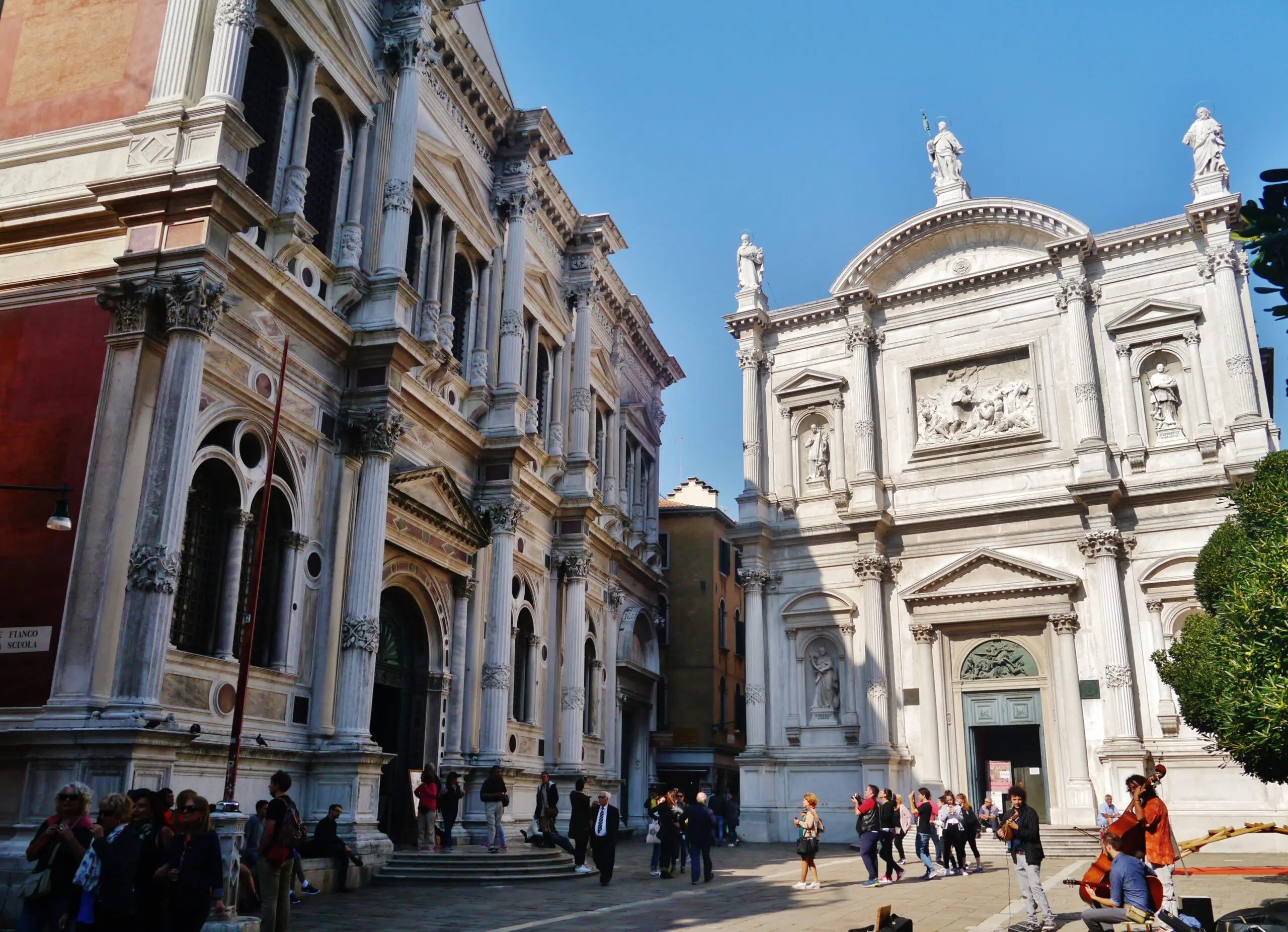
Historical research: Scuola Grande di San Rocco: The Venetian Scuole; City of Venice: Le Scuole Grandi di Venezia; San Rocco institutional history; City of Venice: Scuola Grande di San Marco. Featured image: documentary photograph by Zairon, Wikimedia Commons, CC BY-SA 4.0.