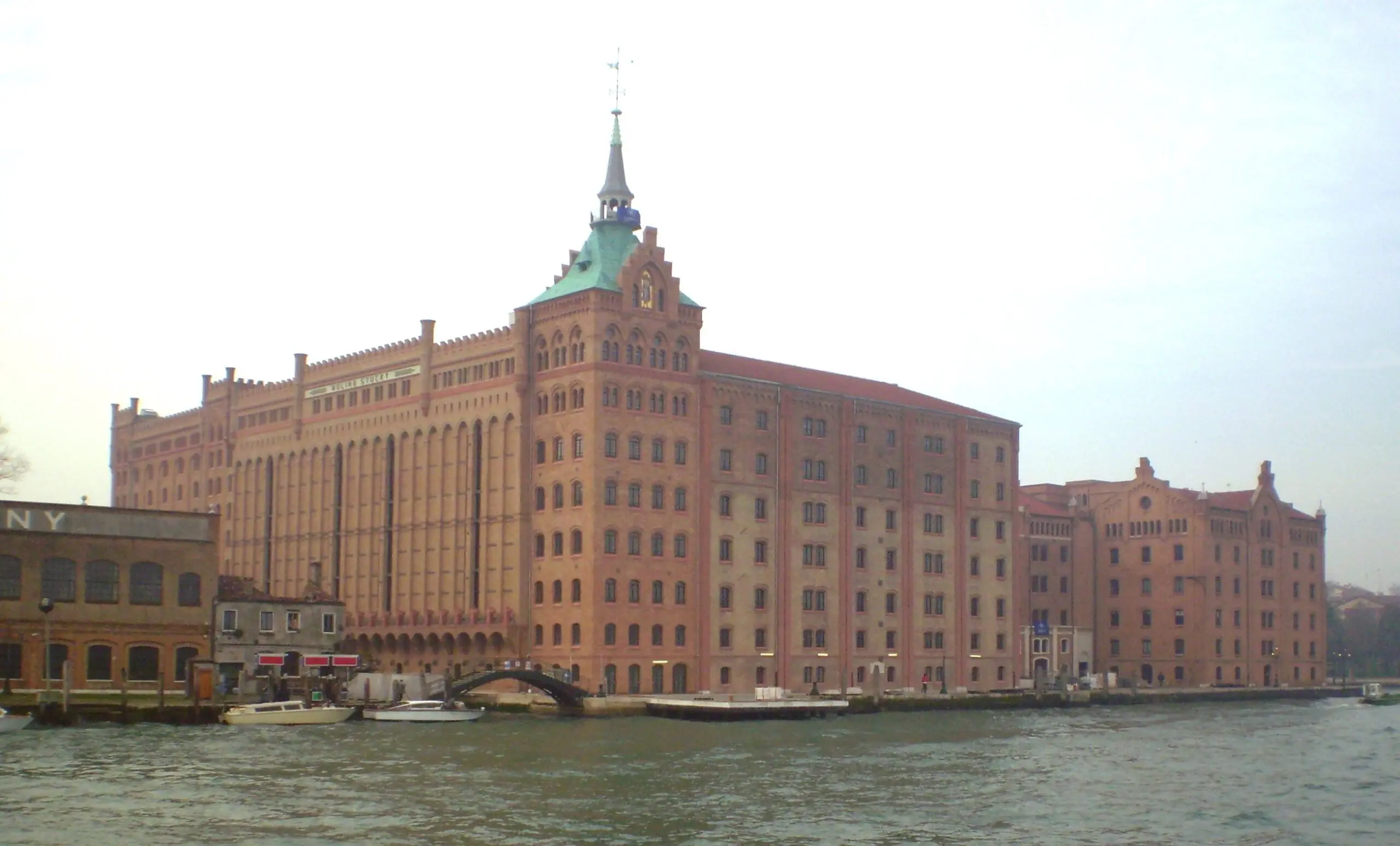
The Stucky dynasty transformed Venice’s Giudecca into an industrial center. Hans arrived from Switzerland, Giovanni built the monumental flour mill, and Giancarlo witnessed the collapse of the family fortune. Their history extends from 1829 to the 2007 conversion of the former factory into a hotel.
Swiss roots and Hans Stucky’s journey
The documented chronology begins with Hans Stucky, a Swiss immigrant who entered the milling trade in northern Italy before moving to Venice. His son Giovanni developed an industrial business that became one of the city’s largest employers, and grandson Giancarlo inherited a very different economic situation. Every stage belongs to a wider history of European trade, industrial technology, and urban change.
The mill stood on Giudecca because Venice’s waterways made grain transport and distribution practical. Its large brick mass and later Neo-Gothic façade were expressions of industrial ambition rather than aristocratic domestic architecture. Looking at the building from the canal makes the relationship between manufacturing, boats, workers, and commerce especially clear.
Milling work in the Treviso area
The mill stood on Giudecca because Venice’s waterways made grain transport and distribution practical. Its large brick mass and later Neo-Gothic façade were expressions of industrial ambition rather than aristocratic domestic architecture. Looking at the building from the canal makes the relationship between manufacturing, boats, workers, and commerce especially clear.
One important distinction is that the fate of a family, the fate of its company, and the fate of its building are not the same thing. The Stucky fortune deteriorated before the factory closed, and the structure survived long after industrial production ended. Its eventual conversion to hospitality preserved a recognizable landmark while changing its social role.
The move to Venice in 1841
One important distinction is that the fate of a family, the fate of its company, and the fate of its building are not the same thing. The Stucky fortune deteriorated before the factory closed, and the structure survived long after industrial production ended. Its eventual conversion to hospitality preserved a recognizable landmark while changing its social role.
Historical accounts published by the City of Venice provide the strongest chronology for the family, including the 1884 inauguration, the 1910 murder of Giovanni, and the mid-twentieth-century closure. The hotel itself documents the scale of production and its 2007 reopening. These sources should be read together rather than treating modern hotel marketing as the whole story.
The former church used as a mill
Historical accounts published by the City of Venice provide the strongest chronology for the family, including the 1884 inauguration, the 1910 murder of Giovanni, and the mid-twentieth-century closure. The hotel itself documents the scale of production and its 2007 reopening. These sources should be read together rather than treating modern hotel marketing as the whole story.
The documented chronology begins with Hans Stucky, a Swiss immigrant who entered the milling trade in northern Italy before moving to Venice. His son Giovanni developed an industrial business that became one of the city’s largest employers, and grandson Giancarlo inherited a very different economic situation. Every stage belongs to a wider history of European trade, industrial technology, and urban change.
Domenica Forti and family life
The documented chronology begins with Hans Stucky, a Swiss immigrant who entered the milling trade in northern Italy before moving to Venice. His son Giovanni developed an industrial business that became one of the city’s largest employers, and grandson Giancarlo inherited a very different economic situation. Every stage belongs to a wider history of European trade, industrial technology, and urban change.
The mill stood on Giudecca because Venice’s waterways made grain transport and distribution practical. Its large brick mass and later Neo-Gothic façade were expressions of industrial ambition rather than aristocratic domestic architecture. Looking at the building from the canal makes the relationship between manufacturing, boats, workers, and commerce especially clear.
The 1848 revolution
The mill stood on Giudecca because Venice’s waterways made grain transport and distribution practical. Its large brick mass and later Neo-Gothic façade were expressions of industrial ambition rather than aristocratic domestic architecture. Looking at the building from the canal makes the relationship between manufacturing, boats, workers, and commerce especially clear.
One important distinction is that the fate of a family, the fate of its company, and the fate of its building are not the same thing. The Stucky fortune deteriorated before the factory closed, and the structure survived long after industrial production ended. Its eventual conversion to hospitality preserved a recognizable landmark while changing its social role.
Giovanni Stucky’s childhood
One important distinction is that the fate of a family, the fate of its company, and the fate of its building are not the same thing. The Stucky fortune deteriorated before the factory closed, and the structure survived long after industrial production ended. Its eventual conversion to hospitality preserved a recognizable landmark while changing its social role.
Historical accounts published by the City of Venice provide the strongest chronology for the family, including the 1884 inauguration, the 1910 murder of Giovanni, and the mid-twentieth-century closure. The hotel itself documents the scale of production and its 2007 reopening. These sources should be read together rather than treating modern hotel marketing as the whole story.
Learning modern milling across Europe
Historical accounts published by the City of Venice provide the strongest chronology for the family, including the 1884 inauguration, the 1910 murder of Giovanni, and the mid-twentieth-century closure. The hotel itself documents the scale of production and its 2007 reopening. These sources should be read together rather than treating modern hotel marketing as the whole story.
The documented chronology begins with Hans Stucky, a Swiss immigrant who entered the milling trade in northern Italy before moving to Venice. His son Giovanni developed an industrial business that became one of the city’s largest employers, and grandson Giancarlo inherited a very different economic situation. Every stage belongs to a wider history of European trade, industrial technology, and urban change.
Giovanni and Antonia Alverà
The documented chronology begins with Hans Stucky, a Swiss immigrant who entered the milling trade in northern Italy before moving to Venice. His son Giovanni developed an industrial business that became one of the city’s largest employers, and grandson Giancarlo inherited a very different economic situation. Every stage belongs to a wider history of European trade, industrial technology, and urban change.
The mill stood on Giudecca because Venice’s waterways made grain transport and distribution practical. Its large brick mass and later Neo-Gothic façade were expressions of industrial ambition rather than aristocratic domestic architecture. Looking at the building from the canal makes the relationship between manufacturing, boats, workers, and commerce especially clear.
The purchase of land on Giudecca
The mill stood on Giudecca because Venice’s waterways made grain transport and distribution practical. Its large brick mass and later Neo-Gothic façade were expressions of industrial ambition rather than aristocratic domestic architecture. Looking at the building from the canal makes the relationship between manufacturing, boats, workers, and commerce especially clear.
One important distinction is that the fate of a family, the fate of its company, and the fate of its building are not the same thing. The Stucky fortune deteriorated before the factory closed, and the structure survived long after industrial production ended. Its eventual conversion to hospitality preserved a recognizable landmark while changing its social role.
The 1884 opening of the mill
One important distinction is that the fate of a family, the fate of its company, and the fate of its building are not the same thing. The Stucky fortune deteriorated before the factory closed, and the structure survived long after industrial production ended. Its eventual conversion to hospitality preserved a recognizable landmark while changing its social role.
Historical accounts published by the City of Venice provide the strongest chronology for the family, including the 1884 inauguration, the 1910 murder of Giovanni, and the mid-twentieth-century closure. The hotel itself documents the scale of production and its 2007 reopening. These sources should be read together rather than treating modern hotel marketing as the whole story.
Why steam power mattered
Historical accounts published by the City of Venice provide the strongest chronology for the family, including the 1884 inauguration, the 1910 murder of Giovanni, and the mid-twentieth-century closure. The hotel itself documents the scale of production and its 2007 reopening. These sources should be read together rather than treating modern hotel marketing as the whole story.
The documented chronology begins with Hans Stucky, a Swiss immigrant who entered the milling trade in northern Italy before moving to Venice. His son Giovanni developed an industrial business that became one of the city’s largest employers, and grandson Giancarlo inherited a very different economic situation. Every stage belongs to a wider history of European trade, industrial technology, and urban change.
Waterborne grain supply
The documented chronology begins with Hans Stucky, a Swiss immigrant who entered the milling trade in northern Italy before moving to Venice. His son Giovanni developed an industrial business that became one of the city’s largest employers, and grandson Giancarlo inherited a very different economic situation. Every stage belongs to a wider history of European trade, industrial technology, and urban change.
The mill stood on Giudecca because Venice’s waterways made grain transport and distribution practical. Its large brick mass and later Neo-Gothic façade were expressions of industrial ambition rather than aristocratic domestic architecture. Looking at the building from the canal makes the relationship between manufacturing, boats, workers, and commerce especially clear.
The industrial waterfront
The mill stood on Giudecca because Venice’s waterways made grain transport and distribution practical. Its large brick mass and later Neo-Gothic façade were expressions of industrial ambition rather than aristocratic domestic architecture. Looking at the building from the canal makes the relationship between manufacturing, boats, workers, and commerce especially clear.
One important distinction is that the fate of a family, the fate of its company, and the fate of its building are not the same thing. The Stucky fortune deteriorated before the factory closed, and the structure survived long after industrial production ended. Its eventual conversion to hospitality preserved a recognizable landmark while changing its social role.
Ernst Wullekopf and the 1895 expansion
One important distinction is that the fate of a family, the fate of its company, and the fate of its building are not the same thing. The Stucky fortune deteriorated before the factory closed, and the structure survived long after industrial production ended. Its eventual conversion to hospitality preserved a recognizable landmark while changing its social role.
Historical accounts published by the City of Venice provide the strongest chronology for the family, including the 1884 inauguration, the 1910 murder of Giovanni, and the mid-twentieth-century closure. The hotel itself documents the scale of production and its 2007 reopening. These sources should be read together rather than treating modern hotel marketing as the whole story.
The Neo-Gothic factory façade
Historical accounts published by the City of Venice provide the strongest chronology for the family, including the 1884 inauguration, the 1910 murder of Giovanni, and the mid-twentieth-century closure. The hotel itself documents the scale of production and its 2007 reopening. These sources should be read together rather than treating modern hotel marketing as the whole story.
The documented chronology begins with Hans Stucky, a Swiss immigrant who entered the milling trade in northern Italy before moving to Venice. His son Giovanni developed an industrial business that became one of the city’s largest employers, and grandson Giancarlo inherited a very different economic situation. Every stage belongs to a wider history of European trade, industrial technology, and urban change.
The Stucky clock and signage
The documented chronology begins with Hans Stucky, a Swiss immigrant who entered the milling trade in northern Italy before moving to Venice. His son Giovanni developed an industrial business that became one of the city’s largest employers, and grandson Giancarlo inherited a very different economic situation. Every stage belongs to a wider history of European trade, industrial technology, and urban change.
The mill stood on Giudecca because Venice’s waterways made grain transport and distribution practical. Its large brick mass and later Neo-Gothic façade were expressions of industrial ambition rather than aristocratic domestic architecture. Looking at the building from the canal makes the relationship between manufacturing, boats, workers, and commerce especially clear.
The workforce of fifteen hundred
The mill stood on Giudecca because Venice’s waterways made grain transport and distribution practical. Its large brick mass and later Neo-Gothic façade were expressions of industrial ambition rather than aristocratic domestic architecture. Looking at the building from the canal makes the relationship between manufacturing, boats, workers, and commerce especially clear.
One important distinction is that the fate of a family, the fate of its company, and the fate of its building are not the same thing. The Stucky fortune deteriorated before the factory closed, and the structure survived long after industrial production ended. Its eventual conversion to hospitality preserved a recognizable landmark while changing its social role.
Flour production and export
One important distinction is that the fate of a family, the fate of its company, and the fate of its building are not the same thing. The Stucky fortune deteriorated before the factory closed, and the structure survived long after industrial production ended. Its eventual conversion to hospitality preserved a recognizable landmark while changing its social role.
Historical accounts published by the City of Venice provide the strongest chronology for the family, including the 1884 inauguration, the 1910 murder of Giovanni, and the mid-twentieth-century closure. The hotel itself documents the scale of production and its 2007 reopening. These sources should be read together rather than treating modern hotel marketing as the whole story.
Giovanni’s wealth
Historical accounts published by the City of Venice provide the strongest chronology for the family, including the 1884 inauguration, the 1910 murder of Giovanni, and the mid-twentieth-century closure. The hotel itself documents the scale of production and its 2007 reopening. These sources should be read together rather than treating modern hotel marketing as the whole story.
The documented chronology begins with Hans Stucky, a Swiss immigrant who entered the milling trade in northern Italy before moving to Venice. His son Giovanni developed an industrial business that became one of the city’s largest employers, and grandson Giancarlo inherited a very different economic situation. Every stage belongs to a wider history of European trade, industrial technology, and urban change.
The family residence at Palazzo Grassi
The documented chronology begins with Hans Stucky, a Swiss immigrant who entered the milling trade in northern Italy before moving to Venice. His son Giovanni developed an industrial business that became one of the city’s largest employers, and grandson Giancarlo inherited a very different economic situation. Every stage belongs to a wider history of European trade, industrial technology, and urban change.
The mill stood on Giudecca because Venice’s waterways made grain transport and distribution practical. Its large brick mass and later Neo-Gothic façade were expressions of industrial ambition rather than aristocratic domestic architecture. Looking at the building from the canal makes the relationship between manufacturing, boats, workers, and commerce especially clear.
The prince of millers
The mill stood on Giudecca because Venice’s waterways made grain transport and distribution practical. Its large brick mass and later Neo-Gothic façade were expressions of industrial ambition rather than aristocratic domestic architecture. Looking at the building from the canal makes the relationship between manufacturing, boats, workers, and commerce especially clear.
One important distinction is that the fate of a family, the fate of its company, and the fate of its building are not the same thing. The Stucky fortune deteriorated before the factory closed, and the structure survived long after industrial production ended. Its eventual conversion to hospitality preserved a recognizable landmark while changing its social role.
Philanthropy and labor
One important distinction is that the fate of a family, the fate of its company, and the fate of its building are not the same thing. The Stucky fortune deteriorated before the factory closed, and the structure survived long after industrial production ended. Its eventual conversion to hospitality preserved a recognizable landmark while changing its social role.
Historical accounts published by the City of Venice provide the strongest chronology for the family, including the 1884 inauguration, the 1910 murder of Giovanni, and the mid-twentieth-century closure. The hotel itself documents the scale of production and its 2007 reopening. These sources should be read together rather than treating modern hotel marketing as the whole story.
The assassination in 1910
Historical accounts published by the City of Venice provide the strongest chronology for the family, including the 1884 inauguration, the 1910 murder of Giovanni, and the mid-twentieth-century closure. The hotel itself documents the scale of production and its 2007 reopening. These sources should be read together rather than treating modern hotel marketing as the whole story.
The documented chronology begins with Hans Stucky, a Swiss immigrant who entered the milling trade in northern Italy before moving to Venice. His son Giovanni developed an industrial business that became one of the city’s largest employers, and grandson Giancarlo inherited a very different economic situation. Every stage belongs to a wider history of European trade, industrial technology, and urban change.
Giancarlo’s inheritance
The documented chronology begins with Hans Stucky, a Swiss immigrant who entered the milling trade in northern Italy before moving to Venice. His son Giovanni developed an industrial business that became one of the city’s largest employers, and grandson Giancarlo inherited a very different economic situation. Every stage belongs to a wider history of European trade, industrial technology, and urban change.
The mill stood on Giudecca because Venice’s waterways made grain transport and distribution practical. Its large brick mass and later Neo-Gothic façade were expressions of industrial ambition rather than aristocratic domestic architecture. Looking at the building from the canal makes the relationship between manufacturing, boats, workers, and commerce especially clear.
Competition and changing transport
The mill stood on Giudecca because Venice’s waterways made grain transport and distribution practical. Its large brick mass and later Neo-Gothic façade were expressions of industrial ambition rather than aristocratic domestic architecture. Looking at the building from the canal makes the relationship between manufacturing, boats, workers, and commerce especially clear.
One important distinction is that the fate of a family, the fate of its company, and the fate of its building are not the same thing. The Stucky fortune deteriorated before the factory closed, and the structure survived long after industrial production ended. Its eventual conversion to hospitality preserved a recognizable landmark while changing its social role.
The First World War
One important distinction is that the fate of a family, the fate of its company, and the fate of its building are not the same thing. The Stucky fortune deteriorated before the factory closed, and the structure survived long after industrial production ended. Its eventual conversion to hospitality preserved a recognizable landmark while changing its social role.
Historical accounts published by the City of Venice provide the strongest chronology for the family, including the 1884 inauguration, the 1910 murder of Giovanni, and the mid-twentieth-century closure. The hotel itself documents the scale of production and its 2007 reopening. These sources should be read together rather than treating modern hotel marketing as the whole story.
The crisis of the 1930s
Historical accounts published by the City of Venice provide the strongest chronology for the family, including the 1884 inauguration, the 1910 murder of Giovanni, and the mid-twentieth-century closure. The hotel itself documents the scale of production and its 2007 reopening. These sources should be read together rather than treating modern hotel marketing as the whole story.
The documented chronology begins with Hans Stucky, a Swiss immigrant who entered the milling trade in northern Italy before moving to Venice. His son Giovanni developed an industrial business that became one of the city’s largest employers, and grandson Giancarlo inherited a very different economic situation. Every stage belongs to a wider history of European trade, industrial technology, and urban change.
The loss of the family fortune
The documented chronology begins with Hans Stucky, a Swiss immigrant who entered the milling trade in northern Italy before moving to Venice. His son Giovanni developed an industrial business that became one of the city’s largest employers, and grandson Giancarlo inherited a very different economic situation. Every stage belongs to a wider history of European trade, industrial technology, and urban change.
The mill stood on Giudecca because Venice’s waterways made grain transport and distribution practical. Its large brick mass and later Neo-Gothic façade were expressions of industrial ambition rather than aristocratic domestic architecture. Looking at the building from the canal makes the relationship between manufacturing, boats, workers, and commerce especially clear.
The workers’ factory occupation
The mill stood on Giudecca because Venice’s waterways made grain transport and distribution practical. Its large brick mass and later Neo-Gothic façade were expressions of industrial ambition rather than aristocratic domestic architecture. Looking at the building from the canal makes the relationship between manufacturing, boats, workers, and commerce especially clear.
One important distinction is that the fate of a family, the fate of its company, and the fate of its building are not the same thing. The Stucky fortune deteriorated before the factory closed, and the structure survived long after industrial production ended. Its eventual conversion to hospitality preserved a recognizable landmark while changing its social role.
The closure in 1954
One important distinction is that the fate of a family, the fate of its company, and the fate of its building are not the same thing. The Stucky fortune deteriorated before the factory closed, and the structure survived long after industrial production ended. Its eventual conversion to hospitality preserved a recognizable landmark while changing its social role.
Historical accounts published by the City of Venice provide the strongest chronology for the family, including the 1884 inauguration, the 1910 murder of Giovanni, and the mid-twentieth-century closure. The hotel itself documents the scale of production and its 2007 reopening. These sources should be read together rather than treating modern hotel marketing as the whole story.
Giancarlo’s testament
Historical accounts published by the City of Venice provide the strongest chronology for the family, including the 1884 inauguration, the 1910 murder of Giovanni, and the mid-twentieth-century closure. The hotel itself documents the scale of production and its 2007 reopening. These sources should be read together rather than treating modern hotel marketing as the whole story.
The documented chronology begins with Hans Stucky, a Swiss immigrant who entered the milling trade in northern Italy before moving to Venice. His son Giovanni developed an industrial business that became one of the city’s largest employers, and grandson Giancarlo inherited a very different economic situation. Every stage belongs to a wider history of European trade, industrial technology, and urban change.
The abandoned industrial landmark
The documented chronology begins with Hans Stucky, a Swiss immigrant who entered the milling trade in northern Italy before moving to Venice. His son Giovanni developed an industrial business that became one of the city’s largest employers, and grandson Giancarlo inherited a very different economic situation. Every stage belongs to a wider history of European trade, industrial technology, and urban change.
The mill stood on Giudecca because Venice’s waterways made grain transport and distribution practical. Its large brick mass and later Neo-Gothic façade were expressions of industrial ambition rather than aristocratic domestic architecture. Looking at the building from the canal makes the relationship between manufacturing, boats, workers, and commerce especially clear.
Restoration in the 1990s
The mill stood on Giudecca because Venice’s waterways made grain transport and distribution practical. Its large brick mass and later Neo-Gothic façade were expressions of industrial ambition rather than aristocratic domestic architecture. Looking at the building from the canal makes the relationship between manufacturing, boats, workers, and commerce especially clear.
One important distinction is that the fate of a family, the fate of its company, and the fate of its building are not the same thing. The Stucky fortune deteriorated before the factory closed, and the structure survived long after industrial production ended. Its eventual conversion to hospitality preserved a recognizable landmark while changing its social role.
The fire of April 2003
One important distinction is that the fate of a family, the fate of its company, and the fate of its building are not the same thing. The Stucky fortune deteriorated before the factory closed, and the structure survived long after industrial production ended. Its eventual conversion to hospitality preserved a recognizable landmark while changing its social role.
Historical accounts published by the City of Venice provide the strongest chronology for the family, including the 1884 inauguration, the 1910 murder of Giovanni, and the mid-twentieth-century closure. The hotel itself documents the scale of production and its 2007 reopening. These sources should be read together rather than treating modern hotel marketing as the whole story.
The hotel opening in June 2007
Historical accounts published by the City of Venice provide the strongest chronology for the family, including the 1884 inauguration, the 1910 murder of Giovanni, and the mid-twentieth-century closure. The hotel itself documents the scale of production and its 2007 reopening. These sources should be read together rather than treating modern hotel marketing as the whole story.
The documented chronology begins with Hans Stucky, a Swiss immigrant who entered the milling trade in northern Italy before moving to Venice. His son Giovanni developed an industrial business that became one of the city’s largest employers, and grandson Giancarlo inherited a very different economic situation. Every stage belongs to a wider history of European trade, industrial technology, and urban change.
How Giudecca changed
The documented chronology begins with Hans Stucky, a Swiss immigrant who entered the milling trade in northern Italy before moving to Venice. His son Giovanni developed an industrial business that became one of the city’s largest employers, and grandson Giancarlo inherited a very different economic situation. Every stage belongs to a wider history of European trade, industrial technology, and urban change.
The mill stood on Giudecca because Venice’s waterways made grain transport and distribution practical. Its large brick mass and later Neo-Gothic façade were expressions of industrial ambition rather than aristocratic domestic architecture. Looking at the building from the canal makes the relationship between manufacturing, boats, workers, and commerce especially clear.
The factory seen from the canal
The mill stood on Giudecca because Venice’s waterways made grain transport and distribution practical. Its large brick mass and later Neo-Gothic façade were expressions of industrial ambition rather than aristocratic domestic architecture. Looking at the building from the canal makes the relationship between manufacturing, boats, workers, and commerce especially clear.
One important distinction is that the fate of a family, the fate of its company, and the fate of its building are not the same thing. The Stucky fortune deteriorated before the factory closed, and the structure survived long after industrial production ended. Its eventual conversion to hospitality preserved a recognizable landmark while changing its social role.
What visitors can still discover
One important distinction is that the fate of a family, the fate of its company, and the fate of its building are not the same thing. The Stucky fortune deteriorated before the factory closed, and the structure survived long after industrial production ended. Its eventual conversion to hospitality preserved a recognizable landmark while changing its social role.
Historical accounts published by the City of Venice provide the strongest chronology for the family, including the 1884 inauguration, the 1910 murder of Giovanni, and the mid-twentieth-century closure. The hotel itself documents the scale of production and its 2007 reopening. These sources should be read together rather than treating modern hotel marketing as the whole story.
The legacy of three generations
Historical accounts published by the City of Venice provide the strongest chronology for the family, including the 1884 inauguration, the 1910 murder of Giovanni, and the mid-twentieth-century closure. The hotel itself documents the scale of production and its 2007 reopening. These sources should be read together rather than treating modern hotel marketing as the whole story.
The documented chronology begins with Hans Stucky, a Swiss immigrant who entered the milling trade in northern Italy before moving to Venice. His son Giovanni developed an industrial business that became one of the city’s largest employers, and grandson Giancarlo inherited a very different economic situation. Every stage belongs to a wider history of European trade, industrial technology, and urban change.
Three complementary Venice stories
Read how Venice works before sunrise, why Venice has no cars, and the hidden details that tell Venice’s real story.
Sources and photo
The City of Venice historical account provides the family chronology. The Hilton history confirms the reopening. The featured photograph by Lucarelli is in the public domain on Wikimedia Commons.
Explore the wider story
For related perspectives, discover Venice’s merchant houses; historic floating markets; the Arsenal’s industrial heritage. These articles add historical and practical context to this subject.
Frequently Asked Questions
Who founded Molino Stucky?
Giovanni Stucky, son of Swiss immigrant Hans Stucky, built the Giudecca flour mill inaugurated in 1884.
What happened to the Stucky family?
Giovanni was murdered in 1910; his son Giancarlo later suffered major financial decline, while the factory continued until the mid-1950s.
When did Molino Stucky become a hotel?
The former mill reopened as Hilton Molino Stucky Venice on June 1, 2007.