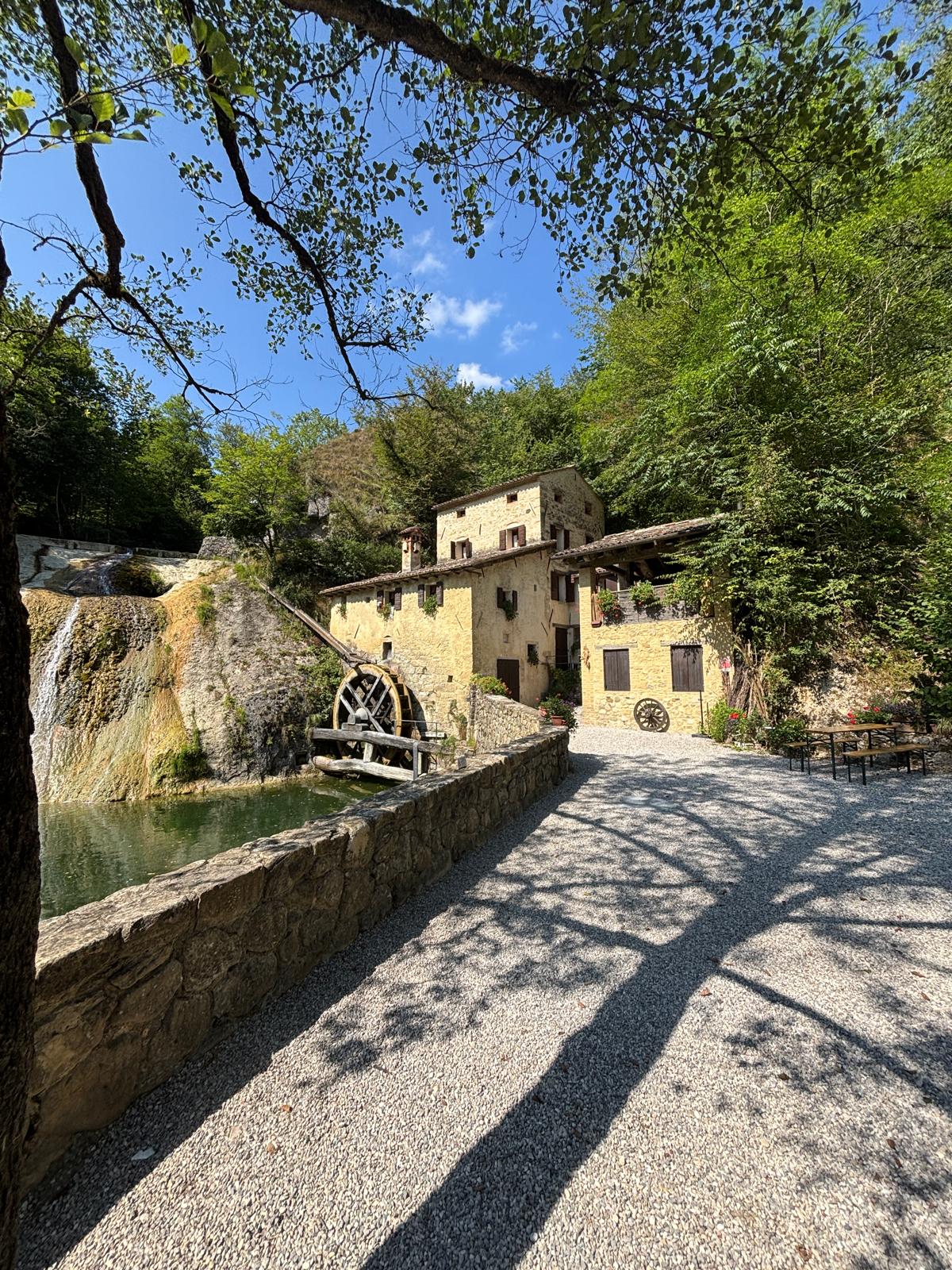
Along the narrow road connecting Refrontolo to the hillside village of Rolle, tucked directly against a rock face at the base of a small waterfall, sits one of the most genuinely fairy-tale spots in the entire Prosecco Hills: a small stone-and-wood watermill nearly four centuries old, its wooden wheel still turning in the same stream that’s powered it since the 17th century. Molinetto della Croda is exactly the kind of place I send guests who’ve already done the standard winery circuit and want something quieter, older, and considerably less crowded.
Built Into the Rock in 1630
The mill dates to 1630, built directly against a rocky outcrop, the “Croda” that gives it its name, in the Lierza Valley within the municipality of Refrontolo, in the province of Treviso. Shortly after its original construction, a small housing addition for the resident caretaker family was built alongside a stable and a granary, transforming the mill from a purely functional structure into a genuine working household, home to generations of milling families who lived and worked directly beside the water that powered their livelihood.
The mill drew its power from the Torrente Lierza, the main tributary of the Soligo river, channeling the stream’s flow at the base of a roughly 12-meter waterfall to turn its grinding wheel. For over three centuries, the mill ground grain into flour, most notably for polenta, the cornmeal staple that remains a defining dish of Veneto cuisine, serving the surrounding rural community until it finally ceased operation in 1953.
A Waterfall With Its Own Geological Trick
The waterfall powering Molinetto della Croda carries a genuinely curious geological detail worth looking for on site. Partway down its 12-meter drop, a visible hole in the rock swallows part of the falling water, which then re-emerges lower down inside the basin beneath the falls, an interesting erosion phenomenon carved gradually into rock hard enough to have resisted the water’s persistent work for a very long time before finally giving way to it. The basin itself moves with its own circular current, strong enough to keep floating debris from ever fully escaping the pool, a small natural detail that adds a genuinely mesmerizing quality to sitting beside the water for any length of time.
A History Shadowed by the Same Water That Gave It Life
The Lierza stream that powered the mill for centuries has also, at points across its history, turned violently against it. Serious flooding damaged the mill’s structure in both 1934 and 1941, a recurring vulnerability inherent to any building sited directly beside a mountain stream capable of rising suddenly after heavy rain. More recently, in August 2014, a sudden, devastating flash flood struck the area during a public event held near the mill, when the Lierza overflowed with tragic consequences that the local community still remembers solemnly today. It’s a sobering reminder, alongside the mill’s undeniable charm, of the same restless natural force that both gave this building its purpose for three centuries and periodically threatened its survival.
From Ruin to Restored Museum
By the mid-20th century, with milling operations ended and the building left largely unused, Molinetto della Croda fell into a real period of neglect and decay. A first structural consolidation effort took place in the 1970s, but it wasn’t until the Municipality of Refrontolo purchased the property around 1991 that a genuinely thorough restoration returned the mill to something close to its historic appearance. That restoration faithfully rebuilt the original millstone and grinding mechanism, still operational and viewable today, and transformed the building into a small museum dedicated to traditional milling and rural life in the Lierza Valley, alongside space for rotating exhibitions, including a notable 2009 retrospective dedicated to the painter Angelo Lorenzon, and an annual international nativity scene exhibition held each winter, drawing visitors well outside the mill’s usual warm-weather season.
A Movie Star, Briefly
Molinetto della Croda’s genuinely picturesque setting caught the eye of Italian cinema decades before its formal restoration. In 1977, the mill served as a filming location for Mogliamante, starring Marcello Mastroianni and Laura Antonelli, two of the biggest names in Italian film at the time, a small but genuine claim to cinematic fame for a rural watermill most visitors today discover purely by word of mouth rather than film history.
Visiting Molinetto della Croda
The mill sits directly along the scenic road linking Refrontolo to Rolle, itself one of the most photogenic villages in the entire Prosecco Hills and the first village ever placed under FAI protection, making the two an entirely natural pairing for anyone exploring this stretch of the Conegliano Valdobbiadene wine country. Outdoor picnic tables sit near the mill for anyone who wants to bring their own food and simply sit beside the waterfall for a while, and a small parking area a short walk away makes access straightforward. Walking paths trace the stream on either side of the mill, offering several different vantage points on both the waterfall and the building itself, particularly rewarding in spring when the Lierza runs fuller and the surrounding vegetation is at its greenest. The mill’s interior museum keeps more limited opening hours than the surrounding grounds, so it’s worth checking current days and times before planning a visit specifically around seeing the working millstone in operation.
Plan your visit: Explore the Prosecco Hills covers the wider Conegliano and Valdobbiadene wine country surrounding Refrontolo, and reaching out through our customized private tours page lets us build an itinerary that pairs Molinetto della Croda with nearby Rolle and the region’s wineries.
Frequently Asked Questions
How old is Molinetto della Croda, and is it still a working mill?
The mill dates to 1630. It operated continuously for over three centuries, grinding grain until it closed in 1953. Following restoration by the Municipality of Refrontolo around 1991, the original millstone was faithfully rebuilt and remains operational today as part of the site’s small milling museum.
Where exactly is Molinetto della Croda, and can it be combined with a visit to Rolle?
The mill sits in the Lierza Valley in the municipality of Refrontolo, Treviso province, directly along the road connecting Refrontolo to the nearby hilltop village of Rolle. The two make a natural, easy pairing, both sitting within the heart of the UNESCO-listed Prosecco Hills wine country.
Is Molinetto della Croda open year-round?
The mill’s grounds and waterfall are generally accessible year-round, though the interior museum keeps more limited hours that can vary by season, and the site also hosts an annual international nativity scene exhibition each winter. It’s worth confirming current opening times before planning a visit specifically around the mill’s interior.