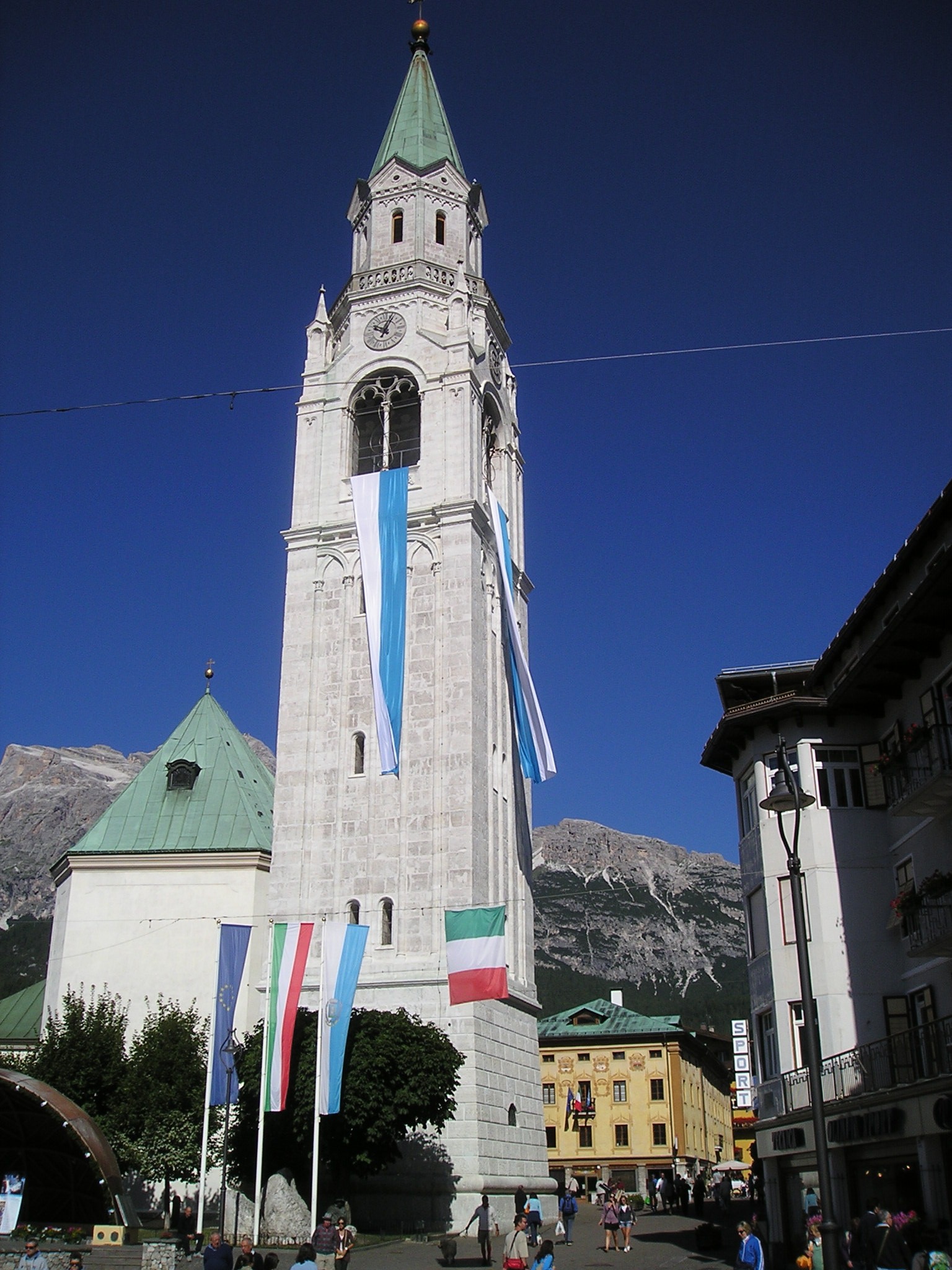
Ask most Americans what they know about Cortina d’Ampezzo, and the answer, if there is one, usually involves the Winter Olympics or a vague memory of a James Bond ski chase. Both are genuinely part of the story, but they’re really the second half of it. Cortina’s fame didn’t start with a five-ringed flag or a movie camera; it started with a mountain town caught for centuries between empires, and it’s that longer, stranger history that actually explains why this specific alpine valley became the single most glamorous address in the Italian Dolomites.
Caught Between Venice and Vienna for Five Centuries
Cortina sits in the Boite river valley, in a broad glacial basin known as the Conca d’Ampezzo, and its history is inseparable from its position on the border between competing powers. During the medieval period, the area fell under the joint jurisdiction of the Patriarchate of Aquileia and the Holy Roman Empire, before the Republic of Venice conquered it in 1420, bringing it, for a time, under Venetian rule. Venetian control didn’t last: from 1508 onward, Cortina spent most of the following four centuries under Habsburg rule, part of Austria and later the Austro-Hungarian Empire’s Tyrolean crownland, remaining an Austrian possession until the end of the First World War.
What makes that long Austrian chapter genuinely interesting is what it didn’t do to the town’s identity. Despite centuries under German-speaking Habsburg administration, Cortina never actually became a German-speaking territory itself. It remained part of Ladinia, the cultural and linguistic region defined by the Ladin language, a distinct Romance language still spoken across several Dolomite valleys today, and the town’s architecture, cuisine, and local traditions preserved a genuinely unique blend of Ladin, Tyrolean, and Italian influences that survives, at least in fragments, right through to the present day.
A Front Line, Then a New Flag
That centuries-long border position turned violently relevant during the First World War, when the surrounding Dolomites became one of the most brutal, high-altitude fronts of the entire conflict, the Italo-Austrian front cutting directly through peaks and valleys around Cortina itself. The scars of that fighting are still visible today across the surrounding mountains: preserved trenches, tunnels, and fortifications carved directly into rock at genuinely extreme altitude, remnants of a mountain war fought in conditions almost impossible to imagine from a comfortable valley floor. When the war ended in 1918, Cortina was formally ceded to Italy, closing out four centuries of Habsburg rule and beginning the town’s identity as part of the modern Italian state, a transition formalized over the following years and reflected in the town’s own 1928 Latin motto, granted alongside its flag and coat of arms: Modo Vivo ac Tuta Quiesco, roughly, “I live frugally and rest secure.”
Discovered by Mountaineers, Claimed by the Jet Set
Cortina’s transformation from a remote alpine valley into an international glamour destination actually began decades before any Olympic flag flew over it. Starting in the final decades of the 19th century, mountaineering became a fashionable pursuit among the Austrian, English, and French upper classes, and this specific corner of the Dolomites, with its dramatic, pale limestone peaks, drew increasing numbers of well-heeled climbers and travelers who fell thoroughly in love with the landscape. Within a matter of years, that early mountaineering tourism had begun turning Cortina into a genuinely fashionable destination, a reputation that only accelerated through the interwar years and into the 1950s, as European royalty, film stars, and aristocracy increasingly adopted the town as a preferred alpine retreat.
The Olympics Italy Waited Twelve Years For
Cortina had actually been awarded the Winter Olympics once before its famous 1956 debut: the 1944 Games were originally set to take place here, before the Second World War forced their cancellation entirely. Cortina finally got its chance twelve years later, when the VII Olympic Winter Games opened on January 26, 1956, running through February 5, with 821 athletes from 32 nations competing across 24 events. The Games carried genuine national significance for Italy, taking place barely a decade after the devastation of the Second World War, with the country still working to rebuild both its infrastructure and its international reputation; commentators at the time dubbed the event the “Games of the Renaissance,” a deliberate nod to Italy’s broader postwar recovery, and the Games served as a genuine dress rehearsal for Italy’s larger Olympic ambitions, helping demonstrate the country’s organizational capabilities ahead of hosting the Summer Olympics in Rome just four years later.
Cortina 1956 carried its own list of genuine firsts. It was the first Winter Olympics broadcast live on television, reaching audiences across eight European countries in black and white, a technological milestone that dramatically internationalized the resort’s reputation practically overnight. It remains, to this day, the last Winter Olympics at which figure skating competitions were held outdoors. Austrian skier Toni Sailer became the Games’ breakout star, winning all three men’s alpine skiing gold medals on offer, and the opening ceremony itself, presided over by Italian President Giovanni Gronchi, saw the skier Giuliana Chenal Minuzzo deliver the Olympic Oath.
The infrastructure built for those Games left Cortina with a permanent competitive legacy. The Olympia delle Tofane, a demanding 2,560-meter downhill run with 750 meters of vertical drop, hosted alpine skiing events in 1956 and has remained a fixture of the women’s World Cup downhill and Super-G calendar since 1993, along with hosting World Championship races in 2021; the Italian skier Sofia Goggia has called it her favorite course, winning there three separate times. The Stadio Olimpico del Ghiaccio, the town’s Olympic ice stadium, similarly remained in continuous use for major skating and curling events for decades afterward.
The Movie Camera Arrives
Television coverage of the 1956 Games introduced Cortina to a global audience, and Hollywood followed close behind. The town became a favored filming location beginning in the 1950s, its combination of dramatic alpine scenery, genuinely fashionable atmosphere, and glamorous architecture proving irresistible to directors working on both romantic comedies and action films. The 1963 comedy The Pink Panther, starring Peter Sellers and David Niven, filmed extensively in Cortina, with cast and crew based at the town’s five-star Miramonti Grand Hotel. Nearly two decades later, that same hotel hosted Roger Moore’s James Bond during the filming of 1981’s For Your Eyes Only, whose centerpiece sequence sends 007 skiing down Cortina’s slopes pursued by motorcycle-mounted assassins, weaving past the town’s real Olympic ski jump in one of the more memorable action sequences of the entire Bond franchise. Elizabeth Taylor filmed scenes for Ash Wednesday here in 1973, and the surrounding peaks later stood in for entirely different landscapes in films like Cliffhanger and Sergio Corbucci’s revisionist spaghetti western The Great Silence, whose snowbound Dolomite scenery doubled convincingly for 19th-century Utah.
Seventy Years Later, the Olympics Return
In 2026, Cortina co-hosts the Winter Olympics for a second time, alongside Milan, marking the 70th anniversary of that first 1956 Opening Ceremony. The Olympic flame is scheduled to return to Cortina on January 26, 2026, exactly seven decades after its original arrival, and the town will host women’s alpine skiing events alongside the sliding sports, bobsleigh, luge, and skeleton, a genuine nod to Cortina’s own deep historical connection to bobsled competition, which the town hosted regularly between 1937 and 2007, along with curling events. During the Paralympic Games immediately following, Cortina will host Paralympic alpine skiing, wheelchair curling, and, for the first time in Paralympic history, Paralympic snowboarding, along with the Paralympic Closing Ceremony itself.
Why Cortina Is So Famous, in Short
Pull all of these threads together and Cortina’s fame stops looking like a single lucky break and starts looking like layered, cumulative history: a genuinely spectacular natural setting inside the UNESCO-listed Dolomites, discovered early by exactly the kind of well-connected European travelers who could spread its reputation quickly; a hard-won Olympic debut that arrived at precisely the right moment in Italy’s own postwar story and happened to coincide with the birth of international live television; and, on top of all of that, decades of Hollywood attention that kept the town’s glamorous image circulating globally long after the Olympic torch had moved on. Very few ski resorts anywhere in the world can claim that specific combination of geological drama, geopolitical history, sporting pedigree, and cinematic glamour, and it’s genuinely all four working together, not any single factor alone, that explains why “Cortina” remains instantly recognizable even to people who’ve never set foot in the Dolomites.
Visiting Cortina Today
Cortina remains a genuinely small town at heart, with a permanent population well under ten thousand residents, its outsized international reputation resting on a physical footprint considerably more modest than most visitors expect. Corso Italia, the town’s pedestrian main street, remains the hub of its fashionable daily life, lined with boutiques and cafés and still recognizable from its own film appearances, and the surrounding Dolomiti Superski network, one of the largest ski areas in the world at roughly 1,200 kilometers of linked runs, keeps the town a genuine winter sports destination well beyond its Olympic history alone.
Plan your visit: Tour of the Dolomites: A Journey Through Italy’s Most Breathtaking Mountains covers Cortina d’Ampezzo as part of a full day trip from Venice, alongside Pieve di Cadore and Lake Misurina, and our helicopter tours over the Dolomites offer a genuinely dramatic way to see the Conca d’Ampezzo and the surrounding peaks from above.
Frequently Asked Questions
Why is Cortina d’Ampezzo called the “Queen of the Dolomites”?
The nickname reflects Cortina’s long-standing reputation as the most fashionable and internationally recognized resort in the Dolomites, a status built up over more than a century, from its late-19th-century discovery by European mountaineering tourists through its 1956 Winter Olympics debut and decades of Hollywood film productions shot in and around the town.
Was 1956 the first time Cortina was set to host the Winter Olympics?
No. Cortina was originally awarded the 1944 Winter Olympics, which were cancelled due to the Second World War. It finally hosted the Games in 1956, becoming the first Winter Olympics broadcast live on television, and returns as co-host, alongside Milan, for the 2026 Winter Olympics, exactly 70 years after its original Opening Ceremony.
Which movies were filmed in Cortina d’Ampezzo?
Cortina has hosted numerous film productions since the 1950s, most famously the original 1963 Pink Panther and the 1981 James Bond film For Your Eyes Only, both of which used the town’s Miramonti Grand Hotel as a filming base, along with scenes for Cliffhanger, Krull, Ash Wednesday, and Sergio Corbucci’s western The Great Silence.