Most visitors who walk between Piazza delle Erbe and Piazza della Frutta in Padua see the Palazzo della Ragione from the outside only, a long, elegant loggia they photograph on the way to somewhere else. That’s a genuine shame, because upstairs sits one of the strangest, most intellectually ambitious rooms surviving from medieval Europe: a single enormous hall, its walls covered floor to ceiling with an astrological universe painted onto plaster, a building that Padua’s own citizens nicknamed, simply, Il Salone, the Hall, because no other word quite captured its scale.
A Palace Built for Reason, Not Religion
Construction on the Palazzo della Ragione began in 1218, its name translating literally to “Palace of Reason,” built as Padua’s seat of civic justice and administration during the height of the medieval commune period, when Padua governed itself as an independent city-state before eventually coming under Carrara, and later Venetian, rule. The building originally held three separate rooms on its upper floor, a courtroom, an office for the city’s tax and seal administration, and a chapel dedicated to San Prosdocimo, Padua’s first bishop, along with a prison occupying the western end.
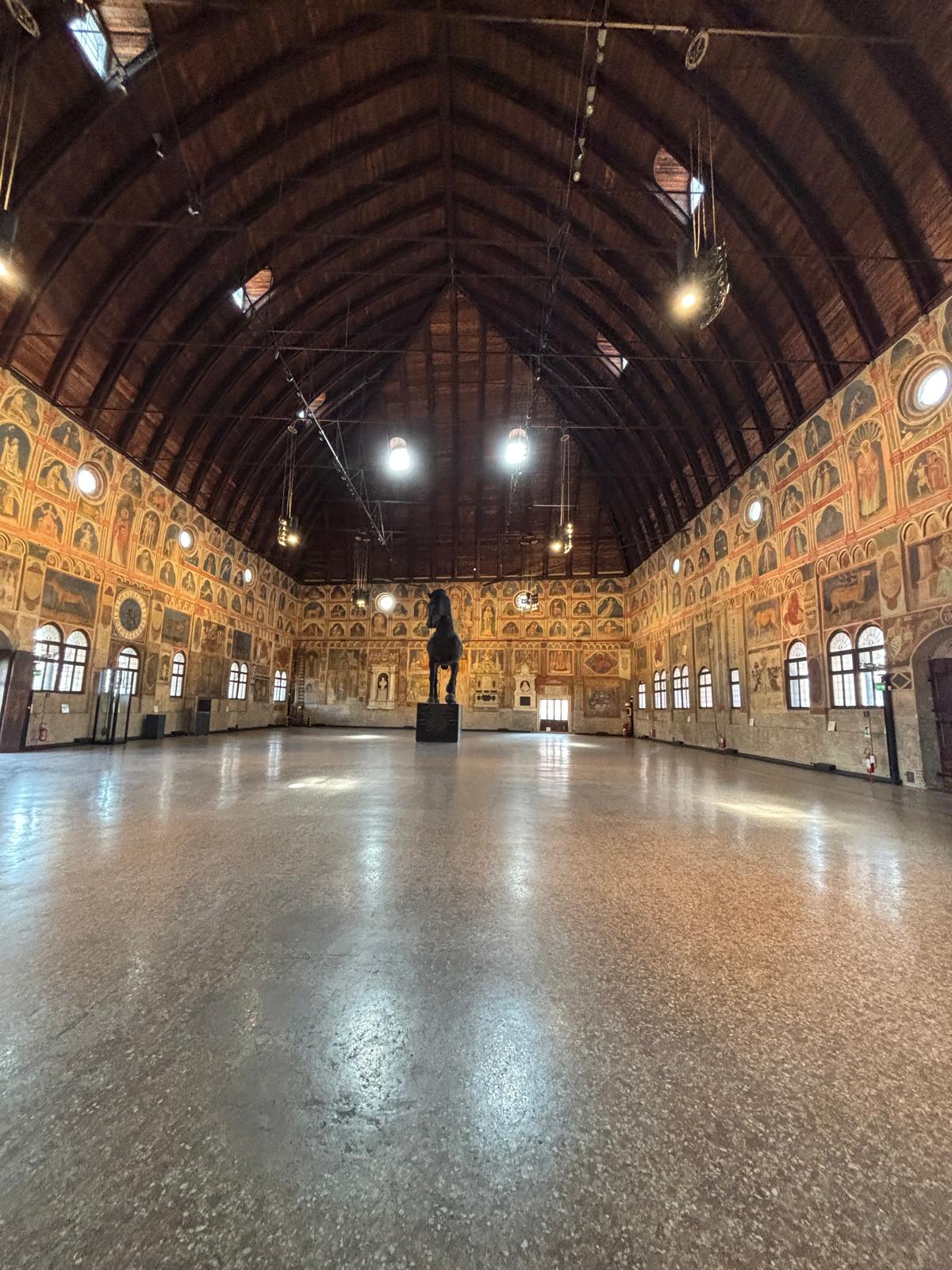
Between 1306 and 1309, the friar and architect Giovanni degli Eremitani oversaw a genuine transformation: the internal dividing walls came down, and the entire upper floor became a single, uninterrupted rectangular hall, roughly 80 meters long and 27 meters wide, one of the largest enclosed spaces in medieval Europe unsupported by internal columns. Above it, carpenters built a distinctive wooden roof shaped like an inverted ship’s hull, a carena di nave, both a genuine structural achievement and, as we’ll see, a deliberate visual echo of the night sky the room’s decoration was about to depict.
Giotto’s Lost Astrological Universe
That same early-14th-century renovation brought Giotto di Bondone, fresh from his revolutionary work at the nearby Scrovegni Chapel, to decorate the Salone’s interior with a sweeping cycle of astrological, religious, and allegorical imagery. Historical accounts describe planets, constellations, and elaborate symbolic figures covering the walls, and tradition holds that Giotto’s own name once appeared painted beneath a panel depicting Mercury in Virgo, a small signature buried inside an enormous cosmic program.
None of it survives. A devastating fire broke out on February 2, 1420, destroying the roof and the upper portions of the frescoed walls, taking Giotto’s astrological masterpiece with it. It’s a loss art historians still describe with genuine regret, since what little is known of the original program suggests it may have rivaled the Scrovegni Chapel itself in ambition, produced by the same artist at the height of his powers, just a few streets away from his most famous surviving work.
Rebuilding the Sky: Miretto, Stefano da Ferrara, and Pietro d’Abano’s Theories
Padua didn’t simply patch the damage; it rebuilt with intent. The reconstruction, this time removing even the last structural traces of the original three-room division, was overseen by the architect Bartolomeo Rizzo, notably an expert in naval construction, a detail that shows up directly in the new roof’s ship-hull silhouette. And for the walls, the city commissioned a fresh astrological cycle, painted primarily between 1425 and 1440 by the Paduan master Niccolò Miretto, who completed more than 240 individual scenes, joined around 1430 by Stefano da Ferrara, who contributed roughly 74 more, along with several other collaborating painters.
Crucially, the new artists weren’t inventing a new program from scratch. They worked from the theories of Pietro d’Abano, a Paduan physician, philosopher, and astrologer active in the decades before Giotto’s original commission, whose writings had argued that the position of the stars and planets at the moment of a person’s birth directly shaped their character, temperament, and inclinations, a belief system taken with genuine scholarly seriousness in medieval Padua rather than dismissed as superstition. Miretto and Stefano da Ferrara appear to have worked, wherever possible, from surviving traces and descriptions of Giotto’s destroyed original, attempting a faithful reconstruction of the earlier iconographic scheme rather than a purely new invention.
The result, what still covers the Salone’s walls today, ranks among the rarest survivals in all of European art: one of only a handful of medieval astrological fresco cycles left anywhere in the world, largely intact and viewable in its original setting.
Reading the Walls: A Giant Cosmic Calendar
Stepping into the Salone for the first time, most guests need a moment for their eyes to adjust before the sheer scale of the cycle becomes legible: roughly 217 linear meters of fresco wrapping across all four walls, traditionally described as somewhere between 333 and around 500 individual painted panels depending on how the smaller decorative elements are counted, arranged across three superimposed horizontal bands.
The cycle’s main structure divides into twelve sections, one for each month of the year, each built from three rows of nine panels. Within each monthly section, the frescoes depict that month’s zodiac sign, its associated constellations, the symbolic figure of the ruling planet, one of the twelve apostles paired symbolically with that month, and scenes of the seasonal trades and labor associated with that point in the agricultural and civic calendar, farming, hunting, craft work, all rendered as part of a single, unified system connecting celestial movement directly to earthly human activity. Taken together, the whole cycle functions as something closer to a working instrument than a decorative scheme, a kind of monumental cosmic clock: a large sundial built into the hall itself marks the sun’s actual position as it rises, striking the corresponding zodiac panel on the wall at the correct moment, tying the painted astrology directly to the real, observable movement of the sky outside.
The Oldest Surviving Layer: Court Emblems and Medieval Bestiaries
Look toward the lower band of the walls and you’ll find the Salone’s genuinely oldest surviving decoration, predating even Giotto’s lost original by decades. Starting in 1271, well over a century before the fire, Padua’s various civic courts began painting their own symbolic emblems along the hall’s lower registers, each court represented by an animal drawn from medieval bestiaries, illustrated moral texts in which every creature carried an assigned set of virtues and vices understood to mirror specific human character traits. The “Tribunale della Volpe,” the Court of the Fox, for instance, takes its name from exactly this tradition, and it’s also, remarkably, the specific spot where the historical contract between the Ovetari family and the painter Andrea Mantegna was formally signed in the 15th century, commissioning what would become the celebrated, and later partially destroyed, Ovetari Chapel frescoes at the nearby Eremitani Church.
The same lower band also holds a fresco cycle depicting the Theological and Cardinal Virtues alongside a striking, somewhat unsettling companion piece: a depiction of the Trial of Pietro d’Abano, painted between 1370 and 1380, showing the same scholar whose astrological theories underpin the entire hall above being posthumously investigated for heresy, a genuine irony worth pointing out to any guest standing beneath a ceiling built entirely on his ideas. In the hall’s southeastern corner, a small number of surviving sacred images, painted before 1390, are attributed to Giusto de’ Menabuoi, the same artist responsible for the extraordinary fresco cycle inside Padua’s Cathedral Baptistery, offering a rare direct thread connecting two of the city’s separate UNESCO-listed fresco sites within a single building.
A Second Disaster, and a Venetian Clockmaker’s Repair
The Salone’s roof met catastrophe a second time on August 17, 1756, when a violent storm tore through the building and destroyed the roof structure entirely. The reconstruction fell to Bartolomeo Ferracina, a clockmaker and engineer working for the Venetian Republic, a name Venice-based visitors may recognize from elsewhere in his career: Ferracina was also responsible for restoring the great astronomical clock on St. Mark’s Clock Tower in Venice and for rebuilding Palladio’s wooden bridge in Bassano del Grappa. It’s a small, satisfying detail that ties the Salone’s own physical survival back to the same Venetian engineering tradition responsible for some of the region’s other most recognizable landmarks.
The courts themselves finally moved out of the building entirely in 1797, and since then the Salone has served a rotating series of civic functions, public meetings, exhibitions, festivals, no longer a courtroom but still, in its own way, a working part of the city’s public life.
The Ground Floor: A Market That Never Stopped
Beneath the frescoed Salone, the Palazzo della Ragione’s ground-floor arcade remains exactly what it’s been for centuries: a working covered market, one of the oldest continuously operating in Europe, lined today with butchers, cheesemongers, and delicatessens doing genuine daily business rather than performing for tourists. Inside the arcade stands a large wooden horse, a 15th-century replica of Donatello’s celebrated bronze equestrian monument to the mercenary general Gattamelata, standing just outside the nearby Basilica of St. Anthony; the wooden version was originally built for a jousting tournament before finding a permanent home inside the Palazzo. Few buildings anywhere let you walk beneath one of medieval Europe’s most ambitious astrological ceilings and then, a single flight of stairs later, buy prosciutto from a stall that’s occupied the same spot for generations.
Part of Padua’s UNESCO Story
The Palazzo della Ragione isn’t simply a remarkable standalone monument; it’s one of the eight building complexes that together make up “Padua’s Fourteenth-Century Fresco Cycles,” inscribed on the UNESCO World Heritage List in 2021 alongside the Scrovegni Chapel, the Eremitani Church, the Cathedral Baptistery, the Carrara Chapel, the Basilica of St. Anthony, and the Oratories of San Giorgio and San Michele. Within that listing, the Palazzo represents something the other seven sites largely don’t: a secular, civic building rather than a religious or private chapel, decorated not with saints and scripture but with an entire cosmological system built from medieval science, astrology, and civic pride, a genuinely different register of fourteenth-century Paduan achievement standing right alongside the more famous devotional cycles nearby.
Planning Your Visit
The Palazzo della Ragione sits directly between Piazza delle Erbe and Piazza della Frutta in the heart of Padua’s historic center, with the main visitor entrance via the Scala dei Ferri staircase from Piazza delle Erbe. The Salone is generally open Tuesday through Sunday, with slightly different hours between the summer and winter seasons, and standard admission runs a modest few euros, with reduced rates for groups, students, and seniors. Given its central location, the Palazzo pairs naturally with a Scrovegni Chapel visit and a walk through the surrounding market squares, all comfortably covered within the same morning or afternoon.
Plan your visit: Padua Day Trip from Venice: Why Visit and What to See covers how to build the Palazzo della Ragione into a full Padua itinerary alongside the Scrovegni Chapel and the city’s other UNESCO-listed highlights.
Frequently Asked Questions
Are the frescoes inside the Palazzo della Ragione the original work by Giotto?
No. Giotto and his workshop painted the Salone’s original astrological cycle in the early 1300s, but it was destroyed in a fire on February 2, 1420. What survives today is a faithful 15th-century reconstruction, painted primarily by Niccolò Miretto and Stefano da Ferrara between roughly 1425 and 1440, based on the same underlying astrological theories and, where possible, on traces of the lost original.
What do the frescoes in the Salone actually depict?
The cycle is organized into twelve monthly sections, each showing that month’s zodiac sign, associated constellations, ruling planet, a paired apostle, and scenes of seasonal trades and labor, based on the astrological theories of the Paduan scholar Pietro d’Abano. A sundial built into the hall ties the painted zodiac directly to the sun’s real position throughout the year, functioning as a kind of monumental cosmic calendar.
Is the Palazzo della Ragione part of Padua’s UNESCO World Heritage status?
Yes. It’s one of eight building complexes included in “Padua’s Fourteenth-Century Fresco Cycles,” inscribed on the UNESCO World Heritage List in 2021, alongside the Scrovegni Chapel, the Eremitani Church, the Cathedral Baptistery, the Basilica of St. Anthony, and several smaller chapels and oratories across the city.