Most Americans know Galileo as the man who got in trouble with the Catholic Church for saying the Earth orbits the sun. Almost nobody realizes that the actual breakthrough, the telescope itself, the observations, the discovery that changed astronomy forever, happened not in Florence or Rome but right here in the Veneto, across a wooden lectern in Padua and a bell tower in Venice, built in part with glass ground from one of the most famous furnaces in the world. This is the story of Galileo’s eighteen years in this region, and of a simple wooden podium and a lens that, together, quietly rewired how humanity understood its place in the universe.
Eighteen Years at a Podium in Padua
Galileo Galilei taught at the University of Padua from 1592 to 1610, and he later described this period, without qualification, as the happiest and most productive of his entire life. He’d left a teaching post in Pisa under something of a cloud, and Padua, then part of the Venetian Republic’s mainland territory, offered him something Florence and Rome couldn’t: genuine intellectual freedom, protected by a university whose own founding motto, Universa Universis Patavina Libertas, promised exactly that freedom to everyone who taught or studied within its walls.
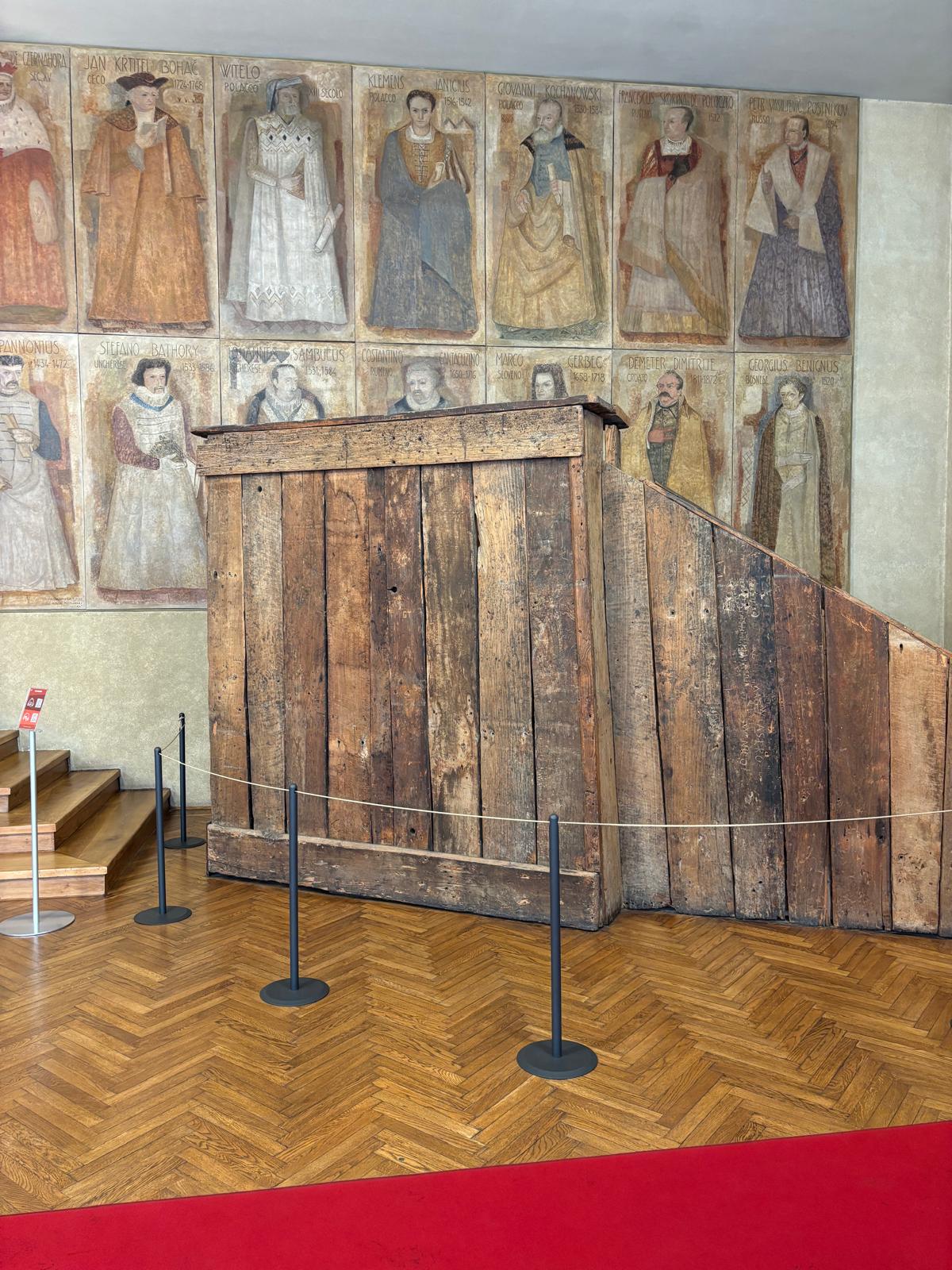
Inside Palazzo Bo, the university’s historic seat, sits the Sala dei Quaranta, the Hall of the Forty, and inside that room stands the actual object at the center of this story: Galileo’s original wooden lectern, the cattedra from which he lectured on mathematics, mechanics, and astronomy to a room of students for nearly two decades. It’s a plain, unadorned wooden podium, nothing monumental about its appearance, and that plainness is precisely why standing in front of it lands so differently than looking at a painting or a monument. This is the literal, physical object Galileo stood behind while he taught geometry and mechanics, while he corresponded with fellow astronomers across Europe, and while he quietly began working, in his own time, on the project that would eventually make him famous.
Padua gave Galileo more than a comfortable teaching post. It gave him proximity, roughly 25 miles, to a city that happened to be the single best place in the world to source the one material his next project would depend on entirely: glass.
Learning of a Dutch Invention, and Teaching Himself to Grind Lenses
In the spring of 1609, word reached Galileo, likely through his friend Paolo Sarpi, a Venetian scholar and diplomat, of a new instrument recently invented in the Netherlands: a spyglass, patented the year before by the lens maker Hans Lippershey, capable of making distant objects appear closer. Galileo had never seen one himself, but the description was enough. Working from theory alone, he set about building his own version, and within a remarkably short span of months, he did something none of the original Dutch inventors had managed: he improved it dramatically.
His first working telescope achieved a magnification of about three, roughly matching what was already circulating in northern Europe. But Galileo quickly worked out the underlying optical principle, that magnification depended on the precise ratio between a concave eyepiece lens and a convex, more distant objective lens, and realized that the ordinary eyeglass lenses available from opticians simply weren’t precise or consistent enough to push the design further. So he taught himself to grind his own lenses, by hand, testing and refining as he went. By August 1609, he had built an instrument with roughly nine-fold magnification, several times more powerful than anything else in existence anywhere in Europe at that moment.
Why Murano Mattered
Here’s the detail most visitors never connect, and the one I think matters most for understanding why this story belongs so specifically to the Veneto rather than to Galileo alone: grinding a precise lens starts with genuinely clear, optically consistent raw glass, and in 1609, nowhere in the world produced glass of that quality more reliably than the furnaces of Murano.
Venetian glassmakers had held a technological edge in producing clear, bubble-free, optically usable glass since at least the 15th century, a skill that had already made Murano the center of European eyeglass production for generations before Galileo ever picked up a lens-grinding tool. It’s precisely why the story of the telescope’s birth is so tightly wound around Venice specifically: Galileo wasn’t simply a brilliant theorist working in isolation, he was a brilliant theorist working within walking, or rather short boat, distance of the one place on Earth best equipped to supply the exact raw material his design depended on. Historical accounts and the glassmaking families of Murano themselves have long pointed to this connection directly, crediting the quality of Venetian glass as fundamental to making Galileo’s optical breakthrough physically possible in the first place, not simply a convenient coincidence of geography.
Whether every specific blank of glass Galileo ground into a lens can be traced to a single named Murano workshop is, four centuries later, impossible to state with total certainty. What’s not in dispute is the broader picture: Galileo built the instrument that changed astronomy while living and working inside the same regional glass economy that had spent nearly two centuries perfecting exactly the kind of clear, precise glass his design required, and Murano’s furnaces, whether through direct supply or through the trained hands of lens grinders working in that same Venetian glass tradition, sit at the material root of the telescope’s story in a way that’s genuinely inseparable from the region itself.
August 1609: A Bell Tower, a Doge, and a Letter About Enemy Ships
On August 21, 1609, Galileo climbed the Campanile di San Marco, the bell tower rising above St. Mark’s Square, and demonstrated his telescope in person to Doge Leonardo Donà and members of the Venetian Senate. It was, in the most literal sense, a sales pitch. Galileo had drafted a letter to the Doge describing the instrument’s practical value to a maritime republic whose wealth and survival depended entirely on controlling the sea: with his telescope, he explained, Venice could identify an enemy ship’s flag, and therefore its intentions, roughly two hours before that ship could be seen with the naked eye, a genuinely significant tactical advantage for a naval power. Galileo promised, at least initially, to keep the invention as Venice’s exclusive secret.
The demonstration worked. Standing atop the bell tower, senators and officials took turns looking out across the lagoon, watching distant ships and church towers snap into unexpected clarity. The Senate was sufficiently impressed that they doubled Galileo’s university salary and, remarkably, made his position at Padua a lifetime appointment, a level of job security almost unheard of for an academic of the period. It’s worth noting, for anyone who visits today, that the Senate didn’t actually end up needing Galileo personally to manufacture telescopes for Venice going forward; the basic Dutch design was already becoming known elsewhere, and Venice’s own glassmakers and lens grinders, already the best equipped workshops in Europe for the task, were entirely capable of producing them independently once the concept was understood. A commemorative plaque was unveiled on the Campanile itself in 2009, marking the 400th anniversary of that August afternoon.
Turning the Telescope Toward the Sky
The Venice demonstration was a triumph, but it was also, in hindsight, only the beginning. Galileo kept refining his design through the autumn of 1609, and by November he had built an instrument with roughly twenty-fold magnification, dramatically more powerful than anything else circulating in Europe, including the six-fold instrument the English astronomer Thomas Harriot had used just months earlier to sketch the lunar surface.
It was with this improved instrument, built and refined in Padua, that Galileo made the observations that would genuinely change the world. Turning the telescope toward the Moon, he saw mountains and craters where classical astronomy insisted on a perfectly smooth celestial sphere. And on successive nights in January 1610, watching several small points of light near Jupiter shift position night after night, he worked out that he wasn’t looking at background stars at all, he was watching four moons in orbit around Jupiter, a direct, observable demonstration that not everything in the heavens circled the Earth. It was precisely the kind of evidence that would, in the following years, push Galileo toward open, public support for the Copernican, sun-centered model of the solar system, a position that would eventually put him in direct conflict with the Catholic Church after he left Padua’s comparatively protected environment for a position in Florence later in 1610.
Historians have long pointed out the genuine irony in that timeline: the observational work that eventually got Galileo into serious trouble in Florence and Rome was overwhelmingly developed during his safer, more protected years teaching from that same modest lectern in Padua, under exactly the kind of institutional freedom the university had been founded to defend.
Standing Where It Happened
What makes this story worth experiencing in person, rather than simply reading about, is that so much of it survives in physical, visitable form, a genuinely rare thing for a scientific breakthrough this old.
In Padua, Galileo’s original lectern still stands in the Sala dei Quaranta inside Palazzo Bo, accessible on the university’s guided tour alongside the world’s oldest surviving anatomical theatre, itself built just a few years before Galileo’s own arrival at the university. In Venice, the Campanile di San Marco still rises above St. Mark’s Square (rebuilt after a 1902 collapse, but standing on the same site and following the same basic form Galileo would have climbed), and a plaque near its base marks the spot where a Venetian Doge first looked through a lens ground with the help of the same glassmaking tradition still practiced on Murano today. And on Murano itself, the same fundamental craft, molten glass shaped by hand into something optically precise, continues in working furnaces you can watch in person, a living link back to the exact material foundation Galileo’s breakthrough depended on.
Few scientific origin stories let you walk through this many of their actual physical locations within a single, easy day trip from Venice.
Plan Your Visit
See the lectern in Padua: Padua Day Trip from Venice: Why Visit and What to See covers how to build a visit to Palazzo Bo, and Galileo’s original lectern in the Sala dei Quaranta, into a full day alongside the Scrovegni Chapel and the city’s other highlights.
See where he demonstrated it in Venice: Our full guide to St. Mark’s Basilica covers the square and campanile where Galileo’s Venice demonstration took place, right at the heart of the city’s most iconic public space.
See the glass tradition that made it possible: Murano Workshop and Visit – Discover the Art of Glassblowing puts you in front of a working furnace practicing the same fundamental craft, hand-shaping precise, clear glass, that gave Galileo the material his telescope depended on four centuries ago.
Frequently Asked Questions
Did Galileo invent the telescope?
No. The basic design was patented in the Netherlands in 1608 by the lens maker Hans Lippershey. Galileo, working from a secondhand description, built his own version within months and dramatically improved its magnification and optical quality, turning a novelty spyglass into a genuinely useful scientific instrument.
Is it true Galileo’s telescope lenses were made from Murano glass?
The broader connection is well documented and widely credited by historians and Murano’s own glassmaking tradition: Venice, and Murano specifically, was the world’s leading center for clear, optically consistent glass in 1609, and Galileo, teaching in Padua and demonstrating his telescope in Venice, worked within that same regional glassmaking economy. While tracing every individual lens blank to one named workshop isn’t possible four centuries later, the quality of Venetian glass is consistently credited as a foundational factor in making his optical breakthrough achievable.
Can I still see Galileo’s original lectern today?
Yes. It’s preserved in the Sala dei Quaranta inside Palazzo Bo, the historic seat of the University of Padua, accessible as part of the university’s guided tour alongside the world’s oldest surviving anatomical theatre. Access is by scheduled guided tour only, so advance booking is required.