
By Igor Scomparin, licensed Venice tour guide since 1997, Tour Leader Venice
Ask most visitors what UNESCO protects in Venice, and they’ll say the city itself, maybe the lagoon if they’ve read closely. Almost nobody mentions the glass beads, and that’s a genuine gap in how most people understand Venetian heritage, because since December 2020, the art of making them carries its own, separate UNESCO recognition, distinct from the city’s famous 1987 World Heritage listing, and arguably just as remarkable a story.
Two Different UNESCO Lists, and Why That Distinction Matters
It’s worth clearing up a common confusion before going further. “Venice and its Lagoon” was inscribed on UNESCO’s World Heritage List in 1987, protecting the physical city, its buildings, and its surrounding ecosystem. Venetian glass beadmaking sits on an entirely different UNESCO register: the Representative List of the Intangible Cultural Heritage of Humanity, a category that protects living traditions, skills, and practices rather than physical places. Think of it as the difference between UNESCO protecting a building and UNESCO protecting a recipe, a language, or a craft passed hand to hand across generations.
The Art of Glass Beads was formally inscribed on this intangible heritage list on December 17, 2020, following a joint nomination submitted by Italy and France, representing two distinct but historically connected bead-making communities: the Venetian tradition, championed by the Comitato per la Salvaguardia dell’Arte delle Perle di Vetro Veneziane (the Committee for the Safeguarding of the Art of Venetian Glass Beads), and the French tradition, represented by the Association des Perliers d’Art de France. For the city of Venice specifically, it marked the first time any intangible element of its culture, rather than a physical monument, earned UNESCO recognition, a genuinely significant milestone that received far less international attention than it deserved.
A Craft Older Than the Republic’s Golden Age
Venetian glass beads have a documented history stretching back centuries earlier than most visitors assume. Some of the earliest evidence of glass imitation gemstones produced in the city dates back close to the 10th century, and clear documentary evidence of dedicated bead production exists from at least the 14th century, predating even the famous 1291 decree that relocated Venice’s glass furnaces to Murano for fire safety. That relocation is a detail worth pausing on, because it shaped the craft in a way that’s easy to miss: while the heavy furnace work, melting and shaping raw glass, moved to Murano, much of the delicate secondary work, stringing, sorting, and finishing beads, remained centered in Venice itself, particularly around what’s still known today as Calle delle Conterie in the Cannaregio district, a street literally named after the bead trade that once filled it.
This division of labor also had a strongly gendered history that the UNESCO recognition specifically highlights. The furnace work was traditionally the domain of men, the perleri, while stringing finished beads into sellable strands, sorting them by size and color, and threading them for the export trade fell largely to women, known as impiraresse, who would gather in courtyards across Venice, working by hand, often in large informal groups, to string thousands of tiny beads a day. It was skilled, essential labor that sustained entire households and neighborhoods for generations, even though it rarely received the recognition given to the more visible, more celebrated furnace masters.
From Marco Polo to Global Currency
Venetian glass beads didn’t stay in Venice. According to a long-standing local account, Marco Polo, on returning from his travels to China in 1295, helped reveal just how lucrative the markets of the Far East could be for Venetian glass exports, whether or not that specific story is entirely historically precise, what’s firmly documented is that Venice had built an intense, sustained bead trade with ports across the eastern Mediterranean and the Levant by the following centuries, and that trade only expanded from there.
By the height of the trade, Venetian beads, increasingly known internationally as “conterie,” a name that stuck by the 19th century, were being shipped in staggering volumes across Africa, the Middle East, and eventually the Americas. In many of these markets, small glass beads functioned less like decorative jewelry and more like a genuine medium of exchange, traded directly for gold, ivory, spices, and other valuable goods, which is exactly why English-language trade records so often referred to them simply as “trade beads.” For a period of real economic significance, a tiny, hand-strung glass bead made by a Venetian impiraressa could move goods and wealth across three continents.
The Three Techniques UNESCO Actually Recognized
The 2020 inscription doesn’t cover a single, generic bead-making method; it specifically protects three distinct traditional techniques, each requiring its own set of skills, tools, and years of training to master.
Beads a lume (lampwork, sometimes called flamework) are formed by winding molten glass directly around a metal rod over an open flame, a technique documented in Venice since at least the 17th century, allowing for enormous variation in shape, layering, and color as the glass is worked while still hot.
Cane and rod beads are produced differently: glass rods, sometimes made by fusing multiple colored canes together, are drawn out, cut into short segments, and ground and polished to reveal patterns running through the cross-section. This is the family of technique behind chevron beads, with their distinctive layered, star-shaped pattern visible at each cut end, and murrine, the same slicing technique famous from Murano’s decorative glassware, applied here at a much smaller, more intricate scale.
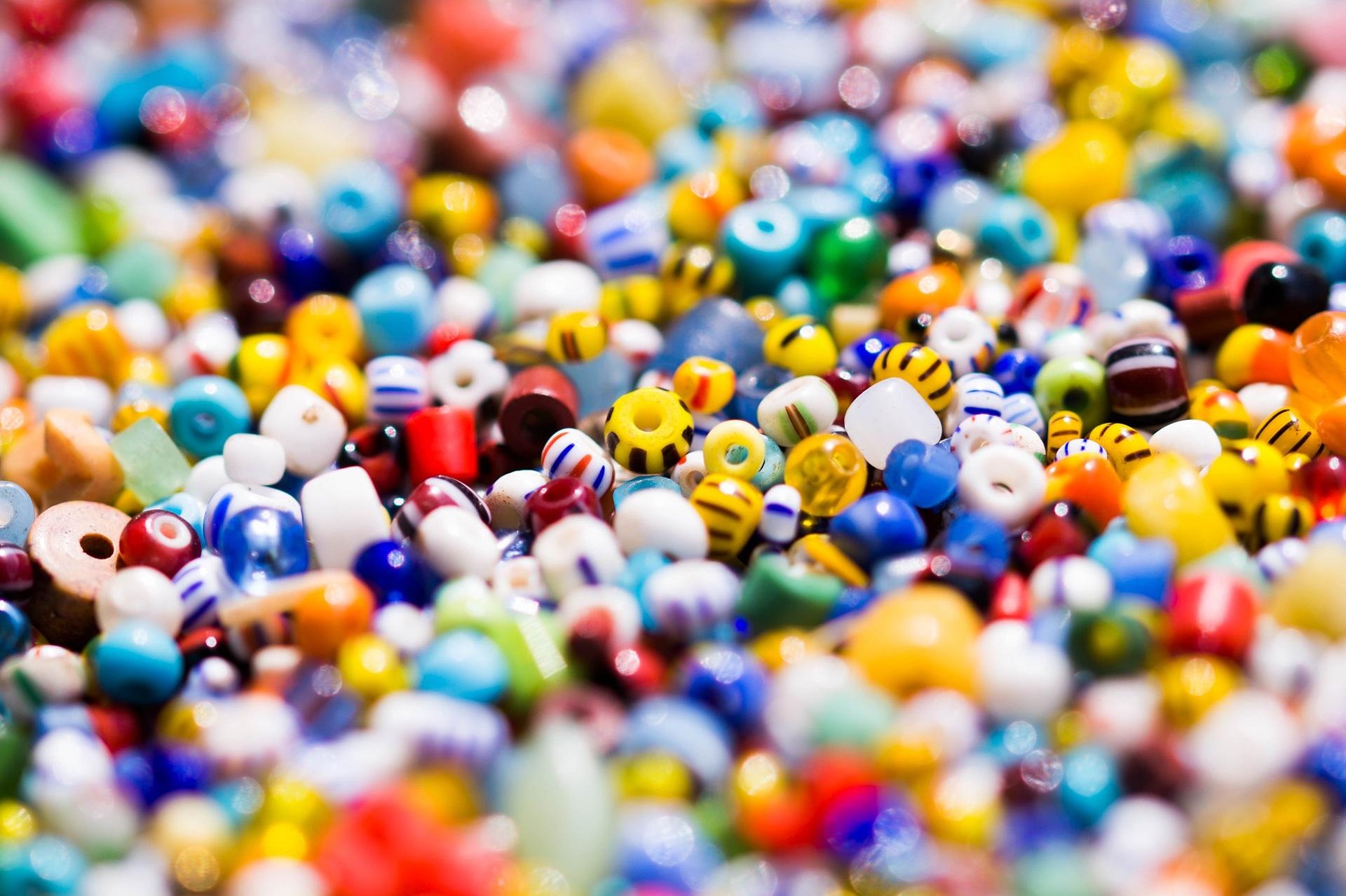
Conterie, or seed beads, are the smallest and were historically the most mass-produced of the three: tiny glass beads, often just a few millimeters across, drawn from long hollow glass canes and cut into short segments, then finished and sorted by hand. It was this category, produced at genuine industrial scale by the 19th century through operations like the Società Veneziana per l’Industria delle Conterie, that dominated the global trade bead market for the longest stretch of Venetian history.
A Living Heritage, Not a Museum Piece
What makes this UNESCO designation different from protecting a historic building is that it explicitly recognizes the people still practicing the craft today, not just the objects they make. Some of Murano’s bead-making furnaces in operation today have been active for generations, using tools and techniques that have barely changed, and the specialized vocabulary, gestures, and informal knowledge passed between masters and apprentices are considered every bit as much a part of what’s being protected as the finished beads themselves.
That’s also precisely why the craft is genuinely fragile today, and why the UNESCO listing matters practically rather than just symbolically. Mass-produced imitation “Murano-style” beads, often manufactured outside Italy entirely, have flooded souvenir markets near St. Mark’s Square for years, undercutting authentic workshops on price while offering none of the actual craftsmanship. Every authentic piece you buy directly from a working Murano furnace or a legitimate Venetian bead workshop is a small, direct contribution to keeping a centuries-old, UNESCO-recognized living tradition economically viable for the families still practicing it.
How to See the Real Thing
If you want to actually witness this craft rather than just read about it, the only reliable way is to see it made in person, ideally inside a genuine working furnace or workshop rather than a retail showroom designed primarily to sell finished pieces. Look for the “Vetro Artistico Murano” trademark seal on any piece you’re considering buying, a legal guarantee that it was actually produced on Murano using traditional methods, and don’t hesitate to ask a shop directly whether they can show you where and how a piece was made; a legitimate workshop will never hesitate to answer.
Watch it happen: Murano Workshop and Visit – Discover the Art of Glassblowing puts you directly in front of a working furnace with a private boat ride from Venice included, where you can watch artisans at work and ask questions about the exact techniques described here.
Go deeper into the history: Discover Murano Glass Museum: Skip-the-Line Tickets houses centuries of Venetian glass artistry inside the historic Palazzo Giustinian, including pieces that trace this exact bead-making tradition.
Read the fuller island story: For the broader context of Murano as a UNESCO-protected part of the Venetian Lagoon, along with the island’s furnace history and artisan culture, see Murano: The Island of Glass and the Soul of Venetian Art, and for the full picture of what UNESCO protects across Venice more broadly, Venice’s UNESCO Heritage: What’s Actually Protected, and the Venetian Pearls of Murano.
Frequently Asked Questions
Are Venetian glass beads a UNESCO World Heritage Site?
No. The beads themselves aren’t a physical site, so they don’t fall under the 1987 “Venice and its Lagoon” World Heritage listing. Instead, the craft of making them, the Art of Glass Beads, was inscribed on UNESCO’s separate Representative List of the Intangible Cultural Heritage of Humanity on December 17, 2020, a category that protects living skills and traditions rather than places.
How can I tell real Murano glass beads from fakes?
Look for the “Vetro Artistico Murano” trademark seal, a legal guarantee the piece was made on Murano using traditional methods. Mass-produced imitations, often manufactured outside Italy, are common in souvenir shops near St. Mark’s Square. A legitimate workshop will always be willing to show you where and how a piece was actually made.
What’s the difference between Murano glassware and Venetian glass beads?
Murano is famous for both, but they’re distinct crafts within the same glassmaking tradition. Murano glassware, vases, chandeliers, sculptures, is shaped through glassblowing at the furnace. Glass beads involve separate, smaller-scale techniques (lampwork, cane-cutting, and seed-bead production), and historically much of the finishing work, stringing and sorting, was done by women in Venice itself rather than on Murano.