Venice doesn’t have grand boulevards lined with monuments the way Paris or Rome does — there simply isn’t room. Instead, its finest statues turn up in small squares, tucked into church facades, or standing where a crowd of merchants once gathered eight hundred years ago. I’ve picked out five I think earn a detour, not just for their craftsmanship but for what each one tells you about the city that kept them.
1. The Equestrian Statue of Bartolomeo Colleoni
Standing in Campo Santi Giovanni e Paolo, this bronze figure of a mercenary commander on horseback is, for my money, the single finest piece of sculpture in the city that isn’t inside a church or museum.
Bartolomeo Colleoni served the Republic on and off as a condottiere — a mercenary captain-general — through much of the fifteenth century, and when he died in 1475 he left Venice a substantial fortune on one condition: that a statue of him be erected in Piazza San Marco. Venetian law, however, forbade monuments to individuals in the main square, so the Republic did something quintessentially Venetian — it honored the letter of his will while ignoring its spirit, placing the statue instead in front of the Scuola Grande di San Marco, a building that merely shared his patron saint’s name. The sculptor, Andrea del Verrocchio, died before completing the work, and the casting was finished by Alessandro Leopardi. Even so, it’s considered one of the two great equestrian monuments of the early Renaissance, full of coiled, dynamic energy that most static statues of the period never attempted.
My tip: visit in the late afternoon, when the light rakes across the bronze and the horse’s musculature really comes alive. The square itself, dominated by the enormous Basilica dei Santi Giovanni e Paolo, is worth lingering in regardless.
2. The Horses of Saint Mark
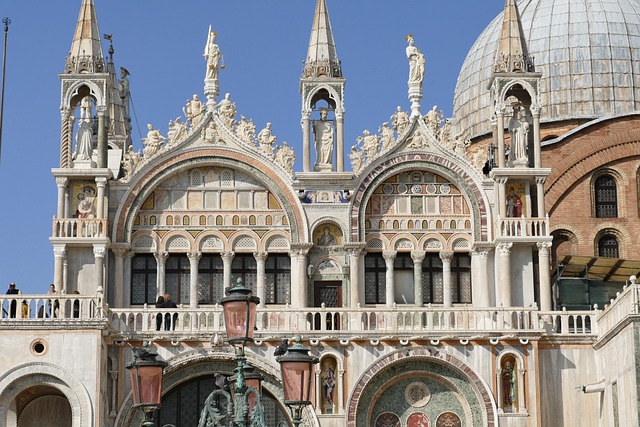
Above the main entrance of St. Mark’s Basilica stand four gilded bronze horses — or rather, replicas of them. The originals, kept just inside the basilica for their protection, are arguably the most well-traveled statues in European history, and their story ties directly into two other figures I’ve written about at length: Enrico Dandolo and Napoleon.
The horses were cast in antiquity, likely displayed for centuries at the Hippodrome of Constantinople, before Doge Enrico Dandolo’s forces looted them during the sack of the city in 1204 — part of the same campaign that built Venice’s maritime empire. They were installed on the basilica’s facade sometime in the following decades and stayed there for nearly six hundred years, becoming one of the most recognizable symbols of the Republic itself. Then, in 1797, Napoleon had them dismantled and carted off to Paris as war trophies, where they briefly topped a triumphal arch. They didn’t return to Venice until 1815, after Napoleon’s final defeat, when the sculptor Antonio Canova helped negotiate the return of looted artworks across Europe.
I find this one genuinely moving to explain to guests, because the horses connect two of the most consequential figures in Venetian history — the doge who helped build the empire and the general who ended it — through a single object that survived both of them.
My tip: the exterior horses are reproductions; to see the real bronze originals up close, you need to go inside the basilica and up to the loggia museum, which is well worth the modest extra ticket.
3. Il Gobbo di Rialto (The Hunchback of Rialto)
Tucked into Campo San Giacomo di Rialto, opposite one of Venice’s oldest churches, sits a squat marble figure that most visitors walk past without a second glance — which is a shame, because it has one of the more unusual backstories of anything on this list.
Sculpted by Pietro da Salò and unveiled in 1541, the statue depicts a crouching, muscular man supporting a small staircase on his back — not actually a hunchback, but a figure bent under the physical weight of his burden, which climbs to a porphyry column called the Pietra del Bando. From that platform, Republic officials read out new laws, decrees, and death sentences aloud to the crowded market below — this is the origin of Shylock’s line in Shakespeare’s Merchant of Venice, “What news on the Rialto?” The statue had a darker second life, too: it marked the finish line for minor offenders sentenced to run a public gauntlet from Piazza San Marco to Rialto, stripped and whipped by the crowd along the way, with the ordeal ending only when they reached the statue and kissed it.
My tip: it’s easy to miss because it’s genuinely small and unmarked by any plaque. Look for it directly across from the Church of San Giacomo di Rialto, just steps from the Rialto Market.
4. Portrait of the Four Tetrarchs
Set into the southwest exterior corner of St. Mark’s Basilica, this squat, deep-purple porphyry sculpture is one of the oldest objects on public display anywhere in Venice — and one of the strangest.
Carved around 300 AD, the group depicts four Roman emperors from Diocletian’s tetrarchy — a short-lived system of shared imperial rule — locked in a stiff, symbolic embrace meant to represent unity among the four rulers. Like the Horses of Saint Mark, it was looted from Constantinople during the same 1204 sacking, and set into the basilica’s corner not long after. One curious footnote: one figure is missing a foot, broken off during the original theft — and in the 1960s, archaeologists excavating in Istanbul actually found the missing fragment, confirming exactly where the statue had stood for nearly a thousand years before Venice took it.
My tip: it’s easy to miss because it’s mounted low and unobtrusively on the building’s exterior rather than displayed as a standalone monument — look for it near the basilica’s south facade, close to the Doge’s Palace side.
5. The Statue of Carlo Goldoni
In Campo San Bartolomeo, at the foot of the Rialto Bridge, stands a bronze figure caught mid-stride, hat and cane in hand, greeting the crowd around him with a slight, knowing smile. This is Carlo Goldoni, the eighteenth-century Venetian playwright often called the father of modern Italian comedy, and it’s the only statue on this list honoring an artist rather than a ruler or a religious figure.
Erected in 1883, more than a century after Goldoni’s death, the monument captures something genuinely Venetian in its informality — he isn’t posed with imperial gravity like the Tetrarchs or mounted on a warhorse like Colleoni. He’s simply walking through the city he wrote about, which feels appropriate, since Goldoni built his career writing comedies rooted directly in the everyday speech and social types of eighteenth-century Venice.
My tip: Campo San Bartolomeo is one of the busiest crossroads in the city, connecting Rialto to San Marco, so the statue is easy to reach but also easy to overlook in the crowd. Take thirty seconds to actually look up at his face — the humor in the expression is worth it.
Are the Horses of Saint Mark on the basilica’s facade the real ones?
No — the horses visible outside today are replicas. The original bronze horses, dating to antiquity, are preserved inside the basilica’s loggia museum to protect them from weather damage.
Is Il Gobbo di Rialto hard to find?
It’s unmarked and easy to walk past, but it sits directly across from the Church of San Giacomo di Rialto, just a couple of minutes’ walk from the Rialto Bridge and market.
Why is the Colleoni statue not in Piazza San Marco, as Colleoni requested in his will?
Venetian law prohibited monuments to individuals in the main square, so the Republic placed it instead in front of the Scuola Grande di San Marco — a building sharing the saint’s name, technically fulfilling the will’s wording without breaking the law.