I get asked constantly for a route people can follow on their own — something specific enough to hand someone a map and say “start here, end there.” So here’s the walk I’d sketch out for you over coffee: a loop through Dorsoduro that takes about three to four hours at an unhurried pace, museum stops included, ending with a spritz on the water.
Starting Point: Ca’ Rezzonico (Vaporetto Line 1)
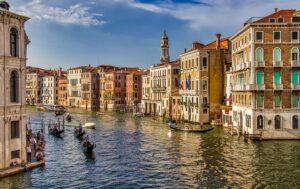
Begin at the Ca’ Rezzonico vaporetto stop on the Grand Canal. Before you even go inside, take a minute at the water’s edge — this is one of the great, uncrowded Grand Canal views in the city. Ca’ Rezzonico itself, designed by Baldassare Longhena and completed by Giorgio Massari, now houses the Museum of 18th-Century Venice, with Tiepolo ceiling frescoes and Pietro Longhi’s small, sharply observed portraits of aristocratic life. If you only have time for one interior museum stop on this walk, this is my pick — it’s less about paintings on walls and more a full immersion into how Venetians actually lived. Budget two hours if you go in; it’s closed Tuesdays.
Ponte dei Pugni and Campo San Barnaba
Exit Ca’ Rezzonico and follow the rio (canal) on foot toward Ponte dei Pugni, the “Bridge of Fists.” From roughly 1600 to the mid-1700s, this was where rival Venetian factions — the Castellani and the Nicolotti — staged organized brawls, trying to knock each other into the canal below. Marble footprints once marked where combatants squared off. It’s a quiet, almost ordinary-looking bridge today, which is exactly what makes the story worth telling as you cross it.
On the other side is Campo San Barnaba, one of Dorsoduro’s most photogenic squares — a floating vegetable barge still moors along the canal here, and the deconsecrated Church of San Barnaba (recognizable to film fans as the entrance to the catacombs in Indiana Jones and the Last Crusade) anchors one side of the square. Grab a coffee at one of the campo’s cafés and let this be your first proper pause.
South to San Sebastiano and Sant’Angelo Raffaele
From San Barnaba, head south through the quieter residential calli toward Campo San Sebastiano. This stretch is where the walk earns the word “ultimate” — almost no tourists make it this far west, and the streets feel like the working, lived-in Venice that existed before mass tourism. The Church of San Sebastiano and, a short walk further, Sant’Angelo Raffaele are both worth a look inside if you have the time and they happen to be open; if not, the campo itself, with its cafés and unhurried pace, is reward enough.
East Toward San Trovaso
Loop back east, ideally via Calle della Toletta, toward Campo San Trovaso. This is where you’ll find the Squero di San Trovaso, Venice’s most famous working gondola boatyard, viewable from across the canal at Fondamenta Nani. I’ve written a full piece on the history and craft of the squeri if you want the deeper story — for this walk, just know it’s one of the best photo stops in the city, and best enjoyed with a glass of wine from a nearby bacaro rather than a rushed phone snap.
The Zattere Waterfront
From San Trovaso, walk south to the Zattere, the long promenade running along the Giudecca Canal. The name comes from the flat-bottomed rafts that once carried timber down from the mountains — a reminder that Venice was a working port city long before it was a monument to itself. Head east along the water. You’ll pass the Gesuati church (Santa Maria del Rosario), with its Tiepolo ceiling frescoes, and eventually reach Gelateria Nico, a Zattere institution since 1937, famous for its gianduiotto da passeggio — a slab of chocolate hazelnut gelato served with whipped cream, meant to be eaten while strolling.
Continue along the Zattere and you’ll arrive at the Punta della Dogana, the former customs house at the very tip of Dorsoduro, where the Grand Canal meets the Giudecca Canal — its bronze weathervane of Fortuna balancing on a golden globe is one of the city’s most photographed rooftop details.
Finishing at the Peggy Guggenheim Collection
From the Dogana, it’s a short walk north along the Grand Canal to the Peggy Guggenheim Collection, my recommended final stop. Housed in the unfinished Palazzo Venier dei Leoni, it holds one of Italy’s most important collections of 20th-century American and European art. Allow two to three hours if you want to do it properly, or simply end the walk at its garden café overlooking the canal if the museums have worn you out by this point.
Practical Notes for Walking This Route
Total distance is modest — under 3km — but Venice’s uneven paving and bridges make comfortable shoes essential.
Weekday mornings are quietest; the San Sebastiano/Sant’Angelo Raffaele stretch is peaceful nearly any time.
The Zattere has little shade, so in July or August, aim to walk that stretch either early or in the late afternoon.
Vaporetto stops along the route (Ca’ Rezzonico, San Basilio, Zattere, Accademia) let you shorten the walk or skip a section if energy runs low.
Why Do This Walk With a Guide Instead of Alone
This route works perfectly well with a map in hand — that’s the point of a self-guided walk. But the churches that happen to be open, the bacaro that’s actually pouring good wine that afternoon, the chance to step inside a squero rather than just view it from across the canal — that’s the layer a private guide adds. Italian law also restricts guided access inside the state monuments along this route to licensed professionals, so if Ca’ Rezzonico’s history or the Guggenheim’s collection is something you want brought to life rather than just viewed, that’s where a private Venice tour changes the experience rather than just the pace.
How long does this walk take?
Three to four hours at a relaxed pace with one museum stop; closer to five to six if you go inside both Ca’ Rezzonico and the Guggenheim.
Is this route suitable for a first visit to Venice, or better for return visitors?
Both — it’s gentle enough for first-timers and rich enough in overlooked corners that returning visitors often find it feels like a different city.
What’s the best time of day to start?
Mid-morning, so you reach Campo San Barnaba before the day heats up and arrive at the Zattere for a late-afternoon stroll with better light and fewer crowds.