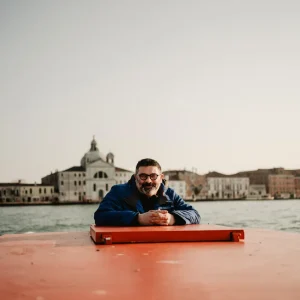
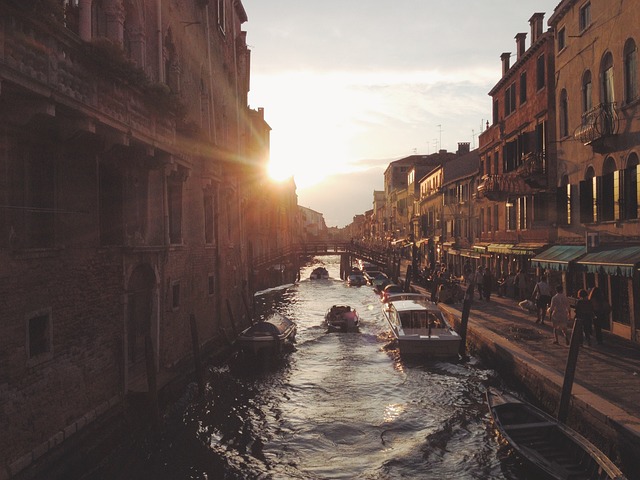
I’ve guided guests through Venice for close to thirty years, and there’s a particular kind of satisfaction in watching someone’s face when they realize a detail has been sitting in plain sight for eight hundred years and almost nobody stops to look at it. Cannaregio is full of these moments — not because the district is short on famous sights, but because most visitors move through it too quickly to notice what’s actually on the walls, in the courtyards, and at the water’s edge. Here are three I return to again and again with guests who want Venice to surprise them.
1. The Camel on Palazzo Mastelli
Tucked into Campo dei Mori, a small square most tourists pass through in under a minute on their way to Madonna dell’Orto, sits a Gothic palace with a detail almost nobody looks up to find: a carved relief of a turbaned man leading a camel, set into the facade of Palazzo Mastelli, also known locally as Palazzo del Cammello — the Camel House.
The building dates back to the 12th century and belonged to three merchant brothers — Rioba, Sandi, and Afani — who arrived in Venice from the Peloponnese around 1112 and traded in silk and spices. Locals called them “the Moors,” and the same square holds four stone statues traditionally identified as the brothers and one of their servants. One of those statues, nicknamed Sior Rioba, has an iron nose bolted onto his face — a repair made after Venetians spent centuries using the statue as an unofficial noticeboard for anonymous political grumbling, and after the original was actually decapitated in 2010 and later restored.
The camel relief has its own local legend, unverifiable but wonderful: a merchant from the East, forced to leave Venice and the woman he loved, supposedly commissioned the carving as a landmark — so that if she ever changed her mind and came looking for him, she’d only need to ask for “the house of the camel.” She never came, according to the story. What’s verifiable is more prosaic and, to me, just as interesting: the relief was almost certainly a straightforward advertisement of the family’s trade, carved in Istrian stone along with the rest of the facade’s ornamentation.
I always point out one more thing here that even repeat visitors to the square miss: a few steps further along the same fondamenta, at the building numbered 3399, is the house where Tintoretto actually lived, with a small plaque and a separate Roman-era relief of Hercules built into the wall beside it. Two completely different eight-hundred-year gaps in history, standing about twenty meters apart, and I’d estimate one visitor in fifty notices either.
Getting there: Walk north from the Ghetto toward Madonna dell’Orto: Campo dei Mori sits directly on the route, on the Rio della Sensa.
2. Marco Polo’s Courtyard, Steps from Rialto
This is the gem I save for guests who assume that anything genuinely historic in Venice requires a ticket, a queue, and a gift shop at the exit. It doesn’t.
Behind the church of San Giovanni Crisostomo, near the Teatro Malibran and only a few minutes’ walk from the Rialto Bridge, sits a modest pair of connected courtyards: Corte Prima del Milion and Corte Seconda del Milion. According to long-standing local tradition, this is where the explorer Marco Polo lived with his family after returning from his travels in the Far East (Save Venice Inc.) , and the courtyards take their name from the nickname Venetians gave him — Milione — supposedly earned from his habit of describing the wealth of the Mongol court in the millions.
The original Polo family home burned down in 1597, so what survives isn’t a house you can walk into — it’s a courtyard, a plaque, and a beautifully carved Veneto-Byzantine stone arch that historians believe is one of the only physical fragments remaining from the property. I tell guests not to come expecting a grand facade or a dramatic reveal; the appeal here is almost the opposite. You’re standing in a working residential courtyard, laundry sometimes hanging overhead, and the single plaque on the wall is the only acknowledgment that one of history’s most consequential travelers spent his final decades on this exact spot, a short walk from where cruise-ship crowds are photographing the Rialto Bridge without any idea this is here.
I find this gem works particularly well early in a walking day, before the Rialto fish and produce market gets busy — you can fold it into a route that continues on to the market and the bridge itself.
Getting there: From Rialto Bridge, head toward Teatro Malibran and the church of San Giovanni Crisostomo; the courtyards are tucked just behind it, easy to walk past without a guide who knows exactly where to look.
3. Fondamenta degli Ormesini and the Sacca della Misericordia
Everyone who’s researched Cannaregio even lightly has heard of Fondamenta della Misericordia — it’s become genuinely popular in the last several years, and rightly so. What almost nobody does is keep walking past it to where the canal actually ends.
Cross the black iron bridge at the far end of Misericordia onto Fondamenta degli Ormesini — named for the fine fabric merchants from Ormuz who once worked this stretch — and continue north until the buildings simply stop and the water opens up into the Sacca della Misericordia, a wide rectangular basin where Cannaregio’s canals meet the open lagoon. This is a working small-craft marina today, not a monument, and that’s precisely the point: you’re standing at the literal edge of the historic city, with nothing performative about the view. Look east and the lagoon stretches toward the cemetery island of San Michele and Murano beyond it; on a clear evening, the Dolomite foothills are sometimes visible on the horizon, some seventy kilometers away.
I bring guests here specifically for sunset, and specifically because it requires almost no effort to reach once you’re already in Cannaregio — it’s a ten-minute walk past the bacari everyone else is queuing at. There’s a bench-worthy stretch of fondamenta where you can watch small boats come and go, the light change over the water, and the city’s edge dissolve into lagoon with none of the crowding you’d find at the Zattere or Riva degli Schiavoni for the same kind of view.
Getting there: Continue past Fondamenta della Misericordia onto Fondamenta degli Ormesini, then keep walking north until the canal opens into the basin.
Can I visit all three of these in one afternoon?
Yes, comfortably. All three sit within a twenty-minute walking radius of each other if you route through central Cannaregio, and I typically combine them with stops at Madonna dell’Orto or the Ghetto for guests who want a fuller afternoon in the district.
Is the Marco Polo courtyard open to the public at all times?
Yes — it’s a public courtyard, not a ticketed site, so you can visit any time of day. Early morning tends to be quietest, before nearby shops and the Rialto market fill the surrounding streets with foot traffic.
Is the Sacca della Misericordia accessible for those with mobility concerns?
Largely yes. The fondamenta leading to it is flat and paved, though like most of Venice it involves some uneven stone underfoot rather than smooth pavement, and there are a couple of small bridges to cross en route.