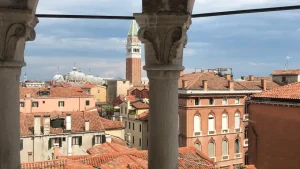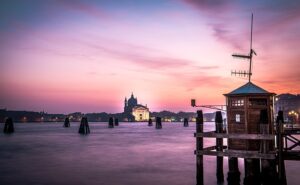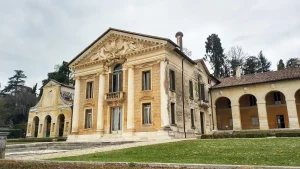
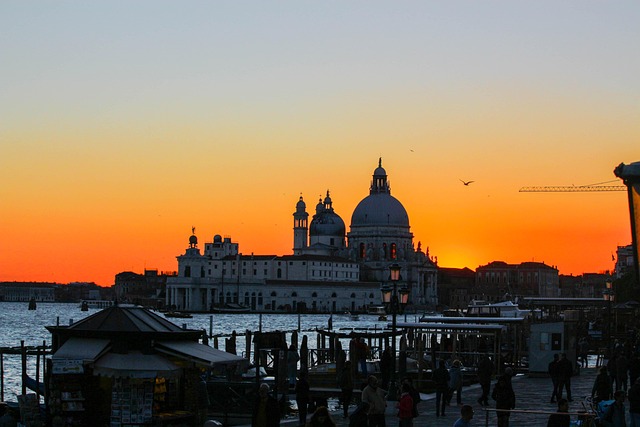
In almost every city I’ve ever visited, walking is how you get to the thing you came to see. You walk to the museum, to the church, to the restaurant, and the walk itself is just transit — necessary, forgettable, a means to an end. Venice is the one place I know where that’s not true. Here, the walk isn’t how you reach the attraction. The walk is the attraction, and after thirty years of leading people through these streets, I still notice something new almost every day.
A City Built at the Scale of a Footstep
Most cities, even beautiful ones, were eventually rebuilt around the needs of wheeled traffic — widened for carriages, then cars, then buses. Venice never had that option, and never had that pressure, because it was laid out entirely before any of those vehicles existed and has stayed that way since. Its calli were shaped by pedestrian movement alone, some barely wide enough for two people to pass shoulder to shoulder. That’s not a preserved historical curiosity retrofitted for tourists — it’s the city’s original, unaltered logic, still fully intact eleven centuries later. Nowhere else in Europe do you get an entire historic city center this large that was never once redesigned around a vehicle larger than a person.
What that means practically is that every proportion in Venice — the width of a passage, the height of a doorway, the placement of a window — was calculated for someone walking, at walking speed, at eye level. You feel it physically in a way you don’t in cities merely closed to cars for an afternoon. This is architecture that has never had to compromise with a windshield.
The Rhythm of Compression and Release
Here’s the thing I try to get guests to actually notice, rather than just experience passively: Venice moves in a rhythm, and that rhythm is the whole trick. You walk down a narrow, shadowed calle — sometimes so tight your shoulders nearly brush both walls — and the sound of your own footsteps becomes strangely loud, almost the only thing you can hear. Then, without warning, the passage opens into a campo: light, space, sky, the sudden murmur of a fountain or a conversation at a café table. Compression, then release. Over and over, block after block, all day.
No other city I know does this so relentlessly or so well. It’s closer to the pacing of a piece of music, or a well-built story, than to ordinary urban movement — tension and resolution, tension and resolution — and it happens entirely because of how Venice’s builders had to work centuries ago: carving usable land out of a lagoon, wherever a scrap of dry ground allowed it, with no grid, no master plan, no obligation to make anything symmetrical. The result, by accident as much as design, is a city that choreographs your attention without you ever noticing you’re being led.
Every View Is Discovered, Never Announced
In a car, or even on a bicycle, a view arrives at you. In Venice on foot, you arrive at the view — and because nothing here is set back from a road or framed by a parking lot, the reveal is always close, immediate, and slightly startling. A canal you didn’t know was there. A palace facade that fills your entire field of vision because you’re standing four feet from it rather than across a boulevard. A gondola gliding past close enough to hear the oar. Nothing in Venice is viewed from a comfortable distance, because there’s rarely room for a comfortable distance. You’re always inside the scene, not observing it from outside.
This is part of why photographs of Venice, however beautiful, consistently undersell the real thing. A photograph flattens the compression-and-release rhythm into a single frozen frame. Walking is the only way to actually experience the sequence — the buildup, the surprise, the next corner already pulling you forward.
Getting Turned Around Is Part of the Design, Not a Flaw
I’ve written elsewhere about the specific mechanics of navigating Venice without losing your mind, so I won’t repeat all of that here — but it’s worth saying plainly in this context: the disorientation that frustrates first-time visitors is, from a walker’s perspective, one of the city’s best features rather than a bug to be engineered around. Venice has no long straight avenues to rush down distracted. It forces a kind of attention that a modern grid city simply doesn’t require, and that attention is exactly what makes the walking itself feel like the point of the trip rather than the preamble to it.
Why This Changes How You Should Plan a Visit
If walking is genuinely Venice’s greatest attraction, it follows that the worst way to experience the city is to treat it purely as a checklist of sights connected by the fastest possible route between them. The better approach is to build in real walking time — not rushed transit between the Basilica and the Rialto, but unhurried stretches where the calli themselves are the destination.
This is exactly the pacing I build into every private walking tour: real time inside the rhythm of the city, not just efficient routes between its landmarks. If you’d like a day designed around actually experiencing Venice on foot rather than just getting between its highlights, take a look at our private tours, or reach out through the contact page and I’ll build it around exactly that.
Is Venice genuinely walkable for visitors with mobility limitations?
It requires more care than most flat cities, since the historic center involves frequent bridges and steps, but many of the most rewarding stretches of walking — the wider fondamente and larger campi — are relatively level, and a private guide can plan a route around the more difficult crossings.
How much walking should I expect on a typical day in Venice?
Most visitors comfortably cover five to eight kilometers a day without realizing it, simply because everything in the historic center is reached on foot; comfortable, broken-in shoes matter more here than almost anywhere else in Italy.
Is it worth hiring a guide just for walking, rather than for a specific museum or monument?
Yes — a guide’s real value on a walking-focused day isn’t unlocking a single site, it’s shaping the route itself so the compression-and-release rhythm of the city is paced well rather than rushed or accidental.