After thirty years walking this city with visitors, I’ve learned that Venice reveals its history most clearly not in its famous squares, but in its thresholds — the doorways, gates, and staircases where centuries of ambition, wealth, and craftsmanship converge into a single carved frame. Here are the three I find myself returning to again and again, and stopping to point out every time.
1. The Porta della Carta — The Doge’s Palace’s Ceremonial Gateway
If you’ve walked toward the Doge’s Palace from Piazza San Marco, you’ve passed beneath this gate without necessarily registering what you were looking at. The Porta della Carta was built between 1438 and 1442 by the father-and-son workshop of Giovanni and Bartolomeo Bon, and it served as the ceremonial entrance to the palace — the threshold a newly elected Doge would cross for his formal inauguration.
The name itself carries genuine historical debate: it likely derives either from the public scribes who once set up their desks in this area, or from its proximity to the cartabum, the state archive of official documents. Structurally, it’s a masterclass in Venetian Gothic ornamentation — pointed arches, intricate stone tracery, and sculptural detail dense enough that most visitors walk beneath it focused entirely on getting into the Palace itself, never looking up. I always stop clients here before we go inside, because the gate is making a political statement as much as an architectural one: this is Venice announcing, in stone, exactly how it saw itself.
The same Bon workshop responsible for the Porta della Carta also carved the portal of the Church of Santo Stefano, and their fingerprints are all over the city’s most significant Gothic facades — which is part of what makes the next doorway on this list so remarkable, since it’s their work again, on an entirely different building.
2. The Water Gate of Ca’ d’Oro — Venice’s Most Extravagant Front Door
Most Venetian palaces along the Grand Canal have two entrances: a modest land gate for everyday use, and a grand water gate facing the canal, meant to be seen by arriving guests stepping directly from their boats. Ca’ d’Oro — the “Golden House” — takes this concept further than almost any building in the city.
Built between 1428 and 1430 for the wealthy Contarini family, Ca’ d’Oro was designed by a team including the Milanese architect Matteo Raverti and, once again, Giovanni and Bartolomeo Bon, the same workshop behind the Doge’s Palace’s ceremonial gate. The facade was originally covered in gold leaf and polychrome pigment — an almost unimaginable extravagance even by Venetian Republic standards — which is where the building gets its name. What remains today has lost most of that gilding to centuries of weather and, at one low point, an owner who stripped out the staircase and sold off marble pieces before the building was rescued and eventually donated to the city in 1922.
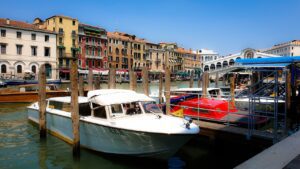
The water gate itself is the building’s most theatrical feature: a triple-arched loggia at canal level, designed purely to be glimpsed from a passing gondola, framing the entrance the way a stage frames a performance. The best way to actually see it properly is from the water — either by gondola or from the small wooden pontoon near the Rialto Market that places you directly opposite the facade. It’s one of the few buildings in Venice where I genuinely recommend seeing it twice: once from the water for the full effect, and once from inside the courtyard, where the polychrome marble paving — sourced from Rome by a later owner, Baron Franchetti — tells an entirely different story about how this palace has been loved and restored across the centuries.
3. The Spiral Staircase of Palazzo Contarini del Bovolo — Venice’s Hidden Architectural Secret
This is the one most visitors miss entirely, tucked into a small, quiet calle near Campo Manin — and it’s exactly the kind of discovery I love walking clients toward precisely because it isn’t on the standard postcard circuit. The Palazzo Contarini del Bovolo takes its name from “bovolo,” Venetian dialect for “snail,” a direct reference to the building’s signature feature: an external spiral staircase that winds up a cylindrical tower built of Istrian stone and exposed brick, perforated by arch after arch in ascending rows.
Commissioned in 1499 by Pietro Contarini, the staircase was built specifically to embellish an already richly frescoed side of the palace, though the identity of its architect remains genuinely disputed among historians — some credit the local builder Giovanni Candi, others the architect Giorgio Spavento. What’s not disputed is how unusual it is: this is the only structure of its kind still standing in Venice, and it was built taller than almost any secular structure of its era, at a time when towers were typically reserved for churches and government buildings. Climbing its eighty stone steps, winding counterclockwise past open arched loggias, is unlike any other experience in the city — and the payoff at the top is a genuine one: a rooftop terrace, the Belvedere, offering sweeping views over Venice unlike the more crowded vantage points near San Marco.
Fun footnote for film lovers: Orson Welles chose this exact staircase as a filming location for his 1952 adaptation of Othello, and it’s easy to see why once you’ve climbed it yourself.
Can you go inside Palazzo Contarini del Bovolo, or just view it from outside?
You can go inside and climb the staircase itself — it’s been open to visitors since 2016, with a small entry fee, and the climb to the rooftop Belvedere terrace is included.
What’s the best way to photograph the water gate of Ca’ d’Oro?
From the water — either aboard a gondola or from the small wooden pontoon near the Rialto Market, directly across the Grand Canal, which frames the entire facade in a single shot.
s the Porta della Carta the main entrance used to visit the Doge’s Palace today?
It’s part of the historical entrance sequence and visible as you approach, but modern visitor entry follows a separate, ticketed route through the complex rather than the original ceremonial path a Doge would have used.