“What is Scala Contarini del Bovolo? Where is the hidden spiral staircase in Venice? Is it worth visiting, or just another tourist attraction?”
These questions appear from travelers who’ve heard about Venice’s famous spiral staircase, recognize it as architecturally significant, want to understand whether climbing it offers worthwhile experience, curious about whether it deserves time investment versus competing Venice attractions, seeking authentic Venice discoveries beyond San Marco and Rialto crowds.
The honest answer: Scala Contarini del Bovolo represents genuinely significant Renaissance architectural achievement — a 15th-century external spiral staircase carved in perfect curves, hidden within palazzo courtyard in central Venice, recently restored and reopened to public, offering extraordinary architectural experience, exceptional 360-degree Venice views from summit, and escape from tourist masses, creating encounter that rewards genuine discovery with rare combination of architectural beauty, historical importance, and peaceful exploration impossible at Venice’s famous landmarks.
After 28 years guiding Venice — understanding which sites genuinely deserve visitor attention versus marketing hype, knowing how to discover hidden gems requiring intentional seeking, recognizing the profound difference between photographed attractions and embodied experiences, working with travelers seeking authentic Venice beyond guidebook predictability — I know that Scala Contarini del Bovolo represents exactly the type of discovery that creates memorable Venice experiences while remaining relatively unknown despite architectural significance and public accessibility.
The fundamental realities most travelers miss:
Scala Contarini del Bovolo isn’t famous despite deserving recognition — the staircase achieves architectural mastery (perfect proportions, structural innovation, aesthetic refinement) at level Palladian churches receive, yet most Venice visitors never encounter it because it’s hidden within palazzo courtyard, requires intentional navigation to discover, doesn’t appear on major tourist maps, and lacks the institutional marketing of museums or famous churches.
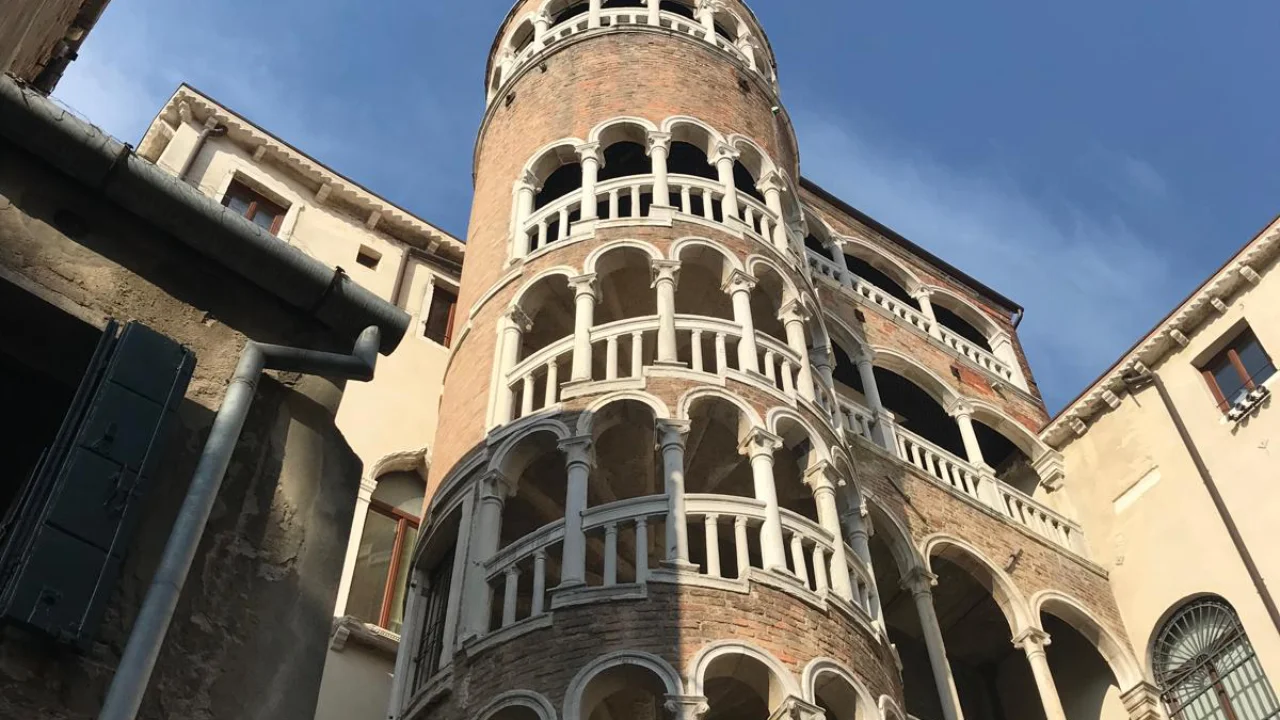
The “bovolo” (snail in Venetian) name derives from the staircase’s spiral form resembling snail shell — the spiral Renaissance staircase represents architectural innovation resolving the challenge of ascending multiple stories within restricted courtyard space, creating sculptural form achieving both functional and aesthetic perfection.
Recent restoration (completed approximately 2016-2020) made the staircase publicly accessible after decades of limited viewing, changing it from architectural footnote locals knew about to genuine visitor destination, though relatively undiscovered by international tourism compared to Venice’s overcrowded major attractions.
Understanding that climbing the staircase (approximately 80 steps through six spiral revolutions) provides intimate architectural experience impossible from external viewing — each level reveals different perspective, the spiral creates constantly-shifting geometric relationships, the experience engages body and sensation versus passive sightseeing, creating embodied understanding of Renaissance spatial conception.
The summit view (approximately 65 feet above courtyard) provides exceptional 360-degree Venice perspective from unique vantage point — roofline views, neighborhood spatial relationships, geometric patterns of buildings, understanding Venice’s urban fabric from position unavailable elsewhere except Doge’s Palace tower or church campanili.
This is the completely honest Scala Contarini del Bovolo guide — explaining what the staircase actually is and why it matters architecturally, describing the visitor experience in specific sensory and spatial detail, revealing how to locate it and navigate the hidden courtyard entry, addressing why it remains relatively unknown despite architectural importance, providing practical information for visit optimization, and helping you understand whether this discovery aligns with your Venice interests and visiting approach.
What Is Scala Contarini del Bovolo: The Architecture and History
Understanding the staircase’s significance and why it matters architecturally.
The Historical Context:
Construction period: Approximately 1499-1502 (late 15th/early 16th century, early Renaissance period)
Architect/patron: Built by the Contarini family (prominent Venetian noble lineage), likely designed by architect of significant skill though specific designer unrecorded in historical documents
The palazzo context: Palazzo Contarini del Bovolo represents 15th-century Venetian Gothic-Renaissance transition structure, located near Rialto in San Marco district
The functional problem it solved:
Medieval and early Renaissance Venetian palazzi faced specific architectural challenge — ascending multiple stories within tightly constrained urban plot (Venice’s density and expensive water-front property created severe space limitations), requiring efficient vertical circulation without consuming excessive courtyard or interior space
The innovative solution:
The external spiral staircase emerged as Renaissance architectural response — creating sculptural architectural element serving functional purpose while achieving aesthetic beauty, essentially transforming utilitarian necessity into artistic expression
The Architectural Significance:
Renaissance spiral staircase mastery:
The bovolo represents sophisticated understanding of Renaissance geometric principles — the spiral maintains perfect mathematical proportions across six revolutions, creating ascending path where each step relates proportionally to overall form, achieving harmony between structural logic and aesthetic beauty
The sculptural quality:
Unlike functional staircases existing purely for circulation, the bovolo operates as freestanding sculpture integrated into palazzo courtyard — the marble-faced exterior curves create dynamic visual forms shifting perspectives as viewer moves, the spiral defies static viewing (constantly revealing new aspects), achieving three-dimensionality impossible in flat architectural drawing
The structural innovation:
Building a spiral staircase in 1500 required sophisticated understanding of radial geometry, load distribution, and stone-working technique — the helical form distributes weight along curved surfaces, demonstrates engineering skill rivaling military fortifications or bridge construction
The spatial integration:
Rather than a staircase appearing as foreign insertion into courtyard, the bovolo integrates architecturally — creating proportion and presence suggesting intentional composition, the spiral’s geometry echoes natural forms (snail shells, nautilus chambers, spiral galaxies) creating aesthetic satisfaction beyond pure functionality
Comparative Architectural Significance:
Palazzo context: Belongs to palazzo architecture category (noble residences), distinct from churches or public buildings yet representing equivalent artistic ambition
European Renaissance comparison: Similar spiral staircases exist in other Renaissance palaces (Rome, Florence, other Italian cities) but Venice’s bovolo achieves particular refinement and visibility creating distinctive character
Architectural preservation: The staircase survived centuries of Venice’s structural decay (building subsidence, water damage, material deterioration), requiring periodic restoration but maintaining essential form and character
Modern recognition: Recently restored staircase now receives architectural attention it previously lacked, with international architects studying its geometric and structural properties
The Physical Experience: What Climbing the Staircase Feels Like
Understanding the embodied encounter visitors actually have.
The Approach and Entry:
Location navigation: Campo San Paternian, near Rialto area, San Marco district (requires intentional seeking — not on major walking routes, hidden within palazzo complex)
The hidden courtyard entry: Access through modest palazzo entrance (no grand facade) into private courtyard space; the transition from busy campo into enclosed courtyard creates sudden atmosphere shift from tourist Venice to intimate private space
The courtyard context: Upon entering, the bovolo appears as dramatic sculptural element dominating intimate courtyard space (approximately 30-foot diameter open area), the spiral staircase appearing unexpectedly monumental despite actual modest dimensions
First impression: Viewers typically experience moment of architectural discovery — “how did I not know this existed?” combined with immediate recognition of the staircase’s geometric elegance, the curved lines creating visual satisfaction even before climbing
The Climbing Experience:
Physical engagement: Climbing approximately 80 steps through six spiral revolutions engages body and proprioception (sense of self in space) in ways passive viewing never does — the consistent spiraling creates particular spatial disorientation initially (which direction are you facing? where is the courtyard now? where is up?) before orientation stabilizes
The sensory progression:
Level 1-2: Courtyard still visible, context maintained, architectural detail visible (notice stone carving, proportion relationships, how spiral curves)
Level 3-4: Courtyard disappears below, viewing angle shifts to rooftop level, beginnings of Venice panorama appearing (neighboring palazzo rooflines, water glimpses in distance)
Level 5-6 (summit): Full roofline and lagoon perspective emerges, 360-degree view over neighboring buildings, understanding of neighborhood spatial relationships, feeling of modest elevation (65 feet not vertiginous but creating distinct “looking down at Venice” perspective)
The architectural revelation: As climber ascends, the staircase’s geometry reveals itself progressively — each spiral creates different sightlines, the geometric perfection becomes apparent through movement and changing perspective, understanding the architect’s proportional thinking through embodied experience
The physical sensation: The climb is moderate (80 steps, consistent handrail, not strenuous), achievable for most fitness levels, though steep narrow steps require care, stone surfaces sometimes slightly worn creating authentic aging character
The spatial experience: The spiral creates constant leftward-curve movement (ascending roughly counterclockwise), creating particular movement pattern that becomes familiar, the consistent pitch and radius making mechanical sense gradually apparent
The Summit Experience:
The viewing platform: Small open area at staircase summit (approximately 8 feet diameter, open to sky) provides 360-degree Venice perspective without barrier obstruction
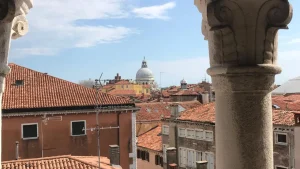
The roofline intimacy: Views show Venice’s roofscape up close — chimney pots, weathered tiles, antennas, architectural details normally invisible from street level, creating different Venice understanding (roofline patterns, building density, elevation changes)
The distant perspectives:
- Southern view: Grand Canal curves and major landmarks (Doge’s Palace tower visible in distance, Santa Maria della Salute church dome)
- Northern view: Neighborhoods extending toward lagoon edge
- Eastern/Western views: Residential Venice quarters, palazzo density, campo positions
- 360-degree comprehension of Venice’s geographic position on islands
The atmospheric quality: Wind conditions at summit often different from street level (breezes cooling in summer, carrying lagoon scents), light quality different from ground perspective, creating sensory experience beyond visual
The meditation possibility: Small platform crowds rarely (unlike famous viewpoints), creating potential for quiet contemplation, the intimate height and seclusion enabling personal reflection or photography without jostling crowds
The Photographic Opportunity:
The self-portrait potential: The spiral staircase itself becomes subject — photographers document the curves, the proportions, personal positioning within geometric forms
The view documentation: The roofline perspective and lagoon distance provide photography subjects unavailable from ground level
The geometric abstraction: The spiral creates compositional subject matter (curved lines, concentric circles, perspective studies) appealing to photographers interested in form and geometry
The light quality: Depending on time of day, the marble surfaces catch light creating sculptural dramatic contrast, photography improving during golden hours (early morning, late afternoon)
Locating and Accessing Scala Contarini del Bovolo
Understanding how to find the hidden staircase and practical visitor information.
Geographic Location:
Precise address: Campo San Paternian, San Marco district (near Rialto area but not directly on Grand Canal)
Navigation landmarks:
- Approximately 5-minute walk from Rialto Bridge (northwest direction)
- Near Ponte dei Bareteri bridge spanning Grand Canal
- Campo San Paternian is small secondary campo (not major tourist square)
- Palazzo Contarini del Bovolo faces the campo directly
How to find it:
From Rialto Bridge: Cross bridge toward San Marco district, descend on eastern side, turn left along Calle del Carbon or Calle della Bissa (multiple routes possible), navigate through secondary calli eventually reaching Campo San Paternian; requires navigation but follows logical progression
Using landmarks: The palazzo isn’t visible from main routes; must enter campo to see it
GPS/mapping apps: Modern smartphone mapping shows campo and location precisely, removing navigation guesswork though discovering it through intentional seeking creates more meaningful discovery
Practical Visitor Information:
Current status: Restored and publicly accessible (reopened to public 2016-2020 after restoration)
Hours of operation: Generally open daily 10:00 AM-6:00 PM (subject to seasonal variation and special closures; verify current hours before visiting as they occasionally change)
Admission fee: Modest entrance fee (approximately €5-6 for European adults, €3-4 for reduced rates); provides access to climb staircase and summit platform
Accessibility considerations:
- 80 steps required (no elevator option)
- Narrow steep stairs requiring careful footing
- Not wheelchair accessible
- Not appropriate for young children or those with mobility limitations
- Takes approximately 10-15 minutes for complete climb and summit time
Crowds and timing:
- Never extremely crowded (remains relatively unknown despite reopening)
- Early morning (before 11:00 AM) typically very quiet
- Afternoon (2:00-4:00 PM) potentially more crowded (though still manageable)
- Rainy days almost empty (few tourists venture out in rain)
- Weekdays quieter than weekends
Best visiting times:
For photography: Early morning (6:30-8:00 AM) provides optimal light, empty platform, golden-hour illumination; late afternoon (5:00-6:00 PM) secondary golden hour
For quiet experience: Weekday mornings (Tuesday-Thursday 8:00-10:00 AM) essentially private viewing
For views: Any time avoiding midday glare; sunset timing (8:00+ PM June, earlier other seasons) provides dramatic lagoon light
Weather consideration: Clear days preferable for distant view visibility; surprisingly beautiful in soft overcast light (less glare, architectural details more visible)
Practical Preparation:
Physical preparation: Comfortable walking shoes essential (stone steps require good traction), light layers (summit exposed to wind despite Venice’s typically calm conditions)
What to bring: Camera/phone for documentation, water bottle for hydration, modest backpack for belongings
What to expect: 15-20 minute total experience (5 minutes climb, 10 minutes summit time, 5 minutes descent); can extend with extended observation
Language: Onsite signage minimal; understanding spiral staircase history enhances experience but not essential; modern interpretive signs at entry provide basic information
Why Scala Contarini del Bovolo Remains Underknown
Understanding why this significant site doesn’t receive attention matching its importance.
The Visibility Problem:
Hidden location: Enclosed within palazzo courtyard, invisible from major routes, existing in secondary campo rather than famous squares, requiring intentional navigation creating natural barrier to casual discovery
No commercial presence: Unlike museums or tourist attractions with signage, marketing, gift shops encouraging visibility, the bovolo exists quietly without commercial apparatus drawing attention
Competitive positioning: Located near more famous attractions (Rialto, Grand Canal), competing for tourist attention with monumentally famous landmarks, receiving attention overflow rather than direct seeking
Tourist guidebook hierarchy: Standard guidebooks mention bovolo but not prominently (interior pages, brief mention), prioritizing San Marco, Doge’s Palace, Academia, creating impression of secondary importance despite architectural significance
The Historical Obscurity:
Limited documentation: Specific architect unrecorded, patron family (Contarini) important but not universally known, creating less colorful historical narrative than buildings associated with famous figures or dramatic stories
No dramatic narrative: Unlike buildings with romantic or tragic histories, the bovolo’s historical significance lies in architectural achievement rather than human drama, appealing to architecture enthusiasts rather than general audience
Renaissance architectural complexity: Understanding the staircase’s geometric and structural innovation requires some architectural literacy, less immediately accessible than visual beauty of monuments or artistic masterpieces
The Restoration Timing:
Recent public reopening: The staircase only became widely publicly accessible within last 5-10 years (post-restoration, 2016+), not enough time for international tourism reputation to develop compared to sites famous for centuries
Catch-up phenomenon: Established tourist attractions (100+ years reputation) maintain visitor momentum despite relative quality; newly opened sites require time to overcome obscurity
Word-of-mouth lag: Unlike famous attractions with self-perpetuating fame, lesser-known sites depend on recommendation networks, traveler blogs, guide repositioning — slower adoption than established tourism infrastructure
The Ironic Advantage:
Undiscovery creates authenticity: Precisely because Scala Contarini del Bovolo remains relatively unknown, visiting it provides genuine discovery experience, escape from crowds, encounter with architecture on own terms without tourism performance pressure
The reward structure: Travelers who intentionally seek it experience satisfaction of discovery greater than visiting famous sites everyone visits, creating more memorable experience precisely because effort required
The selective audience: The site attracts visitors specifically interested in architecture or Venice discovery rather than checklist tourism, creating community of engaged visitors rather than cruise-ship crowds
Integration with Broader Venice Exploration
Understanding how to incorporate the staircase into complete Venice visiting strategy.
Neighborhood Context:
Rialto area proximity: Located within walking distance of Rialto Bridge, Rialto Market, San Polo neighborhood, Grand Canal, creating natural integration with broader central Venice exploration
Route integration: Can be incorporated into neighborhood walking route combining Rialto Market visit, campo exploration, bacari circuit, creating morning sequence
Neighborhood character: Located in active residential/working Venice, surrounded by artisan workshops, neighborhood restaurants, authentic Venice rather than tourist zone, enabling authentic exploration alongside architectural visit
Temporal Strategy:
Early morning priority: Visit 8:00-9:00 AM (before crowds, optimal light, quiet experience, cool morning), before proceeding to other activities
Combination approach: Spiral staircase climb (20 minutes) + Rialto Market exploration (45 minutes) + neighborhood walking (60 minutes) creates morning sequence totaling 2-3 hours with thematic coherence (architecture, market, authentic Venice)
Sequential visiting: After staircase, continue to nearby San Polo neighborhood, artisan workshops, secondary churches, creating coherent neighborhood immersion
Comparative Viewing Strategies:
Staircase climbing advantage: Physical embodied experience superior to passive viewing — climbing reveals architecture through movement and sensation impossible from photographs or external observation
The viewpoint comparison: San Giorgio Maggiore campanile or Doge’s Palace tower provide broader lagoon perspective; bovolo provides intimate roofline understanding of specific neighborhood — different vantage points serving different purposes
The architectural understanding: Viewing spiral staircase provides specific Renaissance proportional understanding; visiting other palazzi provides broader architectural context; combination creates comprehensive understanding
Matching to Visitor Interests:
Ideal for: Architecture enthusiasts, photographers interested in form/geometry, travelers seeking authentic discovery, those interested in Renaissance architectural innovation, photographers seeking unique perspectives, visitors wanting escape from crowded major attractions
Less essential for: Those with limited Venice time (must prioritize major sites), visitors uninterested in architecture, those unable to climb 80 steps, rush-paced tourists following fixed itineraries
Recommended combination: Neighborhood exploration, museum-free days, spontaneous wandering approaches where architectural discovery and unexpected encounters are priorities
Our Guided Experiences
If you want expert architectural context and optimal navigation for experiencing Scala Contarini del Bovolo and related Venice discoveries — understanding Renaissance proportions, discovering similar architectural gems, contextualizing within broader architectural narrative — we provide specialized architectural and discovery-focused tours.
What We Provide:
Architectural expertise:
- Explaining Renaissance geometric principles and proportional relationships
- Contextualizing bovolo within broader palazzo architecture
- Identifying architectural details and construction techniques
- Comparative analysis with other spiral staircases and Renaissance innovations
- Understanding architect’s intentions and problem-solving approach
Discovery facilitation:
- Guiding to hidden location (eliminating navigation uncertainty)
- Timing optimization (early morning/quietest periods)
- Photography guidance (best angles, timing, compositional advice)
- Extended time allowing contemplative exploration
- Sharing insider knowledge about restoration and current status
Neighborhood context:
- Rialto Market integration (understanding produce/fish, meeting vendors, learning seasonal patterns)
- Neighborhood palazzo tour (viewing exterior architecture, understanding spatial relationships)
- Artisan workshop visits (meeting craftspeople, observing traditional practices)
- Bacari circuit experience (authentic neighborhood dining, local social patterns)
Comparative architectural tours:
- Other Renaissance palazzi and architectural innovations
- Church and religious architecture comparison
- Hidden architectural gems throughout Venice
- Evolution from Gothic to Renaissance principles
Photography-focused guidance:
- Optimal timing and positioning for light
- Compositional strategies for spiral geometry
- Documentation of details and perspectives
- Creating portfolio of architectural study
Understanding Complete Context
For architectural exploration: Hidden viewpoints, neighborhood characters, museums and collections.
For discovery approaches: Spontaneous wandering, getting lost productively, museum-free days.
For practical navigation: Vaporetto guide, neighborhood exploration, Rialto Market.
For all experiences: Complete tour options.
Scala Contarini del Bovolo Represents Hidden Renaissance Architectural Masterpiece — 15th-Century External Spiral Staircase, Perfect Geometric Proportions, 360-Degree Venice Summit Views, Recently Restored and Public Access, Relatively Unknown Despite Architectural Significance, Rewards Intentional Discovery
After 28 years guiding Venice and being featured by Rick Steves, NBC, and US Today, I recognize Scala Contarini del Bovolo as genuinely significant discovery element — hidden within palazzo courtyard Campo San Paternian (San Marco district near Rialto), the 1499-1502 spiral staircase solves Renaissance architectural problem (ascending multiple stories within constrained urban plot) through sculptural innovation achieving geometric perfection and aesthetic beauty. The “bovolo” (snail in Venetian) spiral staircase represents sophisticated proportional understanding, structural engineering, and integration of function with artistic expression rivaling cathedral design or military fortifications in technical achievement. Recent restoration (reopened public access 2016+) made previously inaccessible staircase discoverable; approximately 80-step climb through six spiral revolutions provides embodied architectural experience (understanding spatial relationships through movement) unavailable through passive viewing, summit at ~65 feet elevation provides 360-degree roofline perspective and lagoon view from unique vantage point (different from famous campanile views, emphasizing neighborhood intimacy rather than distant grandeur). The staircase remains underknown despite significance because hidden location (invisible from major routes), requires intentional seeking in secondary campo, lacks commercial marketing infrastructure, documented as Renaissance geometric-structural achievement rather than dramatic historical narrative, relatively recent public reopening (insufficient time for established reputation). Accessing involves navigating from Rialto area through secondary calli to Campo San Paternian, modest entrance fee (~€5-6), 80 stairs requiring careful footing but achievable for most fitness levels, approximately 15-20 minutes total experience (5 minutes climb, 10 minutes summit, 5 minutes descent). Best visiting: early morning (6:30-8:00 AM) for photography, quiet experience, weekday mornings (Tuesday-Thursday) for minimal crowds, clear weather for vista visibility. Integration: near Rialto Market, San Polo neighborhood, bacari circuit, creating morning sequence combining market visit, architectural exploration, neighborhood discovery. Ideal for: architecture enthusiasts, photographers studying geometry, discovery-oriented travelers, those seeking escape from crowded major attractions, Renaissance principle appreciation. We provide architectural expertise, guided navigation, optimal timing coordination, neighborhood context, photography guidance, discovery facilitation. Contact us for expert Scala Contarini del Bovolo experiences revealing hidden Venice architectural mastery. Let’s discover Venice’s secret spiral staircase.
Contact us for guided Scala Contarini del Bovolo experiences — architectural expertise and discovery focus.
Frequently Asked Questions
Is climbing Scala Contarini del Bovolo worth the time and effort, or should I prioritize more famous Venice attractions if my time is limited?
The value of visiting depends entirely on your Venice priorities and visiting approach — it’s worth prioritizing only if architectural discovery and authentic experience matter more than checklist tourism or major monuments. Arguments for prioritizing (climbing worth time investment): (1) Authentic discovery dimension — the hidden location, required seeking, quiet experience create genuine “finding Venice” satisfaction unavailable at San Marco or Doge’s Palace, creating memorable experience precisely because effort required. (2) Architectural mastery — the spiral staircase achieves Renaissance proportion and geometric perfection rivaling any Venice building; if architecture interests you, this represents world-class achievement, justifying time. (3) Embodied understanding — climbing the staircase reveals architectural thinking through movement and sensation (spiraling, changing perspective, proportional relationships) impossible through passive viewing of buildings or looking at photographs; this physical engagement creates deeper comprehension than intellectual appreciation. (4) Unique roofline perspective — the 360-degree summit view reveals Venice’s neighborhood spatial relationships, roofline patterns, architectural density from vantage point unavailable elsewhere (different from campanile views emphasizing distant lagoon), creating geography understanding. (5) Time efficiency — entire experience (navigation + climb + summit time) requires 20-30 minutes, minimal time investment compared to multi-hour museum visits, yet provides meaningful engagement. (6) Crowd escape — complete privacy and absence of tourism chaos creates psychological refreshment and mental space for actual observation (versus jostling crowds at major attractions). (7) Photography opportunity — the geometric spiral, roofline perspective, intimate scale provide unique compositional subjects unavailable elsewhere. Arguments against prioritizing (if time severely constrained): (1) Essential landmark status — if visiting Venice only once, time perhaps better spent at Doge’s Palace, basilicas, museums representing essential Venice knowledge. (2) Requires physical ability — if climbing 80 steps presents challenge, time/energy might be better allocated to accessible major sites. (3) Architectural knowledge prerequisite — if Renaissance architecture doesn’t interest you, the proportional beauty and geometric innovation may feel inaccessible, reducing experienced value. (4) Results depend on experience approach — the staircase rewards those visiting with openness to discovery, slow observation, architectural curiosity; rushing tourists checking items off list derive minimal benefit. Strategic recommendation: Include bovolo if: (a) Your Venice visit allows 3+ days (enables both essential sites and discoveries), (b) Architecture or authentic discovery matters more than checklist completion, (c) You’re comfortable with “getting lost” and intentional seeking as part of experience, (d) Photographing form/geometry interests you. Skip bovolo if: (a) Time severely limited (1-2 days absolute maximum), (b) You must see Basilica, Doge’s Palace, Academia (essential canonical Venice), (c) Climbing stairs problematic, (d) You prioritize famous monuments over unknown discoveries. The honest assessment: Bovolo offers greater experience-to-time-investment ratio than many major attractions (20 minutes yields disproportionately meaningful encounter versus 2 hours at crowded Academia with mediocre engagement), making it excellent priority for thoughtful travelers with moderate time availability; for extreme time constraint, major canonical sites take precedence, but bovolo deserves inclusion whenever schedule allows.
How difficult is finding Scala Contarini del Bovolo, and should I use a guide or can I locate it independently?
Finding the location independently is feasible but challenging — the hidden courtyard requires intentional seeking, and GPS alone may not prevent getting lost; your comfort level with navigation should determine approach. Independent finding difficulty factors: (1) Hidden location — the palazzo/courtyard invisible from main routes; unlike landmarks visible from distance allowing approach correction, you must navigate through secondary streets without clear target orientation. (2) Navigation by landmark alone — starting from known location (Rialto Bridge) and using directional knowledge requires understanding Venice’s street system and maintaining sense of direction while navigating multiple small calli (streets). (3) Dead ends and backtracks possible — Venice’s medieval layout creates multiple possible routes; wrong turns lead to dead ends requiring retracing (frustrating but not dangerous). (4) Secondary streets unmarketed — Campo San Paternian doesn’t appear prominently on tourist maps or signage; modern GPS helps but may provide imprecise directions. Independent finding strategies: (1) Smartphone GPS advantage — modern mapping apps (Google Maps, Apple Maps) show campo and palazzo precisely, eliminating historical navigation difficulty; simply following GPS provides accurate route, though removes organic discovery element. (2) Rialto Bridge starting point — well-known landmark allows confident navigation start, followed by GPS guidance through secondary streets. (3) Local asking — Venetians willingly provide directions; asking is culturally acceptable and often rewarded with friendly assistance plus potentially interesting side streets discovered. (4) Time buffer — allocate 30 minutes navigation time (rather than assuming 5 minutes) to account for exploration, wrong turns, stopping to observe surroundings. (5) Exploration opportunity — getting “lost” discovering secondary Venice through failed navigation often creates positive experience (discovering unknown bacari, artisan workshops, neighborhood character) versus efficiently reaching target. Guided advantages: (1) Navigation certainty — guide knows exact path, eliminates uncertainty and dead ends, allowing full attention to architectural context rather than street navigation. (2) Architectural expertise — guide explains Renaissance principles, geometric innovation, proportional relationships enhancing understanding beyond what independent visitors recognize. (3) Timing optimization — guide coordinates early morning visit (quietest conditions, optimal light) versus visiting whenever you happen to arrive. (4) Time efficiency — guided experience provides complete context efficiently; independent visiting often results in spending time navigating, reducing time for actual experience. (5) Photography guidance — guide assists with optimal angles, timing, compositional strategy for documentation. (6) Reduced stress — no navigation anxiety, full presence for observation, cultural relaxation. Practical recommendation: Use guide if: (a) You’re unfamiliar with Venice navigation, (b) You value architectural context and expert explanation, (c) Early morning/optimal timing important, (d) Photography guidance desired. Navigate independently if: (a) Confident with Venice navigation, (b) GPS mapping sufficient, (c) Enjoy intentional seeking as part of discovery experience, (d) Have adequate time buffer for navigation exploration. Many visitors successfully combine approaches — use GPS reaching campo independently, then hire guide or access interpretive materials at site for architectural explanation, creating balance between discovery and expert context.
What’s the actual view like from the top, and does it justify the climb, or is it just a roofline looking at more rooflines?
The summit view genuinely justifies climbing and rewards observation — it’s not merely repetitive rooflines but reveals Venice’s neighborhood structure, architectural density, spatial relationships, and island geography in ways ground-level viewing cannot, though appreciation depends on observation quality and architectural interest. What you actually see from summit (~65 feet elevation): (1) Immediate roofline intimacy — directly surrounding palazzo rooflines at approximately same height, visible roofline details (chimney pots, tile patterns, antennas, weathered materials), revealing building techniques and construction methods invisible from street level; this architectural detail view interests architecture enthusiasts even if non-specialists don’t consciously register it. (2) Campo spatial understanding — the Campo San Paternian spreads below, revealing its scale, shape, proportional relationship to surrounding buildings, pedestrian patterns, seasonal use (whether filled with locals, tourists, or empty), providing geography understanding impossible from street within the campo. (3) Neighborhood block structure — the interconnected buildings reveal how Venice’s residential blocks organize, how private courtyards nestle within building clusters, how water channels between buildings, showing spatial complexity invisible navigating street-level calli. (4) Water identification — while not directly on water, the view shows where canals intersect neighborhoods (visible as building gaps, water glints in distance), revealing Venice’s water-based structure. (5) Distant landmark positioning — on clear days, distant landmarks (Doge’s Palace tower, Basilica domes, church campanili in other neighborhoods) visible at distance, contextualizing neighborhood position within larger Venice. (6) Horizon and island consciousness — the view extends to Venice’s edges (where buildings meet lagoon water), creating awareness of Venice as genuinely island city surrounded by water (though water not dramatically visible from this elevation/location, the edge awareness emerges). (7) Geometric patterns — the roofline tessellation creates abstract geometric beauty, the building patterns creating visual interest through repetition and variation (flat roofs, slopes, varied materials, architectural styles), appealing to photographers and those interested in visual composition. What you DON’T get (vs. campanile views): (1) Distant lagoon panorama — Doge’s Palace or San Giorgio Maggiore campanile provide dramatic open-water views, Venice surrounded by lagoon visible; bovolo’s neighborhood location provides no such vista. (2) Complete city overview — the elevation is insufficient for comprehensive Venice-wide view; you’re seeing single neighborhood context, not bird’s-eye understanding of city’s full geography. (3) Iconic monument views — from campanile, famous buildings and basilicas visible as recognizable distant objects; bovolo’s neighborhood location doesn’t provide famous landmark sightlines. The honest assessment: The bovolo view appeals most to those interested in (a) architectural detail and building techniques, (b) urban spatial organization and neighborhood structure, (c) abstract geometric beauty and visual composition, (d) intimate community-level understanding versus panoramic vistas. If you visit expecting dramatic lagoon panorama like famous campanile views, you’ll be disappointed; if you visit seeking understanding of Venice’s neighborhood fabric and architectural complexity, you’ll find the intimate roofline perspective genuinely rewarding. Comparative framework: Different viewpoints serve different purposes — campanile views provide iconic distant perspective (good for orientation, photography, dramatic impact); bovolo provides intimate local perspective (good for architectural understanding, neighborhood comprehension, compositional abstraction). Value justification: The climb’s value comes not from spectacular panorama but from embodied architectural experience — climbing the staircase itself is primary experience (understanding proportion through movement), the summit view is secondary benefit providing neighborhood context and architectural detail observation, combined creating meaningful encounter unavailable through other Venice experiences.