“Who is JR and why is his Venice installation important? Where is Ca’ da Mosto and how do I see the JR exhibition? Is this part of the official Biennale?”
These questions appear from Venice visitors who’ve heard about JR’s dramatic Grand Canal intervention, recognizing his name from massive public art projects worldwide but uncertain what to expect in Venice, wanting to understand how street art’s most ambitious practitioner engages with Venice’s historic architecture, questioning whether this represents essential viewing during Biennale season or peripheral distraction from main pavilions.
The honest answer: JR’s Ca’ da Mosto installation represents genuinely significant cultural moment — one of contemporary art’s most recognizable figures (whose massive photographic interventions have covered buildings from Paris to Rio to New York) creating site-specific work on Venice’s Grand Canal, transforming historic 13th-century palazzo facade into living artwork visible to everyone passing the waterway, addressing themes of memory, time, Venetian identity, and the relationship between contemporary intervention and historical preservation, creating free public art accessible to all versus ticketed exhibition exclusivity.
After 28 years experiencing Venice’s relationship with contemporary art — understanding how the city’s historic fabric creates both opportunity and constraint for contemporary practitioners, knowing which interventions generate genuine cultural significance versus superficial spectacle, recognizing how Venice’s UNESCO status and preservation regulations complicate contemporary art installations, working with travelers seeking authentic artistic experiences beyond tourist clichés — I know that JR’s work creates rare convergence where world-class contemporary artist, historic Venetian architecture, and democratic public accessibility combine producing experiences worth serious attention.
The fundamental realities most travelers miss:
JR isn’t typical contemporary artist but global phenomenon whose public art interventions reach audiences numbering millions rather than gallery-attending thousands, whose work appears in urban spaces without requiring museum admission, whose practice explicitly democratizes art access while maintaining aesthetic and conceptual sophistication, making his Venice presence significant beyond typical Biennale collateral exhibition.
Ca’ da Mosto isn’t random palazzo but one of Venice’s oldest surviving structures (13th century origins, Byzantine-Venetian Gothic architecture, historically significant as birthplace of navigator Alvise da Mosto), creating meaningful dialogue when 21st-century photographic intervention engages with nearly 800-year-old facade, raising questions about preservation, transformation, memory, and Venice’s identity as living city versus museum artifact.
The installation’s Grand Canal visibility means experiencing JR’s work requires no special access, tickets, or art world credentials — simply riding vaporetto or walking along waterfront provides viewing, creating democratic encounter versus Biennale’s ticketed pavilions or invitation-only palazzo exhibitions, though understanding the work’s significance benefits from context about JR’s practice and Venice’s architectural history.
Understanding that temporary interventions on historic Venetian architecture face extraordinary regulatory scrutiny — UNESCO World Heritage designation, Soprintendenza (cultural heritage authority) oversight, neighborhood opposition to contemporary alterations, making approval for facade-covering installations rare and significant when they occur, JR’s project representing institutional validation of his approach.
This is the completely honest JR Ca’ da Mosto guide — explaining who JR is and why he matters to contemporary art and public space, describing what the installation actually involves and how to experience it, revealing Ca’ da Mosto’s historical significance and why this location matters, addressing the broader questions about contemporary art’s relationship to Venice’s preservation mandates, providing viewing strategies and optimal perspectives, and helping you understand this work’s place within Venice’s complicated negotiation between past and present.
Who Is JR and Why Does He Matter?
Understanding the artist’s practice, significance, and global recognition.
The Anonymous Street Artist Turned Art World Star:
JR (born 1983, Paris) — French artist known only by initials, maintaining semi-anonymity despite international fame, working primarily with large-scale photographic installations in public spaces
The signature approach:
Photographing individuals (often from marginalized communities, conflict zones, or overlooked populations), creating massive black-and-white portraits, wheat-pasting these enormous images onto buildings, walls, trains, favelas, refugee camps, transforming urban architecture into temporary galleries celebrating human dignity
The “pervasive art” philosophy:
JR describes his practice as bringing art to people rather than requiring people to come to art (museums, galleries), creating interventions in everyday spaces where anyone can encounter them regardless of cultural capital or economic access, democratizing art experience while addressing urgent social and political themes
The Major Projects That Built His Reputation:
“Portrait of a Generation” (2004-2006, Paris suburbs):
- Massive portraits of young people from French housing projects posted throughout Paris
- Confronting stereotypes about suburban youth and immigration
- Created without permission (illegal street art) but later officially recognized
“Face 2 Face” (2007, Israel-Palestine):
- Portraits of Israelis and Palestinians doing the same jobs (teachers, mechanics, etc.) displayed on both sides of separation wall
- Demonstrating shared humanity despite political conflict
- First major project bringing international attention
“Women Are Heroes” (2008-2010, global):
- Photographs of women in conflict zones (Kenya, Sierra Leone, Liberia, Brazil) installed in their own communities
- Eyes and faces covering buildings, rooftops, hillsides
- Celebrating resilience while highlighting violence against women
“Inside Out Project” (2011-ongoing):
- Participatory global art project allowing anyone to submit portraits for public posting
- Over 400,000 participants in 140+ countries
- Democratizing JR’s methodology, making it available to communities worldwide
“The Wrinkles of the City” (2008-2015, various cities):
- Portraits of elderly residents wheat-pasted on buildings in cities undergoing rapid transformation (LA, Havana, Shanghai)
- Preserving memory and human stories as urban fabric changes
“Unframed” series (recent years):
- Architectural interventions where portraits appear to emerge from or interact with buildings
- Creating optical illusions and trompe-l’oeil effects
- More sculptural/architectural versus flat wheat-pasting
The Recognition and Institutional Validation:
TED Prize (2011): $100,000 award and platform launching Inside Out Project
Academy Award nomination (2018): Documentary “Faces Places” (collaboration with Agnès Varda) nominated for Oscar
Major museum exhibitions: Brooklyn Museum retrospective “Chronicles” (2019), institutional recognition while maintaining street art roots
Public commissions: Louvre Pyramid transformation (2019), creating optical illusion making pyramid “disappear,” demonstrating ability to work with world’s most prestigious cultural institutions
The art market paradox: Despite street art origins and democratic accessibility philosophy, JR’s work commands high prices in galleries and auctions, creating tension between populist practice and elite market
Why He Matters to Contemporary Art:
Bridged street art and institutional art world — maintaining credibility in both realms (street cred and museum validation) few artists achieve
Addressed urgent social issues — conflict, poverty, displacement, inequality through aesthetically compelling rather than didactic work
Pioneered large-scale photography — using scale as primary artistic strategy, creating images impossible to ignore or overlook
Democratized contemporary art — making sophisticated contemporary practice accessible to non-art-world audiences
Maintained anonymity — refusing celebrity culture despite international fame, keeping focus on work and subjects rather than artist personality
What the Ca’ da Mosto Installation Actually Involves
Understanding the specific intervention and its relationship to the historic palazzo.
Ca’ da Mosto: The Historic Context:
One of Venice’s oldest surviving structures:
Built 13th century (approximately 1200s), making it one of few Venetian buildings predating the Gothic period, representing early Venetian-Byzantine architectural fusion, originally two separate buildings later combined
Architectural significance:
Byzantine-Venetian style with distinctive arched windows (round-headed Byzantine arches versus later pointed Gothic), ornamental details showing Eastern Mediterranean influence from Venice’s trading connections, ground-floor portico (originally open arcade allowing water access, now enclosed), patinated facade revealing centuries of weathering and alteration
Historical importance:
Birthplace of Alvise (Luigi) da Mosto (circa 1432), Venetian navigator who explored West African coast under Portuguese sponsorship, documented in “The Navigations” describing his Atlantic voyages, representing Venice’s maritime exploration heritage
Current status:
Located on Grand Canal between Rialto Bridge and Ca’ d’Oro, highly visible to vaporetto passengers and waterfront pedestrians, privately owned with ground floor hosting hotel (Albergo Ca’ da Mosto), upper floors residential or commercial
The preservation challenge:
UNESCO World Heritage site designation plus Italian cultural heritage laws create extraordinary restrictions on facade alterations, making approval for contemporary art interventions rare and significant
JR’s Intervention (Based on Typical JR Methodology):
Note: Specific details drawn from JR’s established practice and Italian art reporting
The photographic subjects:
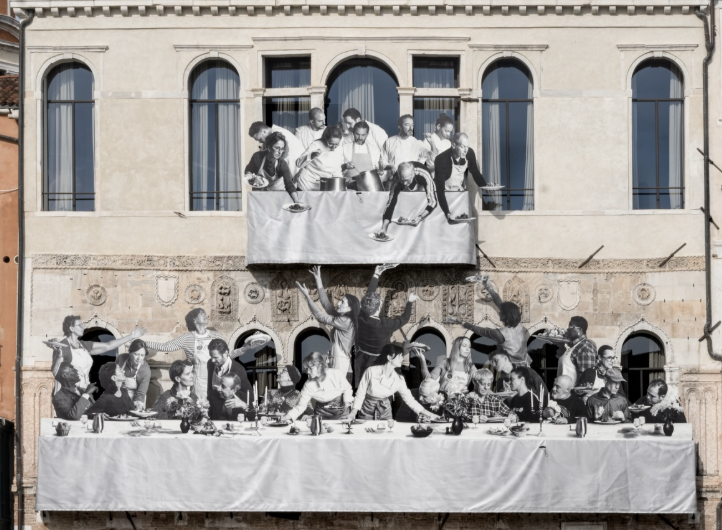
Large-scale black-and-white portraits likely featuring Venetians (potentially residents, workers, artisans, elderly longtime inhabitants) or individuals connected to Ca’ da Mosto’s maritime history, faces emerging from or integrating with the palazzo’s historic architecture
The installation technique:
Massive printed photographic panels (potentially vinyl or specialized architectural fabric) applied to palazzo facade, creating temporary covering visible from Grand Canal and surrounding areas, designed for eventual removal without damaging historic stone/plaster beneath
The visual effect:
Portraits interacting with building’s architectural elements — eyes appearing in windows, faces emerging from doorways, creating illusion that photographed individuals inhabit or emerge from the structure, blending contemporary image with historic architecture
The thematic resonance:
Addressing Venice’s depopulation crisis (fewer than 49,000 residents remain), celebrating Venetian identity and memory, questioning relationship between preservation and transformation, exploring who Venice “belongs to” (residents, tourists, history, future)
The temporal dimension:
Temporary installation (likely weeks to months, not permanent), emphasizing ephemerality and change versus Venice’s preservation-oriented mentality, the work’s eventual disappearance mirroring Venice’s ongoing residential disappearance
The Viewing Experience:
Primary perspectives:
From vaporetto: Line 1 (slow Grand Canal route) provides extended viewing as boat approaches, passes, and departs from Ca’ da Mosto, allowing observation of how images interact with architecture from water level
From opposite bank: Fondamenta del Vin and Riva del Carbon (across Grand Canal from Ca’ da Mosto) provide stable viewing positions for photography and extended observation
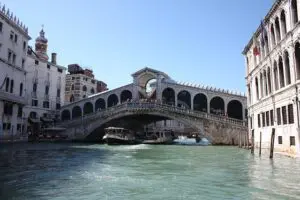
From Rialto Bridge: The bridge’s elevated position provides distant but comprehensive view of the installation in architectural context
The accessibility:
Completely free and public — no tickets, no admission, no restricted hours (visible 24/7 during installation period), democratic access JR’s methodology emphasizes, anyone passing Grand Canal encounters the work regardless of art world credentials or Biennale attendance
The documentation impulse:
The installation’s visibility and Instagram-ready character creates desire to photograph, but the experience benefits from pausing to actually observe beyond image capture — noticing how light changes throughout day, how different viewing angles reveal different aspects, how other viewers respond
The Broader Context: Contemporary Art and Venetian Preservation
Understanding the tensions and dialogues this installation represents.
The Preservation vs. Transformation Debate:
Venice exists in perpetual tension:
Preservation mandate — UNESCO World Heritage designation (1987), Italian cultural heritage laws, Soprintendenza oversight, neighborhood associations, all emphasizing protecting Venice’s historic character, preventing alterations to architectural fabric, maintaining “authentic” appearance
Living city needs — Actual Venetian residents requiring modern infrastructure (plumbing, electricity, internet), business adaptations (restaurants, hotels, shops), contemporary life creating pressure for modifications preservation regulations resist
Tourist economy tension — Tourism provides economic survival but threatens residential character, creating question whether preservation serves actual Venetians or creates museum-city for tourist consumption
Contemporary art’s role — Can contemporary interventions help Venice remain culturally vital versus becoming frozen historical artifact? Or do they represent further commodification and spectacle?
JR’s Installation as Intervention in This Debate:
The temporary aspect:
Removable installation without permanent alteration respects preservation concerns while allowing contemporary expression, proposing model where Venice can engage with present while maintaining past
The visibility:
Grand Canal placement versus hidden interior installation makes statement about contemporary art’s right to public architectural space not just gallery containment, asserting Venice as living cultural city not just historical museum
The subject matter:
If featuring actual Venetians (rather than generic portraits), work celebrates remaining residents, making their presence monumental and visible, counteracting the invisibility and marginalization depopulation creates
The dialogue:
13th-century architecture + 21st-century photography creates temporal conversation, questioning whether Venice’s identity lies in unchanging preservation or continued cultural production
Historical Precedents:
Venice has complicated history with contemporary architectural/artistic interventions:
Accepted examples:
- Scarpa’s interventions (Querini Stampalia, Olivetti showroom) now considered masterpieces despite initial controversy
- Contemporary Biennale pavilions in Giardini coexisting with 19th-century garden
- Punta della Dogana and Palazzo Grassi contemporary art venues (Pinault Collection)
- Periodic contemporary sculpture in historic campi
Rejected examples:
- Proposed Frank Gehry building blocked by preservationists
- Various modern architecture proposals refused
- Continuous battles over satellite dishes, air conditioning units, modern shop signs
The regulatory gauntlet:
Any significant intervention requires Soprintendenza approval, neighborhood consultation, cultural heritage review, creating process where most contemporary proposals fail, making JR’s approval notable
How to Actually Experience the Installation
Practical strategies for optimal viewing and engagement.
The Vaporetto Strategy:
Line 1 slow route:
Board at Piazzale Roma, Ferrovia (train station), or Rialto, ride toward San Marco, watch for Ca’ da Mosto (shortly after Rialto Bridge on right side if traveling toward San Marco, left side if traveling opposite direction), position near boat’s edge for unobstructed view, consider riding multiple times for different light conditions and perspectives
Optimal timing:
Morning (8:00-10:00 AM): Eastern light illuminating palazzo facade, fewer tourists on vaporetto, calmer water creating better photographic conditions
Late afternoon (4:00-6:00 PM): Warm golden-hour light, potential sunset glow, more crowded but dramatic atmospheric conditions
Evening (after 7:00 PM): Artificial illumination creating different character, fewer vaporetto passengers, romantic atmosphere
Photography considerations:
Vaporetto movement creates challenges for sharp photographs, use fast shutter speeds, consider video instead of stills to capture approach/passage/departure sequence, wide-angle lens to capture full facade given limited distance from moving boat
The Shore-Based Viewing:
Opposite bank positions:
Cross Rialto Bridge to eastern side, walk along Riva del Carbon and Fondamenta del Vin (the fondamente directly across from Ca’ da Mosto), find position allowing unobstructed view across canal, allows extended stationary observation and stable photography impossible from moving vaporetto
Rialto Bridge viewpoint:
Bridge apex provides elevated distant perspective, showing installation in complete architectural context, understanding relationship to surrounding Grand Canal palazzi, trading proximity for comprehensive view
Close approach (limited):
The eastern fondamenta adjacent to Ca’ da Mosto allows very close viewing but extremely limited perspective (too close to see complete installation), useful for detail observation and understanding materials/technique
Combining with Broader Venice Experience:
The location integration:
Ca’ da Mosto sits between Rialto and Ca’ d’Oro, making it natural point on Grand Canal exploration, easily combined with Rialto Market visit (mornings), Cannaregio neighborhood walking, Ca’ d’Oro museum, creating coherent itinerary versus isolated installation visit
The Biennale coordination:
For Biennale attendees, JR’s installation provides break from intensive pavilion viewing, requires no additional ticket, accessible during vaporetto commutes between Giardini/Arsenale and hotels, functions as public art complement to ticketed exhibitions
The museum-free Venice day inclusion:
JR’s work perfectly fits non-museum Venice exploration — public free art, accessible while navigating city, combines with neighborhood wandering, bacari culture, authentic experiences versus institutional visiting
Understanding JR’s Work: Questions and Interpretations
Engaging critically with the installation beyond surface aesthetics.
The Key Questions to Consider:
Who are the photographed subjects and why were they chosen?
If Venetians — which Venetians? Longtime residents representing disappearing Venice? Service workers maintaining tourist economy? Elderly embodying memory? The selection itself makes statement about whose Venice matters
What does temporary intervention on permanent architecture mean?
JR’s removable installation contrasts with palazzo’s 800-year permanence — does this emphasize human ephemerality? Venice’s ongoing transformation? Contemporary art’s necessarily temporary relationship to historic city?
Is this celebration or critique?
Does monumental portraiture celebrate Venetian identity and resilience? Or does it critique Venice’s reduction of residents to museum-piece curiosities for tourist consumption? JR’s work often holds both simultaneously
Who is the audience?
Primarily tourists/art world (who see via vaporetto/Biennale context) versus actual Venetians (who might pass daily) — does this create tension between work about Venice for outsiders versus insiders?
What happens after removal?
The installation’s eventual disappearance — does it leave trace? Change how people see the palazzo afterward? Exist primarily as photographic documentation? Questions about ephemeral art’s lasting impact
Connecting to JR’s Broader Practice:
The social justice dimension:
JR typically features marginalized communities (refugees, conflict zone residents, favela inhabitants) — how does this translate to Venice where remaining residents face different but real marginalization (displacement by tourism, economic pressure, cultural erasure)?
The public space claim:
All JR’s work asserts public space as legitimate art venue — particularly significant in Venice where privatization (hotels, Airbnb, luxury retail) increasingly dominates, public space shrinking
The photographic medium:
Why photography versus painting or sculpture? Photography’s documentary character creates different relationship to subjects (these are “real people” not artistic inventions), raising questions about representation and consent
The anonymity paradox:
JR maintains semi-anonymity while photographed subjects often gain visibility and voice — how does this power dynamic function? Who benefits from the work’s attention and acclaim?
Our Expert Contemporary Art Guidance
If you want deep understanding of JR’s practice and Venice installation — contextualizing his career, explaining the Ca’ da Mosto historical significance, revealing broader contemporary art and preservation debates — we provide specialized guided experiences combining contemporary art expertise with architectural and cultural knowledge.
What We Offer:
JR career and methodology context:
- Explaining how he developed large-scale photographic public art
- Understanding his major projects and social justice focus
- Connecting Venice work to broader practice
- Addressing the street art to art world trajectory
Ca’ da Mosto architectural and historical analysis:
- 13th-century Byzantine-Venetian architecture significance
- Alvise da Mosto maritime exploration legacy
- How building evolved across centuries
- Its role in Grand Canal architectural narrative
Contemporary art and preservation dialogue:
- Understanding Venice’s preservation mandates and tensions
- How contemporary interventions navigate regulations
- Historical precedents (successful and rejected)
- What JR’s approval reveals about institutional attitudes
Optimal viewing strategies:
- Best vaporetto timing and positioning
- Shore-based perspectives and photography tips
- Integration with broader Venice itinerary
- Combining with Biennale or non-museum experiences
Critical engagement tools:
- Questions to consider beyond surface aesthetics
- Understanding the work’s social and political dimensions
- Connecting to Venice’s contemporary challenges
- Developing informed personal interpretation
Understanding Complete Context
For Biennale experiences: Pavilion tours, luxury guide, 2026 changes.
For Venice understanding: What makes Venice unique, depopulation reality, neighborhoods.
For public art and architecture: Hidden viewpoints, spontaneous exploration.
For all experiences: Complete tour options.
JR’s Ca’ da Mosto Grand Canal Installation Creates Significant Contemporary Art Moment — Global Street Art Pioneer Transforming 13th-Century Venetian Palazzo Facade With Massive Photographic Portraits, Free Public Access Via Vaporetto Viewing, Addressing Venice Depopulation, Memory, Preservation-Transformation Tensions
After 28 years guiding Venice cultural experiences and being featured by Rick Steves, NBC, and US Today, I recognize JR’s intervention as genuinely important — world-renowned artist (TED Prize winner, Oscar-nominated filmmaker, major museum retrospectives) known for massive public photographic installations celebrating marginalized communities, applying his “pervasive art” democratic accessibility philosophy to Venice’s most visible waterway, creating work everyone encounters regardless of art world credentials or Biennale tickets. Ca’ da Mosto’s significance (one of Venice’s oldest structures, 13th-century Byzantine-Venetian architecture, birthplace of navigator Alvise da Mosto) creates meaningful historical-contemporary dialogue when 21st-century photography covers 800-year facade. Installation likely features large-scale portraits (possibly Venetians representing disappearing residential population) wheat-pasted or vinyl-applied to palazzo exterior, visible from vaporetto Line 1, opposite-bank fondamente, Rialto Bridge viewpoints. Temporary removable nature respects preservation mandates while asserting contemporary art’s right to public space, addressing Venice’s perpetual preservation-transformation tension. Optimal viewing: morning or late-afternoon light, vaporetto positioning for photography, shore-based observation for extended engagement, integration with Rialto Market, Cannaregio neighborhoods, Biennale itineraries. We provide expert guidance contextualizing JR’s practice, Ca’ da Mosto history, preservation debates, viewing strategies. Contact us for contemporary art experiences combining Venice expertise with critical engagement. Let’s explore JR’s democratic public art vision.
Contact us for expert JR installation guidance — contemporary art and Venice architecture context.
Frequently Asked Questions
Is JR’s Ca’ da Mosto installation part of the official Venice Biennale, or is it an independent project?
JR’s installation operates as independent project separate from the official Venice Biennale (which consists of curated International Art Exhibition at Giardini/Arsenale plus national pavilions), though likely timed to coincide with Biennale season to maximize visibility and leverage the concentrated art world attention Venice receives May-November odd years. The “collateral exhibition” designation: During Biennale, dozens of parallel exhibitions occur throughout Venice receiving “collateral event” official recognition from La Biennale di Venezia organization, creating semi-official status (acknowledged by Biennale, included in promotional materials, benefiting from association) without being part of central curated exhibition; JR’s project may hold this collateral status or function completely independently depending on organizational arrangements. Why the distinction matters: (1) Official Biennale requires tickets (€25-30), operates on fixed schedule (typically 10:00 AM-6:00 PM), represents curated vision of artistic director and national pavilion commissioners. (2) Independent/collateral projects often free or separate ticketing, may have different hours or 24/7 public visibility (JR’s case), reflect individual artist or gallery vision rather than institutional curation, create parallel art landscape during Biennale season. Practical implications: You can experience JR’s work without purchasing Biennale tickets, it’s not included in Biennale maps/guides (though collateral exhibitions receive separate guide), visiting doesn’t require navigating Giardini/Arsenale logistics, but it participates in the broader cultural moment Biennale creates when Venice becomes global contemporary art epicenter. Strategic approach: Serious Biennale visitors should experience both official exhibitions AND significant collateral/independent projects like JR’s work, creating comprehensive understanding of contemporary art production during Venice’s most important season; the free public accessibility makes JR’s installation perfect complement to ticketed Biennale viewing.
How long will the JR installation remain on Ca’ da Mosto, and what happens to it afterward?
Specific duration details require checking official announcements from JR’s team or organizing institutions, but typical JR installations remain 3-6 months before removal. The timing logic: (1) Biennale season coordination — if timed with Biennale (May-November opening year), installation likely coincides with peak art world attention period, potentially remaining entire Biennale duration or substantial portion. (2) Regulatory constraints — Venice’s Soprintendenza (cultural heritage authority) approval likely includes specific time limit ensuring temporary nature, preventing permanent alteration to historic palazzo, requiring removal by predetermined date. (3) Weather considerations — outdoor installations on Grand Canal face sun exposure, humidity, rain, acqua alta flooding potentially damaging materials, limiting viable duration before deterioration affects visual quality. (4) Artistic intention — JR’s methodology emphasizes ephemerality, the works’ disappearance creating meaning (mirroring human transience, urban transformation, memory’s fragility), so prolonged duration may contradict artistic concept. What happens after removal: (1) Complete removal — workers carefully peel/remove photographic panels from palazzo facade, ideally without damaging historic plaster/stone beneath (though some cleaning/restoration may be required). (2) Documentation remains — extensive photography and video capture installation during its existence, becoming primary way future audiences experience work, raising questions about ephemeral art living primarily through documentation. (3) Palazzo returns to original appearance — Ca’ da Mosto reverts to its standard historic facade, though viewers who experienced installation may perceive it differently afterward (similar to how Christo’s wrapped buildings were “never the same” even after unwrapping). (4) Materials disposition — photographic panels may be archived, destroyed, or potentially repurposed/sold, depending on JR’s practice and agreements with commissioners. Practical visitor timing: Check JR’s official social media (@jr), Venice art news sources (Artribune, The Art Newspaper), or contact us for current status before planning visit specifically for this installation, as removal means the experience becomes unavailable unlike permanent museum collections.
Can I get close to the installation to see details, or is it only viewable from vaporetto distance across the canal?
Viewing options span complete spectrum from very close to distant, each offering different perspectives and experiences. Close viewing (limited angles): Ca’ da Mosto’s location means you CAN walk directly to the building — the palazzo sits on the Grand Canal with adjacent fondamente (canal-side walkways) allowing approach, though the extremely close position prevents seeing complete installation (like standing at base of skyscraper preventing seeing top floors), useful for understanding materials, technique, photographic detail, but not optimal for comprehensive viewing. Mid-range viewing (optimal for understanding complete work): The Grand Canal’s width (varies 30-70 meters at different points, approximately 40-50 meters at Ca’ da Mosto) creates ideal viewing distance when positioned on opposite bank (Riva del Carbon and Fondamenta del Vin provide stable viewing positions), allowing appreciation of complete installation within architectural context while seeing sufficient detail to understand portraits, creating most satisfying viewing experience for photography and extended observation. Vaporetto viewing (dynamic moving perspective): Line 1 slow route passes directly by Ca’ da Mosto at approximately 20-30 meters distance, providing changing angles as boat approaches and passes, excellent for general impression and video documentation, less ideal for photography (boat movement, crowd positioning challenges) or extended contemplation, but conveniently accessible during normal Venice navigation. Distant viewing (architectural context): Rialto Bridge (approximately 200 meters from Ca’ da Mosto) provides elevated perspective showing installation in complete Grand Canal architectural context, revealing how contemporary intervention relates to surrounding historic palazzi, good for orientation and contextual photography, insufficient for seeing portrait details or materials. Recommended approach: Experience multiple viewing positions — start with mid-range opposite-bank observation for complete appreciation, ride vaporetto for dynamic perspective and video, approach closely if curious about technical execution, view from Rialto Bridge for architectural context, creating comprehensive engagement versus relying on single vantage point. Accessibility note: All viewing positions are free and publicly accessible (opposite bank walkways, vaporetto passage requires valid ticket, Rialto Bridge free public access), no special permissions or tickets needed for any vantage point.