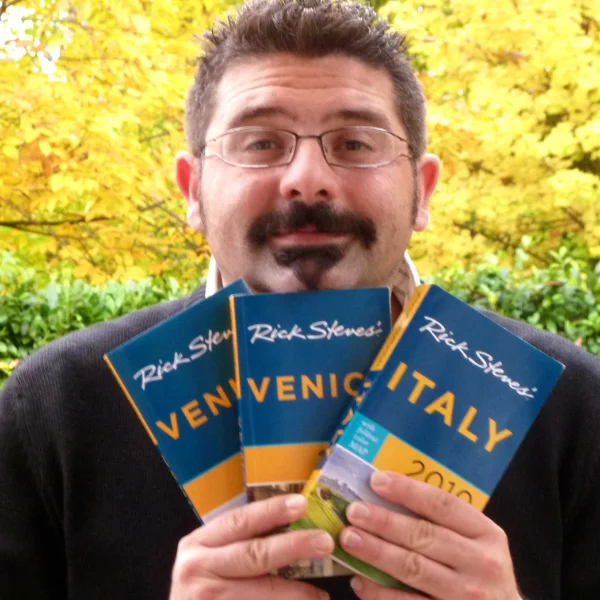
I’ve worked with Rick Steves’ tour groups in Venice for years.
Not occasionally. Regularly. His Italy tours include Venice stops where I provide the local guidance that his philosophy demands — knowledgeable residents who understand that tourism should educate rather than simply entertain, who can distinguish genuine culture from tourist performance, and who believe that travel makes people better when done thoughtfully.
Rick’s approach to Venice mirrors everything I’ve learned in 28 years living here: slow down, engage deeply, support local businesses, understand context rather than just collecting photos, and recognize that the best experiences cost time and attention rather than money.
The Rick Steves audience — millions of travelers who trust his guidance above every other travel voice — already understands these principles intellectually. But applying them specifically to Venice requires understanding how his philosophy translates into actual choices about where to stay, what to see, how to eat, and what to skip.
After years working with Rick’s groups and watching his recommendations shape how thoughtful Americans approach Venice, I know exactly which aspects of his travel philosophy matter most in this specific city, where his guidance is spot-on, and where Venice’s unique characteristics require adapting his general principles.
This is the honest assessment of what Rick Steves gets right about Venice — and how to apply his slow-travel philosophy to create genuinely meaningful experiences rather than rushed tourism disguised as cultural engagement.
Understanding how to approach Venice changes everything about the experience.
What “Traveling Slow” Actually Means in Venice
Rick Steves built his entire travel philosophy around a concept he calls “traveling slow” — but what does that actually mean when you’re planning three or four days in Venice?
It doesn’t mean staying weeks or months. Most travelers don’t have that luxury. Rick acknowledges this reality constantly. “Traveling slow” with normal vacation constraints means making deliberate choices that create depth rather than attempting superficial breadth.
In Venice specifically, traveling slow means:
Staying three to four nights minimum rather than attempting Venice as day trip from elsewhere. Rick explicitly recommends against day-tripping Venice — the city reveals itself in early morning and evening hours that day-trippers miss entirely.
Choosing accommodations thoughtfully rather than defaulting to cheapest option. Rick advocates staying in Venice proper despite higher costs, because the experience of being in Venice at dawn and dusk justifies the premium. His guidebook acknowledges Mestre as budget alternative but emphasizes what you sacrifice.
Visiting fewer sites more thoroughly rather than checking boxes frantically. Rick’s Venice recommendations include major landmarks but emphasize experiencing them properly — spending genuine time in the Basilica, actually looking at art in the Accademia rather than rushing through.
Building unscheduled time into every day. This is perhaps Rick’s most countercultural travel advice. His itineraries explicitly include “free time” or “wandering” — acknowledging that discovering Venice’s neighborhoods, sitting in campos watching daily life, and allowing serendipity matters as much as hitting predetermined attractions.
Eating where locals eat rather than where tour groups congregate. Rick’s restaurant recommendations consistently emphasize neighborhood spots serving Venetians rather than tourist-facing establishments in San Marco.
The philosophical core: Rick believes travel should broaden perspective, increase cultural understanding, and make participants better global citizens. This requires engagement rather than consumption — learning why things are the way they are rather than simply photographing that they exist.
Venice implements this philosophy better than almost anywhere because the city itself demands slowness. You can’t rush Venice. The geography prevents it. The navigation confuses efficient movement. The beauty stops you constantly. Rick’s slow-travel philosophy aligns perfectly with what Venice requires anyway.
Rick’s Venice Recommendations: What He Gets Exactly Right
Rick Steves’ Venice guidebook and tour itineraries emphasize specific approaches that 28 years living here confirms are absolutely correct.
Stay in Venice, Not on the Mainland
Rick is adamant about this. Yes, Mestre is cheaper. Yes, hotels are larger with better amenities. But you miss Venice at its most genuine — early morning when the city wakes up, evening when day-trippers depart and locals reclaim their city.
The decision where to stay fundamentally affects your experience. Rick acknowledges budget constraints but maintains that if Venice is worth visiting at all, it’s worth staying in Venice to experience the city when tourism pressure temporarily lifts.
I’ve watched this play out thousands of times. Travelers staying in Mestre see tourist Venice. Travelers staying in Venice see tourist Venice during the day, then experience genuinely residential Venice in early morning and evening. The difference is profound.
The Frari Church Over Generic Museum Visits
Rick’s Venice itinerary prioritizes the Frari church (Santa Maria Gloriosa dei Frari) — a massive Gothic church in San Polo holding Titian masterpieces including his Assumption of the Virgin and Pesaro Madonna.
Most Venice visitors skip the Frari entirely, focusing on the Accademia Gallery or Doge’s Palace instead. Rick insists the Frari deserves equal time because experiencing art in its intended religious context rather than museum setting provides understanding that gallery visiting can’t match.
He’s absolutely right. The Titian paintings in the Frari were painted FOR the Frari. Seeing them there, understanding their relationship to the space, experiencing them as part of functioning church rather than as museum artifacts — this creates engagement that museum labels and audioguides struggle to provide.
Venice’s churches holding masterpiece art often charge minimal admission or are free entirely, making them excellent cultural values that Rick’s budget-conscious audience particularly appreciates.
Avoiding Gondolas Unless the Circumstances Are Right
Rick doesn’t tell people never to take gondolas. He tells them to understand what they’re actually buying before paying.
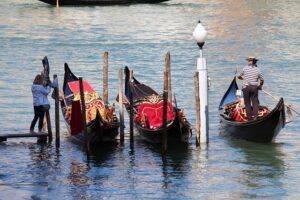
The gondola is expensive. The ride is brief (30 minutes, not an hour). The route is predetermined. The gondolier doesn’t automatically narrate. These facts disappoint tourists who arrive expecting romantic, narrated, hour-long journeys at moderate prices.
Rick’s pragmatic gondola advice matches what I tell visitors: if you understand the limitations, if the cost fits your budget without strain, if you’re treating it as splurge rather than essential Venice experience — gondolas can be lovely. If you’re going into debt or have expectations that reality won’t meet, skip it.
He also recommends the traghetto (standing gondola ferry crossing the Grand Canal) as alternative that provides gondola experience at minimal cost without pretending to be something it’s not.
Getting Lost Is Feature, Not Bug
Rick explicitly tells people to get lost in Venice. Not as failure to navigate but as deliberate strategy for discovery.
His guidebook includes general navigation advice but emphasizes that Venice rewards aimless wandering in ways that rigid itinerary-following doesn’t.
This terrifies some travelers who need structure and predictability. But for those who can embrace it, deliberately getting lost in Castello or Cannaregio or Dorsoduro produces discoveries that no guidebook can anticipate.
Where Rick’s General Advice Needs Venice-Specific Adaptation
Rick Steves’ travel philosophy works globally, but Venice’s peculiarities sometimes require adapting his standard recommendations.
The “Eat Cheap and Well” Principle
Rick consistently advocates finding excellent food at reasonable prices — the neighborhood trattoria serving locals rather than the tourist trap with English menu.
This works in Venice but requires understanding that “reasonable” means something different here. Venice is genuinely expensive — not tourist-trap expensive but structurally expensive because everything must arrive by boat, because space is scarce, because the city operates with costs mainland cities don’t face.
Rick’s guidebook acknowledges this but travelers sometimes arrive expecting Florence or Rome prices. Venice costs 20-30% more across the board. The “cheap and well” principle still applies — bacari serving cicchetti provide excellent value, neighborhood restaurants away from San Marco deliver quality food at relatively moderate prices — but “moderate” in Venice is higher baseline than elsewhere.
The “Skip It If There’s a Line” Advice
Rick generally advises that if there’s a long line, the attraction probably isn’t worth waiting for. This works in many cities. Venice requires nuance.
San Marco Basilica and Doge’s Palace generate lines precisely because they’re genuinely extraordinary. During peak season, the lines are unavoidable. Rick’s solution — skip-the-line reservations — costs money but saves hours, aligning with his slow-travel philosophy that values time over absolute minimum expenditure.
The principle remains sound: don’t waste vacation hours standing in lines. But in Venice, the solution is often paying modest fees for advance tickets rather than skipping major cultural sites entirely.
The Museum Focus
Rick’s Italy tours and guidebooks emphasize museums heavily — the Uffizi in Florence, the Vatican Museums in Rome, the Accademia in Venice.
This makes sense for his culturally-focused audience. But Venice’s character reveals itself as much in neighborhoods, markets, and daily life as in museums. Spending entire days museum-hopping means missing how Venetians actually live, the market culture, the residential rhythms that distinguish living city from museum-city.
Rick’s itineraries do build in wandering time. But travelers sometimes fixate on his museum recommendations while skipping the “free time” he explicitly includes. The balance matters — cultural sites AND neighborhood exploration, not one at the expense of the other.
Rick’s Audience: Why His Followers Excel at Venice
Rick Steves has cultivated specific traveler demographic that approaches Venice particularly well.
His audience tends to be:
Older (50+), often retired, with more flexibility about timing and duration than younger travelers with limited vacation days.
Culturally curious rather than luxury-focused. They care about understanding Renaissance art, learning history, engaging with local culture — not about staying at five-star hotels or eating Michelin-starred meals.
Budget-conscious but willing to spend on experiences that matter. They’ll stay at three-star hotels and eat at neighborhood restaurants to afford museum tickets and local guides.
American or Canadian, often from smaller cities or suburbs, for whom European travel represents significant investment of time and money they want to maximize.
This demographic succeeds in Venice because:
The cultural focus aligns perfectly with what Venice offers. The art, the architecture, the history — these are Venice’s strengths, and Rick’s audience comes specifically seeking them.
The willingness to engage deeply rather than checking boxes quickly matches what Venice requires. You can’t rush Venice successfully. Rick’s audience has internalized this principle through his teaching.
The budget consciousness combined with strategic spending means staying in Venice proper rather than defaulting to cheapest mainland options, investing in good guides rather than attempting everything independently, and supporting local businesses rather than international chains.
The slightly older demographic often brings patience and adaptability that Venice’s navigation challenges, crowds, and logistics demand. They’re less likely to get frustrated by getting lost or by limitations that younger, more impatient travelers find intolerable.
What Rick Gets Right About Private Guides
Rick Steves consistently recommends hiring private guides for complex destinations — and Venice absolutely qualifies.
His philosophy on guides:
Good guides aren’t luxury splurge. They’re educational investment that transforms passive sightseeing into genuine learning. The cost per hour matters less than the value in understanding, context, and insider access that guides provide.
Private guides beat group tours because customization, flexibility, and ability to ask questions creates learning that group formats prevent. Rick’s own tours use local guides extensively precisely because local expertise matters.
Hiring guides for half-day or full-day rather than attempting multi-day comprehensive coverage allows combining guided learning with independent exploration. Rick advocates 3-4 hour guided introduction followed by days of independent wandering informed by what the guide taught.
Where this applies in Venice:
A first-day orientation tour with licensed local guide provides geographic understanding, navigation strategies, and cultural context that make subsequent independent exploration dramatically more productive. This investment pays dividends throughout entire stay.
Specialized tours — market and food culture, off-beaten-path neighborhoods, artistic depth — allow exploring interests that guidebooks cover superficially while maintaining independence for general sightseeing.
The guide provides ongoing resource. Reputable guides offer contact information for the rest of your stay, allowing questions via text or email when you’re confused, lost, or seeking recommendations. This accessibility extends the value far beyond the scheduled tour hours.
Rick’s guide recommendations in his Venice guidebook include professionals he trusts — myself among them. This vetting matters. Rick doesn’t recommend guides who treat tourism as transaction. He recommends guides who share his educational philosophy and who understand that their job is teaching rather than entertaining.
The Rick Steves Approach to Seasonal Timing
Rick explicitly addresses Venice seasonal variations in ways that align with honest assessment of trade-offs.
He acknowledges summer’s problems: Crowds, heat, higher prices, and the sense that Venice is overwhelmed by tourism rather than functioning as actual city. His guidebook notes these issues without pretending they don’t exist.
He advocates shoulder season — April-May and September-October — as optimal timing for visitors who have schedule flexibility. The weather is generally good, crowds are moderate rather than overwhelming, prices are lower than peak summer, and Venice feels more balanced between tourism and residential function.
He’s honest about winter trade-offs: Venice in winter offers dramatically fewer crowds and lower prices but brings cold, damp weather and shorter daylight hours. Rick presents this as legitimate choice for travelers who prioritize atmosphere and budget over guaranteed sunshine.
March gets particular attention as transitional month where Carnival crowds have departed, Easter hasn’t yet arrived, and weather is unpredictable but often pleasant. Rick positions March as underrated option for flexible travelers willing to accept weather variability.
The seasonal guidance avoids the generic “best time to visit” advice that tourism marketing provides. Rick acknowledges that optimal timing depends on individual priorities — what you value (sunshine versus crowds, budget versus comfort, atmospheric versus predictable) determines which season actually serves you best.
Rick’s Restaurant Philosophy Applied to Venice
Rick’s approach to eating — avoid tourist traps, find where locals eat, understand value — requires Venice-specific application.
His red flags for tourist traps:
Menus in six languages with photos. Touts standing outside aggressively soliciting customers. Locations immediately adjacent to major landmarks. Fixed-price tourist menus. These indicators work universally and certainly apply in Venice.
His green flags for quality:
Handwritten menus or frequent menu changes (indicating seasonal cooking). Clientele that includes locals rather than pure tourist crowds. Locations in residential neighborhoods away from obvious tourist zones. Servers who can explain dishes and origins rather than simply taking orders.
Venice-specific considerations:
Bacari culture provides Rick’s ideal eating experience — traditional establishments serving locals, reasonable prices, food that changes based on market availability, standing-room format that encourages brief visits rather than lingering tourist occupation.
Seasonal eating matters more in Venice than in cities with year-round ingredient access. Spring brings specific ingredients that define the season. Restaurants serving genuinely seasonal menus align with Rick’s emphasis on authentic local experience.
The price-to-quality relationship Rick advocates requires accepting that Venice’s baseline is higher. A “reasonably priced” Venetian restaurant serving locals might cost what an expensive restaurant elsewhere charges. The comparison should be Venice tourist trap versus Venice local establishment, not Venice versus Florence or Rome.
Where Rick and I Completely Agree: Venice Without a Checklist
Rick Steves’ most countercultural travel advice — and the principle I’ve built my entire guiding philosophy around — is that the best travel experiences often happen when you’re not following predetermined itineraries.
Rick explicitly tells travelers to close the guidebook occasionally. To wander without destination. To sit in a campo watching daily life. To follow interesting streets without knowing where they lead. To allow Venice to surprise rather than confirming that you’ve seen what you expected to see.
This terrifies checklist-oriented travelers. Rick acknowledges this tension constantly. His guidebooks provide detailed itineraries for people who need structure while simultaneously advocating that rigid adherence to itineraries prevents the serendipitous discoveries that make travel memorable.
In Venice specifically, the checklist-free approach matters enormously:
The city rewards wandering in ways that efficient routing doesn’t. Getting deliberately lost in Castello or Dorsoduro produces discoveries — beautiful campos, hidden churches, neighborhood bars, architectural details — that no amount of guidebook research anticipates.
The pressure to “see everything” means rushing through experiences without actually experiencing them. Spending two hours properly engaging with the Accademia beats spending thirty minutes each at four museums simply to check boxes.
The best Venice moments — sunset on the Zattere, morning coffee at a neighborhood bar, stumbling onto a campo where locals gather — aren’t items you plan. They’re moments you allow by not scheduling every minute.
Rick and I both believe that travel done properly should change you. Not just provide photos and stories but alter perspective, broaden understanding, and increase capacity for empathy. This transformation requires presence and attention that checklist-completion actively prevents.
Venice facilitates this transformation better than almost anywhere because the city itself resists efficient tourism. You can’t power through Venice successfully. Accepting this and letting Venice dictate pacing rather than imposing external efficiency creates experiences that matter rather than simply accomplishments to report.
How to Actually Apply Rick’s Philosophy in Three Days
Theoretical agreement with Rick’s slow-travel principles means nothing without practical application. Here’s what his philosophy looks like implemented in typical three-day Venice visit.
Day One: Orientation and Major Landmarks
Rick advocates starting with orientation — either private guide or his self-guided walking tour — that teaches geography and navigation before attempting independent exploration.
Morning: San Marco area including Basilica and Doge’s Palace. Skip-the-line tickets eliminate waits. Spend genuine time rather than rushing through.
Afternoon: Unscheduled wandering. No specific destination. Simply exploring neighborhoods, following interesting streets, allowing discovery.
Evening: Bacaro culture — wine and cicchetti at neighborhood establishments rather than formal restaurant.
Day Two: Cultural Depth
Morning: The Frari church and surrounding San Polo neighborhood. Then the Rialto Market (arriving early allows seeing it function rather than just viewing tourist spectacle).
Afternoon: Accademia Gallery with focus on specific masterworks rather than attempting everything. Then Dorsoduro wandering.
Evening: Neighborhood restaurant in Castello or Cannaregio away from tourist zones.
Day Three: Beyond Tourist Venice
Morning: Lagoon islands — Murano and Burano provide context for Venice’s relationship to lagoon environment.
Afternoon: The Jewish Ghetto and Cannaregio exploration.
Evening: Final wandering in favorite neighborhood discovered during previous days.
What this itinerary provides:
Major cultural sites seen properly rather than rushed through. Significant unscheduled time allowing discovery. Eating where locals eat rather than tourist establishments. Geographic diversity showing Venice beyond San Marco. Balance between guided learning and independent exploration.
What this itinerary skips:
Trying to “see everything.” Rigid hour-by-hour scheduling. Eating all meals at expensive restaurants. Gondola rides (unless circumstances make them worthwhile). Attempting to visit every museum Venice offers.
The framework implements Rick’s philosophy: slow enough to engage deeply, structured enough to see what matters, flexible enough to adapt based on what interests you most.
Plan Your Rick Steves-Style Venice Visit
For slow-travel orientation: Private walking tours provide the local expertise Rick consistently advocates — not to see more things faster but to understand what you’re seeing more deeply.
For skip-the-line efficiency: Museum and church tickets implement Rick’s principle that time matters more than saving small amounts of money. Spending hours in lines wastes vacation.
For where to stay: Venice versus mainland options helps implement Rick’s recommendation to stay in Venice proper despite higher costs — the experience justifies the premium.
For neighborhood exploration: Which sestiere fits your style guides the unscheduled wandering Rick advocates — providing enough structure to be productive while maintaining flexibility for discovery.
For food culture: Bacari exploration and seasonal eating implement Rick’s emphasis on eating where locals eat and understanding food’s connection to place.
For three-day structure: A balanced itinerary combines major cultural sites with neighborhood exploration and unscheduled time — implementing Rick’s philosophy of depth over breadth.
For honest expectations: Reality versus myths aligns with Rick’s insistence on honest travel advice that acknowledges challenges alongside beauty.
Travel Venice the Rick Steves Way — Slowly, Thoughtfully, and With Local Expertise
After years working with Rick Steves’ tour groups and being featured in his guidebook recommendations, I know exactly what his slow-travel philosophy means in practice — not rushing through checklists but engaging deeply with culture, supporting local businesses, and recognizing that the best travel changes you rather than simply entertaining you. Rick’s audience already understands these principles. Implementing them in Venice requires local knowledge, honest guidance, and willingness to slow down enough that Venice can actually reveal itself. Let me show you Venice the way Rick recommends — with depth, authenticity, and the understanding that comes from genuine engagement.
Book your slow-travel Venice experience — join the millions of Rick Steves followers who’ve discovered that traveling well means traveling thoughtfully.
Frequently Asked Questions
Does Rick Steves actually recommend you specifically as a Venice guide?
Yes. I’m among the local Venice guides Rick recommends in his Italy guidebook and through his tour operations. This recommendation comes from his direct assessment of my guiding philosophy, knowledge, and approach — not from any advertising or promotional relationship. Rick only recommends guides who share his educational travel philosophy, who can distinguish genuine culture from tourist performance, and who understand that guiding should teach rather than simply entertain. His vetting process is thorough, his standards are high, and his recommendations carry weight precisely because they’re earned rather than purchased. When travelers contact me mentioning Rick’s recommendation, I know they’re already predisposed toward the slow-travel approach that makes Venice visits genuinely meaningful rather than simply checked boxes.
Can I do Venice “the Rick Steves way” on a tighter budget than he suggests?
Partly, but with important trade-offs. Rick’s Venice recommendations already emphasize value — bacari meals instead of expensive restaurants, free church visits alongside paid museums, three-star hotels instead of luxury properties. But he maintains that some investments matter: staying in Venice rather than Mestre, buying museum tickets rather than standing in lines, hiring good guides rather than attempting everything independently. Ultra-budget approaches — staying on mainland, skipping paid attractions entirely, avoiding guides — contradict his philosophy that understanding costs money and that the investment creates value beyond simple sightseeing. The question isn’t whether you can do Venice cheaper (you can, by sacrificing almost everything Rick values) but whether cheaper approaches serve your actual goals.
Is Rick’s slow-travel approach realistic for people with limited vacation time?
Yes, but it requires accepting limitations rather than attempting impossible comprehensiveness. Rick explicitly designs his itineraries for normal American vacation constraints (1-2 weeks total Europe trip). “Slow travel” with limited time means choosing fewer destinations and experiencing them properly rather than attempting whirlwind multi-country sprints. In Venice specifically, this means allocating 3-4 nights minimum, accepting that you won’t “see everything,” and prioritizing depth in what you do see over breadth of checkbox completion. The rushed alternative — Venice day trip or single overnight — violates Rick’s philosophy completely and delivers genuinely inferior experience. If you only have one week total for Italy, Rick advocates Venice plus one other destination rather than attempting Venice-Florence-Rome-Naples marathon that creates exhaustion without understanding. The adaptation for limited time isn’t abandoning slow-travel principles but applying them ruthlessly to reduce scope while maintaining depth.