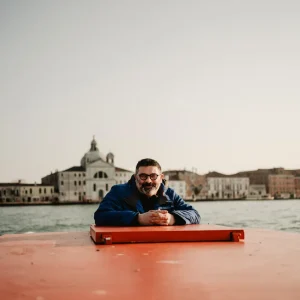
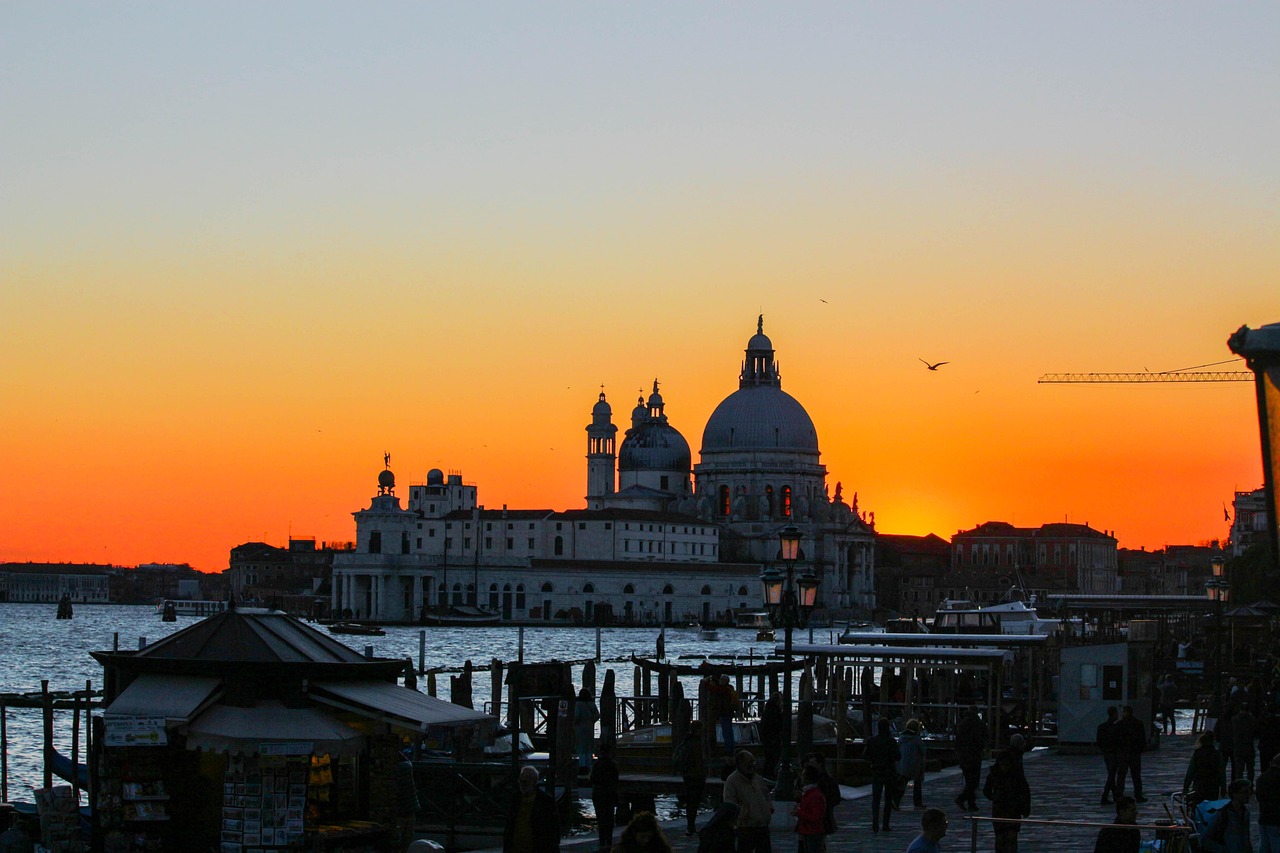
Venice transforms at dusk.
Not gradually. Not subtly. The shift is total — from daytime clarity to something approaching the dreamlike. The light turns gold, then amber, then deep orange. The stone facades glow. The water reflects everything doubled. The tourist crowds thin noticeably as day-trippers catch trains back to Padua or Verona.
This hour — roughly 30 minutes before sunset through twilight — is when Venice delivers what every visitor hopes for but rarely finds during daylight. The romance, the atmosphere, the sense of being somewhere genuinely extraordinary rather than simply famous. Dusk removes Venice’s hard edges. The intensity softens. The city becomes exactly what the photographs promised.
After 28 years watching light move across this city, I know exactly where dusk matters most — where the angle, the architecture, and the timing combine into moments that justify every travel cliché ever written about Venice. These aren’t Instagram-famous viewpoints crowded with tripods. They’re places where Venetians themselves go when they want to watch their city become beautiful.
Understanding when Venice shows its best self changes how you experience the entire city.
The Zattere: Where the Light Meets the Water
The Zattere is a long waterfront promenade running along Dorsoduro’s southern edge, facing the Giudecca Canal.
This is Venice’s finest sunset location. Not most dramatic. Not most famous. Simply finest — the combination of accessibility, atmosphere, and light quality that makes dusk here genuinely memorable.
The Zattere faces south and west, meaning late afternoon and evening light hits it perfectly. The wide promenade provides space to sit, stand, or walk without navigating crowds. Stone benches line the waterfront. The Giudecca island across the canal catches the last sunlight beautifully — Palladio’s Il Redentore church glowing gold against darkening sky.
Venetians know this. Late afternoon through dusk, the Zattere fills with residents taking evening walks, couples sitting on benches, families with gelato watching the light change. This isn’t tourism. This is simply where Venetians go when they want to experience their city at its most beautiful.
The walk from the Accademia Bridge westward along the Zattere stretches roughly one kilometer. Any point along this route provides excellent dusk viewing. But the section between the Gesuati church and the maritime station holds the best combination of architecture, water views, and comfortable sitting spots.
Timing matters. Arrive 45 minutes before sunset. Watch the light change gradually rather than showing up at the last moment. Dusk is a process, not a moment. The gradual shifts in color and atmosphere — from golden to amber to deep orange to purple twilight — create the experience. Rushing in for the final five minutes misses everything that makes dusk special.
Gelateria Nico sits on the Zattere and serves excellent gelato at reasonable prices. A cone from Nico, a bench overlooking the Giudecca Canal, and 45 minutes watching light turn stone and water into something approaching magic — this costs perhaps five euros and creates one of Venice’s most satisfying experiences.
Venice at sunset transforms into something genuinely romantic beyond the clichés — and the Zattere delivers this experience without the performance pressure that San Marco’s famous viewpoints impose.
Fondamenta della Misericordia: Cannaregio’s Secret Waterfront
Fondamenta della Misericordia runs along Cannaregio’s northern edge, facing the lagoon toward the cemetery island of San Michele.
This canal-side walkway is where Cannaregio residents gather in the evening. Bars and restaurants line one side. The water lies on the other. The atmosphere is relaxed, local, and completely divorced from Venice’s tourist intensity.
Dusk here feels different from the Zattere. Less expansive. More intimate. The canal is narrower. The buildings press closer. But the light quality is extraordinary — the low sun catching palazzo facades at angles that create deep shadows and brilliant highlights simultaneously.
The northern exposure means the light arrives indirectly, reflected and filtered through atmosphere. This creates softer, warmer tones than direct sunlight produces. Photographers call this “open shade” — the gentlest, most flattering light conditions possible.
Fondamenta della Misericordia is also where Venetians drink evening aperitifs. The bars here serve locals first, tourists second. Prices reflect this. A Spritz costs what it should cost, not what San Marco cafés charge. The clientele is mixed — students from Ca’ Foscari University, neighborhood residents, young Venetians meeting friends after work.
Sitting at one of these bars at dusk — watching the light change, listening to conversations in Venetian dialect, feeling the city relax as the tourist day ends — provides genuine immersion in residential Venice. You’re not observing local life. You’re participating in it.
The walk from the Rialto to Fondamenta della Misericordia takes roughly 15 minutes through increasingly residential Cannaregio streets. Most visitors never make this walk. Those who do discover one of Venice’s most authentic neighborhood atmospheres.
The Accademia Bridge: Classic Venice Framed Perfectly
The Accademia Bridge — the wooden bridge spanning the Grand Canal near the Accademia Gallery — offers Venice’s most classically beautiful dusk view.
This is the postcard angle. The Grand Canal stretching toward Santa Maria della Salute’s domes. Palaces lining both banks. Water reflecting everything. The view everyone imagines when they think of Venice.
The bridge is genuinely crowded at sunset — this isn’t a secret spot unknown to tourists. But the crowds are manageable, the view justifies the popularity, and the experience delivers exactly what it promises.
Timing again matters crucially. Sunset itself brings maximum crowds. But arriving 30-45 minutes before sunset — when light is still strong but beginning to warm — provides excellent conditions with fewer people. The light is arguably better at this earlier hour anyway — strong enough to illuminate detail, warm enough to create atmosphere, but not yet at the intense orange-red of actual sunset that photographers obsess over but which human eyes sometimes find overwhelming.
The bridge’s elevated position provides perspective impossible from canal level. You see Venice’s layered depth — foreground palaces, middle-distance churches, distant horizon where lagoon meets sky. The composition is naturally balanced, inherently beautiful regardless of photographic skill.
Stay past sunset into twilight. Most visitors leave once the sun disappears. But the 20 minutes after sunset — as sky turns from orange to purple to deep blue — create some of Venice’s most beautiful light conditions. The city’s artificial lights begin glowing. The architectural details that harsh daylight washes out become visible. The Grand Canal transforms from busy waterway to atmospheric stage set.
Skip-the-line tickets for the Accademia Gallery mean you can visit the museum during the afternoon, exit directly onto the bridge at dusk, and experience both the city’s greatest painting collection and its finest architectural views in a single late afternoon.
Punta della Dogana: Where Two Canals Meet the Sky
Punta della Dogana — the triangular point where Dorsoduro terminates — sits at the meeting of the Grand Canal and the Giudecca Canal.
This location offers 270-degree water views. The Grand Canal to one side. The Giudecca Canal to the other. The San Marco basin opening straight ahead. The customs house building — now a contemporary art museum — provides architectural interest. The positioning creates viewing angles that no other single Venice location matches.
Dusk here is all about water and sky. The canals reflect sunset colors with an intensity that stone architecture can’t match. When conditions are right — clear sky, minimal wind, proper timing — the water becomes a perfect mirror. The reflections are as beautiful as the actual sunset.
This is where Venetian photographers come. Not to the Rialto Bridge. Not to San Marco. Here, where the light, the water, and the positioning combine into conditions professionals actually want to capture. If you see someone with serious camera equipment on a tripod at dusk in Venice, they’re probably at Punta della Dogana.
The contemporary art museum (Punta della Dogana) operates within the customs house building. Museum admission allows access to the building’s waterfront terraces — providing elevated viewpoints that ground-level visiting can’t match. The museum itself holds excellent rotating exhibitions of contemporary art, making the visit worthwhile regardless of sunset timing.
Without museum admission, the public areas around Punta della Dogana still provide excellent dusk viewing. Stone steps descend to water level. The fondamenta allows walking completely around the point. Every angle offers something — distant San Giorgio Maggiore catching last light, the Salute church glowing against darkening sky, vaporetti leaving glowing wakes across the basin.
The walk from San Marco to Punta della Dogana takes roughly 15 minutes through Dorsoduro. The route passes the Peggy Guggenheim Collection and several excellent gelato options — making the entire late afternoon a continuous experience rather than a single-purpose sunset viewing.
San Giorgio Maggiore: Venice Viewed From Outside
San Giorgio Maggiore — the island church directly across the basin from San Marco — offers something no mainland viewpoint can provide: Venice seen from a distance, complete, as a single composed image.
The church’s bell tower is accessible for a modest admission fee and provides 360-degree views. From this height, Venice spreads before you in every direction. The lagoon. The distant Alps on clear days. The Lido. And, most importantly, Venice itself — the entire city visible as a coherent form rather than experienced as immersive density.
Sunset from San Giorgio’s tower is spectacular. But dusk — the 30 minutes after sunset — is even better. As Venice’s lights begin glowing against darkening sky, the city transforms from stone and water into something approaching abstract beauty. The individual details that daylight emphasizes disappear. What remains is silhouette, reflection, and the accumulating lights of a city turning inward for the evening.
The tower accommodates fewer visitors than ground-level viewpoints. This constraint feels frustrating if you’re hurrying. But it creates genuinely contemplative conditions if you time it right. Arriving 45 minutes before sunset provides plenty of time to climb, settle, and watch the light change without rushing or competing for position with dozens of other visitors.
The vaporetto ride to San Giorgio takes roughly 5 minutes from San Marco’s waterfront. The boat departs every 10-15 minutes during daylight hours. Planning the timing requires working backward — sunset time, minus 45 minutes for optimal viewing, minus time for tower climb, minus vaporetto journey — but this simple arithmetic ensures you’re in position when light is best rather than showing up as sun disappears.
The island itself rewards exploration beyond the tower. Palladio’s church interior is architecturally significant. The cloisters behind the church are sometimes accessible. The waterfront promenade completely around the island provides continuously changing Venice views — something mainland visiting can never offer.
Riva degli Schiavoni: Where Venetians Watch Tourist Venice
Riva degli Schiavoni is the broad waterfront promenade running east from San Marco along Venice’s southern shore.
This is tourist-heavy territory during the day. Hotels line the promenade. Souvenir vendors work the crowds. Water taxis depart constantly. Everything is visible, loud, and intensely commercial.
But at dusk, something shifts. The commercial pressure eases slightly. The vendors pack up. The light softens everything. And Venetians emerge for their evening walks — not performing for tourists, simply inhabiting their city during the hour when it becomes beautiful.
The dusk walk along Riva degli Schiavoni stretches roughly one kilometer from San Marco eastward past the Arsenal entrance. Every section offers water views — across the basin toward San Giorgio Maggiore, along the lagoon toward the Lido, back toward the city’s silhouette against darkening sky.
What makes this location special isn’t unique beauty — the Zattere is more beautiful, Punta della Dogana is more dramatic. What makes Riva degli Schiavoni special is accessibility combined with genuine local presence. You’re watching Venice at dusk alongside Venetians watching Venice at dusk. The experience is shared rather than performed.
The promenade is completely flat and wide — unlike many Venice walks that navigate narrow calli and frequent bridges. This accessibility makes dusk walks here practical for visitors with limited mobility, families with strollers, or anyone seeking gentle exercise without navigation challenges.
Cafés line the route, though prices skew tourist. Better to grab gelato from a shop slightly inland and bring it to the waterfront. The experience improves, the cost drops, and you’re supporting businesses that serve residents rather than businesses that replace them.
Understanding how Venetians actually live includes recognizing that evening walks along the Riva aren’t tourist activities for residents. They’re simply part of daily routine — the way people inhabit their city when work ends and evening begins.
Campo San Giacomo dell’Orio: Dorsoduro’s Hidden Evening Campo
Campo San Giacomo dell’Orio sits in San Polo — not Dorsoduro, despite what many visitors assume — in a residential neighborhood that tourist routes rarely penetrate.
This campo transforms at dusk. During the day, it’s quiet, residential, occasionally visited by travelers who’ve intentionally sought out the medieval church of the same name. At dusk and into evening, the campo becomes a social gathering point — locals meeting for aperitifs at the campo’s bars, students from the nearby university gathering, families with children playing as light fades.
The campo is architecturally beautiful without being spectacular. No grand palaces. No famous landmarks. Simply a well-proportioned medieval square surrounded by residential buildings that have aged beautifully. Trees provide shade — rare in Venice’s dense urban environment. Stone wellheads mark the campo’s center.
The dusk light here is exceptional because the campo is slightly elevated and open enough to catch long-angled sun. The building facades glow. The shadows are soft. The atmosphere is genuinely peaceful — the kind of peace that comes from being in a neighborhood space rather than a tourist destination.
The bars around the campo serve excellent Spritz at local prices. Sitting here at dusk — watching Venetians socialize, listening to conversations in dialect, feeling completely divorced from tourist Venice despite being mere minutes from the Rialto — provides immersion that no amount of landmark-visiting can match.
Finding the campo requires navigating San Polo’s streets with some intention. It doesn’t sit on major walking routes. You won’t stumble onto it accidentally. But this inaccessibility is precisely what keeps it genuinely local. A five-minute walk from the Rialto reaches it easily. But those five minutes through residential streets filter out casual tourists entirely.
Venice’s best free experiences include simply sitting in residential campos at dusk — no admission fee, no reservation required, just presence and attention to what’s happening around you.
The Secret Gardens at Dusk: When Green Space Glows
Venice’s hidden gardens take on special character at dusk — the few hours when limited public access overlaps with beautiful light.
The garden behind Il Redentore on Giudecca — one of Venice’s newest accessible green spaces — offers dusk viewing that almost no tourists discover. The garden faces west across the Giudecca Canal toward Venice proper, meaning sunset light is perfect. The church’s architectural mass creates dramatic shadows. The few other visitors present are typically locals who know this space exists and when it opens.
Venice’s secret gardens hide behind walls most visitors never notice — and visiting them at dusk combines two rare Venice experiences: green space and beautiful evening light.
The Querini Stampalia garden — Carlo Scarpa’s modernist courtyard — is accessible during museum hours, which extend into early evening during summer months. The garden’s water features catch and reflect dusk light beautifully. The geometric design creates sharp contrasts between illuminated surfaces and deep shadows. The effect is genuinely striking — contemporary design enhanced by natural light conditions.
These gardens aren’t destinations for dusk viewing alone. But combining garden visits with proper timing creates experiences that feel discovered rather than planned — the kind of serendipitous beauty that makes Venice genuinely memorable.
Timing Dusk Correctly: When to Actually Go
Dusk timing varies significantly by season — and understanding this prevents missed opportunities or arriving after light has already gone.
Summer (June-August): Sunset occurs around 8:30-9:00 PM. This means golden hour — the hour before sunset — begins around 7:30-8:00 PM. Plan dinner afterward rather than before. The long summer evenings allow generous timing.
Spring and Autumn (March-May, September-November): Sunset shifts earlier — roughly 6:00-7:30 PM depending on specific month. Golden hour begins correspondingly earlier. This timing actually works better for most visitors — you can experience dusk, then enjoy dinner at normal hours.
Winter (December-February): Sunset occurs around 4:30-5:00 PM. Golden hour begins around 3:30-4:00 PM. This early timing feels strange initially but creates opportunities. Venice in winter offers atmosphere summer can’t match — and winter dusk is part of that. The cold, the early darkness, the dramatic light on winter fog create conditions photographers spend entire careers chasing.
Check actual sunset times before planning. Don’t assume. Smartphone weather apps show precise sunset timing. Working backward from that number — sunset time, minus 45 minutes for optimal golden hour — gives you exact arrival timing for any location.
What to Bring, What to Skip
Experiencing Venice at dusk requires minimal preparation but a few specific considerations.
Dress warmly. Even summer evenings turn cool once the sun drops. Waterfront locations — the Zattere, Riva degli Schiavoni, Punta della Dogana — catch wind that inland campos block. A light jacket feels unnecessary at 7:00 PM and essential by 8:30 PM.
Bring a camera if photography matters to you — but don’t let it dominate the experience. The best dusk moments are felt as much as seen. Spending 45 minutes staring at a camera screen means missing what you came to experience. Take a few photos. Then put the camera away and simply watch.
Skip the tripod unless you’re seriously pursuing photography. Tripods aren’t prohibited in most Venice locations, but they’re awkward to carry, claim space that crowds make scarce, and signal “serious photographer” in ways that change how people interact with you. Modern cameras and smartphones handle low light well enough that tripods rarely provide enough benefit to justify the burden.
Food and drink: Some locations (the Zattere, Fondamenta della Misericordia) have nearby options. Others don’t. A bottle of water or a coffee to go doesn’t hurt. Gelato from a good shop brought to a waterfront bench elevates the entire experience.
Arrive early rather than precisely on time. Finding the exact viewpoint, claiming a good position, settling in — these all take time. Arriving 15 minutes before you think you should means you’re comfortable and positioned properly when light is best. Arriving exactly on time means you’re rushed and stressed during the moments that should be most relaxing.
Plan Your Venice Golden Hour
For understanding when Venice shows its best self: Venice without a checklist means recognizing that the city’s most beautiful moments often happen in the margins — dusk, dawn, quiet afternoons in residential neighborhoods. Planning for these moments matters more than hitting every famous landmark.
For romantic experiences beyond the obvious: Venice holds genuine romance that doesn’t require performing for cameras — dusk on the Zattere with gelato, twilight in Campo San Giacomo dell’Orio with Spritz, evening walks along Fondamenta della Misericordia. These experiences feel genuinely romantic rather than staged.
For museum visits that complement evening viewing: Skip-the-line tickets for Venice museums allow afternoon museum visits followed by perfectly timed dusk viewing. Visit the Accademia, exit onto the bridge at golden hour. Visit the Querini Stampalia, linger in Scarpa’s garden as light turns golden. The combination of indoor cultural experience and outdoor atmospheric beauty creates satisfying complete afternoons.
For local knowledge about where light matters most: A private Venice tour can include photography-focused routing that positions you at the right locations at the right times. A guide who knows the city intimately understands which locations face which directions, when light is best, and how to time a day’s exploration so you’re naturally positioned perfectly as evening arrives.
For understanding residential Venice: How Venetians actually live includes evening routines that revolve around dusk — the passeggiata, the aperitivo hour, the evening walks that mark the transition from work to leisure. Experiencing dusk where Venetians experience it means participating in these daily rhythms rather than simply observing them.
For hidden spaces that glow at sunset: Venice’s secret gardens take on special character when golden light filters through leaves and illuminates spaces that stone campos simply can’t provide. Timing garden visits for late afternoon creates experiences that combine rare green space with optimal light conditions.
For winter atmospheric conditions: Venice in winter transforms dusk into something even more dramatic than summer — fog, early darkness, the contrast between cold air and warm light creating conditions that summer’s gentle evenings can’t match.
Experience Venice When the City Becomes Genuinely Beautiful — Not Just Famous
After 28 years watching light move across Venice and being featured by Rick Steves, NBC, and US Today, I know exactly where dusk matters most — where the timing, the positioning, and the atmosphere combine into moments that justify every travel photograph you’ve ever seen. These aren’t Instagram-famous viewpoints. These are where Venetians themselves go when they want to watch their city glow. Let me show you Venice when the light does what photographs promise but daylight rarely delivers.
Book a private Venice tour focused on photography and timing or plan your museum visits around optimal evening light — experience Venice at the hour when beauty becomes undeniable.
Frequently Asked Questions
Does weather affect dusk beauty significantly?
Absolutely. Clear skies create the most dramatic sunsets — deep oranges, reds, and purples that photographs capture beautifully. But partially cloudy conditions often create the most interesting light — broken clouds that catch sun from below, creating complexity and variation that clear skies can’t match. Overcast conditions eliminate sunset color entirely but create soft, diffused light that’s genuinely beautiful in different ways. Rain obviously complicates outdoor viewing but creates reflections on wet stone that can be stunning. The worst condition for dusk viewing is actually haze or humidity that makes the horizon indistinct and mutes colors. Checking weather forecasts before committing to specific dusk locations allows adjusting plans toward locations that work better under actual conditions.
Can I experience good dusk light from a gondola ride?
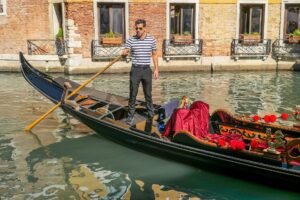
Yes, but with timing challenges. Standard gondola rides last 30 minutes. Golden hour lasts roughly an hour. Coordinating a gondola ride to overlap perfectly with optimal dusk light requires precise booking — and gondoliers sometimes hesitate to guarantee exact departure times that specific. Evening gondola rates also apply (significantly higher than daytime rates). The experience can be extraordinary if timing works — moving silently through glowing canals as light turns golden creates exactly the atmospheric Venice experience most visitors imagine. But the coordination complexity and additional cost mean most visitors experience dusk better from stable waterfront locations where timing is more flexible and budgets are less stressed.
Which dusk location works best for families with young children?
The Zattere wins this comparison easily. The promenade is wide, flat, and safe — no risk of children falling into canals, no narrow spaces where small kids feel confined. The waterfront has gelato shops, simple restaurants, and public restrooms nearby. Stone benches allow sitting when children tire. The atmosphere is relaxed enough that normal child energy doesn’t feel disruptive. Most other dusk locations involve either bridges (the Accademia), elevated viewpoints requiring climbing (San Giorgio Maggiore), or narrow fondamente where supervising active children becomes stressful. The Zattere accommodates family logistics while still delivering genuinely beautiful dusk viewing — making it the rare Venice location that works excellently for both romantic couples and families with young children.