By the second or third hour of a hot afternoon, almost every visitor to Venice asks me some version of the same question: where is everyone supposed to sit down? It’s a fair question, and it has a real answer — Venice genuinely does have far less public seating than most cities its size, and it’s not an oversight. It’s the product of centuries of urban habit, an economy built around café culture, and a fairly recent, ongoing tension between a city designed for residents and a city now overwhelmed by day-trippers.
This Isn’t Unique to Venice — But Venice Feels It Most
The first thing worth knowing is that Venice isn’t actually an outlier here so much as an extreme case of a broader Italian pattern. Visitors frequently notice that Italian cities generally have very few places to sit outside of a café — almost no park benches compared with, say, Paris, where benches line parks, small squares, and streets alike. Italy’s urban squares were historically built around commerce and civic life, not leisure seating, and the café — where you sit, order something, and pay for the privilege of resting — has always been the default answer to “I need to sit down” in a way it isn’t in northern Europe.
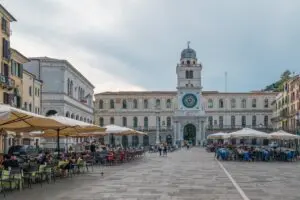
Venice inherits that pattern and then intensifies it. The city has essentially no true parkland in its historic center — its public space instead takes the form of promenades, narrow alleys, tiny plazas, and grand squares built for movement and gathering rather than rest. A campo was historically a working civic space — market, meeting point, sometimes literally a field, as the name implies — not a park in the modern sense, and it was never furnished the way a park would be.
The Café Economy Fills the Gap on Purpose
Here’s the part that surprises most visitors: the scarcity of free seating isn’t just neglect, it’s partly structural. Sitting down in Venice has, for a very long time, been something you pay a café or restaurant for rather than something the city provides for free. That’s precisely why Piazza San Marco is ringed with famous historic cafés rather than public benches — the seating was always meant to be commercial. It’s a real cultural difference for American visitors especially, coming from a country where a park bench is simply assumed to exist wherever people gather.
Tourism Has Made the Gap Worse, Not Better
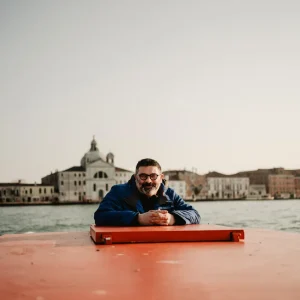
The scarcity has become a genuinely documented problem in recent years, and not just for visitors. Recent academic research into the city’s public infrastructure found that the main touristified squares and areas — despite being densely packed precisely because of their touristic appeal — often lack basic public seating, in contrast to parks and public spaces in residential neighborhoods away from the tourist track, which do have proper benches. In residential areas like Sant’Elena, the city’s simple red-painted public benches function as genuinely important social infrastructure — everyday meeting and chatting points, especially for elderly Venetians — while in the tourist-heavy core around San Marco and the Rialto, that same kind of seating has largely never existed or has been actively removed.
That contrast is worth sitting with for a moment, so to speak. It tells you something real about the city’s two-tier relationship with its own public space: where Venetians actually live and gather day to day, there are humble red benches doing exactly the social job benches are supposed to do. Where millions of visitors pass through in a single afternoon, there’s often nowhere to sit at all — not because the need is smaller, but because the commercial incentive to keep you moving toward a café table is bigger.
A Citywide Conversation, Not Just a Venice One
It’s worth knowing that Venice isn’t alone in grappling with this, and the disappearance of public benches has become enough of a wider urban issue that it’s shown up as art. At the 2019 Venice Biennale, the artist Jeppe Hein installed a series of “Modified Social Benches” around the city, directly responding to what he described as public benches increasingly disappearing from cities in general — a quiet observation that Venice’s seating shortage is, in some ways, a heightened preview of a problem many cities are now facing as public space gets steadily commercialized.
What Actually Counts as “Acceptable” Seating
If official benches are scarce, Venetians and experienced visitors alike have developed a set of informal, generally tolerated substitutes worth knowing before you’re desperately searching for somewhere to rest. Shaded stone or wooden benches do exist under certain porticoes — the Doge’s Palace portico and around Bacino Orseolo near San Marco are two reliable examples — and the rims of old wellheads in the center of many campi are generally accepted as informal seating, since most of these wells have been capped and are no longer used for water access. Steps leading down to a canal can work in a pinch too, though they’re worth approaching cautiously since they can be slippery and sitting too close to the edge risks an unplanned swim.
One rule to know before you sit down anywhere in Venice, official bench or improvised curb: picnicking and feeding pigeons are both prohibited under the city’s public behavior rules, and your conduct in these spaces is expected to stay respectful of the surroundings— worth keeping in mind if you’re tempted to turn a wellhead or a set of church steps into a full lunch spot.
Where I Actually Send Guests
I’ve written a full, practical list of the best specific spots to sit and recharge in my guide to Venice’s best places to take a break, covering the shaded benches at Campo San Giacomo dell’Orio, the length of Campo Santo Stefano, and the quiet garden paths of the Giardini Reali near San Marco — genuinely useful if you need the actionable list rather than the explanation of why the list has to exist in the first place.
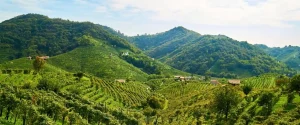
But understanding the why changes how you plan your day here, and it’s one of the small, practical things I build into every private itinerary — knowing exactly where the shaded, genuinely restful spots are, rather than discovering the hard way, three hours into a July afternoon, that Venice was never designed with your tired feet specifically in mind. If you’d like a walking pace and route built around real rest stops rather than a punishing straight-through itinerary, get in touch directly and I’ll design the day around comfort as much as sightseeing. And for a full day of open, unhurried seating with a glass of wine in hand, a private day trip to the Prosecco Hills is about as far from a crowded campo as you can get.
Why doesn’t Venice have more public benches?
Public seating in Venice’s historic center has traditionally been commercial rather than civic — cafés, not city-provided benches, have long been the default place to sit down — and this scarcity is more pronounced in heavily touristed squares than in residential neighborhoods, which do have proper public benches.
Is it okay to sit on the edge of a wellhead or church steps in Venice?
Generally yes — old wellheads are capped and commonly used as informal seating, and church or canal steps are typically fine as long as you’re respectful of the space and cautious near water. Picnicking in these spots is not permitted.
Where can I reliably find free seating in central Venice?
Shaded porticoes near Piazza San Marco, the benches at Campo San Giacomo dell’Orio, and the Giardini Reali garden are among the most reliable free rest spots in the busiest part of the city — details are in my full guide to Venice’s best places to take a break.