Venice is stone, water, and sky.
Or so every visitor assumes. The photographs show narrow streets, canal reflections, ancient buildings pressed against each other with barely enough space between them for a person to pass. Green space — gardens, trees, grass — seems fundamentally incompatible with a city built on wooden pilings driven into lagoon mud.
But Venice holds gardens. Dozens of them. Some tiny. Some surprisingly expansive. Almost all hidden behind walls, gates, or buildings that reveal nothing from the street.
These aren’t public parks in the modern sense. They’re private spaces — monastery courtyards, palazzo gardens, hidden cloisters — that occasionally open to visitors who know they exist and when access is permitted. Walking Venice’s stone calli for days, you’d never suspect that lush gardens exist mere meters away, invisible behind centuries-old walls.
After 28 years exploring every corner of this city, I know which gardens are genuinely accessible, which ones require special permission, and which ones remain visible only through locked gates. These hidden green spaces reveal a Venice that contradicts everything visitors expect — quieter, softer, and genuinely surprising.
Understanding Venice means understanding what hides behind the facades everyone photographs.
Why Venice Has So Few Visible Gardens
Before exploring Venice’s hidden gardens, it helps to understand why they’re hidden in the first place.
Venice was built on limited, extremely valuable land. Every square meter of the island represented enormous investment — wooden pilings driven deep into mud, foundations stabilized, buildings constructed on top of this artificial ground. Using that expensive land for gardens rather than buildings or commercial space represented genuine luxury that only the wealthiest residents could afford.
The gardens that existed were therefore private — attached to palaces, monasteries, or wealthy institutions. They faced inward, away from public streets. High walls protected them from view. Gates controlled access. The gardens served as private retreats for aristocratic families or religious communities, not as public amenities.
Modern Venice inherited this pattern. The gardens still exist — sometimes maintained exactly as they were centuries ago, sometimes adapted for contemporary use — but they remain largely private. Some open to the public during specific hours or seasons. Others never do. Walking past them on Venice’s public streets reveals nothing. The walls show only blank stone. The gates stay locked. The gardens hide completely.
This creates a strange situation: Venice contains genuine green spaces, but visitors leave believing the city is entirely stone and water simply because they never discovered where the gardens actually are.
The Garden Behind Il Redentore — Giudecca’s Newest Hidden Space
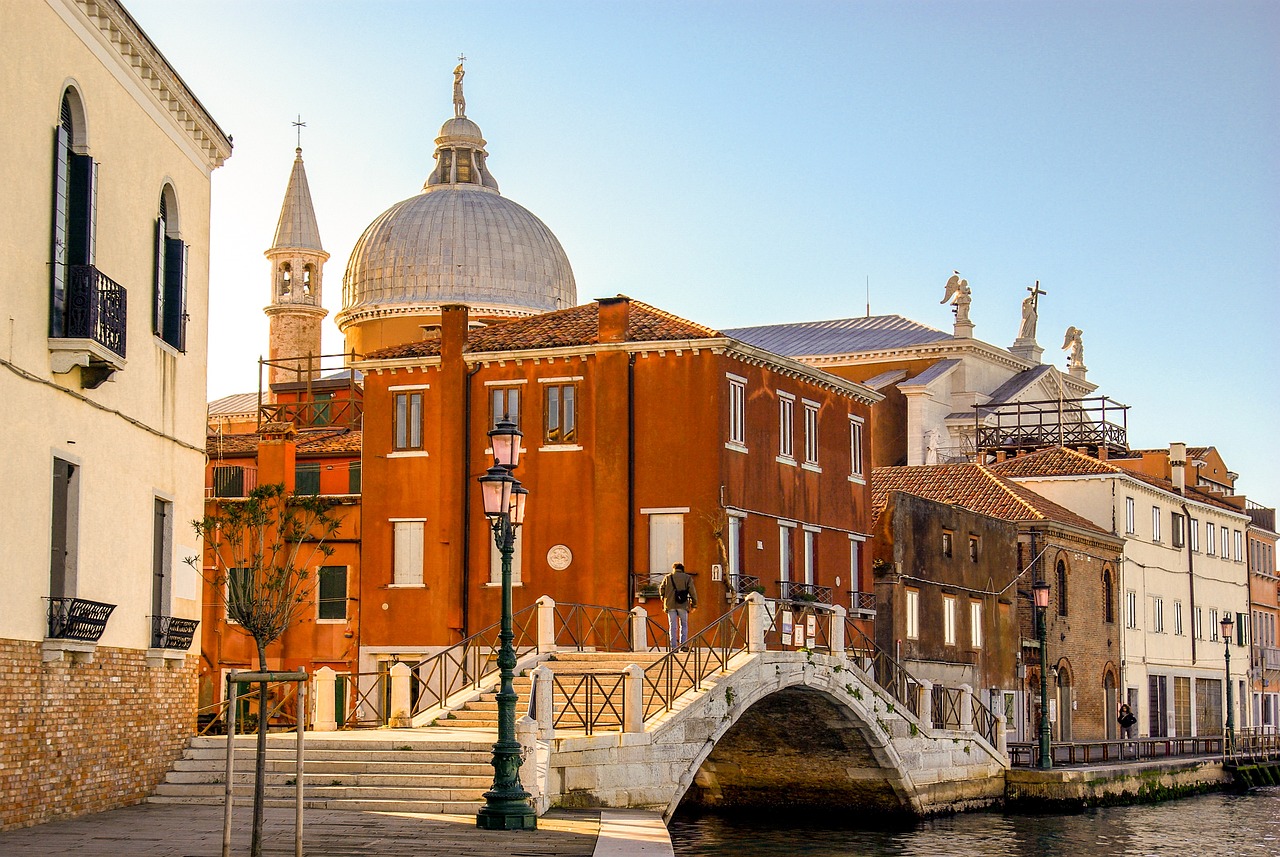
One of Venice’s most recent garden openings sits directly behind Il Redentore, Palladio’s magnificent church dominating Giudecca’s waterfront.
This garden was previously closed to the public entirely. The space belonged to the church complex, accessed only by clergy and authorized personnel. In recent years, limited public access has been permitted during specific hours — creating one of Venice’s least-known but most atmospheric garden experiences.
The garden isn’t large. But its position — directly behind one of Venice’s most architecturally significant churches, overlooking the Giudecca Canal toward Venice’s main island — creates views that few visitors ever see. Looking back toward Venice from this angle, the city appears exactly as it would have appeared to Palladio himself when he designed Il Redentore in the 16th century.
The atmosphere differs entirely from Venice’s tourist-heavy areas. Giudecca remains relatively quiet, residential, and uncrowded compared to San Marco or the Rialto. The garden behind Il Redentore amplifies this quietness — stone paths, simple plantings, wooden benches facing the water. Nothing dramatic or elaborate. Simply a contemplative space where the noise of the city fades entirely.
Access is limited and sometimes unpredictable. The garden opens during specific seasons and specific hours — typically daylight hours during warmer months, though schedules vary. Checking with the church directly or arriving during likely open hours (mid-morning on weekdays) provides the best chance of finding the gate unlocked.
Visiting the garden requires deliberate effort. You must travel to Giudecca by vaporetto. You must walk past Il Redentore’s main facade and find the side entrance leading to the garden area. You must arrive when the space is actually open — which isn’t guaranteed. But this effort is precisely what keeps the garden genuinely secret. Most visitors never cross to Giudecca at all. Those who do rarely venture beyond the waterfront. The garden exists in plain sight yet remains completely unknown to the vast majority of Venice tourists.
The Cloisters of San Francesco della Vigna
San Francesco della Vigna sits in eastern Castello — one of Venice’s most residential and least visited neighborhoods. The church itself is architecturally significant, designed by Jacopo Sansovino with a facade by Palladio. But what most visitors miss entirely is the cloister garden hidden behind the church.
Two cloisters actually exist here — the larger one visible through gates but not always open, and a smaller cloister that sometimes permits access during church visiting hours. Both contain planted courtyards, shaded walkways, and an atmosphere of complete tranquility that feels impossible in a city as densely built as Venice.
The larger cloister was originally a vineyard — vigna in Italian, giving the church its name. The monastic community cultivated grapes here centuries ago. Today, the space maintains greenery but no longer functions as working farmland. Trees shade the perimeter. Grass covers the central area. Stone benches line the walkways.
Accessing the cloisters requires timing and sometimes asking. The church itself is open during regular hours, but the cloisters aren’t always accessible. If the gate is locked, asking politely at the church office sometimes gains permission to enter — particularly during quiet weekday mornings when few visitors are present. Weekends see more local parishioners, making access less predictable.
The walk from San Marco to San Francesco della Vigna takes roughly 20 minutes through increasingly residential neighborhoods. This distance alone deters most tourists. Those who make the effort find not just the cloisters but an entire neighborhood — quiet campos, local shops, the sense of Venice functioning as an actual city rather than performing for visitors.
The Garden of the Fondazione Querini Stampalia
The Querini Stampalia palace in Castello holds one of Venice’s finest small museums — an aristocratic residence preserved with its original furnishings, artwork, and decorative objects largely intact. But the palace also contains a modernist garden designed by Carlo Scarpa in the 1960s.
This garden is deliberately contemporary. Scarpa’s design doesn’t attempt to recreate a historical Venetian garden. Instead, it creates a contemplative space using modern materials — concrete, steel, stone — arranged in geometric patterns. Water features dominate. Shallow pools reflect light. Plantings are minimal but carefully chosen.
The garden is small — essentially a courtyard behind the palace. But its design is so thoughtful, so carefully considered, that spending time here feels genuinely restorative. Benches allow sitting. The sound of water replaces Venice’s usual ambient noise. The surrounding walls block views of adjacent buildings, creating a sense of complete isolation within one of the city’s densest neighborhoods.
The garden is open during museum hours — making it one of Venice’s most reliably accessible hidden gardens. Museum admission includes access to the garden, and the museum itself is worth visiting regardless. The combination of historic palace, world-class art collection, and Scarpa’s modern intervention creates one of Venice’s most satisfying cultural experiences.
The museum sits minutes from San Marco but receives a fraction of the crowds. Walking here through Castello’s quiet streets, visiting the museum and garden, then continuing deeper into the neighborhood creates a Venice morning that feels completely different from the tourist-heavy experience most visitors encounter.
The Querini Stampalia Museum deserves time on any Venice itinerary — the palazzo’s preserved aristocratic interiors, the painting collection, and Scarpa’s architectural interventions combine into something genuinely special. The garden is simply one more reason to prioritize this overlooked museum.
The Gardens of Palazzo Soranzo Cappello
This Renaissance palace in San Polo holds one of Venice’s largest private gardens — roughly 3,000 square meters, an almost unimaginable luxury in a city where every square meter of land represents enormous value.
The garden isn’t regularly open to the public. Access is controlled, typically limited to special events, private tours, or cultural programs organized by the foundation that maintains the property. But when access is available, the experience is extraordinary.
The garden is genuinely lush. Mature trees create canopy shade. Flowering plants line pathways. A central lawn — rare in Venice — provides open space that feels shockingly generous compared to the city’s usual density. Stone benches, Renaissance statuary, and carefully maintained plantings create atmosphere that wouldn’t feel out of place in a Tuscan villa.
What makes this garden remarkable isn’t just its size. It’s the sense of discovering something that has no business existing in Venice at all. You walk narrow San Polo streets, surrounded by stone buildings pressed tightly together, and suddenly step through a gate into expansive greenery. The contrast is total. The effect is genuinely disorienting.
Access typically requires advance planning. The palace occasionally hosts cultural events — concerts, lectures, exhibitions — that include garden access. Private tours can sometimes be arranged through specialized Venice tour operators. Simply showing up and hoping for entry rarely works. But for visitors who plan ahead and secure access, the garden delivers one of Venice’s most unexpected experiences.
The Eden Garden at Sant’Elena
Sant’Elena occupies Venice’s eastern tip — a residential neighborhood that feels more like a small Italian town than like Venice proper. The area holds parks, tree-lined streets, and green spaces that mainland Italian cities take for granted but which are almost nonexistent in Venice’s historic center.
The Eden Garden (Giardini dell’Eden) is Sant’Elena’s largest public green space — not hidden behind walls but freely accessible, which makes it unusual among Venice gardens. The space contains mature trees, grassy areas, playgrounds for children, and benches where locals sit reading or chatting.
This isn’t a secret garden in the traditional sense. It’s simply a neighborhood park that tourists never visit because Sant’Elena itself sees almost no tourism. The vaporetto stops here — the neighborhood is fully connected to Venice’s transportation network — but no major attractions exist nearby. Visitors have no reason to come here unless they’re specifically seeking quiet residential Venice or staying in Sant’Elena’s few hotels.
The garden’s accessibility makes it valuable for specific visitors. Families traveling with children find the playgrounds and open space welcome after days of navigating narrow, crowded tourist areas. Visitors staying longer in Venice appreciate having somewhere to simply sit on grass — something the historic center rarely permits. Runners use the area’s wider, flatter paths for morning exercise that Venice’s uneven, stone-paved streets make difficult elsewhere.
Sant’Elena isn’t picturesque in the way Dorsoduro or Cannaregio are picturesque. But it’s genuinely livable in ways those neighborhoods aren’t. The trees, the grass, the relative quiet — these create an atmosphere of genuine residential comfort that most Venice neighborhoods simply can’t provide.
The Cloisters of Santa Maria della Carità
The Accademia Gallery — Venice’s premier art museum, holding the world’s greatest collection of Venetian painting — occupies a former monastery and church complex. Most visitors enter the museum, view the paintings, and leave without realizing that monastic cloisters still exist behind the gallery spaces.
These cloisters are occasionally accessible during the museum visit, depending on which galleries are open and which renovation work might be happening. The spaces aren’t guaranteed — sometimes they’re closed for conservation or maintenance — but when accessible, they provide a brief glimpse of the monastic environment that originally housed the religious community here.
The cloisters are small and simple. Stone columns support covered walkways around a planted courtyard. The atmosphere is contemplative rather than dramatic. Nothing here competes with the extraordinary paintings hanging in the adjacent galleries. But stepping from the intensity of the museum galleries into the quiet of these monastic spaces creates a moment of genuine relief — a chance to breathe, sit, and let the art you’ve just seen settle into memory.
The Accademia deserves extended time regardless of cloisters. The painting collection includes Bellini, Titian, Tintoretto, Veronese, Carpaccio — essentially every significant Venetian painter across several centuries. Rushing through in an hour means seeing nothing properly. Dedicating two or three hours means actually understanding why Venetian painting matters.
Skip-the-line tickets for the Accademia Gallery ensure the time you dedicate to the museum goes toward viewing paintings rather than waiting in queues. The museum is popular. Summer lines can extend 30-45 minutes. Skip-the-line access eliminates this waste entirely, delivering you directly to the art you came to see.
The Giardini Pubblici and the Biennale Gardens
The Giardini Pubblici (Public Gardens) in Castello represent Venice’s largest public park — not a hidden garden but rather the opposite, a deliberately created public green space established during the Napoleonic period when much of Venice’s urban fabric was reorganized.
These gardens are genuinely public and genuinely open. No gates, no admission fee, no restricted hours beyond normal park closing times. Trees provide shade. Paths allow walking or jogging. Benches invite sitting. The atmosphere is relaxed, local, and completely divorced from Venice’s tourist intensity.
The gardens hold particular significance during the Venice Biennale — the massive contemporary art exhibition that occurs every two years. National pavilions scattered throughout the gardens showcase cutting-edge art from countries around the world. Even outside Biennale years, the pavilion architecture — ranging from historical to contemporary — creates visual interest beyond typical park landscapes.
Visiting the Giardini during non-Biennale periods feels like discovering a neighborhood secret. Locals walk dogs, students study under trees, elderly Venetians sit chatting in dialect. The tourist presence drops to nearly zero. You’re experiencing Venice exactly as residents experience it — as a functioning city with genuine public amenities rather than as a open-air museum designed for visitor consumption.
The walk from San Marco to the Giardini takes roughly 25-30 minutes through progressively residential neighborhoods. This distance deters casual tourists. But for visitors staying multiple days in Venice and seeking variety beyond constant sightseeing, the Giardini provide exactly what the historic center cannot — space, green, and the chance to simply exist somewhere without performing tourism.
Why These Gardens Matter
Venice’s hidden gardens aren’t simply pleasant bonuses to an already rich city. They reveal something fundamental about what Venice actually is beneath its tourist identity.
The gardens prove that Venice was always a livable city — not just a collection of monuments and museums. The aristocratic families, the monastic communities, the wealthy merchants — they all created private spaces where daily life could happen away from commerce and public display. The gardens were essential to how Venice functioned as a city for actual residents.
Modern Venice has largely lost this balance. Tourism dominates so completely that the city’s residential infrastructure — the schools, the markets, the quiet neighborhoods, the green spaces — becomes invisible to visitors. The gardens matter because they’re some of the last remaining evidence that Venice was built for living, not just for looking at.
Seeking out these gardens also changes how you move through Venice. Instead of rushing between famous landmarks, you start walking with attention to what might exist behind walls and gates. You notice doors. You peer through windows. You ask questions. This kind of attentive exploration consistently produces discoveries that no guidebook mentions — not just gardens but courtyards, architectural details, quiet campos where Venice’s real character reveals itself.
Venice rewards visitors who skip the rigid checklist — the best discoveries can’t be planned. They happen when you’re present, paying attention, and willing to let curiosity guide you rather than executing a predetermined itinerary downloaded from travel blogs.
Practical Considerations for Garden Hunting
Finding Venice’s hidden gardens requires strategies different from typical Venice sightseeing.
Research opening hours and access restrictions before going. Many gardens are only accessible during limited hours or seasons. Some require museum admission. Others open only during special events. Arriving at a locked gate after walking 20 minutes wastes time and creates frustration. Five minutes of research prevents this entirely.
Ask locals and hotel staff. Venetians know their neighborhoods intimately. Asking your hotel concierge or a neighborhood shopkeeper about nearby gardens sometimes reveals spaces that don’t appear in any guidebook or online resource. These hyper-local recommendations often lead to the most satisfying discoveries.
Visit residential neighborhoods. The gardens don’t cluster in tourist areas. They hide in Castello, Sant’Elena, Cannaregio, and Giudecca — the neighborhoods where actual Venetians live and where tourist infrastructure barely exists. Walking these areas with attention reveals gates, walls, and architectural hints suggesting gardens behind them.
Respect private property. Some gardens are genuinely private — they’re someone’s home. Peering through gates is acceptable. Attempting to enter uninvited is not. Understanding the difference prevents awkwardness and maintains the goodwill that allows some gardens to open publicly at all.
Combine garden visits with other destinations. The gardens rarely justify trips on their own — they’re too small or too briefly accessible. But combining garden visits with nearby museums, churches, or neighborhoods creates satisfying half-day or full-day explorations that feel varied and genuinely surprising.
A private Venice tour can include hidden gardens as part of a broader neighborhood exploration — a knowledgeable guide knows which gardens are accessible on any given day, how to reach them efficiently, and how to place them within the broader context of Venice’s residential history and contemporary urban life.
Plan Your Hidden Garden Discoveries
For museum gardens with guaranteed access: The Querini Stampalia Museum includes Carlo Scarpa’s modernist garden as part of museum admission. This represents one of Venice’s most reliably accessible hidden gardens, combined with an excellent art collection and beautifully preserved aristocratic interiors.
For major museum visits: Skip-the-line tickets for Venice’s museums ensure you spend time viewing art rather than waiting in queues. Several major museums — including the Accademia — contain monastic cloisters or courtyard gardens that occasionally open to museum visitors. Museum admission provides access when these spaces are available.
For neighborhood exploration that reveals hidden spaces: Private Venice tours led by licensed guides who know the city intimately can include garden visits, architectural discoveries, and access to spaces that independent exploration rarely reveals. A knowledgeable guide understands which gardens are accessible on specific days and how to reach them without wasted time wandering lost through residential neighborhoods.
For approaching Venice beyond the obvious: Venice without a rigid checklist means allowing curiosity and discovery to guide your days rather than executing a predetermined plan downloaded from travel blogs. The gardens are perfect examples of this approach — you find them by paying attention, asking questions, and following hints rather than by following directions to famous landmarks.
For free atmospheric experiences: Venice offers dozens of extraordinary experiences that cost nothing — many of which involve simply walking residential neighborhoods where glimpses of hidden gardens, private courtyards, and unexpected green spaces appear around corners that tourist routes never reach.
Discover the Venice Hidden Behind Stone Walls — Where Green Exists Against All Logic
After 28 years exploring every corner of Venice and being featured by Rick Steves, NBC, and US Today, I know where the city’s secret gardens hide — and when they’re actually accessible. These green spaces reveal a Venice that contradicts everything visitors expect. Let me show you the hidden Venice that exists behind the facades everyone photographs.
Book a private Venice tour for insider garden access or secure museum tickets that include hidden courtyards — discover the green Venice that almost no tourist finds.
Frequently Asked Questions
Are Venice’s gardens actually worth seeking out, or are they anticlimactic?
They’re worth seeking out if you understand what they actually are — small, quiet spaces providing contrast to Venice’s dense stone environment. These aren’t elaborate botanical gardens with exotic plantings and dramatic landscape design. They’re simple courtyards, monastic cloisters, and modest green spaces that matter precisely because they exist at all in a city where every square meter of land represents enormous value. Visitors expecting Versailles-scale gardens will be disappointed. Visitors appreciating the significance of finding any green space in Venice’s dense stone fabric will find them genuinely special.
Can I visit the garden behind Il Redentore reliably, or is access too unpredictable?
Access is somewhat unpredictable, which keeps the garden genuinely unknown to most tourists. The space opens during specific hours that vary by season — typically daylight hours during warmer months, less frequently during winter. Checking directly with the Redentore church (which manages the space) provides the most current information. Arriving mid-morning on a weekday during spring or summer offers the best chance of finding the gate unlocked. The unpredictability is part of what maintains the garden’s quiet, secret character — if access were guaranteed and convenient, the space would fill with tourists and lose the contemplative atmosphere that makes it worthwhile.
Which single hidden garden should I prioritize if I only have time for one?
The Querini Stampalia garden is the most reliably accessible and combines garden access with an excellent museum visit — making it the best single choice for visitors with limited time. The garden itself is small but beautifully designed by Carlo Scarpa. Museum admission includes garden access, and the museum opens during predictable hours year-round. You’re guaranteed both entry and context, unlike some gardens that may be closed when you arrive or accessible only through locked gates you can peer through but not enter. The combination of guaranteed access, architectural significance, and excellent surrounding museum makes Querini Stampalia the safest single-garden recommendation.