Almost two thousand years ago, Roman engineers built an amphitheater on the edge of Verona to host gladiatorial combat. Today, on a summer evening, that same structure fills with fifteen thousand people holding lit candles, waiting for Verdi’s Aida to begin on a stage large enough to fit live elephants and camels. Very few buildings anywhere on Earth have stayed in continuous, genuinely popular use across two thousand years while shifting this dramatically in purpose, and understanding both halves of the Arena’s story, ancient and modern, is the difference between seeing an old ruin and seeing one of the most remarkable continuously living monuments in Italy.
Built for the Empire, Outside the Walls
The Arena di Verona was built around 30 AD, likely sometime between the reigns of the emperors Augustus and Claudius, making it roughly contemporary with the earliest phases of Roman imperial expansion into northern Italy. It was constructed just outside Verona’s city walls at the time, a common placement for Roman amphitheaters, which needed to accommodate massive crowds and required more open space than a dense urban center could easily provide. It wasn’t until 265 AD, when the emperor Gallienus extended the city’s fortifications, that the amphitheater was formally absorbed within Verona’s walls, becoming part of the city proper rather than a structure just outside it.
By scale alone, the Arena ranks among the most significant surviving structures of its kind anywhere in the world: it’s the third-largest Roman amphitheater still standing today, smaller only than the Colosseum in Rome and the amphitheater at Capua. Its outer dimensions run roughly 152 by 123 meters, with a total perimeter of around 391 meters, and the arena floor itself, the space where gladiatorial combat once took place and where opera productions are staged today, measures approximately 73 by 44 meters. Originally built to hold as many as 30,000 spectators, the structure today accommodates roughly half that number for modern safety standards, though even at that reduced capacity it remains one of the largest functioning performance venues, indoor or outdoor, anywhere in Europe.
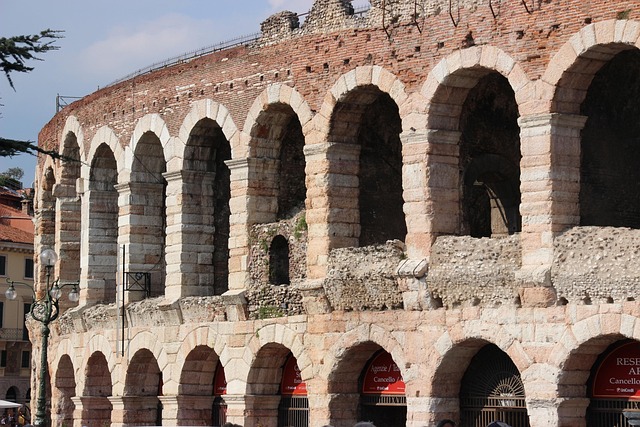
The Arena’s construction relied on pink and white limestone quarried from the nearby Valpolicella hills, the same wine-producing region famous today for Amarone and Valpolicella wine, material chosen both for its structural durability and its distinctive, warm coloring, still visible in the building’s weathered stone facade today. Its original design included three full tiers of arched arcades, seventy-two arches in total, each framed in red limestone, creating a rhythmic, monumental exterior facade considerably more elaborate than what survives to view today.
The Earthquake That Reshaped the Building’s Silhouette
Much of that original outer ring is gone, and the reason is a single, catastrophic event. In 1117, an exceptionally powerful earthquake, among the strongest ever recorded in northern Italy, struck the region and largely destroyed the Arena’s outer ring of arcades. What survives from that original three-tiered exterior is a single, freestanding fragment on the structure’s northern side, still known today simply as l’Ala, “the Wing,” a genuinely evocative name for the last visible trace of an entrance system that once wrapped entirely around the building. Numbered inscriptions carved above several of the surviving arches, originally used to help direct enormous Roman crowds to their correct seating sections in an orderly fashion, are still visible on the Ala today, a small but genuinely striking detail connecting directly back to how the building actually functioned in daily Roman use.
It’s worth noting that the earthquake wasn’t the only force that reshaped the Arena’s exterior over the centuries. Under the Ostrogothic king Theodoric, ruling Italy between 493 and 526 AD, sections of the outer ring were deliberately demolished specifically to provide building material for Verona’s expanding second city wall, meaning the Arena had already begun losing its original exterior well before the 1117 earthquake delivered the more decisive, and more famous, blow.
From Gladiators to Jousting Knights to a Rhinoceros
Like every Roman amphitheater, the Arena’s original purpose was gladiatorial combat, brutal public spectacle staged for audiences drawn from across Roman Verona and the surrounding countryside. That original function faded along with the Western Roman Empire itself, but the building never actually fell out of use; it simply kept finding new purposes across the following fifteen centuries.
Medieval Verona used the Arena for a genuinely wide range of civic functions: as a venue for the administration of justice, for public festivals and processions, and, notably, for jousting and mounted tournaments, with the first formally documented joust held there in 1590, knights demonstrating horsemanship and combat skill to crowds much as gladiators once had. The building’s external arches, meanwhile, took on an entirely different, more mundane life: rented out by the municipal government, they housed prostitutes until roughly the 16th century, and later, artisan workshops and small shops, turning the Arena’s exterior into something closer to an ordinary, if architecturally extraordinary, working commercial street.
The Arena’s role as a genuine spectacle venue never fully disappeared either. In 1751, the exhibition of a live rhinoceros inside the amphitheater reportedly left Veronese spectators genuinely astonished, a small but telling reminder of how much the building continued functioning as the city’s primary venue for anything drawing a large public crowd, whatever the actual content happened to be. Notable visitors left their own mark on the building’s story too: Johann Wolfgang von Goethe visited in 1786 and wrote admiringly of the structure during his own Italian travels, and in 1798, following the fall of the Venetian Republic, Napoleon himself attended a hunting event staged inside the Arena during a visit to the newly conquered city.
1913: A Tenor, a Centenary, and the Birth of Arena Opera
The Arena’s modern identity, the one most visitors actually come for today, began on August 10, 1913, when the Veronese tenor Giovanni Zenatello, together with the theatrical impresario Ottone Rovato, staged a full production of Giuseppe Verdi’s Aida inside the amphitheater, timed specifically to mark the centenary of Verdi’s birth. It was a genuinely bold gamble, staging grand opera inside a two-thousand-year-old ruin rather than a purpose-built theater, but the combination of the Arena’s natural acoustics, its overwhelming scale, and the simple spectacle of opera performed beneath an open summer sky proved immediately, lastingly successful.
The tradition that began that August evening has continued, with only occasional interruptions during the two World Wars and, more recently, the COVID-19 pandemic, essentially every summer since. The festival’s organizational structure evolved considerably over the following decades, various impresarios and production companies took turns running the summer season through the 1920s and 1930s, before the Ente Comunale degli Spettacoli, a municipal performance association, took over management in 1934, followed by the creation of a permanent organizing body in 1936. The Arena sustained genuine damage during Allied bombing raids in 1945, requiring careful post-war restoration, and the festival’s current legal structure, the Fondazione Arena di Verona, dates to a 1998 government reform that transformed Italy’s major opera houses into private-law foundations, with founding members today including the Italian State, the Ministry of Culture, the Veneto Region, the Municipality of Verona, and several private and civic partners.
What an Evening at the Arena Actually Looks Like Today
The modern Arena di Verona Festival runs each summer from June through September, drawing roughly 600,000 spectators across around fifty performance evenings, typically alternating between five or six different productions across the season. Aida remains, by a wide margin, the most frequently staged production in the Arena’s history, often performed with genuinely elaborate sets and, in some productions, live camels and elephants sharing the enormous 73-meter-wide stage, a scale of production simply impossible inside a conventional indoor opera house. Other perennial favorites in the Arena’s repertoire include Turandot, Carmen, Nabucco, and La Traviata.
One tradition specifically defines the modern Arena experience more than any other: at the start of every performance, as the sky darkens and the lights go down, the entire audience, sometimes fifteen thousand people at once, lights a small candle, filling the amphitheater with a genuinely striking sea of flame visible from every seat in the house, a ritual with no direct connection to ancient Rome but one that’s become, in barely a century, every bit as central to the modern Arena’s identity as the building’s own two-thousand-year-old stone.
Part of Verona’s UNESCO Story
The Arena stands as the single most recognizable monument within Verona’s UNESCO World Heritage listing, “City of Verona,” inscribed in 2000 in recognition of the city’s continuous, layered urban development across two thousand years. Few individual buildings anywhere demonstrate that continuity as directly and as literally as the Arena itself, a structure that has never actually stopped serving as the city’s primary venue for large public spectacle, simply shifting what kind of spectacle across two millennia of continuous use.
Visiting the Arena
Outside of the summer opera season, the Arena is open for general daytime visits, allowing you to walk the ancient tiers, examine the surviving Ala up close, and climb toward the upper levels for sweeping views back over Verona’s rooftops. During the June-through-September festival season, evening access is generally reserved for ticketed opera performances, and daytime visiting hours may be more limited on performance days. If your trip allows for it, I’d genuinely encourage building an evening around a performance rather than only a daytime visit; experiencing the Arena as the fifteen-thousand-seat, candle-lit theater it becomes each summer night is a fundamentally different, and in my view considerably more memorable, experience than walking the empty stone tiers alone.
Plan your visit: Verona & Amarone Wine: A Perfect Day Trip from Venice covers how to combine a daytime Arena visit with the rest of Verona’s historic center, and if your travel dates align with the summer opera season, ask about building an evening opera performance into your itinerary as well.
Frequently Asked Questions
How old is the Arena di Verona, and how big is it?
The Arena was built around 30 AD, making it nearly two thousand years old. It’s the third-largest surviving Roman amphitheater in the world, after the Colosseum and the amphitheater at Capua, with outer dimensions of roughly 152 by 123 meters and an original capacity of around 30,000 spectators, reduced to roughly half that today for safety.
Why is part of the Arena’s outer wall missing?
A powerful earthquake in 1117, one of the strongest ever recorded in northern Italy, destroyed most of the Arena’s original three-tiered outer ring of arches. A single surviving fragment, known as l’Ala (“the Wing”), still stands today on the building’s northern side, along with earlier losses from material removed during the reign of Theodoric in the early 6th century.
When did the Arena become an opera venue, and can I still see performances there?
The Arena’s opera tradition began on August 10, 1913, with a production of Verdi’s Aida staged to mark the centenary of the composer’s birth. The Arena di Verona Festival continues every summer today, generally running June through September, and remains one of the largest open-air opera venues in the world.