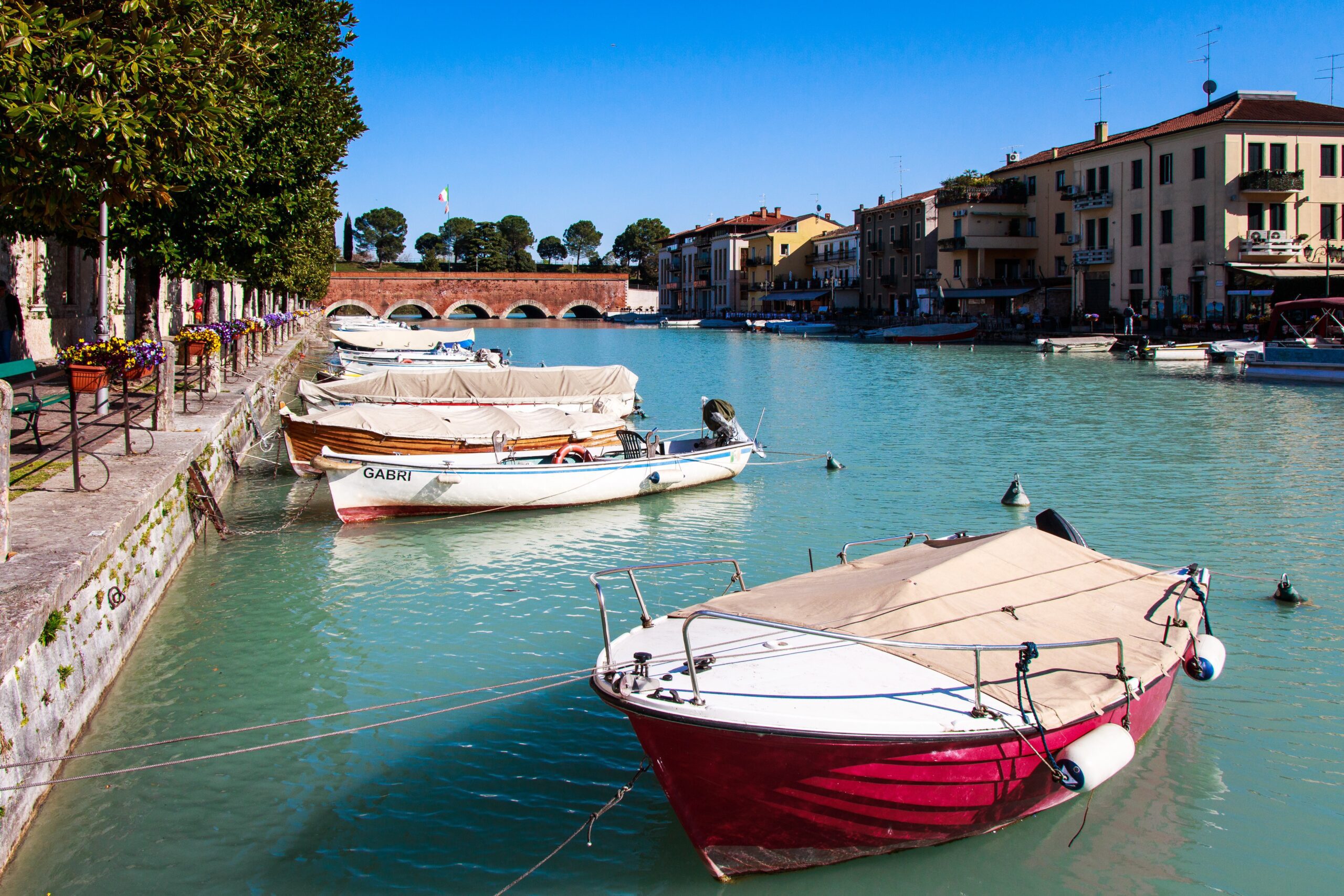
Peschiera del Garda occupies one specific, genuinely unrepeatable spot on the map: it’s exactly where Lake Garda, Italy’s largest lake, narrows and spills out into the Mincio River, the single point where a vast, wind-swept body of water becomes a flowing river headed south toward the Po. Armies have fought over that exact spot for two thousand years, and the small walled town that grew up around it is, today, one of the most rewarding and most overlooked stops on the entire southern shore of the lake.
Why This Specific Spot Mattered So Much
Long before Venice ever set foot here, Peschiera’s position made it a natural chokepoint. The Romans knew the settlement as Arilica, home to the Roman Empire’s fleet on Lake Garda, with the first fortifications dating back to the 1st century BC; fragments of Roman-era towers are still visible near the town’s Mincio bridge today. In the 14th century, under the rule of the Scaligeri family of Verona, Mastino II della Scala ordered the construction of a proper defensive rocca (fortress keep) and walls, using the Mincio’s own branching channels as a natural moat protecting the settlement on five sides.
It was the Venetian Republic, taking control of Peschiera in the 15th century, that recognized the site’s full strategic value and transformed it accordingly. Peschiera sat directly on the trade route carrying goods from northern Europe into Venetian territory, making it an essential customs point, and it guarded the western edge of the Republic’s mainland dominion against imperial attack from the north and west. Venice wasn’t going to leave a position this important defended by outdated medieval walls.
Building the Fortress: della Rovere, Sanmicheli, and a New Kind of War
Construction on Peschiera’s new fortress began in 1549, designed by the military architect Guidobaldo della Rovere and built under the direction of Michele Sanmicheli, the Veronese architect who ranks among the most significant military engineers of the entire Italian Renaissance. Their design responded to a genuine revolution in European warfare: the growing power of cannon and gunpowder artillery had made older, tall, vertical medieval walls dangerously obsolete, easy targets for direct artillery fire. Sanmicheli’s solution, applied here as it was at fortresses across Venetian territory, was to lower the walls, angle them backward, and reshape the fortress into a roughly pentagonal footprint with projecting bastions at each corner, a design specifically engineered to deflect cannonballs along oblique surfaces rather than absorbing their impact directly.
The finished fortress carried five named bastions at its five corners: Guerini, San Marco, Contarana, Feltrin, and Tognon, each a projecting, arrow-shaped stone platform allowing defenders to direct cannon fire along the length of the adjoining walls rather than only straight ahead. Two monumental gates controlled access into the town, each named for the direction of the road it connected to: Porta Verona, the grander of the two and still the most striking entrance into the historic center today, and Porta Brescia. In the mid-16th century, the old medieval rocca at the fortress’s heart was deliberately filled in with earth, a practical modification allowing artillery to be positioned and operated more effectively from what had once been a purely defensive keep. Over the following decades, additional ravelins, freestanding triangular outerworks, were added in front of the main gates, giving attackers yet another layer of defensive works to overcome before reaching the walls themselves.
Living With a River Running Through It
What makes Peschiera’s fortifications genuinely unusual, compared to most Venetian defensive works elsewhere in the region, is how directly the design had to accommodate a real, flowing river rather than simply a static moat. The Mincio, Lake Garda’s only outflow, splits into three separate branches right at Peschiera, and Venetian engineers deliberately shaped that branching specifically to maximize the town’s defensive water barrier on every side. A central waterway, the Canale di Mezzo, splits the historic center itself into two distinct sectors, connected today by two bridges: the Ponte dei Voltoni to the east, a graceful five-arched bridge built in 1556 and one of the most photographed spots in the entire town, and the Viale Cordigero bridge to the west. Beneath the fortress walls themselves, a series of vaulted stone passages, the voltoni that give the eastern bridge its name, were built specifically to manage how the Mincio’s flow passed underneath the curtain walls without compromising the fortress’s structural integrity, a genuinely elegant piece of hydraulic and military engineering solving two problems, water management and defense, in a single system.
Napoleon, the Austrians, and the Quadrilatero
The fortress’s military relevance didn’t end with the fall of the Venetian Republic in 1797. Peschiera passed into Austrian hands and, briefly, under French control: Napoleon’s troops laid siege to the fortress starting in December 1800, and the French held the town from 1801 to 1814. Under subsequent Austrian rule, the fortifications were significantly reinforced rather than left to age quietly, additional forts and entrenched camps were built in the surrounding countryside, and much of the military architecture visible inside the historic center today, barracks, storehouses, administrative buildings, dates specifically from this mid-19th-century Habsburg period rather than from the original Venetian construction.
Peschiera’s fortress took on a genuinely pivotal role during this era as part of the Quadrilatero, the “Quadrilateral,” a network of four linked Austrian fortress cities, Peschiera, Verona, Mantua, and Legnago, that together formed one of the most formidable defensive systems in 19th-century Europe, a strategic barrier the Kingdom of Italy would eventually have to overcome during the wars of the Risorgimento before the region was finally unified with the rest of Italy.
Walking the Walls Today
Peschiera has, understandably, softened considerably since its military heyday, and today the fortress town offers a genuinely pleasant mix of history and lakeside leisure: beaches, waterside restaurants, and a historic center that rewards an unhurried walk along the top of the walls themselves. Porta Verona remains the grandest entry point, and a walkway connecting the Tognon and Feltrin bastions lets visitors walk directly along a stretch of the original defensive perimeter, looking out over both the town’s canals and the open lake beyond. For cyclists, the fortress also marks the starting point of a 44-kilometer cycling and walking path following the Mincio River south all the way to Mantua, beginning right at the Feltrin bastion, a genuinely pleasant way to extend a Peschiera visit into the wider Mincio Valley.
Peschiera’s fortifications form part of the UNESCO World Heritage listing “Venetian Works of Defence between the 16th and 17th Centuries,” inscribed in 2017 as a transnational site shared with related Venetian fortifications in Croatia and Montenegro, recognizing the fortress as one of the finest surviving examples of Renaissance military architecture built to defend the Republic’s mainland territory.
The Lake Itself: Where Peschiera Actually Sits
Step outside the fortress walls and you’re standing at the edge of Lake Garda, Italy’s largest lake by surface area, formed by glacial action during the last Ice Age and stretching across three separate regions, Veneto, Lombardy, and Trentino-Alto Adige, an unusual administrative split that reflects how genuinely large and geographically varied the lake actually is. What surprises most first-time visitors is how dramatically the lake’s character shifts as you move along its shore. The northern end, hemmed in by steep mountains near towns like Riva del Garda, feels almost alpine, dramatic cliffs plunging nearly straight into deep water, prized by windsurfers and sailors for the strong, reliable daily winds, the Ora and the Peler, that funnel down between the surrounding peaks. The southern end, where Peschiera sits, is an entirely different landscape: milder, gentler, ringed by low hills, vineyards, and even olive groves and lemon trees, a genuinely Mediterranean microclimate this far north in Italy, made possible by the lake’s own moderating effect on the surrounding air.
A handful of towns along the southern and eastern shore are worth knowing by name for anyone basing a visit around Peschiera. Sirmione, a short drive or boat ride away on its own narrow peninsula, combines Roman ruins, the sprawling Grotte di Catullo villa complex, a medieval castle, and natural thermal springs, though its popularity means real summer crowds. Bardolino, a little further north along the eastern shore, lends its name to a light, easy-drinking red wine and offers a calmer, more residential lakeside atmosphere. Malcesine, further north still, sits directly beneath Monte Baldo, reachable by a rotating cable car offering sweeping views back down over the entire lake. Each of these towns is easily reached from Peschiera by car, local bus, or lake ferry, making the fortress town a genuinely practical, well-connected base for exploring the wider lake rather than a single, isolated stop.
Peschiera as a Base, Not Just a Stop
I generally recommend Peschiera to guests specifically as a base, rather than a rushed hour-long detour on the way to somewhere else. Its fortress alone rewards a genuinely unhurried half-day, walking the bastions, crossing the Ponte dei Voltoni, and simply sitting canal-side with a coffee. Add an afternoon boat trip on the lake itself, watching the landscape shift from the mild, olive-dotted southern shore toward the steeper mountains further north, and you’ve experienced both halves of what makes this specific corner of the Veneto so genuinely distinctive: a five-century-old military fortress standing guard over one of the most beautiful lakes in Italy, at the exact spot where the lake becomes a river and starts its own journey south.
Getting There and Planning Your Visit
Peschiera del Garda has its own train station, roughly ninety minutes from Venice on a direct regional or intercity service, making the fortress town genuinely easy to reach without a car. It also combines naturally with a Verona day trip, since Verona sits roughly 45 minutes away by car, allowing both the fortress and Verona’s historic center to fit comfortably into a single, well-paced day for travelers who don’t want to commit to an overnight stay on the lake itself.
Plan your visit: Verona & Amarone Wine: A Perfect Day Trip from Venice covers how to combine a Peschiera and Lake Garda stop with Verona’s historic center in a single day trip from Venice.
Frequently Asked Questions
Why does Peschiera del Garda have such a significant fortress?
Peschiera sits exactly where Lake Garda drains into the Mincio River, making it a natural strategic chokepoint controlling trade routes from northern Europe and the western approach to Venetian mainland territory. The Venetian Republic rebuilt the town’s medieval defenses starting in 1549 into a state-of-the-art artillery fortress, a design later reinforced further under Austrian rule as part of the Quadrilatero defensive system.
How many bastions and gates does Peschiera’s fortress have?
Five bastions, named Guerini, San Marco, Contarana, Feltrin, and Tognon, and two main gates, Porta Verona and Porta Brescia, each named for the road it connected to. A walkway along the top of the walls connects the Tognon and Feltrin bastions and remains open for visitors to walk today.
Is Peschiera del Garda a good base for exploring the wider lake?
Yes. Peschiera sits on the milder, gentler southern shore of Lake Garda, close to towns like Sirmione, Bardolino, and, a bit further north, Malcesine, all reachable by car, bus, or lake ferry, making it a practical, well-connected base for a broader Lake Garda visit rather than only a standalone fortress stop.