“How do vaporetti work? Where do I buy tickets? Which lines go where? Will I get lost?”
These anxious questions appear constantly from first-time Venice visitors who’ve seen photos of crowded water buses, heard horror stories about confusing routes and expensive fines, or simply feel uncertain about navigating unfamiliar public water transportation in foreign city where everything happens on boats rather than streets.
The honest answer: Venice’s vaporetto system is fundamentally simple once you understand the basics — it’s public water bus network operated by ACTV with fixed routes, regular schedules, and straightforward ticketing. But the system rewards understanding how it actually works versus wandering onto random boats hoping they go the right direction.
After 28 years riding vaporetti daily — commuting to work, taking children to activities, navigating the system in all weather and seasons, observing which tourist mistakes create problems versus which strategies work efficiently — I know that vaporetto mastery requires understanding the route logic, ticket validation requirements, practical riding strategies, and the realistic limitations that make certain journeys work better via water bus versus walking or water taxi.
The fundamental realities most travelers miss:
Vaporetti aren’t tourist boats or sightseeing cruises — they’re working public transportation serving Venetian commuters, meaning they operate on schedules prioritizing local needs not tourist convenience.
Ticket validation is mandatory before boarding with substantial fines (€60+) for non-validated tickets regardless of whether you paid — the validation timestamps your ticket activating the time window.
Not all vaporetto routes serve tourist needs equally — some lines connect attractions efficiently, others serve primarily residential areas or industrial zones offering minimal tourist value.
Walking often beats vaporetto for short distances despite Venice being water city — the routes follow canals while walking cuts through interior creating faster point-to-point travel for many common tourist movements.
This is the completely honest vaporetto guide — explaining how the system actually works, revealing which routes serve which purposes, providing realistic timing and cost information, and teaching you to navigate like informed user versus confused tourist hoping for the best.
What Vaporetti Actually Are (The Basic System Understanding)
Before attempting to use vaporetti, understanding what they represent prevents unrealistic expectations.
The Fundamental Identity:
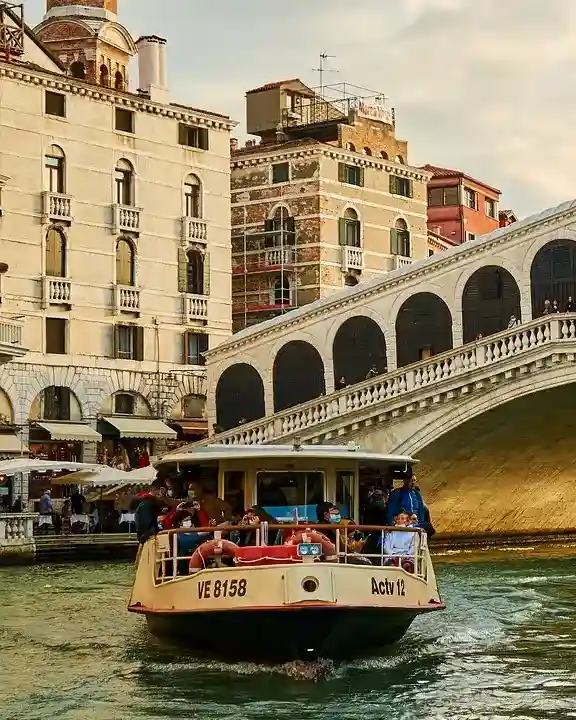
Vaporetti are Venice’s public water buses — large motorboats following fixed routes along canals, operated by ACTV (Azienda del Consorzio Trasporti Veneziano), the same public authority managing mainland buses.
The word “vaporetto” (plural: vaporetti) literally means “little steamer” in Italian, dating from when these boats were steam-powered. Modern vaporetti use diesel engines but the traditional name persists.
They serve dual function:
- Essential public transportation for Venetian residents (commuting to work, transporting children to school, daily errands, visiting family)
- Tourist transportation and sightseeing platform (Grand Canal cruising, island visits, navigating between attractions)
This dual function creates tensions — commuters want fast, efficient, uncrowded service while tourists want scenic routes, time to board with luggage, and accommodation for stopping to take photos.
The Operational Scale:
Venice operates 25+ vaporetto lines serving the historic center, lagoon islands, airport connections, and some mainland routes. The network carries approximately 70,000+ passengers daily during peak season.
The boats vary in size and design — newer models accommodate 150-300 passengers depending on configuration, older boats hold fewer. Some have outdoor deck space popular with tourists, others are primarily enclosed.
Operating hours: Most lines run approximately 5:00 AM to midnight, with limited night service (designated “N” routes) providing reduced-frequency connections through early morning hours.
The Essential Routes (What Actually Matters for Visitors)
Understanding which specific lines serve tourist needs versus which primarily serve residential areas you won’t visit.
Line 1 — The Grand Canal “Local”:
Route: Piazzale Roma (where buses and cars terminate) → Santa Lucia train station → down the entire Grand Canal → San Marco → continuing to Lido
Number of stops: Approximately 18-20 along the route
Journey time: 45-60 minutes end-to-end depending on traffic and time of day
Why it matters: This is Venice’s most famous and scenic vaporetto route, traveling the entire Grand Canal past spectacular Renaissance and Gothic palaces, under the Rialto Bridge, providing what amounts to €9.50 (single ticket price) Grand Canal cruise versus €80-100 -180 tourist boat tours covering less distance.
The tourist value: Sitting on the right side when traveling from Piazzale Roma toward San Marco provides best palace views. The slow pace (frequent stops at every dock) allows extended architectural observation.
The practical limitation: Extremely crowded during daylight hours (often standing-room-only), slow journey time due to frequent stops, hot and uncomfortable during summer peak hours.
When to use it: First-time Venice visitors wanting Grand Canal experience, travelers with time for slow scenic journey, anyone prioritizing sightseeing over efficient point-to-point transport.
Line 2 — The Grand Canal “Express”:
Route: Similar to Line 1 (Piazzale Roma → Grand Canal → San Marco → Lido) but with approximately half the stops
Journey time: 25-35 minutes covering the same distance Line 1 takes 45-60 minutes
Why it matters: Reaches the same major destinations (train station, Rialto, San Marco) far faster than Line 1 while still traveling the Grand Canal.
The practical trade-off: Fewer intermediate stops mean you miss some architectural views and potentially walk farther from your final destination to nearest Line 2 stop.
When to use it: Returning to accommodation after long day when you’re tired and want fastest route, commuting between major points without sightseeing priority, any situation where speed matters more than views.
Lines 4.1 and 4.2 — The Circular Routes:
Route: These lines circle Venice’s perimeter in opposite directions (4.1 clockwise, 4.2 counterclockwise), traveling around the outside of the historic center rather than through the Grand Canal.
Why they matter: Provide access to residential neighborhoods less served by Lines 1/2, connect to Murano island, serve Fondamente Nove (departure point for northern lagoon islands).
The tourist value: Limited unless you’re specifically visiting residential Castello, northern neighborhoods, or taking Line 4.1/4.2 to connect to other lines at Fondamente Nove for Murano/Burano trips.
When to use them: Reaching accommodations in northern Venice, visiting Murano via the circular route, experiencing Venice from outside-looking-in perspective.
Line 12 — The Island Connection:
Route: Fondamente Nove (northern Venice) → Murano → Burano → Torcello
Journey time: Approximately 40 minutes to Murano, additional 30-40 minutes from Murano to Burano
Why it matters: Essential for visiting the famous glass island (Murano), lace island (Burano), and ancient settlement (Torcello) that constitute popular Venice day trips.
Frequency: Every 30-60 minutes depending on time of day and season
The practical reality: This is dedicated island-hopping line with no faster alternative — you’re committed to vaporetto timing and potentially long waits if you miss a boat.
When to use it: Any island visit plans — this is the only public transportation serving these destinations.
Night Lines (N):
Limited routes operating midnight through early morning when standard service stops, connecting major points (Piazzale Roma, train station, San Marco) with reduced frequency (30-60 minute intervals).
Who needs them: Late-arriving travelers, people returning from evening events after regular service ends, very early morning airport departures.
The limitation: Far less frequent than daytime service, potentially long waits, some routes don’t operate at all overnight.
Tickets and Passes (The Cost Reality for 2026)
Understanding the pricing structure and which options actually make financial sense.
The 2026 Pricing:
Single journey ticket: €9.50
- Valid for 75 minutes from validation
- Allows transfers between lines within the time window as long as you keep moving (cannot exit system then re-enter)
Multi-day unlimited passes:
- 24 hours: €25 (from first validation)
- 48 hours: €35
- 72 hours: €45
- 7 days: €65
The pass value calculation:
If you take 3 rides in a day, you’ve spent €28.50 on single tickets versus €25 for 24-hour pass — the pass saves money.
If you’re staying 3 days with regular vaporetto use (daily Grand Canal journeys, island visits, multiple neighborhood trips), you’ll easily take 12-15+ rides costing €140+ on single tickets versus €45 for 72-hour pass.
When single tickets make sense:
- Very short Venice stay (arriving afternoon, leaving next morning)
- Minimal planned vaporetto use (walking most places, using vaporetto only for specific long-distance journeys)
- Uncertainty about actual usage patterns
When passes make sense:
- Multi-day Venice stay (3+ days)
- Island visits planned (each island trip is 2-4 vaporetto rides)
- Regular movement between neighborhoods
- Desire for unlimited flexibility without calculating per-ride costs
Where to Actually Purchase:
ACTV ticket offices: Located at major points (Piazzale Roma, Santa Lucia train station, San Marco area) — staffed windows selling tickets and passes, can answer questions, but create queues during peak hours.
Ticket vending machines: At most major vaporetto stops — accept credit cards and cash (coins and small bills), faster than ticket office queues when working properly, occasionally broken or confusing for first-time users.
Authorized vendors: Tabacchi shops (tobacco shops identified by “T” sign), some newsstands, hotels sometimes sell tickets at slight markup.
Online purchase: Official ACTV/Venezia Unica website allows advance purchase, eliminates arrival queuing, tickets delivered digitally or available for pickup at designated locations.
We can coordinate vaporetto pass provision as part of comprehensive arrival planning, ensuring you have tickets ready immediately without queuing at machines or offices when you’re tired and disoriented from travel.
The Validation Requirement (Critically Important)
Understanding the non-optional validation process that confuses many tourists and results in expensive fines.
What Validation Actually Means:
Every ticket or pass must be validated before boarding any vaporetto — this means tapping your ticket/pass against the electronic validation machine (usually white/yellow boxes) at the vaporetto stop entrance.
Validation timestamps your ticket activating the time window (75 minutes for single tickets, 24/48/72 hours for passes from moment of first validation).
The machine produces: Green light and beep sound confirming validation, potentially printing validation time on paper tickets.
Why This Matters:
Inspectors regularly board vaporetti checking tickets and passes — they appear randomly, not predictably, but frequent enough that riding without validation creates genuine fine risk.
The fine for non-validated ticket: €60+ even if you purchased the ticket legitimately. The validation timestamp is what matters, not simply possessing a ticket.
“But I paid for my ticket” is not valid excuse — inspectors don’t care whether you paid if you didn’t validate. The system requires both purchase AND validation.
The Common Mistakes:
Assuming purchase equals validation: Buying ticket from machine doesn’t automatically validate it — you must separately tap the validation reader.
Using expired time window: Single tickets valid only 75 minutes from validation — using yesterday’s ticket or one from 2 hours ago results in fines.
Sharing passes: Each person needs their own ticket/pass — you cannot validate once then hand pass to companion for their validation.
How to Validate Correctly:
- Approach the validation machine (white/yellow box near vaporetto stop entrance before the actual dock)
- Hold your ticket/pass against the reader surface
- Wait for green light and beep confirming validation
- Proceed to board vaporetto
For multi-day passes: Only validate once at first use — the pass remains valid for the full time period from that initial validation timestamp.
Practical Riding Strategies (What Actually Works)
Understanding the operational realities that make vaporetto use smooth versus frustrating.
The Boarding Process:
Vaporetti operate on tight schedules — captains cannot wait for slow boarders. When the boat arrives at the dock, gates open, passengers exit, new passengers board, gates close, boat departs. This entire process might take 60-90 seconds at busy stops.
Be ready to board quickly:
- Stand near the gate before boat arrival
- Have luggage organized (not sprawled across dock requiring gathering)
- Know which direction you’re traveling (signs indicate boat direction at each stop)
- Move decisively when gates open rather than hesitating
The crowding reality: During peak hours (8-9 AM, 12-2 PM, 5-7 PM) and peak tourist season (June-August), vaporetti are often at capacity. You might:
- Stand for entire journey (no available seating)
- Wait for next boat because current one is completely full
- Squeeze into crowded conditions with limited personal space
The Seating Strategy:
For Line 1 Grand Canal scenic journey: Sitting on the right side when traveling from Piazzale Roma toward San Marco provides best palace and architecture views. The left side shows opposite Grand Canal bank with less spectacular (though still beautiful) views.
Outdoor deck space is most desirable for tourists wanting unobstructed photography and maximum views, but also most crowded and fills fastest.
Interior seating provides weather protection (rain, wind, cold, intense sun) and guaranteed seats but limits photography and views.
The Luggage Consideration:
Large luggage on vaporetti creates problems:
- Takes up space in crowded boats annoying commuters
- Difficult to manage during boarding/exiting
- Potentially requires surcharge (officially luggage over certain size requires additional ticket, though enforcement is inconsistent)
The better approach for airport/train arrivals: Private water taxi from airport or train station directly to accommodation eliminates luggage management on crowded public boats, though it costs substantially more (€110-150 versus €9.50-15 per person).
If using vaporetto with luggage: Travel during off-peak hours when boats are less crowded, keep bags organized and out of walkways, be prepared for difficult boarding with heavy bags.
When Walking Beats Vaporetto (The Route Logic)
Understanding that water buses follow canals while walking cuts through interior, sometimes creating faster walking routes.
The Geographic Reality:
Vaporetti must follow navigable canals — they cannot cut through Venice’s interior, cannot take shortcuts, and stop at every designated dock along their routes.
Walking routes cut through Venice’s interior — crossing campos, navigating narrow calli, traversing bridges over canals that vaporetti must travel around.
Common Examples Where Walking Wins:
Rialto Bridge to San Marco:
- Vaporetto: Board at Rialto, travel down Grand Canal with several intermediate stops, arrive San Marco — 15-20 minutes
- Walking: Direct route through interior streets — 10-12 minutes
Train station to Rialto:
- Vaporetto Line 1: Multiple stops along Grand Canal — 25-30 minutes
- Walking: Direct through Cannaregio — 20-25 minutes
Most trips under 15-20 minutes walking time — vaporetto adds boarding wait time, potential intermediate stops, and circuitous water routing that makes walking faster despite appearing “farther” on maps.
When Vaporetto Makes Sense:
Genuinely long distances where walking would exceed 25-30 minutes
Luggage transport making walking with bags exhausting
Physical limitations preventing extended walking or bridge climbing
Scenic Grand Canal journey where the trip itself is the attraction not just transportation
Island visits where vaporetto is only option (no walking route to Murano/Burano)
Hot summer days where 30-minute walk in 35°C heat is miserable versus air-moving boat ride
The Island Connections (Murano, Burano, Torcello)
Understanding how vaporetto service actually works for popular island visits.
The Route Structure:
Line 12 from Fondamente Nove serves all three islands sequentially: Fondamente Nove → Murano (various stops) → Burano → Torcello
Journey times:
- Fondamente Nove to Murano: 10-15 minutes (depending on which Murano stop)
- Murano to Burano: 30-40 minutes
- Burano to Torcello: 5 minutes
Frequency: Every 30-60 minutes depending on time of day and season
The Timing Implications:
A typical island day trip structure:
- 9:00 AM: Depart Fondamente Nove
- 9:15 AM: Arrive Murano, explore 60-90 minutes
- 11:00 AM: Board Line 12 to Burano
- 11:40 AM: Arrive Burano, explore and lunch 90-120 minutes
- 2:00 PM: Board Line 12 to Torcello
- 2:05 PM: Arrive Torcello, explore 45-60 minutes
- 3:00 PM: Begin return journey to Venice
Total time commitment: 6+ hours for comprehensive three-island visit
The flexibility limitation: You’re constrained by vaporetto schedules — miss a boat and you wait 30-60 minutes for the next one. This affects how long you can stay at each island and overall day structure.
The Single-Island Alternative:
If time is limited, visiting only Murano or only Burano allows more relaxed pace:
- Murano only: 3-4 hours total (including transit)
- Burano only: 4-5 hours total (including transit)
This eliminates rushing between islands to catch boats and allows proper exploration of one destination.
Contact Us for Comprehensive Venice Transportation Planning
If vaporetto navigation represents broader Venice logistics concerns — how to get from airport to hotel, which neighborhoods minimize transportation needs, how to structure days efficiently — we provide consultation addressing practical movement challenges.
We’ll help with:
- Realistic itinerary planning considering transportation time and logistics
- Vaporetto pass coordination ready for pickup upon arrival
- Private water taxi arrangements for arrivals/departures with luggage
- Neighborhood selection affecting daily transportation needs
- Walking versus vaporetto decisions for your specific planned routes
Our 28 years navigating Venice means we understand which tourist assumptions about vaporetti create problems versus which strategies actually work efficiently.
Understanding Venice Transportation
For comprehensive comparison: Vaporetto vs water taxi guide explaining when each makes sense.
For planning context: How many days you need affecting transportation strategy.
For neighborhood understanding: Which sestiere fits your style and location implications.
For efficient movement: Navigation guide and realistic timing.
For comprehensive guidance: Private tours including transportation orientation.
Vaporetti Are Simple Public Transportation Once You Understand Route Logic, Validation Requirements, and Realistic Timing
After 28 years riding Venice vaporetti daily and being featured by Rick Steves, NBC, and US Today, I know the system rewards basic understanding — Line 1 for scenic Grand Canal journey, Line 2 for faster point-to-point, Line 12 for island visits, validation mandatory before every boarding with €60+ fines for non-compliance, multi-day passes cost-effective for 3+ rides daily. Walking often beats vaporetto for short distances despite water city geography because boats follow canals while walking cuts through interior. The keys: understand which routes serve which purposes, validate religiously, board decisively when boats arrive, and recognize when walking serves better than waiting for next vaporetto. Contact us for comprehensive Venice transportation planning addressing practical movement logistics. Let’s help you navigate efficiently rather than wandering confused onto wrong boats.
Contact us for Venice transportation guidance — vaporetto strategies and comprehensive logistics planning.
Frequently Asked Questions
Do I need to buy vaporetto tickets in advance or can I buy at the dock?
You can purchase tickets at the dock via ACTV ticket offices or vending machines, but this creates potential delays (machine queues during peak times, machines occasionally broken, ticket office lines) when you’re ready to board. Buying advance passes online through official ACTV/Venezia Unica website or coordinating with us for pickup upon arrival eliminates this friction. For multi-day stays, advance purchase makes strong sense ensuring you have passes ready without arrival queuing. For very short visits with minimal planned vaporetto use, purchasing on arrival via machines works adequately if you allow extra time for the process. The critical point: whatever purchase method, you must still validate before boarding — purchase and validation are separate required steps.
Can I reach Murano and Burano by vaporetto, and how long does it take?
Yes, Line 12 from Fondamente Nove serves both islands. Journey time to Murano is approximately 10-15 minutes depending on which Murano stop you’re visiting. Continuing from Murano to Burano requires another 30-40 minutes. The boats run every 30-60 minutes depending on time of day and season, meaning you’re constrained by schedule and potentially long waits if you miss boats. A comprehensive three-island visit (Murano, Burano, Torcello) requires 6+ hours total including transit time between islands and waiting for boats. If time is limited, visiting only Murano or only Burano allows more relaxed exploration without rushing between islands to catch schedules. The vaporetto is the only public transportation option — there are no walking routes to these islands obviously, and private water taxis cost substantially more (€80-120 for island trips) though they provide schedule flexibility that vaporetto service doesn’t allow.
Are vaporetti accessible for wheelchairs, strollers, and mobility-limited travelers?
Accessibility varies significantly by boat age and dock configuration. Newer vaporetti have low-floor boarding and designated wheelchair spaces, while older boats have steps creating boarding challenges. Some docks have steep ramps or stairs making wheelchair access difficult or impossible depending on tide levels. Strollers face similar challenges — crowded boats make maneuvering difficult, boarding stairs create obstacles, and you’re competing for limited space with other passengers. The practical reality: mobility-limited travelers often find private water taxis far more accommodating despite higher cost — drivers assist with boarding, boats have more space, direct routing eliminates transfers, and timing flexibility reduces stress compared to trying to navigate crowded public vaporetti with mobility equipment during peak hours.