Let’s clear this up right away.
Yes, Venice involves walking. No, you do not need to be an athlete, a hiker, or someone who enjoys “10 miles a day for fun.”
The problem is not the amount of walking in Venice. The problem is how it’s usually explained.
Most guides either romanticize it (“you’ll walk all day and love it”) or scare people unnecessarily (“Venice is exhausting”). The truth, as always, sits comfortably in the middle — and once you understand it, Venice becomes far easier and more enjoyable than expected.
This is a realistic guide to walking in Venice, written for normal humans with normal knees, normal shoes, and a normal desire to enjoy their vacation.
No myths. No fitness bragging. Just reality.
First, let’s talk numbers.
On an average sightseeing day in Venice, most visitors walk between 3 and 6 miles. That’s roughly 5 to 10 kilometers, spread out across the entire day.
That may sound like a lot, but context matters.
Walking in Venice is not continuous. It happens in short stretches, broken up by bridges, cafés, churches, museums, shops, and moments of standing still to look around. You are rarely walking non-stop for long periods.
Compare that to cities where you walk long blocks without interruption. Venice feels very different.
The second thing to understand is that Venice is flat.
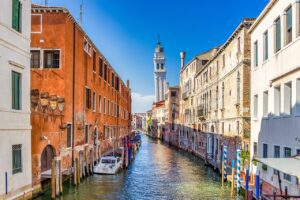
There are no hills. No slopes. No inclines. The only elevation changes are bridges — and even those are short and gradual. Most bridges involve fewer than 30 steps, and many neighborhoods have routes that minimize bridge crossings altogether.
This is why many visitors are surprised to find Venice easier on the body than cities that appear more “walkable” on paper.
Now let’s talk about what actually makes Venice tiring.
It’s not distance. It’s uncertainty.
When people feel exhausted in Venice, it’s usually because they are lost, doubling back, stopping abruptly, or moving against crowds at the wrong time of day. Mental fatigue turns into physical fatigue very quickly.
This is why visitors who begin their stay with a Venice orientation walk with a local guide often report feeling far less tired for the rest of their trip. Knowing where you are and how the city flows saves energy more than saving steps.
Another common concern is bridges.
Yes, Venice has a lot of them. But bridges are not mountains. They are brief interruptions, not obstacles. Most people barely notice them after the first day.
If mobility is a concern, it’s absolutely possible to plan routes that reduce bridge crossings significantly. Venetians do this instinctively. Visitors can do it too, once they understand the layout.
Let’s also address the idea that you need to walk “all the time.”
You don’t.
Walking is the primary way to move within neighborhoods, but public boats are extremely useful for longer distances. The key is using them strategically, not constantly.
Many visitors make the mistake of taking the vaporetto for very short trips, which often adds waiting time and stress rather than saving energy. Walking ten extra minutes is usually easier than navigating crowded docks.
For longer crossings, island visits, or end-of-day returns, public transport becomes a real asset. Having a vaporetto pass gives flexibility without forcing you to use it constantly.
Footwear matters more than fitness.
Venice rewards comfortable, broken-in walking shoes. Not hiking boots. Not brand-new sneakers. Just shoes you already trust.
Dress for movement, not for photos, and Venice immediately becomes kinder.
Timing also changes everything.
Walking at 8:00 am feels completely different than walking at noon. Early mornings and evenings are calmer, cooler, and require less effort simply because you’re not navigating dense foot traffic.
Venetians rarely rush. They move at the right time.
Once you adopt that mindset, walking stops feeling like an obligation and starts feeling like the experience itself.
Here’s the part most people don’t expect.
Many visitors who were worried about walking end up saying the same thing at the end of their trip: “We walked a lot, but it never felt hard.”
That’s Venice.
It doesn’t demand endurance. It asks for awareness.
If you move thoughtfully, plan lightly, and understand the city’s rhythm, walking becomes one of Venice’s greatest pleasures — not something to fear.
Walk Venice With Confidence, Not Guesswork
Frequently Asked Questions
Is Venice too much walking for seniors?
It can be — especially for seniors who have walking difficulties, don’t walk regularly, have disabilities, or struggle with steps.
While Venice is completely flat, it is also a city of bridges, stone steps, and long walking routes with no cars. There are:
Hundreds of bridges with stairs
No benches in many areas
Few places to stop suddenly
Distances that feel short on a map but longer in reality
For seniors who are not used to walking, have knee or balance issues, rely on canes or walkers, or find stairs challenging, Venice can quickly become tiring and uncomfortable.
That said, Venice can still be enjoyed if the visit is planned properly:
Short walking segments
Frequent breaks
Strategic use of water taxis instead of long walks
Carefully chosen routes that minimize bridges and stairs
This is exactly why many senior travelers choose private tours and private boats rather than standard group tours — it allows the day to be adapted to real physical needs, not ideal conditions.
In short:
Venice is not automatically “easy” for seniors — but with the right planning and support, it doesn’t have to be overwhelming either.
Can you use boats instead of walking everywhere?
Yes, for longer distances and island travel. Walking remains the easiest way to move within neighborhoods, while boats work best when used strategically.
Do you need to be in good shape to visit Venice?
Yes — at least reasonably.
You don’t need to be an athlete, but a basic level of physical fitness is important. Venice involves:
A lot of walking on stone streets
Repeated bridge stairs throughout the day
Standing for long periods
Very limited vehicle access
If you walk regularly, feel comfortable doing several miles a day, and can manage steps without difficulty, Venice is absolutely enjoyable.
If you are not in good shape, don’t walk often, or have mobility issues, Venice can quickly feel exhausting unless your visit is carefully planned with:
Short itineraries
Frequent breaks
Strategic use of private boats or water taxis
Private tours adapted to your pace
In other words, Venice doesn’t demand peak fitness — but it does reward preparation and realistic self-assessment. Knowing your limits and planning accordingly makes all the difference between a magical visit and a frustrating one.