“We’ve seen the major museums, visited the famous palazzos, and covered the standard Venice attractions. Is there anything truly special that most tourists never discover?”
This question arrives regularly from return visitors or culturally curious travelers who’ve already experienced Venice’s well-known treasures and want access to the city’s lesser-known cultural gems that reveal deeper layers of Venetian artistic heritage.
My answer increasingly includes: Fondazione Rubelli — one of Venice’s most extraordinary private collections that almost no casual tourists ever see, housed in a historic palazzo, showcasing centuries of textile artistry from Venice and beyond, accessible only through guided visits that must be arranged in advance.
After 28 years guiding visitors through Venice’s cultural landscape — watching the major museums become overcrowded while remarkable private collections remain virtually unknown — I know that Fondazione Rubelli represents exactly the kind of exclusive, meaningful cultural experience that sophisticated travelers specifically seek but rarely find without insider guidance.
What makes Fondazione Rubelli genuinely special:
- Private collection in Ca’ Pisani Rubelli, a 15th-century family palazzo
- Over 3,000 textile pieces spanning five centuries (15th-20th) from Europe, Asia, Pre-Columbian America, and Africa
- The prestigious Rubelli company’s historic archive documenting continuous production since 1889
- Hundreds of cesellated velvets (soprarizzi) representing Venetian textile excellence
- Collaborations with legendary designers including Gio Ponti and Peter Marino
- Rotating thematic exhibitions revealing textile art history through exceptionally preserved examples
- Visit-by-guided-tour-only access creating intimate educational experience impossible in mass-tourism museums
This is the completely honest guide — what Fondazione Rubelli actually contains, why it matters for understanding Venetian artistic traditions, who it serves versus who should skip it, and how to arrange visits through us rather than attempting complicated direct coordination.
Understanding Venice beyond obvious attractions reveals the city’s living cultural heritage.
What Fondazione Rubelli Actually Is
Before attempting to visit, understanding what this institution represents prevents confusion about its purpose and scope.
The Rubelli Company Context:
Rubelli S.p.A. is luxury textile manufacturer founded in Venice in 1889, continuing uninterrupted production for over 135 years. The company produces high-end fabrics for:
- Historic building restorations (royal palaces, museums, UNESCO heritage sites worldwide)
- Luxury hotels and residences
- High-end interior design projects
- Contemporary architectural commissions
Rubelli isn’t mass-market fabric company — they’re specialists in historically-informed luxury textiles requiring traditional techniques and exceptional craftsmanship. Their work appears in Buckingham Palace, the White House, the Kremlin, major European royal residences, and luxury projects globally.
The Foundation’s Establishment:
Founded in 2018 by Alessandro Favaretto Rubelli (company family ownership) with specific mission: preserve, study, and valorize the cultural, historical, and contemporary heritage of both the company and textile arts generally.
Located in Ca’ Pisani Rubelli — the family’s historic palazzo, a 15th-century building in San Marco sestiere that has housed the Rubelli family for generations.
The dual nature: Fondazione Rubelli combines company archive (documenting Rubelli’s own production since 1889) with Alessandro Favaretto Rubelli’s personal collection (3,000+ pieces acquired from various sources spanning five centuries and multiple continents).
The Rubelli Historic Archive: Documenting 135 Years of Venetian Textile Excellence
Understanding what the company archive contains reveals one component of the Foundation’s significance.
What the Archive Includes:
Textile samples and production pieces:
- Countless fabric samples documenting every design produced since 1889
- Historic meters (full-length fabric pieces showing complete pattern repeats)
- Mazze and filzuoli (the wooden pattern templates used in velvet production)
- Passementerie (decorative trimmings, tassels, cords, braids)
Technical documentation:
- Over 1,000 messe in carta (the detailed technical drawings showing how complex patterns are woven)
- Preparatory sketches for fabric designs
- Production records documenting techniques, materials, and processes
Business records:
- Correspondence documenting relationships with clients, artists, and suppliers
- Account books and commercial records
- Photographs documenting production facilities, craftsmen, and historic installations
What this archive demonstrates: The uninterrupted evolution of luxury textile production from late 19th century through present day, showing how traditional Venetian techniques adapted to changing tastes, technologies, and markets while maintaining exceptional quality.
The Velvet Collection (Collezione Velluti):
The archive’s most prestigious component contains hundreds of cesellated velvets (soprarizzi) — the pinnacle of Venetian textile art where velvet pile is cut at different heights creating sculptural three-dimensional patterns.
The soprarizzi tradition: This technique represents Venetian textile mastery — extraordinarily labor-intensive, requiring exceptional skill, producing fabrics so luxurious that historically only royalty and the Church could afford them.
Rubelli’s production: Until the 1960s, Rubelli operated sixty hand-operated velvet looms in Venice, maintaining techniques essentially unchanged since the Renaissance. The collection shows patterns inspired by:
- Sasanid Persian motifs (3rd-7th centuries CE)
- Byzantine decorative vocabulary (particularly relevant to Venice’s Eastern connections)
- Renaissance “inferriata” (grid-based) designs
- Baroque “garden” patterns with naturalistic floral abundance
Why this matters: These aren’t museum pieces from dead tradition — Rubelli continues producing soprarizzi velvets using similar techniques today, making this living craft heritage rather than purely historical archive.
The Designer Collaborations:
Rubelli has always collaborated with major artists and designers, commissioning contemporary patterns alongside historical reproductions:
Gio Ponti’s “Punteggiato” (1934): Created for the Venice Biennale, this modernist textile shows how 20th-century design masters worked with traditional Venetian manufacturers to create something simultaneously contemporary and rooted in craft tradition.
Peter Marino’s contemporary designs: The renowned architect (who designed luxury boutiques for Chanel, Dior, Louis Vuitton worldwide) created Rubelli fabrics inspired by Venetian lagoon light — showing how contemporary designers continue the collaboration tradition into 21st century.
The Alessandro Favaretto Rubelli Collection: Five Centuries of Global Textile Art
Understanding the personal collection component reveals the Foundation’s broader cultural significance beyond company archive.
The Collection Scope:
Over 3,000 pieces spanning 15th-20th centuries, including:
- Draperies and decorative hangings
- Liturgical vestments and church textiles
- Period costumes documenting historical dress
- Sample books from various historic manufacturers
- Individual fabric samples showing specific techniques
Geographic diversity: Not just European textiles, but examples from:
- Asia (Chinese silks, Japanese fabrics, Persian and Ottoman textiles)
- Pre-Columbian America (Andean weaving traditions)
- Africa (various regional textile traditions)
What this breadth demonstrates: Textile production as universal human artistic expression, showing how different cultures solved similar technical challenges, developed distinctive aesthetic vocabularies, and used fabric as canvas for visual storytelling.
The Chronological Range:
Renaissance severity (15th-16th centuries): Austere patterns, limited color palettes, geometric precision reflecting Renaissance mathematical aesthetics and sumptuary laws restricting luxury.
Baroque abundance (17th century): Explosive floral patterns, rich color combinations, three-dimensional effects through sophisticated weaving, reflecting Counter-Reformation’s embrace of sensory magnificence.
Bizzarre and chinoiserie (18th century): Fantastical asymmetrical patterns (bizzarre), exotic Asian-inspired motifs (chinoiserie), showing how global trade and Enlightenment curiosity influenced European textile design.
Neoclassical restraint (late 18th-early 19th centuries): Return to classical simplicity, geometric meander patterns, reaction against Baroque excess.
Victorian complexity (19th century): Industrial production’s impact on design, revival styles, increasing technical sophistication.
Modernist innovation (20th century): Abstraction, new materials, designer collaborations, showing how textile arts engaged with broader modernist movements.
The Exhibition Strategy:
The Foundation displays works through rotating thematic exhibitions rather than permanent comprehensive display:
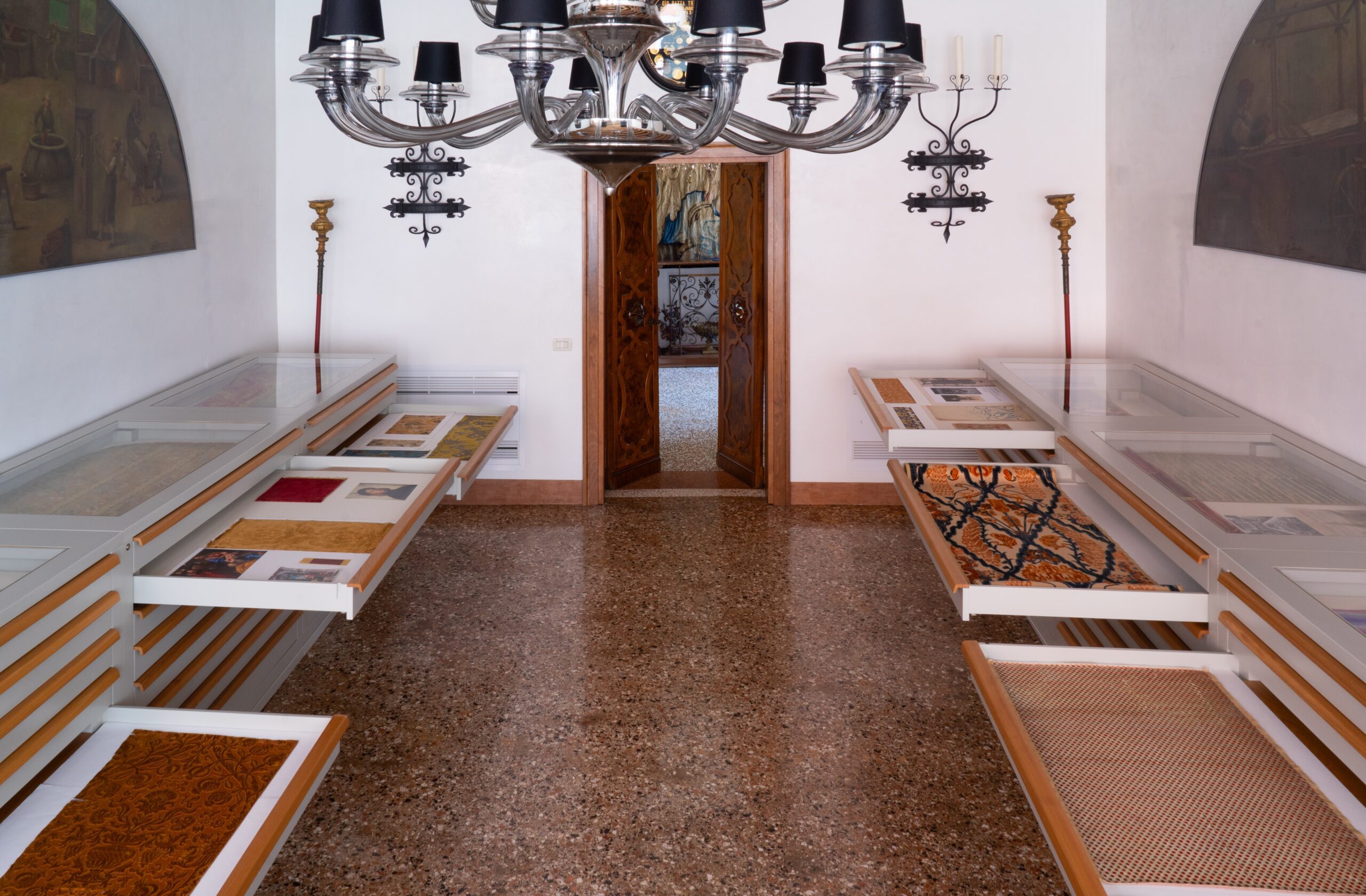
The drawer system: Works are stored in specially designed cabinets and drawers, with curators selecting pieces for specific themes. “Opening one drawer after another” reveals concentrated aspects of textile history — a technique allowing intimate examination impossible in traditional museum display.
Current themes rotate every few months, potentially focusing on:
- Specific periods (Renaissance velvets, Baroque silks)
- Technical traditions (soprarizzi production, embroidery techniques)
- Geographic origins (Ottoman textiles, Chinese silks)
- Design collaborations (Gio Ponti, Peter Marino, other major figures)
- Functional categories (liturgical vestments, domestic furnishings)
Why this approach works: The overwhelming richness of 3,000+ pieces would create museum fatigue if all displayed simultaneously. Curated thematic presentations allow deeper understanding of specific aspects while creating reason for return visits as exhibitions change.
Who Fondazione Rubelli Actually Serves
Understanding the audience match prevents inappropriate recommendations while identifying travelers who’d find this genuinely rewarding.
Fondazione Rubelli Excels For:
Design professionals and students — interior designers, architects, textile artists, fashion designers — who study historic techniques informing contemporary practice.
Art historians and scholars specifically interested in decorative arts, material culture, or textile history as serious academic discipline.
Craft enthusiasts who appreciate technical mastery and want to understand how complex textiles are actually produced beyond simply admiring finished beauty.
Return Venice visitors who’ve covered major museums during previous trips and specifically seek lesser-known cultural institutions revealing specialist knowledge.
Culturally sophisticated travelers who value depth over breadth, preferring intimate expert-guided encounters with focused collections over rushing through comprehensive museums.
People with genuine interest in textile arts, fashion history, or decorative traditions — not casual tourists checking boxes but enthusiasts for whom this subject specifically fascinates.
Fondazione Rubelli Disappoints:
First-time Venice visitors with limited days who need to prioritize Doge’s Palace, St. Mark’s Basilica, Accademia Gallery, and other essential coverage. Fondazione Rubelli rewards specialist interest, not general tourism.
Travelers uncomfortable with advance planning — the visit-by-appointment-only format requires coordination that spontaneous visitors can’t accommodate.
People without particular interest in textiles, design, or decorative arts — if fabrics don’t specifically fascinate you, this collection won’t suddenly create enthusiasm through exposure.
Families with young children — the guided tour format, the palazzo setting without elevators, and the specialized content don’t engage kids who’d be bored regardless of collection quality.
Budget-extremely-conscious travelers for whom the visit contribution (required to support Foundation activities) represents expense better allocated elsewhere.
The Practical Visit Reality
Understanding what visiting actually entails prevents unrealistic expectations about access or format.
The Access Restrictions:
Visit-by-guided-tour-only — you cannot simply walk in during open hours. Every visit is scheduled guided experience with Foundation staff providing context and answering questions.
Advance booking required — minimum 10 days advance notice needed for reservation coordination.
Limited days: Visits occur Wednesday-Friday only (not weekends, not Monday-Tuesday).
Group and individual bookings both possible — whether you’re solo traveler or organized group, the Foundation accommodates both with appropriate advance notice.
The Palazzo Logistics:
Ca’ Pisani Rubelli is 15th-century palazzo with historic architecture, meaning:
No elevator — the Foundation occupies first floor (American second floor), requiring stair navigation. This presents accessibility challenge for visitors with mobility limitations.
Historic building constraints — climate control, lighting, and visitor flow managed to protect collection while allowing access.
Limited capacity — small groups create intimate educational experience but also mean the Foundation can’t accommodate mass tourism volumes.
The Guided Visit Format:
Foundation staff conduct tours — these are textile specialists, curators, and historians (not generic tour guides) providing expert context about specific works, techniques, and historical significance.
The visit duration typically ranges 60-90 minutes depending on current exhibition theme and group interest level.
Questions encouraged — the intimate format allows genuine dialogue between visitors and expert staff rather than one-way information delivery.
Language: Tours primarily conducted in Italian and English, potentially other languages depending on staff availability and advance request.
How to Actually Visit: Working With Us
The coordination complexity makes direct booking challenging for travelers unfamiliar with Italian cultural institution protocols or concerned about language barriers.
Why Arranging Through Us Makes Sense:
We handle all communication with the Foundation — booking coordination, timing confirmation, any special requests, ensuring everything is arranged correctly before your visit.
We integrate Fondazione Rubelli into comprehensive Venice itineraries — positioning the visit at optimal time within your broader schedule, combining with nearby attractions or neighborhood exploration in San Marco area.
We provide context before and during visits — our licensed guides can accompany you to the Foundation, providing additional Venice cultural context that enhances what the Foundation’s specialists share about textiles specifically.
We ensure appropriate expectations — honestly assessing whether this experience serves your specific interests versus representing prestigious addition that doesn’t actually match what you value.
We solve logistics — coordinating timing with your hotel location, other planned activities, ensuring you’re not rushing to/from appointment creating stress.
What We Need From You:
Your Venice travel dates and how many days you’re staying — allowing us to identify appropriate days within Wednesday-Friday availability.
Your specific interests in textiles, decorative arts, design history — helping us assess whether Fondazione Rubelli genuinely serves you versus other cultural options.
Group size — whether you’re traveling solo, as couple, or as larger group.
Any mobility limitations — the stair access requires disclosure so we can assess feasibility or suggest alternatives.
Desired timing within your broader trip — early, mid-visit, or final days; morning versus afternoon preferences.
What We’ll Arrange:
Confirmed reservation with Foundation for specific date and time accommodating your schedule.
All communication handling booking details, confirmations, any adjustments needed.
Integration with other Venice activities — potentially combining with San Marco area tours, nearby museum visits, or traditional Venetian dining experiences.
Pre-visit briefing providing context about what you’ll see and how it fits into broader Venetian artistic heritage.
Post-visit recommendations for related cultural experiences or shopping at quality textile establishments if the visit inspires interest in acquiring pieces.
How Fondazione Rubelli Fits Into Broader Venice Cultural Tourism
Understanding where this experience sits within Venice’s cultural landscape reveals when it makes sense versus when other priorities deserve attention.
The Venice Cultural Hierarchy:
Essential first-visit coverage:
- Doge’s Palace and St. Mark’s Basilica (political and religious power centers)
- Accademia Gallery (Venetian Renaissance painting)
- Major churches with significant art (Frari, San Giorgio Maggiore)
- Neighborhood exploration (understanding how the city functions)
Second-tier cultural attractions:
- Ca’ Rezzonico (18th-century Venetian life)
- Peggy Guggenheim Collection (modern art)
- Correr Museum (Venetian history and art)
- Scuola Grande di San Rocco (Tintoretto masterworks)
Specialist institutions:
- Fondazione Rubelli (textile arts)
- Ca’ Pesaro (modern art in palazzo setting)
- Naval History Museum (maritime Venice)
- Jewish Museum (Ghetto history and culture)
Fondazione Rubelli occupies specialist tier — it’s not essential first-visit coverage, but it provides depth that return visitors or specialized enthusiasts specifically value.
When to Include Fondazione Rubelli:
Return visits when you’ve already covered essential attractions during previous trips
Extended stays (week or more) allowing time for both major sites and specialist institutions
Specific professional interest in design, architecture, textile arts, or decorative history
Themed cultural focus on Venetian crafts, luxury production, or material culture
Weather-affected days when indoor cultural activities serve better than outdoor exploration
When to Skip Fondazione Rubelli:
First Venice visit with limited days — prioritize essential coverage instead
Traveling with children or teenagers unlikely to engage with specialized textile content
Tight schedules where advance-booking requirement and specific timing create complications
Budget constraints making the visit contribution represent significant expense
No particular interest in textiles — if the subject doesn’t specifically fascinate you, other Venice experiences probably serve better
Contact Us to Include Fondazione Rubelli in Your Venice Experience
If Fondazione Rubelli interests you and you want us to coordinate visit as part of comprehensive Venice itinerary, contact us for consultation and arrangement.
We’ll assess:
- Whether this experience serves your specific interests
- How it fits within your total Venice days and existing plans
- Optimal timing within Wednesday-Friday availability
- Whether combining with other cultural visits creates coherent themed day
Then we’ll arrange:
- Confirmed Foundation booking coordinated with your schedule
- All communication and logistics
- Integration with other Venice activities we organize
- Pre-visit context and post-visit recommendations
Our 28 years organizing Venice cultural experiences means we know how to position specialist institutions like Fondazione Rubelli appropriately within broader trips, ensuring they enhance rather than distract from your primary Venice goals.
Plan Your Complete Venice Cultural Experience
For essential coverage: Three-day itinerary structure showing what first-time visitors need.
For expert guidance: Private tours with licensed guides providing context that transforms observation into understanding.
For craft traditions: Hands-on workshops complementing Fondazione Rubelli’s textile focus with direct artisan engagement.
For neighborhood context: San Marco and beyond understanding where cultural institutions sit within living city.
For realistic planning: How many days you need reveals whether specialist institutions fit your timeline.
For museum efficiency: Skip-the-line tickets at major museums freeing time for specialist institutions like Fondazione Rubelli.
Fondazione Rubelli Reveals Venice’s Living Textile Heritage Through Intimate Expert-Guided Access to Extraordinary Private Collection
After 28 years organizing Venice cultural experiences and being featured by Rick Steves, NBC, and US Today, I know that Fondazione Rubelli serves specific travelers exceptionally — design professionals, textile enthusiasts, return visitors, culturally sophisticated travelers wanting depth over breadth — while being inappropriate for first-time visitors with limited days or travelers without particular textile interest. The collection is genuinely extraordinary, the palazzo setting is authentic, the expert-guided access creates meaningful understanding impossible in mass-tourism museums. But the advance-booking requirement, the specialist content, and the visit-by-appointment format mean this rewards planned inclusion by appropriate audience rather than spontaneous visits by general tourists. Contact us. We’ll assess whether Fondazione Rubelli serves you and coordinate all arrangements if appropriate. Let’s create Venice cultural experiences matching your actual interests rather than forcing specialist institutions on inappropriate audiences.
Contact us to include Fondazione Rubelli visits — we’ll coordinate everything and integrate appropriately within your broader Venice experience.
Frequently Asked Questions
Can we visit Fondazione Rubelli without advance booking if we just show up?
No. The Foundation is private institution in family palazzo operating by guided-tour-appointment-only. There are no walk-in hours, no spontaneous access. You must book minimum 10 days in advance, receive confirmation, arrive at scheduled time. If you appear without booking, you’ll be turned away — the palazzo isn’t public museum with open admission. This restriction protects the collection, maintains intimate educational format, and respects the fact that this is family residence adapted for cultural mission rather than purpose-built tourist attraction. The advance planning requirement is non-negotiable feature of visiting, not bureaucratic obstacle you can circumvent through persistence or payment.
Is Fondazione Rubelli worth visiting if we’re not particularly interested in textiles?
Yes, absolutely — and here’s why you might be surprised by how fascinating it becomes even without prior textile interest. The Foundation rewards visitors in ways that transcend specialist knowledge because it reveals how Venice actually created its legendary wealth and cultural power. The textiles aren’t just pretty fabrics — they’re physical evidence of Venice’s global trade networks, technological innovation, artistic collaboration, and luxury production that funded the palaces and paintings you’ve been admiring throughout the city.
The guided tours connect textiles to broader Venetian history you’re already encountering: the soprarizzi velvets weren’t abstract craft objects but the actual furnishings in palazzos you’ve visited, the ceremonial fabrics dressed the Doges whose portraits you’ve seen, the Asian-influenced patterns document Venice’s Eastern trade creating the wealth that built St. Mark’s Basilica. Even visitors who arrive thinking “I don’t care about fabric” often leave genuinely engaged because the expert guides contextualize everything within the larger Venetian story rather than assuming specialist technical knowledge.
Additionally, the intimate palazzo setting — a 15th-century family residence adapted for cultural purpose — creates completely different experience from crowded major museums. You’re seeing extraordinary collection in authentic historic environment with small-group expert guidance impossible at mass-tourism attractions. Many visitors who wouldn’t seek out a “textile museum” deliberately find that Fondazione Rubelli becomes a Venice highlight precisely because it reveals lesser-known aspects of the city’s artistic heritage that complement rather than duplicate what you’re seeing elsewhere.
That said, if you’re on an extremely tight schedule with limited days, prioritize essential Venice coverage first. But if you have adequate time and appreciate expert-guided cultural experiences revealing unexpected depth, the Foundation rewards even casual visitors willing to be engaged by skilled storytelling connecting beautiful objects to broader historical meaning.
How does Fondazione Rubelli compare to seeing textiles at other Venice museums?
Completely different focus and depth. Major museums (Doge’s Palace, Ca’ Rezzonico, Correr) display textiles as components of broader collections — you see fabrics as palace furnishings, historical costume context, or decorative arts examples among paintings, furniture, and other arts. Fondazione Rubelli makes textiles the central focus with specialist expertise, technical depth, and quantity/quality of examples that generalist museums can’t match. The Foundation shows how textiles are made (through technical drawings, production records, tool displays), documents five centuries of evolution, and provides geographic breadth (Asian, African, Pre-Columbian examples) that Venice-focused museums don’t emphasize. If you want to understand Venetian textiles specifically and decorative arts broadly, the Foundation provides depth and expertise impossible at general museums where textiles occupy supporting roles rather than starring positions.