
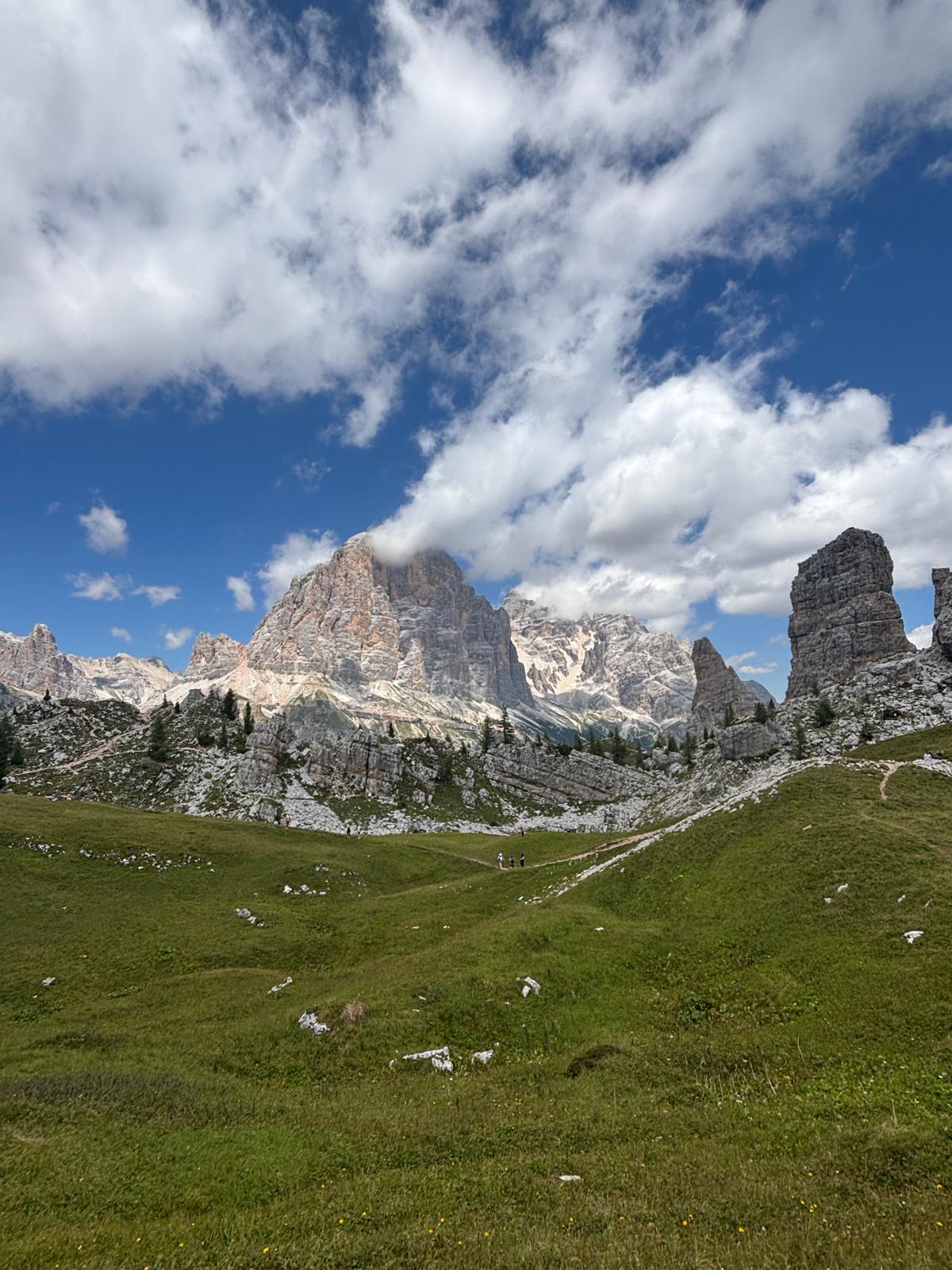
Between Cortina d’Ampezzo and the Passo Falzarego, a cluster of five limestone towers rises out of an open alpine meadow, and it’s genuinely rare to find a single spot in the Dolomites that manages to be a world-class rock-climbing destination, a functioning ski area, and one of the best-preserved First World War battlefield sites in the entire mountain range, all within the same easy walking loop. That combination is exactly what makes Cinque Torri, “Five Towers,” worth building real time around, rather than treating it as a quick photo stop on the way to somewhere else.
Five Towers, One Dramatic Meadow
Cinque Torri sits in the heart of the Cortina Dolomites, positioned between the Passo Falzarego and the Passo Giau, part of the wider Averau and Nuvolau mountain group and protected within the Ampezzo Dolomites Natural Park. The formation itself is exactly what its name promises: five prominent limestone towers rising from a high alpine meadow scattered with massive fallen rock blocks, the tallest of the five, Torre Grande, reaching 2,361 meters. Ringed by views toward the Tofane, Lagazuoi, Formin, Nuvolau, and Averau groups, the setting offers one of the more genuinely photogenic panoramas in this entire stretch of the Dolomites, without requiring the longer, more demanding approach that some of the range’s other famous formations do.
A Frontline Hidden Among the Rocks
What sets Cinque Torri apart from most other Dolomite viewpoints is what happened here just over a century ago. During the First World War, this exact meadow and its scattered rock towers sat directly on the frontline between Italian and Austro-Hungarian forces, and the Italian army’s Brigata Reggio established a command and observation post among the towers themselves, using the natural rock formations as cover and vantage points over the surrounding valleys. Soldiers carved trenches, built bunkers, and constructed walkways directly into and around the towers, adapting the dramatic natural terrain into a functioning defensive position at genuinely extreme altitude.
After the war ended, the position was abandoned, and the fortifications sat quietly deteriorating among the rocks for decades. More recently, the trenches, bunkers, and walkways were carefully restored, and Cinque Torri now functions as a genuine open-air museum, the Museo all’Aperto della Grande Guerra, letting visitors walk directly through the same defensive positions Italian soldiers once occupied, with the towers themselves serving as a natural, unchanged backdrop to the restored military installations. Walking the site today gives a far more visceral sense of the sheer physical difficulty of fighting a war at this altitude than any museum display case could offer, since you’re moving through the actual terrain rather than reading about it secondhand.
Getting Up: Chairlift, Cable Car, or Your Own Two Feet
Reaching Cinque Torri starts at Baita Bai de Dones, a base station on the SR48 road, roughly a 25-minute drive west of Cortina d’Ampezzo and about eight minutes east of the Passo Falzarego. From there, a chairlift carries visitors up to Rifugio Scoiattoli, positioned directly facing the five towers, making the climb accessible to genuinely all fitness levels rather than only experienced hikers. Chairlift tickets typically run somewhere in the range of €18 to €30 depending on the season and exact route, generally cash-friendly but worth confirming current payment options before you go, and the ride itself already offers sweeping views before you’ve taken a single step on the trail above.
For visitors who’d rather hike the full ascent, a walking route climbs from the same base area up past Rifugio Cinque Torri to the towers themselves, a more demanding but genuinely rewarding alternative for anyone with the time and fitness for it. Either way, once at the top, the towers and the surrounding open-air museum are reached on foot, meaning even chairlift visitors get a genuine walking experience once they arrive.
The Loop Walk and the War Museum
The classic Cinque Torri experience centers on a loop trail circling the base of the towers, an easy, family-friendly route roughly 1.9 kilometers long, taking about an hour at an unhurried pace, following Trail No. 425 through the restored trench system and around the base of Torre Grande. For visitors with more time and energy, extended trail combinations stretch the full circuit closer to six kilometers, weaving further through the surrounding meadows and rock formations before looping back to the chairlift station. Either version passes directly through the restored WWI positions, informational panels explaining the fortifications alongside the trenches, bunkers, and walkways themselves, a genuinely rare combination of easy, low-effort hiking and serious historical substance in a single short walk. Two mountain huts, Rifugio Cinque Torri and Rifugio Scoiattoli, both serve food along the route, making it entirely possible to turn the visit into a full, relaxed half-day rather than a rushed hour.
A World-Class Climbing Destination
Beyond its wartime history, Cinque Torri has long been recognized as one of the finest rock-climbing destinations in the entire Dolomites, its scattered limestone towers offering routes across a genuinely wide range of difficulty, from beginner-friendly climbs to serious technical challenges favored by experienced alpinists. The area’s relatively easy access, thanks to the chairlift, combined with the sheer variety and quality of its climbing routes, has made it a longstanding favorite among climbers visiting the Cortina area specifically for this reason, independent of the site’s historical significance.
Winter at Cinque Torri
Cinque Torri isn’t purely a summer destination. In winter, the area forms part of the vast Dolomiti Superski network, connecting to the surrounding ski areas around Cortina and offering downhill runs against the same dramatic backdrop that draws summer hikers and climbers. It’s a genuinely different experience of the same landscape, and one worth knowing about for anyone planning a Cortina trip outside the warmer months.
Cinque Torri or Tre Cime? An Honest Comparison
I get asked this question constantly by guests trying to decide how to spend a single Dolomites day, so I’ll give the same honest answer here that I give in person: Tre Cime di Lavaredo offers more dramatic, more instantly recognizable mountain scenery, genuinely one of the most iconic silhouettes in the entire Alps, but its popularity means real crowds on the trail, and it doesn’t carry Cinque Torri’s specific WWI historical layer. Cinque Torri, by comparison, is generally easier to access, offers more flexible route options thanks to the chairlift, and tends to feel noticeably less crowded, while adding genuine historical depth most Tre Cime visitors never encounter. If you only have time for one, choose based on what you actually want, pure mountain drama, or a more varied day combining scenery, easy hiking, and real history. If your schedule allows for both across a longer Dolomites stay, they complement each other well rather than feeling redundant.
Pair It With the Passo Falzarego and Monte Lagazuoi
Given Cinque Torri’s location just minutes from the Passo Falzarego, it combines naturally with a visit to nearby Monte Lagazuoi, reachable by its own cable car and home to an even more extensive network of WWI tunnels carved directly through the mountain itself. Travelers building a full day around Dolomites military history often combine both sites, Cinque Torri in the morning and Lagazuoi in the afternoon, or the reverse, given how close together they sit along the same stretch of road.
Visiting Cinque Torri
The area is most comfortably visited between late spring and early autumn, when the chairlift operates on its regular summer schedule and the trails are fully clear of snow. Plan for a minimum of two hours if you’re moving quickly, though three to four hours gives a considerably more relaxed pace, time enough to walk the loop trail, properly explore the open-air museum, and stop for lunch at one of the rifugios along the way. Given the elevation, weather can shift quickly even in summer, and layers are genuinely worth packing regardless of how warm the day looks from the valley floor below.
Plan your visit: Tour of the Dolomites: A Journey Through Italy’s Most Breathtaking Mountains covers the Cortina area as part of a full day trip from Venice, and reaching out through our customized private tours page lets us build in dedicated time at Cinque Torri and the surrounding Falzarego area for travelers with a specific interest in WWI history or rock climbing scenery.
Frequently Asked Questions
How do I get to Cinque Torri, and is a car necessary?
Cinque Torri is reached via the SR48 road, roughly 25 minutes west of Cortina d’Ampezzo, driving to the Baita Bai de Dones base station, from which a chairlift carries visitors up to Rifugio Scoiattoli. A car or private driver is the most practical way to reach the base station, since public transport connections are limited.
What is the WWI open-air museum at Cinque Torri?
Yes. The chairlift from Bai de Dones makes the site accessible without a demanding climb, and the main loop trail around the towers is an easy, roughly 1.9-kilometer walk suitable for most fitness levels, including families with children, making it one of the more approachable historical and scenic sites in the Dolomites.
Is Cinque Torri suitable for families or non-hikers?
Yes. The chairlift from Bai de Dones makes the site accessible without a demanding climb, and the main loop trail around the towers is an easy, roughly 1.9-kilometer walk suitable for most fitness levels, including families with children, making it one of the more approachable historical and scenic sites in the Dolomites.