I’ve walked the Ghetto with hundreds of visitors over the years, and it never fails — even people who’ve read up on Venice beforehand are surprised by at least half of what follows. Here are ten facts I bring up most often, the ones that tend to stop people mid-step.
1. The word “ghetto” comes from a foundry, not from segregation
Before 1516, the area was home to a copper foundry, and Venetians called it the “géto” — from gettare, to cast metal. When the Venetian Republic confined the city’s Jewish population to this same spot, the name stuck to the place, and eventually to the concept itself. Every “ghetto” used anywhere in the world today — Warsaw, Rome, any city — borrows a word that started here, in this one corner of Cannaregio.
2. It happened almost overnight, in 1516
On March 29, 1516, the Venetian Senate ordered the city’s Jewish residents into this specific enclosed island. It wasn’t the first forced segregation of Jews in Europe, but it gave the practice its name and its blueprint — walls, gates, and curfews that other cities would later copy.
3. The gates really did lock at night
Guards patrolled the perimeter, and the gates were physically locked after dark, only reopening at dawn. Being caught outside after curfew carried real punishment. This lasted for close to three centuries — the gates weren’t permanently thrown open until 1797, after Napoleon’s forces dissolved the Venetian Republic.
4. Venice’s tallest residential buildings were born here — out of necessity
The Ghetto occupied barely two hectares, and its population kept growing while its footprint couldn’t. The only direction left was up. Some buildings here reached six or seven stories, unusually tall for Venice, with correspondingly low ceilings squeezed floor over floor — the city’s first real skyline, built entirely by restriction rather than ambition.
5. There are five synagogues, and each belongs to a different community
Venice’s Jewish population was never one uniform group — it was organized into distinct “nations,” each with its own rite and its own scuola (synagogue). The Scuola Grande Tedesca (German), built in 1528-29, is the oldest. It was followed by the Scuola Canton (1531-32), the Scuola Italiana (1575), the Scuola Levantina, and the Scuola Spagnola — also called the Ponentine Synagogue, and the largest of the five. Four of the five can be visited today on guided tours run through the Jewish Museum.
6. The synagogues are invisible from the street on purpose
Jewish communities in Venice weren’t permitted to build new religious structures with any external show of grandeur. So the synagogues were tucked onto the upper floors of ordinary residential buildings, identifiable today mostly by their domed roofs or a cluster of five arched windows — not by any facade announcing what’s inside. Step through an unmarked door and the interiors open into rich, gilded rooms that give away nothing from outside.
7. Jewish residents were legally restricted to just a few professions
Inside the Ghetto’s walls, opportunity outside it was tightly controlled. Jewish residents were largely confined to moneylending, the secondhand and textile trade, and medicine — this last one somewhat ironically, since Jewish physicians became so trusted that even Christian patients and Venetian nobility sought them out despite the segregation everywhere else in daily life. The pawnshops tied to moneylending were color-coded by interest rate, and the Banco Rosso — the “red bank” — still stands in the Ghetto today as one of the few surviving physical traces of that economy.
8. A doctor’s final act saved most of Venice’s Jewish community in WWII
When Nazi forces occupied Venice in 1943, they demanded a full list of the city’s Jewish residents from Giuseppe Jona, then head of the Jewish community and a respected physician. Rather than comply, Jona burned every record the night before it was due and took his own life. Because of that decision, the Nazis never obtained a complete list — and while 246 Venetian Jews were still deported to concentration camps between December 1943 and August 1944, roughly 1,200 others were able to escape or go into hiding.
9. The Holocaust memorial names all 246 who were deported
In Campo del Ghetto Nuovo, a series of bronze bas-relief panels by sculptor Arbit Blatas — himself the son of parents who survived and died in Nazi camps — depicts scenes of the deportation. A second, related memorial nearby, unveiled in 1993, carves the name and age of each of the 246 deported into wooden boards behind an iron grate. Only seven of them returned to Venice after the war.
10. The Ghetto is still a living Jewish neighborhood, not a museum
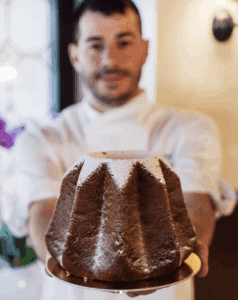
This is the fact I most want visitors to leave with. Around 500 Jewish residents still live in Venice today, a kosher restaurant and a kosher bakery still operate in the square, and two of the five synagogues remain in active religious use. The Ghetto isn’t a preserved relic behind glass — it’s a neighborhood that has continuously housed Jewish Venetian life for over 500 years, through expulsion, restriction, near-annihilation, and now quiet continuity.
Can you go inside the synagogues in Venice’s Jewish Ghetto?
Yes, but only through a guided tour booked via the Jewish Museum of Venice, which typically visits several of the five synagogues. You can’t simply walk in independently.
Is the Jewish Ghetto in Venice still a Jewish neighborhood today?
Yes. Around 500 Jewish residents live in Venice, a kosher bakery and restaurant still operate in the Ghetto, and two of its five synagogues remain active for religious services.
Why is it called a “ghetto” — where does the word come from?
The area previously held a copper foundry, and Venetians called it the “géto,” from the verb gettare, meaning to cast metal. When Jewish residents were confined there in 1516, the name transferred to the neighborhood — and from there, to the world.