People ask me all the time which spots actually deliver that feeling — the one they came to Venice hoping for. Not a checklist moment, but something quieter that catches you off guard. In nearly thirty years of guiding here, these are the three places in Dorsoduro I watch it happen to people, again and again.
1. The Tip of the Punta della Dogana at Golden Hour
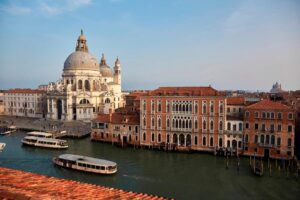
There’s a specific point in Venice where two bodies of water meet — the Grand Canal and the Giudecca Canal — right at the triangular tip of land where the old customs house, the Dogana da Mar, stands. The building itself dates to the 15th century, when it served as Venice’s maritime customs point, and its rooftop is crowned by two bronze figures of Atlas holding a golden globe, with the goddess Fortuna balancing on top, spinning with the wind like a living weathervane.
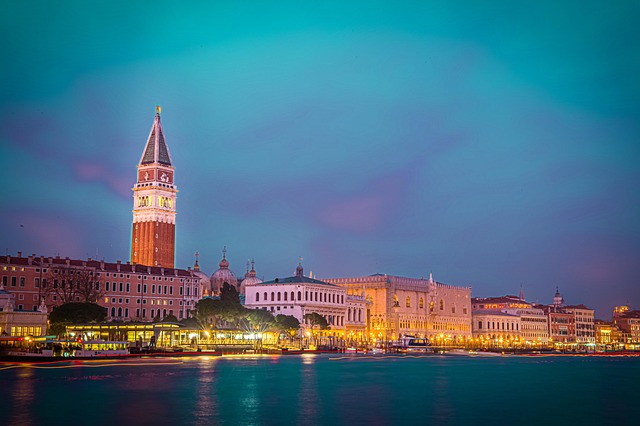
Stand at that tip in the last hour of daylight and you’ll understand why painters have obsessed over this exact vantage point for centuries. The light comes in low across the water, San Giorgio Maggiore glows across the basin, and gondolas cut silent lines through water that’s gone the color of champagne. I’ve brought hundreds of people here over the years, and I’ve never once seen someone check their phone in that first minute. It just doesn’t happen.
2. The Squero di San Trovaso, Watching Gondolas Be Born
Most visitors glance at the Squero di San Trovaso for thirty seconds and move on — a quick photo of the odd, Alpine-looking wooden buildings tucked beside the San Trovaso canal, then off to the next stop. I’d ask you to stay longer than that.
This boatyard has been shaping gondolas since before the 17th century, and the men who work here — the squeraroli — still build almost entirely by hand, using eight different types of wood and no fixed blueprints, only a template called a cantiér that encodes the gondola’s asymmetrical curve. A single gondola takes months and costs around €40,000; the yard produces maybe one new hull a year, spending the rest of its time on repair and maintenance for the roughly 400 gondolas still working Venice’s canals.
What gets people isn’t the craftsmanship alone — it’s realizing this isn’t a museum exhibit. It’s a real workshop, run by families who’ve done this work for generations, still solving the same physical problem their great-grandfathers solved: how to build a boat that can be rowed standing up, by one person, with a single oar, through water barely wide enough for it to pass. Sit at a nearby bacaro with a glass of wine and just watch for twenty minutes. That’s the whole trick.
3. Campo San Barnaba in the Early Evening
Campo San Barnaba doesn’t look like much on a map — just another square with a deconsecrated church and a floating vegetable barge tied up along the canal. But arrive around six or seven in the evening, when the day-trippers have thinned out and the square starts filling with Venetians heading home or stopping for a spritz, and something shifts.
This is the campo where a scene of Indiana Jones and the Last Crusade was filmed, but that’s trivia, not the reason to come. The reason is simpler: this is what an actual Venetian neighborhood square feels like at the hour it’s meant to be used — kids on bikes, neighbors talking across café tables, the vegetable barge closing up for the night. After a day spent among crowds and monuments, there’s something disarming about standing in a place that isn’t performing for anyone. It’s just Venice, being lived in.
Why These Three, and Not the Obvious Choices
I left the big-name museums off this list on purpose. The Guggenheim and the Accademia are extraordinary, and I’ve written about them elsewhere — but “falling in love with Venice” tends to happen in the in-between moments, not the ticketed ones. These three places share something: they ask you to slow down and simply be present in them, rather than move through them.
That’s also, frankly, the argument for exploring Dorsoduro with someone who knows it well. A platform-assigned guide moving a group through on a fixed schedule can’t linger at the Dogana for that last stretch of light, or decide on the spot that tonight’s the night to sit an extra twenty minutes in San Barnaba. On my private Venice tours, that flexibility is the whole point.
What time of day is best to experience these three spots?
Late afternoon into evening works best for all three — the Dogana for golden-hour light, the squero for active work hours (mornings and early afternoons on weekdays), and San Barnaba for the early-evening neighborhood shift.
Are these places included on typical group tours of Venice?
Rarely — most itineraries move through Dorsoduro quickly en route to the Accademia or Guggenheim, which is exactly why they tend to feel fresh even to repeat visitors.
Can I visit all three in one outing?
Yes, comfortably — they sit within a 15-20 minute walk of each other and pair naturally with a longer Dorsoduro walk if you want to see more of the neighborhood along the way.