Most cities preserve their history behind glass — in museum cases, roped-off rooms, plaques on buildings that used to be something else. Venice does that too, but it also does something rarer: parts of its history never stopped happening. The same professions, the same institutions, in some cases the very same families, are still doing today roughly what their ancestors were doing centuries ago. That’s a different kind of history than the kind you look at. This is the kind you can still watch happen.
The Gondoliers’ Guild: A Thousand Years of the Same Job
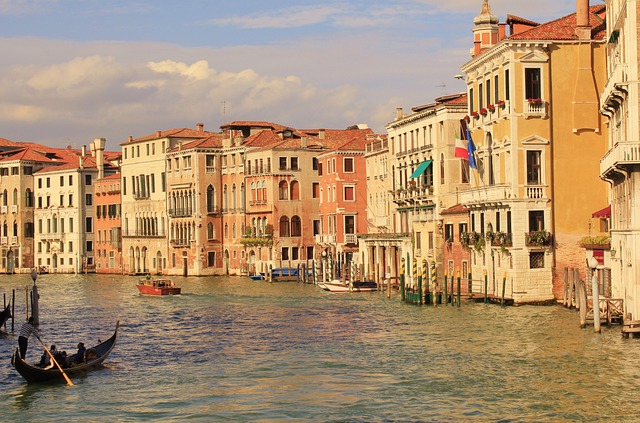
The single clearest example of living history in Venice isn’t a building at all — it’s a profession. The first documented reference to a gondola appears in 1094, in a license issued by Doge Vitale Falier, and the guild that has governed the trade ever since, the Scuola dei Gondolieri, has been continuously regulating who gets to do this job for close to a thousand years. Its historic rulebook, the mariegole, laid out the duties, training, and conduct expected of every gondolier — a level of formal, guild-based control that has barely loosened even today.
Becoming a licensed gondolier now means roughly 400 hours of training, a lengthy apprenticeship shadowing an experienced gondolier, and a comprehensive final exam covering rowing technique, Venetian history, local landmarks, and foreign languages — not so different in spirit from the trade knowledge apprentices would have absorbed centuries ago, just formalized into a modern curriculum. The license itself remains genuinely scarce: roughly 400 exist today, each tied to a specific gondola station, down from as many as 10,000 gondoliers working the canals in the seventeenth century. For most of the guild’s history, a license passed from father to son as a matter of course; that changed only in 2010, when Giorgia Boscolo became the first woman to complete training and receive a license — nine hundred years into the profession’s existence. When you watch a gondolier navigate a blind corner today, you’re watching the tail end of an unbroken chain of trained professionals stretching back to the eleventh century, still operating under rules that trace directly back to that same guild.
Squero di San Trovaso: Where the Boats Themselves Are Still Born
A short walk from the Accademia, along a quiet stretch of Dorsoduro, sits one of the last working boatyards still building and repairing gondolas by hand — a squero, built to resemble an Alpine chalet because the earliest boatbuilders came down from the mountains to work Venice’s waterfront. I’ve mentioned this yard elsewhere on the site in the context of Venice’s traditions, so I won’t repeat the full story here, but it belongs on this list for a specific reason: it’s not a recreation. The same techniques, the same materials, and in some cases the same families have been building gondolas at this exact spot for generations, using methods that predate photography.
The Rialto Market: Thirteen Centuries Without Closing
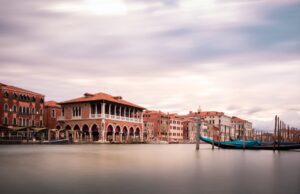
Long before Venice built palaces or churches worth photographing, it built a marketplace — and the Rialto has functioned as one, on essentially the same ground, since the earliest centuries of the city’s existence. This wasn’t a quaint neighborhood market; it was the Republic’s financial engine, home to some of Europe’s first banks and currency exchanges, centuries before anything resembling Wall Street existed. The Erbaria and Pescaria sections still operate today, still selling produce and fish to working chefs and residents in the early morning hours, on the same footprint that’s held a market since medieval Venice.
What makes the Rialto genuine living history, rather than a historic site with a market attached, is that it never actually stopped. Wars, plagues, the fall of the Republic itself, and eight centuries of everything else Venice endured — the market kept opening. It’s one of the very few places in the city where you can stand in a location that has served the exact same civic function, continuously, since before most of Europe’s nations existed in their current form.
The Jewish Ghetto: A Living Community, Not a Historic Site
Established in 1516, the Venetian Ghetto is the oldest in Europe, and the word “ghetto” itself entered the world’s languages from this specific place. But what I try to impress on guests is that the Ghetto isn’t a preserved historical district in the way a battlefield or ruin is preserved — it remains a living Jewish community today, with two working synagogues, kosher shops, and a congregation that has maintained continuous religious life on this site for over five hundred years, through periods of genuine danger as well as periods of relative peace. Visiting respectfully means recognizing the difference between a monument and a neighborhood where people still worship.
Why “Living” History Changes How You Should Experience It
A monument asks you to look at it. A living institution asks something different — patience, attention, maybe a little humility, because you’re witnessing something that isn’t performing for visitors at all. It would exist exactly the same way if you weren’t there. That’s rarer in heavily touristed cities than people realize, and it’s a large part of why I try to build encounters with these places into private tours rather than just pointing at them from across a canal.
If you’d like a walking route built specifically around Venice’s living institutions rather than its static monuments, take a look at our private tours, or reach out through the contact page and I’ll design a day around it.
Can visitors watch gondolas actually being built at a squero?
Squeri are working yards, not public attractions, so you generally can’t go inside without arrangement, but you can observe respectfully from across the canal, and a private guide can sometimes arrange a closer visit in advance.
Is the Rialto Market still worth visiting if I’m not shopping for food?
Yes — arriving early enough to see it functioning as a genuine working market, rather than just browsing the surrounding shops later in the day, is worth doing purely to witness a commercial rhythm that predates most of Europe’s modern institutions.
Is the Jewish Ghetto open to visitors, or is it a private residential area?
The Ghetto is open to walk through and includes a museum and synagogues that welcome visitors, though it remains a residential and religious community, so visiting with quiet respect matters more here than in a purely touristic site.